
Best AR apps to see how furniture looks in a room


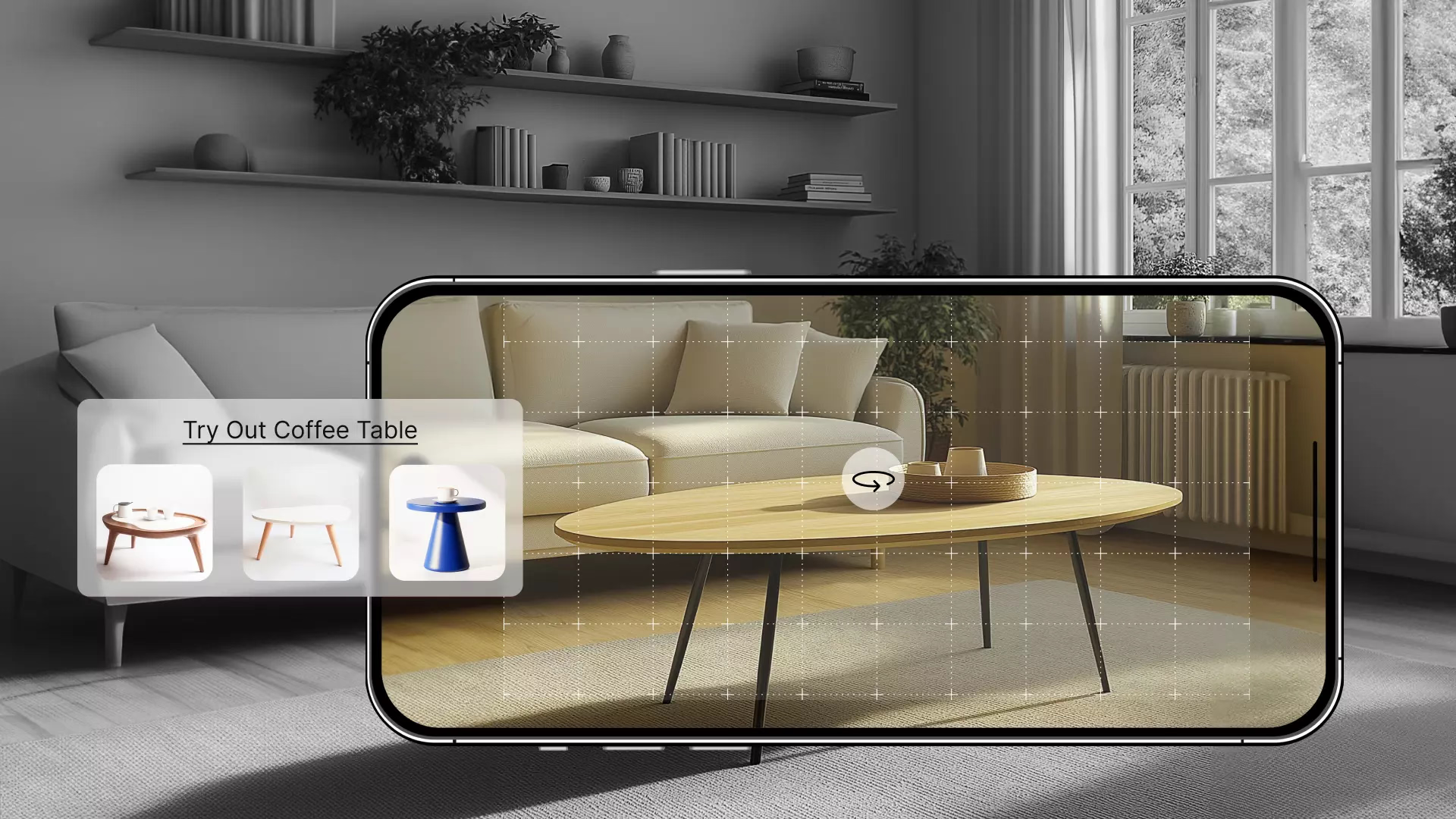
Before the introduction of augmented reality into the tech space, the traditional showroom experience was the normal pattern of furniture sales. Buyers would travel down to the showrooms, and then furniture stores would have to build very spacious and well-ventilated showrooms for their customers.
However, with the innovation and introduction of AR into the furniture industry as a focus, brands like IKEA, Amazon, and Jofran Inc. have developed apps incorporating AR to help see how furniture looks in a room.
A study showed that brands that integrate AR into their shopping experience have recorded that their users are 11 times more likely to purchase those without AR integration. This demonstrates how AR technology not only improves customer satisfaction but can also excessively increase sales for furniture retailers.

What is an app that lets you see how furniture looks in a room?
The uniqueness of how augmented reality has shaped the way the furniture industry now operates is something to pay attention to. Why is that? This is because of the ease AR brings to the furniture businesses and customers in the industry. There are two major improvements that AR has helped bring to the furniture industry. The first is that furniture stores that are fully based online now have reduced furniture returns because customers can use the app to size the furniture in their home space.
They can even change the color or material that they want at the top of their fingers. The second is that it has significantly reduced costs for those who have to go to a showroom or for furniture businesses that have to build a showroom. It would be very important to know that AR has shown significant potential to generate income for furniture businesses in the future if it’s actively integrated now.
Best apps to visualize furniture in your room
1. Wayfair
Wayfair's app was developed and later launched in 2020. In that same year, they launched View in Room on Safari with AR QuickLook, allowing users to view products in their homes and purchase them through AR and Apple Pay. Later, they integrated RealityKit and LiDAR into the latest version of the Wayfair app.
Wayfair serves as retailers that blend augmented reality with its app to increase sales and utility for furniture manufacturers. With Wayfair, your customers can place furniture of different sizes and colors. Also, they can rotate the pieces around the space they are testing it in and eventually adjust it to an accurate fit.
2. Houzz
The app was launched in 2009 by Adi Tartarko. The app offers a lot of AR features, such as home improvement features, AR visualization, and also a marketplace for different types of furniture. As a furniture brand, the Houzz app allows your target audience to see how furniture will look in their home or office space.
All that is needed for your customers is to download the app and then get to use the AR features. They can also get the exact sizes of furniture they want to purchase by sizing it with their camera. The colors, texture, and material can also be changed in the app.
3. IKEA Place
Owned by the supposed largest furniture business in the world, IKEA. It was launched in 2017 and built on Apple’s ARKit technology. It helps customers to see how the furniture looks in their room or home space. In fact, a person can walk past the furniture being visualized in the camera.
It is almost perfect when it is displayed. The app was primarily launched to reduce the cost and stress of visiting a showroom or store and for customers to view furniture at home. To access the IKEA Place app, customers will have to visit the Apple app store or the Android Google Play.
4. Home Design 3D
The app has a user base of more than 90 million worldwide. It can be used to create 3D versions of furniture to be uploaded into the AR integration. The app is rich with a library of over 2,500 fully customizable pieces of furniture and home décor items. The app can be used on both iOS and Android smartphones. It was launched in 2015 by Anuman Interactive for B2C purposes.
5. Home by Me
Home by Me is a user-friendly app that helps to design and visualize furniture in 3D. 3DVIA, a Dassault Systèmes SE brand, developed this app. Whether it is redecorating, moving, or just exploring ideas, the app allows your customers to place furniture, change colors, and experiment with layouts easily.
With augmented reality, users can see how the furniture fits in their space before buying. It is a great app for homeowners, designers, and even businesses looking to improve the customer experience. The app offers a simple drag-and-drop interface. Hence making furniture designs easy, fun, and accessible.
6. Best Buy AR Viewer
Best Buy developed their mobile app for their customers in 2024. The app was developed for the Apple Vision Pro. This app allows customers to see how the home décor and furniture they want to purchase would look in real time. The new app called Best Buy Envision's goal is to help users plan out their perfect home tech setup.
Using advanced AR features, the app lets customers see how products would fit into their living space, as stated on the website. How customers view their products is that the app uses AR to give 3D previews of products they want to buy.
7. Lowe
Developed by Lowe’s Innovation Labs in March 2018, it allows your customers to place lifelike, size-accurate items into their real-life spaces and to also confidently determine if that product will fit into the space. Android users with ARCore-enabled devices can use the “View in Your Space” feature within Lowe’s consumer app to see how products will look in their homes.
The app functions are pretty easy to use. The customer can quickly scan their surroundings and drag and drop the item into their desired spot. As the consumer moves their mobile device, the product will remain scaled to size. This makes it easy to see if the product dimensions will fit in the desired space before placing an order.
8. Target
Target introduced its AR technology to improve the way your customers shop for home furnishings in 2017. To shop all of the AR-enabled items, your customers would have to type "See It in Your Space" into the search bar. This tool then enables your customers to visualize furniture and décor in their actual size before buying.
As users shop in the Target app, they can keep an eye peeled for the AR symbol and also note that only certain items can be viewed in AR. Before accessing the AR feature on this app, the customer needs to allow the app to access their camera. Then, the item will appear to scale in their space.
9. Amazon AR View
Amazon launched its first AR visualization app in November 2017. It is an app that was created to integrate AR into the regular furniture shopping experience for any furniture brand and its target audience. Users or customers who make use of the app can preview home decoration items and furniture in stores or their homes using a tablet or smartphone camera.
Amazon integrated this technology to ease the shopping experience for your customers. In essence, the furniture that your customers want to purchase can be viewed in their room space without going to a physical store. Then, the customer can order directly from the app.
10. Apt2B Inc
Apt2B makes furniture shopping easier with its augmented reality feature called See it in 3D, and it can be tested on its website. Also, it allows your customers to see how furniture will look in their space before buying. With just a smartphone, your customers can place 3D models of sofas, beds, and other pieces right in your home, ensuring the perfect fit and style. This helps eliminate guesswork, reduces returns, and makes decorating effortless. Your customers can also customize fabrics and configurations while visualizing them in real-time.
Whether they are furnishing a cozy apartment or a spacious home, Apt2B’s AR tool lets your customers shop with confidence and create a space that truly fits their style. Trying out AR by users has been simplified across different apps or websites owned by furniture businesses. It's just like a digital designer in your pocket. It seems like magic, but it isn't. The process is helped by three core technologies, which are AR, 3D modeling, and artificial intelligence.


How apps with AR works
As mentioned above, there is the emergence of different apps that have integrated AR features. This means that they will all have distinct ways that customers or furniture brands can operate the AR features. However, the function of AR in any app seems similar. Let's dig deeper. The job of the AR in any app usually starts with 3D modeling. 3D modeling helps to create realistic furniture models, and then it is uploaded to the app.
Then, the AR puts the 3D model in the room, in which customers can place and adjust the 3D model in their home space. With this, customers can see the furniture in real-time as they rotate around to suit their needs. Finally, the customers can check the placement, sizing, and other factors. That's how the magic is unraveled. It's literally the AR technology that has changed the traditional way of buying furniture.
Top features to look for in a virtual furniture placement app
Before you select your choice of virtual furniture placement app, certain features must come with it to ensure that it can perform as it was intended. Some top features to look out for are:
1. Size and scale tool
Your utmost priority while choosing your furniture app shouldn't be entertainment. It's not enough to have a captivating sight while the most important details are left out. Your furniture app should be able to allow your customers to measure the size and dimensions of the furniture. This is possible with the size and scale tools. Your customers want to be sure that the furniture will fit into their room.
2. Compatibility across various platforms
What if your customers had to change their phones? Does it mean you have to lose them? As much as possible, try your best to ensure that your customers have a hitch-free experience while using the app. It's important to provide an app that is compatible across various platforms. This feature would increase the number of your users since a wider range can access it.
3. Customization
Your furniture app should be able to customize the furniture to align with what the customer wants. Your customers don't want to be boxed; they want to explore. The customization feature provides this experience. Customers can play around with the app and include additional features until they get what they want.
4. Multiple items placement
Don't restrict the items on your app. Your customer’s living room doesn't just need a couch; it needs a table, too. Your app should be able to move multiple items to their respective locations. Your customers should be able to set up their items on your app. It increases your chance of getting more purchases from your customers.
5. Real-life experience
Make sure that your furniture app provides a real-life experience for your customers. You don't want them to regret and wish to have visited a physical store. This means that the visuals must be high-quality, and the dimensions must be accurate. Your customers should be confident enough that they are viewing their furniture the same way it would have looked in reality.
Benefits of using AR furniture apps
Adopting AR furniture apps has gained ground and has shown the capacity to help your business upscale among its peers. The usefulness of AR furniture apps includes:
1. Reduced returns
Statistics show that returns on online purchases rise from 15% to 40%, but with the use of AR furniture apps, return rates are 5% to 7%. One way to save your furniture business from unnecessary expenses is to make use of the AR furniture app in your online store. With the use of AR furniture apps, you don't have to worry about high rates of returns.
2. More sales
Buyers would prefer to shop at an online store that gives them perfect visuals of the furniture and not just 2-D images. 40% of customers don't mind paying more if it provides AR technology. It gives them a long-lasting impression of your business. The app helps in making their decision-making process stress-free, and they keep trooping into your app for the next purchase.
3. Saves time and cost
Your customers don't have all the time in the world, and they would jump on every opportunity that helps them save time and spend it on something more productive. The furniture app makes it possible for your customers to conveniently pick their products on the furniture app. 72% of shoppers would hope for your product even if they didn't intend to buy because of the availability of an AR app.
4. Increase confidence
Do you want satisfied customers? AR furniture apps build trust and credibility. Research has shown that about 71% of customers keep trooping into an online store that provides AR technology. Your customers can be assured of getting the perfect furniture for their room while in the comfort of their homes using AR apps.
5. An edge over competitors
A percentage of 61% has been observed to prefer online stores with AR technology over physical stores. The AR app makes your business stand out and gives your customers better reasons to patronize your business.
Limitations and challenges of AR furniture apps
Despite how saturated the AR technology might be, there are constraints that your business must consider before deciding to opt in for it. The limitations that come with adopting furniture apps include
1. Customer’s perception
Your customer's perception of the AR furniture app can be a limitation. Not every one of your customers might be comfortable shopping on an app when they can walk into the physical store to have a grasp of the furniture. Unlike the Gen-Z generation, the older generation might not be captivated by the AR furniture app.
You should be sensitive enough to note that the category of people who are capable of purchasing your furniture is not Gen-Z but their parents. Regardless of how captivating the app might be, if there are no users, it would be a waste.
2. High costs
The cost of developing an AR app is on the high side, especially if you want to build it from scratch. Developers collect a range of $30,000 to $60,000 to build the app. This is a challenge, as you might not be able to afford the costs, especially if your business is just starting.
3. Technical barriers
Due to the sensitivity of the activities on the AR furniture app, technical barriers like slow internet might lead to poor visuals or improper positioning of your furniture. The app might take so long to respond, which would only lead to the frustration of your customers.
Future of AR furniture apps
There is no doubt that AR is presently taking over the furniture industry with its unique features. That is, in a few years to come, AR will be regarded as a valuable tool that can never be overlooked. Let's talk more about this.
1. Furniture catalog option
AR solutions hold a promising future for the furniture industry. It provides you the opportunity to display all the pieces of furniture that you have produced using a catalog. This helps to increase your sales because, in the course of searching for suitable furniture, your customers are exposed to pieces of furniture that they might be interested in.
2. Possibility of the remote furniture industry
AR solutions make it possible for you to operate your furniture business from the comfort of your home. This ensures that cost is maximized. It also promotes creativity by enabling productivity from your comfort zone.
3. Customized furniture option
AR solutions give your customers the option of designing the type of furniture that suits their taste from scratch. This way, it will ensure that your resources are maximally utilized. And at the same time, your customers will be satisfied.
Can you trust GlamAR for accurate furniture placement?
GlamAR is a software platform that any furniture brand can partner with to get AR solutions for effective marketing. Moreover, GlamAR will provide AR, VR, and 3D solutions for your furniture brand to display your product in a more immersive manner. Let's talk more about these features.
VR solutions
Part of the usefulness of partnering with us is that we will provide your furniture brand with an advanced virtual store solution. This comes with an accurate virtual analysis of your products for your customer without having to take measurements in person or consider another virtual showroom platform that is designed solely for this purpose. GlamAR enables your customers to automatically have an understanding of the product quality and designs before purchasing.
3D solutions
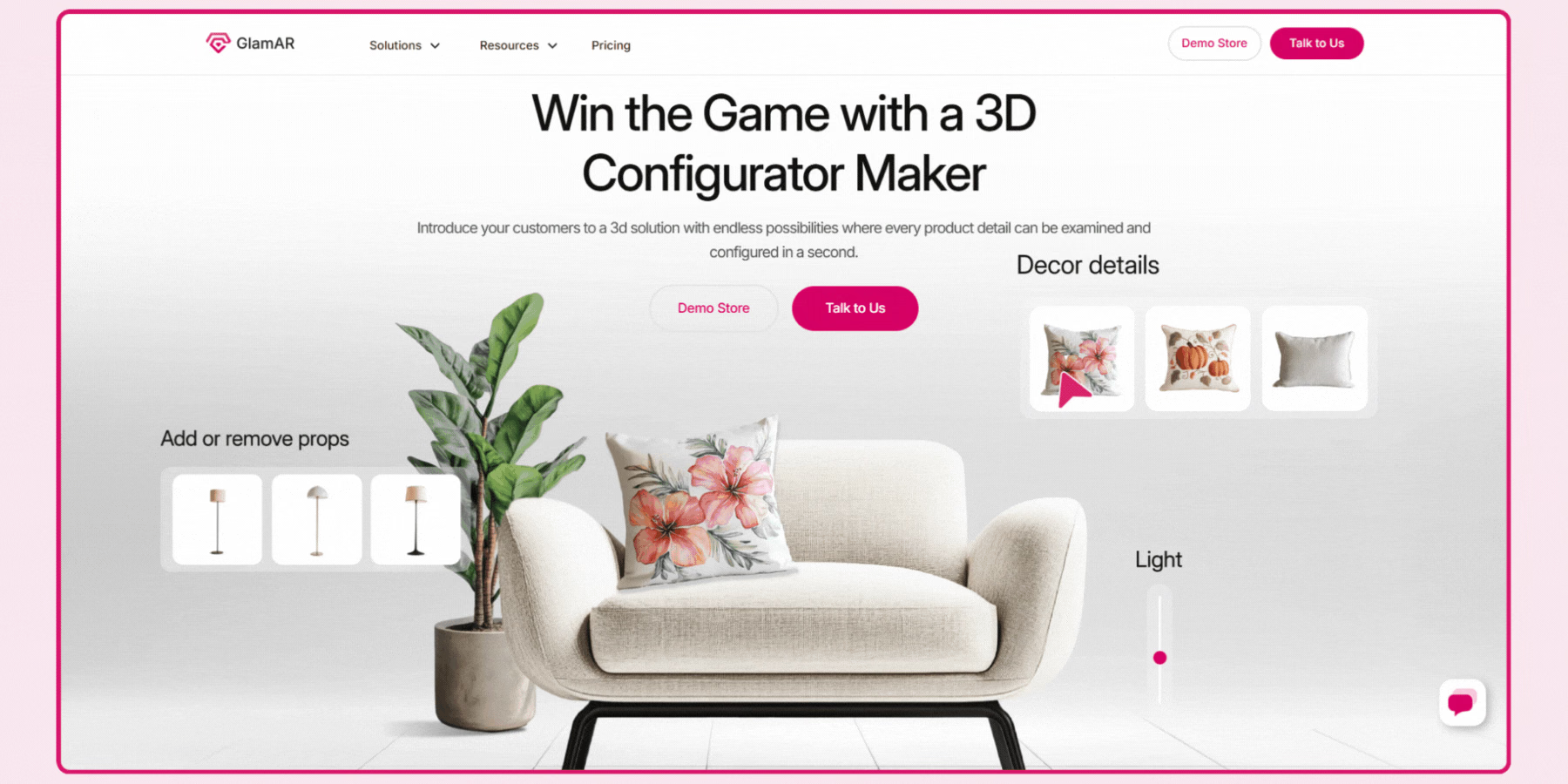
At GlamAR, we leave your customers with absolutely no excuse but to be satisfied. How exactly do we do this? We will grant your customers access to 3D models of all your available furniture. With this, customers can view your furniture piece in a virtual space to get accurate measurements of the product.
Also, your brand will have access to our 3D product configurator, which lets your customers preview your products in 3D detail. Lastly, we offer a 360-degree product viewer for your product to rely on. By this, your customers will have a photo-realistic experience of what your product will look like in the real sense.
AR solutions
As a company that has the global market in mind, we've got you covered at GlamAR. Through quality AR solutions, we will move your brand's online presence and visibility to the maximum. With our AR solutions, your brand will have access to our virtual try-on system. This will grant your customers the opportunity to try each of this furniture on an image of their respective rooms to see what furniture piece fits best.
Also, our AR solutions allow your customers to overlay a virtual 3D model of your furniture products into their physical spaces through their smartphones or AR glasses. This way, we help you achieve your marketing goals while keeping your customers' interests at heart. With our AR features like virtual try-ons, and AR ads, your customers can purchase confidentially. Instead of trying different AR apps, why can't you partner with us and get a maximum satisfaction experience for your brand and customer?
Conclusion
Apps that allow customers to see how furniture looks in their spaces have turned the furniture industry into a collaborative environment. In which there is a productive mutual interaction between you and your customer.
With GlamAR, your furniture brand will have access to our AR solutions for a customer-friendly and performance-oriented. Through our software platform, the sustainability of your furniture business is secured.










