


Best Virtual Try-On Solutions for Luggage Brands in 2026


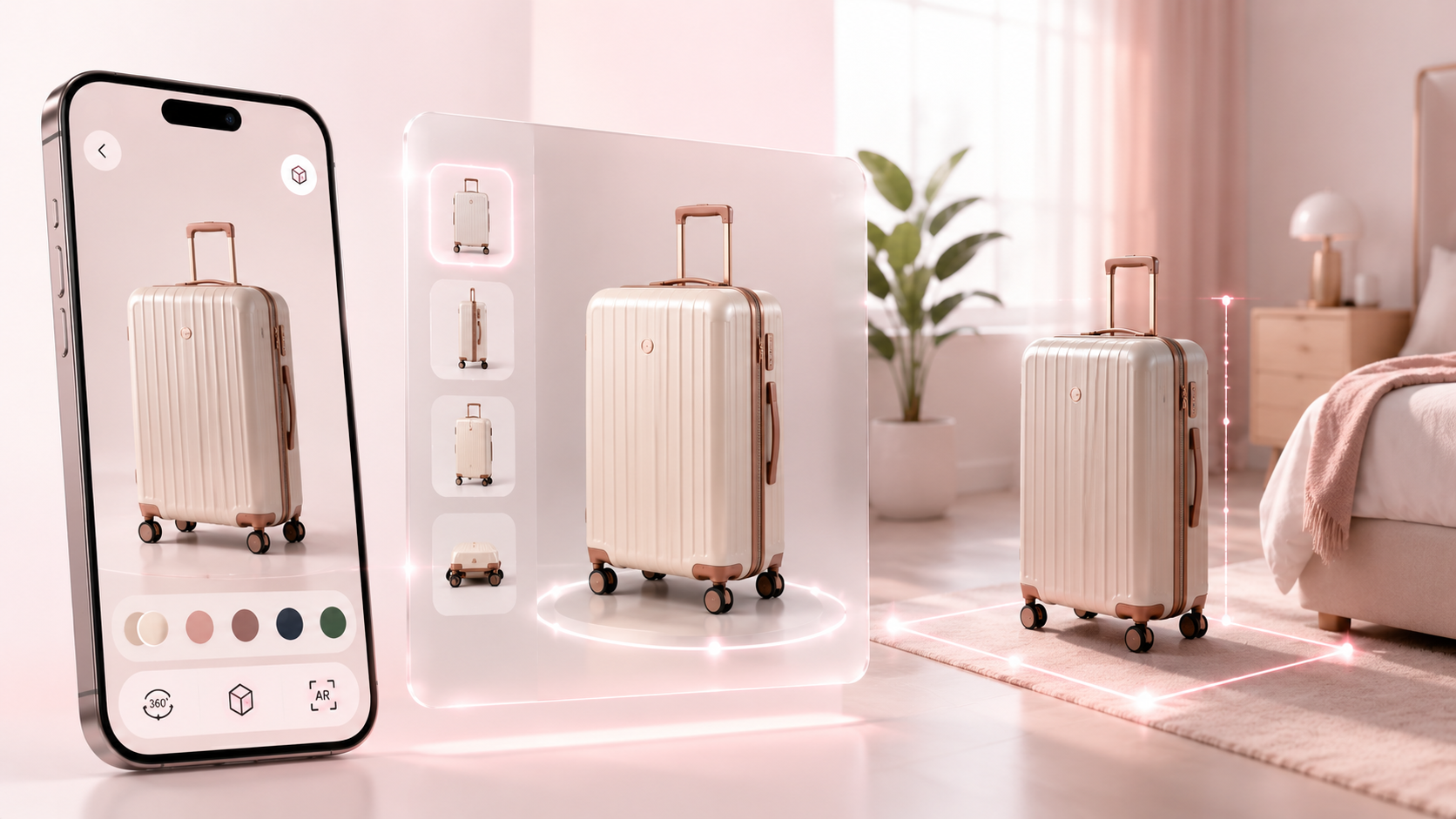
The best virtual try-on solutions for luggage brands in 2026 are GlamAR, WEARFITS, Zakeke, Threekit, and Sketchfab - each enabling customers to visualize bags, suitcases, and travel accessories in accurate 3D or AR before purchasing. For luggage brands, this directly addresses the single biggest barrier to online purchase confidence: not knowing how large a suitcase actually is, or how a bag looks in person.
Why Luggage Brands Need Virtual Try-On
Luggage is a high-consideration purchase. A customer buying a carry-on suitcase online is making a decision worth anywhere from $100 to $800+ based entirely on photographs and dimension tables. They cannot feel the weight, test the wheels, open the compartments, or see how the 55cm case actually looks next to their body before it arrives at their door.The result is a predictable set of problems for any luggage brand selling online:
Size uncertainty drives returns. The most common reason luggage is returned online is that it looks different in reality than in photographs - usually larger or smaller than expected, or proportioned differently relative to the customer's body. Flat product photography, even with professional lighting and styling, cannot communicate the three-dimensional presence of a 28-inch suitcase or a weekender bag the way seeing it in actual scale can.
The market is growing fast but online is still catching up. The global luggage market was valued at USD 41.04 billion in 2025 and is projected to reach USD 60.37 billion by 2031 at a 6.64% CAGR - driven by the global travel recovery and rising demand for premium, tech-enabled travel gear. Online retail is the fastest-growing distribution channel, advancing at 7.82% annually. But online luggage purchases still lag physical retail partly because the confidence gap is wider for luggage than for many other product categories.
47% of buyers replace luggage after repeated use. That replacement purchase is typically made online. The customer who already owns a Samsonite 26-inch spinner knows its dimensions - but switching to a different brand, size, or model creates the same uncertainty all over again. Virtual try-on lets them verify before committing.
Virtual try-on for luggage works differently from beauty or jewellery try-on. Rather than overlaying a product on the face or body, luggage try-on uses 3D visualization and AR room placement - letting customers see the exact size and proportions of a bag or suitcase in their own physical space, next to objects they already know the scale of (a bed, a chair, a standard door). They can view it from every angle, zoom into the texture and hardware detail, and understand the product in a way no photograph achieves.
What to Look for in a Luggage Virtual Try-On Solution
Before comparing providers, these are the features that matter specifically for luggage:
True-to-scale 3D rendering. The 3D model must match the actual dimensions of the bag precisely. A 55cm carry-on must appear as a 55cm carry-on - not a scaled approximation. Inaccurate scale is worse than no try-on at all: it creates the exact misalignment between expectation and reality that drives returns.
Photorealistic material rendering. Polycarbonate shell texture, ballistic nylon weave, leather grain, canvas finish, zips, wheels, and hardware details all need to render with enough fidelity that customers can evaluate quality and appearance accurately. Low-quality 3D models make products look cheaper than they are.
360° viewing from all angles. Customers need to see the front, back, sides, top, and bottom of a bag. Luggage purchases involve checking zip placement, wheel type, handle position, and side pocket configuration - none of which are visible from a single hero shot.
AR room placement. Placing the bag in the customer's actual environment - on their bedroom floor, next to a wardrobe, beside a standard door for scale reference - is the feature that most directly addresses the size uncertainty problem.
Web-based, no app download required. Customers discovering luggage on a brand website or marketplace listing should be able to try it on without friction. Requiring an app download reduces adoption significantly.
3D model creation support. Most luggage brands do not have existing 3D assets in a format ready for AR deployment. A provider that can create high-quality 3D models from product photography or CAD files removes the most common implementation blocker.
Quick Comparison: Best Virtual Try-On Solutions for Luggage Brands
Best Virtual Try-On Solutions for Luggage Brands
1. GlamAR
GlamAR's virtual try-on platform is built for multi-category brands - and luggage is a live vertical with its own industry page and solutions. GlamAR uses AR room placement to help customers visualize luggage in their own space at true-to-scale dimensions, combined with a 360° product viewer for full-angle exploration and a 3D product configurator for customisation options (colour, material, personalisation features where applicable).
What makes GlamAR specifically strong for luggage brands is the combination of these three tools from one platform. Customers can rotate a suitcase through 360°, place it in their bedroom to check how it looks relative to their wardrobe, and in cases where the brand offers colour or material variants, configure and compare those options in real time - all without leaving the product page.
GlamAR's 3D model creation service is included as part of onboarding. The team creates high-fidelity 3D models from product photography or existing CAD files - critical for luggage brands that do not have 3D assets ready. Models are built to the product's precise specifications: dimensions, texture, hardware finish, wheel type, zipper placement - the details that matter for luggage purchase decisions.
The platform is web-based - no app download required. It integrates with Shopify via the GlamAR app, and with custom-built storefronts via the GlamAR Web SDK. GlamAR also supports the 3D virtual photography solution, which generates photorealistic product images from 3D models - meaning the same 3D asset built for AR try-on can simultaneously replace expensive physical photography for the brand's product catalogue.
Best for: Luggage and travel accessories brands that want AR room placement, 360° viewing, and 3D configurator in one platform - with 3D model creation included and no existing 3D assets required.
Standout features:
- AR room placement at true-to-scale dimensions
- 360° product viewer with zoom and rotation
- 3D product configurator (colour, material, finish options)
- 3D model creation from product images or CAD files - included
- 3D virtual photography from the same 3D assets (eliminates physical photoshoots)
- Shopify integration and Web SDK
- Web-based, no app download required
Explore the demo: Visit the accessories demo store to see GlamAR's try-on for bags and accessories in action.
2. WEARFITS
WEARFITS is an enterprise-grade AR and virtual try-on platform with strong credentials in fashion bags, accessories, and footwear. Their tracking technology is designed for high-precision placement - the kind of accuracy that matters when a customer is trying to understand how a bag sits on their shoulder, how a backpack's proportions compare to their frame, or how a tote's depth reads relative to their everyday carry requirements.
WEARFITS offers web-based AR without requiring an app download, and their SDK is developer-accessible for brands that want custom integration. For enterprise luggage brands with complex integration requirements or high SKU volumes, WEARFITS is a credible option.
Best for: Enterprise luggage and fashion bag brands that need high-precision body and space tracking for accurate AR placement.
Standout features:
- High-precision body and space tracking for bags and accessories
- Web-based AR
- Fashion-specific tracking algorithms
- Developer-accessible SDK for custom integration
3. Zakeke
Zakeke is a lightweight, fast-to-deploy 3D and AR solution for small to mid-size brands. For luggage brands that need to get a 3D viewer or basic AR experience running quickly - without a long implementation project or an enterprise-level budget - Zakeke is a practical starting point.
Zakeke supports 3D product viewing (customers can rotate and zoom a model) and AR room placement for eligible products. It integrates directly with Shopify and WooCommerce with minimal developer involvement. For luggage brands on these platforms that want to add 3D/AR quickly, Zakeke is the fastest path.
Best for: Growing and mid-size luggage brands that need quick deployment on Shopify or WooCommerce.
Standout features:
- Fast Shopify and WooCommerce integration
- 3D product viewer with rotation and zoom
- AR room placement for supported product types
- Lightweight and mobile-optimised
- Product customisation options
4. Threekit
Threekit is an enterprise 3D and AR platform built for large catalogues and high-complexity product configurations. For luggage brands at scale - major travel goods retailers with hundreds of SKUs across multiple material variants, colour options, and size configurations - Threekit's virtual photography and 3D configurator features are best-in-class. Their virtual photography tool generates photorealistic product images from 3D models, which dramatically reduces the cost and time of product photography for large catalogues.
Best for: Large luggage retailers and brands with high SKU volumes, complex configuration options, and significant product photography costs.
Standout features:
- Enterprise-scale 3D and AR platform
- Virtual photography - auto-generate product images from 3D models
- Advanced product configurator
- High-fidelity material and texture rendering
5. Sketchfab
Sketchfab is a 3D model viewer and marketplace - a more lightweight option for brands that want to add 3D product exploration to their pages without full AR room placement. Customers can rotate, zoom, and explore a bag or suitcase from all angles in a browser-embedded viewer. There is no room placement AR, but the 360° 3D view is meaningfully better than static photography for communicating size, proportion, and detail.
For luggage brands that want to improve the product page experience with 3D but are not yet ready for full AR implementation, Sketchfab is a cost-accessible entry point.
Best for: Luggage brands that want to start with basic 3D product viewing before investing in full AR room placement.
Standout features:
- Browser-embedded 3D viewer (no app, no plugin)
- 360° product exploration
- Wide file format support (GLB, GLTF, OBJ, and more)
- Large existing model library - some brands may find existing models for reference
The 3D Model Question - The Most Common Implementation Barrier for Luggage Brands
Almost every luggage brand that investigates virtual try-on hits the same first question: we don't have 3D models of our products. Can we still do this?
Yes - but the quality of the 3D model is the single most important factor in whether AR try-on helps or hurts your brand.
A poor-quality 3D model of a suitcase - one where the proportions are slightly off, the texture looks plasticky, or the wheels are simplified rather than rendered accurately - does more damage than good. Customers who visualize a product in AR and then receive something that looks different in reality will have a worse purchase experience than customers who bought from a well-styled flat photograph.
The path to high-quality luggage 3D models:
Option 1: Provider creates models from your product references GlamAR includes a 3D model creation service as part of onboarding. The team creates models from product images (multi-angle, high-resolution photography) or technical specifications. For complex products like hard-shell suitcases with textured surfaces, polycarbonate finishes, and intricate hardware, the more reference material you provide, the higher the fidelity of the resulting model.
Option 2: Photogrammetry from physical products Some providers offer photogrammetry services - where the physical product is scanned in a studio environment to generate an accurate 3D model. This typically produces the highest-fidelity results for complex surfaces and materials.
Option 3: CAD-to-3D conversion If your brand works with manufacturers who use CAD files for production, those files can be converted to 3D models suitable for AR deployment. This is the fastest path if CAD files are available.
What format is needed: Web-based AR platforms typically require models in GLB or GLTF format. If you have existing 3D files in another format (OBJ, FBX, STEP), confirm with your provider that conversion is included or available.
How to Implement Virtual Try-On for Your Luggage Brand: Step by Step
Step 1: Define your priority SKUs. Start with your top 20 SKUs by sales volume or return rate. Creating 3D models and deploying AR try-on across your full catalogue at once is complex. Starting with your highest-impact products - your most-returned or highest-converting items - gives you the fastest return on investment and a manageable first deployment scope.
Step 2: Gather your product references. For each priority SKU, compile multi-angle photography (front, back, both sides, top, bottom, detail close-ups of zips, wheels, handles, and hardware), exact dimensions (height, width, depth, handle drop height for bags), and material and colour specifications. The more precise your references, the more accurate the 3D model.
Step 3: Choose your integration path.
- On Shopify? Use the GlamAR Shopify app or Zakeke's Shopify integration - both deploy with minimal developer involvement
- Custom storefront? Use the GlamAR Web SDK or WEARFITS SDK - requires developer integration but gives full control over placement and UX
- Need to validate first? Consider starting with Sketchfab's 3D viewer as a fast, low-commitment way to test whether 3D visualization improves engagement on your product pages
Step 4: Configure the AR experience on your product pages. Place the "View in 3D" or "Try in Your Space" button prominently - adjacent to the main product image or the add-to-cart button. The higher the visibility of the entry point, the higher the adoption rate. Do not put it below the fold.
Step 5: Measure the right metrics. After launch, track these three numbers weekly:
- 3D/AR engagement rate - what percentage of product page visitors use the 3D viewer or AR placement?
- Conversion rate: engaged vs. non-engaged visitors - are customers who use 3D/AR converting at higher rates?
- Return rate: 3D/AR-assisted purchases vs. standard - are size and appearance-related returns declining on products where 3D/AR is available?
What Luggage Brands Using 3D and AR Are Already Seeing
Samsonite - one of the world's largest luggage brands - uses 3D and AR visualization on product pages to let customers explore its suitcase and bag range from all angles. The 3D viewer is positioned prominently on product pages and includes zoom for detail inspection of texture and hardware.
Away - the DTC luggage brand - uses 360° product imagery and detailed size comparison tools to address the scale uncertainty problem. Their digital experience is explicitly designed around the insight that customers cannot understand luggage size from a flat image alone.
Rimowa - in the luxury luggage segment - uses photorealistic 3D rendering and AR visualization to let customers explore its aluminium and polycarbonate cases in detail, including the distinctive parallel groove texture that defines its visual identity.The pattern across these brands is consistent: 3D and AR are not used as novelty features. They are deployed as direct responses to the size and appearance uncertainty that makes luggage a difficult online purchase.
For AR-enabled product experiences broadly, Shopify's internal research indicates that 3D and AR experiences reduce returns by up to 40% - a meaningful number for a category where returns are logistically expensive (luggage is heavy, bulky, and costly to ship back).
Conclusion
Luggage brands selling online face a structural problem that flat photography has never solved: customers cannot know how large a suitcase actually is, how a bag looks relative to their own body, or how the materials look and feel in real life. Virtual try-on - specifically 3D room placement and 360° product viewing - directly addresses all three.
The global luggage market is growing steadily, online retail is the fastest-growing channel within it, and the brands already deploying 3D and AR are using it to close the confidence gap that drives abandonment and returns.
For luggage brands that need a complete platform covering AR room placement, 360° viewing, 3D configuration, and 3D model creation in one integration, GlamAR is the strongest starting point. For enterprise brands with large catalogues and complex configuration requirements, Threekit is built for that scale. For brands that want a fast, lightweight deployment on Shopify, Zakeke gets you live quickly.
To see how GlamAR's virtual try-on and 3D viewer work for luggage and accessories, visit the accessories demo store or contact the GlamAR team to discuss implementation for your specific catalogue.
Related reading:
- Best AR Try-On Solutions for Furniture Brands in 2026
- Virtual Try-On for Watch Brands: How to Increase Online Sales and Reduce Returns
- AR SDK vs White-Label Try-On: Which Integration Fits Your Brand
- How to Add GlamAR Virtual Try-On to Your E-commerce Store: A Complete Integration Guide
Ready to add virtual try-on to your luggage brand? Talk to the GlamAR team or explore the accessories demo store.
Virtual try-on for luggage brands is a 3D and AR technology that lets customers visualize suitcases, bags, and travel accessories in accurate scale and detail before purchasing. Rather than overlaying a product on the face or body (as with makeup or jewellery try-on), luggage try-on uses 3D room placement - letting customers place the bag or suitcase in their own physical environment at true dimensions - and 360° product viewing for full-angle exploration.
The primary driver of luggage returns online is size and appearance mismatch - the product arrives and looks different from what the customer expected based on flat photography. 3D room placement lets customers verify the actual scale of a suitcase relative to familiar objects in their own space before purchasing. 360° viewing lets them assess the bag's proportions and details from all angles. Both experiences reduce the surprises that drive returns. Shopify's research indicates that 3D and AR experiences reduce returns by up to 40%.
Not with web-based solutions. GlamAR, WEARFITS, Zakeke, and Threekit all offer web-based experiences that work directly in a mobile browser - no app download required. This is important for luggage brands because a significant portion of their customers discover products through mobile search or social media, and requiring an app download introduces friction that reduces adoption.
3D models for luggage are typically created from multi-angle product photography, technical specifications (dimensions, materials), and where available, CAD files from the manufacturer. GlamAR's 3D model creation service creates models from these references as part of onboarding. The quality of the reference material directly determines the accuracy and fidelity of the resulting 3D model - brands should compile high-resolution, multi-angle product images and exact dimension specifications before starting.
A 3D viewer lets customers rotate and zoom a 3D model of the product on their screen - like a 360° product view, but in true 3D rather than a series of flat photographs. AR room placement goes further: it uses the customer's device camera to place the 3D model in their actual physical environment, at true-to-life scale, so they can see how the suitcase looks in their bedroom or how a bag sits next to their desk. For addressing size uncertainty specifically, AR room placement is the more powerful tool.
For brands without existing 3D assets, implementation typically takes 2–4 weeks: 1–2 weeks for 3D model creation and 1–2 weeks for integration and testing. Brands on Shopify can deploy faster using the GlamAR app, which reduces the integration phase significantly. Starting with 10–20 priority SKUs rather than the full catalogue keeps the initial deployment timeline manageable.
Découvrez comment la réalité augmentée, la réalité virtuelle et la 3D peuvent stimuler la croissance des revenus en 2026
Planifiez un appel avec notre équipe

.avif)