
Meilleures solutions AR pour les marques de meubles en 2026


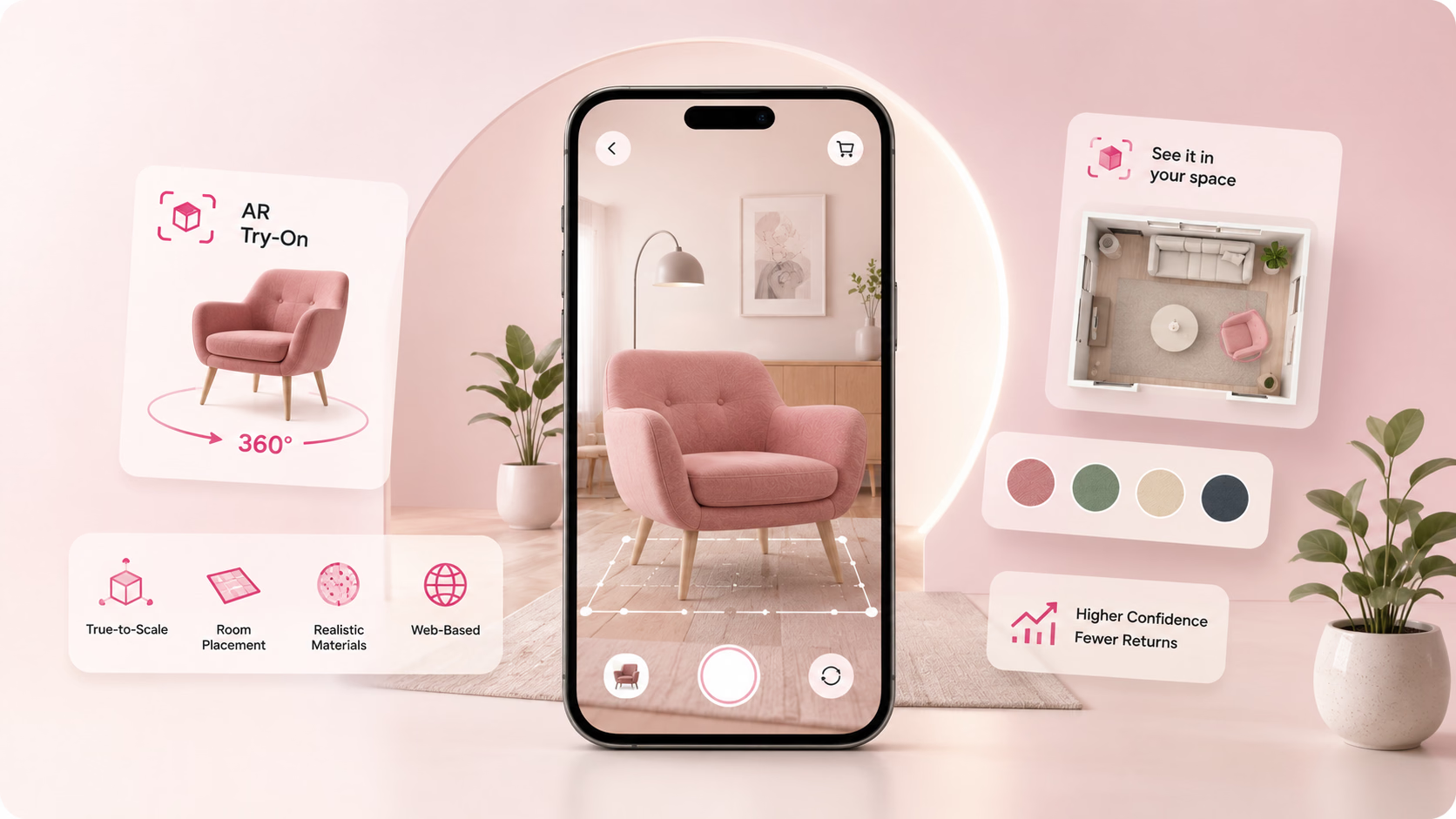
The best AR try-on solutions for furniture brands in 2026 are GlamAR, Threekit, Zolak, Cylindo, and Zakeke - each built to let shoppers place true-to-scale 3D furniture in their own room before buying. This guide compares all five on features, fit, and what type of furniture brand each is best suited for.
Why Furniture Brands Need AR Try-On in 2026
Furniture is the category where online shopping breaks down most severely. A customer cannot tell from flat product images whether a sofa will fit their living room, whether a dining table will match their floors, or whether the colour they see on screen will match the walls at home.
The data backs this up: furniture and home furnishings consistently see some of the highest return rates in e-commerce - industry estimates put furniture return rates at 15–30%, with size and appearance mismatch being the leading causes. AR try-on addresses this directly.
When a shopper can place a true-to-scale 3D model of your product inside their actual room using their phone camera, the uncertainty that drives abandonment and returns disappears. They can see it. They can trust it. They buy.
What to Look for in a Furniture AR Try-On Solution
Before comparing providers, here is what actually matters in a furniture AR platform:
- True-to-scale rendering - the product must appear in its real dimensions, not an approximation. A sofa that looks small in AR and arrives large in real life is worse than no AR at all.
- Floor and wall plane detection - the AR should anchor to real surfaces, not float in mid-air. Poor plane detection is the fastest way to lose customer trust in the experience.
- High-quality 3D models - material texture, fabric weave, wood grain, and finish need to look photorealistic. Low-quality 3D models make products look worse than flat photography.
- Web-based, no app required - requiring shoppers to download an app before they can use AR kills adoption. Web AR works directly in a mobile browser.
- 3D model creation support - most furniture brands do not have 3D assets. Check whether the provider can create them, and at what quality and turnaround.
- Platform integration - the solution needs to integrate cleanly into your existing e-commerce setup: Shopify, custom website, or native app.
Best AR Try-On Solutions for Furniture Brands
Quick Comparison Table
1. GlamAR
GlamAR is a full-platform AR and 3D commerce solution, not a single-feature tool. For furniture brands, this means AR room placement, a 360° product viewer, and a 3D configurator (for material, colour, and finish customization) all in one integration.
The 3D model creation service is particularly relevant for furniture brands, most of which don't have existing 3D assets. GlamAR creates high-fidelity 3D models from product images or CAD files, handles the full asset pipeline, and deploys them across AR try-on, 360° viewing, and configuration from one set of models.
The experience is fully web-based - no app download required from the customer. GlamAR's furniture AR is active on brands including Hamleys, with customers using it to place and explore products in their own spaces in real time.
Best used for: Furniture brands that want a single platform covering AR try-on, 3D visualization, product configuration, and model creation - without stitching together multiple vendors.
Standout features:
- True-to-scale AR room placement (web-based, no app)
- 360° product viewer with zoom and rotation
- 3D configurator for material, colour, and finish options
- 3D model creation service included
- Works on web and mobile across all major browsers
Internal resources: See how GlamAR's AR in furniture retail works in practice, or explore the furniture demo store to try it directly.
2. Threekit
Threekit is built for large-scale furniture and home goods retailers that need photorealistic 3D across thousands of SKUs. Their virtual photographer feature is a standout: it auto-generates product photography from 3D models, which dramatically reduces the cost of product content production for brands with large and frequently updated catalogues.
Best used for: Enterprise furniture retailers with high SKU volumes and complex product configuration needs.
Standout features:
- Photorealistic 3D rendering at enterprise scale
- Virtual photography (auto-generate product images from 3D assets)
- AR room placement
- Advanced product configurator for complex options
3. Zolak
Zolak is a dedicated furniture AR platform with a room planner at its core. Rather than just dropping a single product into a room, Zolak lets shoppers design full room layouts using the brand's products - placing a sofa, adding a coffee table, positioning a rug, and seeing how the room looks as a whole. This makes it particularly effective for brands that sell complementary room sets rather than standalone pieces.
Best used for: Furniture brands selling room sets or complementary collections where showing multiple products together improves conversion.
Standout features:
- Full room planner (design entire room layouts, not just single-item AR)
- Style and product recommendations
- Web-based experience, no app required
4. Cylindo
Cylindo specializes in high-fidelity 3D visualization for furniture brands where material and finish detail is critical. Their rendering quality for upholstered furniture — showing fabric texture, weave, and colour with photographic accuracy - is among the best available. AR placement is available as an extension of the core visualization experience.
Best used for: Furniture brands where material accuracy is critical to purchase decisions, upholstered sofas, premium wood furniture, customizable pieces.
Standout features:
- Ultra-high-fidelity 3D rendering, particularly for fabrics and materials
- Detailed finish and texture rendering
- 360° viewer with deep zoom
- Configurator for fabric and finish customization
5. Zakeke
Zakeke is a lighter-weight, faster-to-deploy option for small to mid-size furniture and home decor brands. It supports AR product visualization and 3D viewing with a simpler integration path than enterprise tools. For brands that need to ship AR quickly without a long implementation project, Zakeke is a practical starting point.
Best used for: SMBs and mid-market furniture and home decor brands that need a fast, manageable path to AR.
Standout features:
- Quick integration with Shopify, WooCommerce, and major platforms
- AR try-on and 3D viewer
- Product customization options
- Lightweight, good mobile performance
How to Choose the Right Furniture AR Platform: 5 Actionable Steps
Step 1: Audit your existing 3D assets.
Do you have 3D models of your products already? If yes, check what file format they're in (GLB, GLTF, OBJ, FBX) and verify each provider accepts them. If not, shortlist only providers that include 3D model creation - GlamAR and Threekit are your best options here.
Step 2: Define your integration requirements before demoing anything.
Know your e-commerce platform (Shopify, WooCommerce, custom build, native app) and your existing CMS before you get into vendor demos. Integration complexity is the single most common reason furniture brands stall on AR deployment.
Step 3: Test the mobile AR experience yourself, on your actual product.
Ask every provider for a working demo using one of your own products, not a generic placeholder model. Test it on a mid-range Android phone, not just the latest iPhone. That's what most of your customers will be using.
Step 4: Check whether the platform supports SKU-level AR, not just category-level.
Some solutions show AR for a category of product (e.g. "sofas") using a representative model. You want SKU-level AR - every individual product with its own 3D model. Confirm this before signing.
Step 5: Ask for return rate and conversion data from existing furniture brand customers.
A provider that can't show you concrete outcomes (conversion uplift, return rate reduction) from furniture brands they've already deployed with is one you should approach cautiously.
Real-World Impact: What Furniture Brands Are Seeing
Furniture brands that have deployed AR report consistent patterns:
- Customers who interact with AR spend significantly longer on product pages than those who don't
- Return rates on AR-enabled product pages fall because customers make more informed size and fit decisions before buying
- Customer service query volume - particularly "will this fit?" and "what does this look like in a lighter room?" - drops after AR is deployed
GlamAR's deployment with Hamleys demonstrated how an AR-first product experience can shift customer confidence directly. Customers who used the AR feature showed higher purchase completion rates than those who browsed product images only. See the full Hamleys case study for detail.
Conclusion
Furniture brands that still rely solely on flat product images are leaving conversion on the table and accepting return rates that AR try-on can significantly reduce. The technology is no longer experimental - it's deployed and performing for brands of all sizes.
For brands that want a single platform covering AR try-on, 360° viewing, product configuration, and 3D model creation, GlamAR is the strongest all-in-one option. For enterprise-scale retailers with photorealism requirements, Threekit. For room-set brands, Zolak. For detail-heavy upholstered furniture, Cylindo. For a fast, lightweight start, Zakeke.
The right choice depends on your product type, your catalogue size, and how quickly you need to deploy. Start with Step 1 above - your existing 3D asset situation will narrow down your options faster than any other factor.
Ready to see AR try-on in action for your furniture brand? Schedule a call with the GlamAR team or try the live furniture AR demo.
Related reading:










