Marché de l'analyse de la peau par IA


Diagnostic facial intelligent

.gif)
Instant Snumérisation Experience
Des informations pratiques sur la beauté
Frequently asked questions
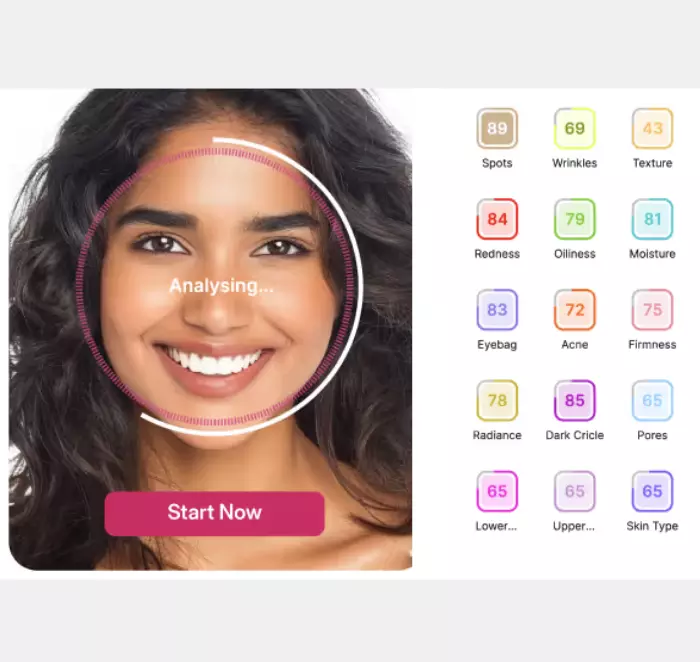
Le marché de l'analyse de peau par IA utilise la vision par ordinateur et l'apprentissage automatique pour scanner un visage à l'aide d'une photo ou d'une caméra en direct et vérifier l'état de la peau. Le système examine les caractéristiques observables telles que la texture, les pores, les ridules, les imperfections, la pigmentation, les rougeurs et l'équilibre du teint. Ces caractéristiques sont traduites pour délimiter ou définir des termes tels que la zone T grasse, le teint irrégulier ou la déshydratation de la peau. Dans le cas des marques de soins de la peau, cela peut servir de moyen de fournir des informations instantanées et basées sur des données sur la peau à des fins cosmétiques.
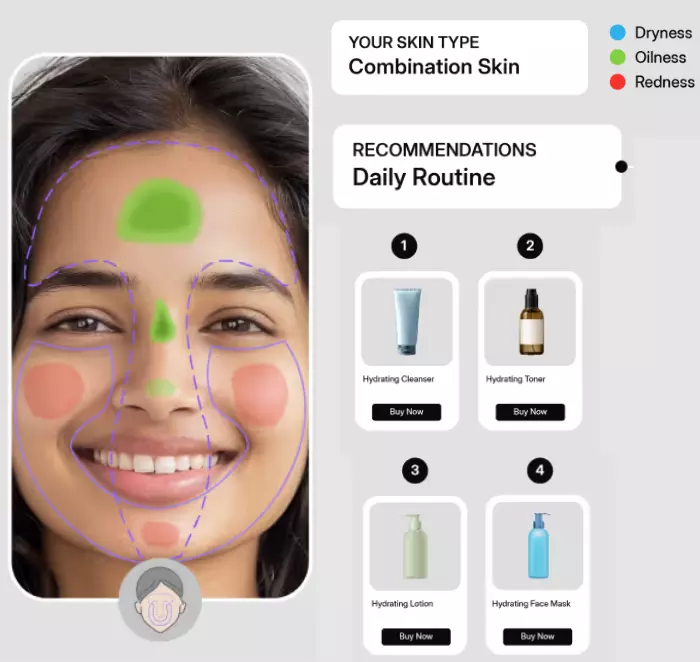
La capture d'images, généralement celle de l'appareil photo d'un smartphone ou d'une webcam, constitue le début du processus. L'IA identifiera ensuite le visage, le fera correspondre et le divisera en zones (front, joues, nez, menton, contour des yeux). Les algorithmes de chaque zone déterminent individuellement le contraste, la distribution des couleurs, les motifs des bords et la microtexture afin de détecter des problèmes tels que les taches brunes, les rides, les pores dilatés ou la sécheresse. Ils sont comparés à des modèles d'ensembles de données de peau étiquetés qui sont entraînés. Enfin, le système produit un résultat organisé : scores, étiquettes, indicateurs de risque ou recommandations pour la prochaine étape. Tout cela peut prendre quelques secondes pour l'utilisateur.
L'analyse de la peau par IA ne remplace pas les soins d'un dermatologue, mais il peut être surprenant de constater à quel point elle est constante en matière d'observation superficielle. L'exactitude dépend de divers facteurs : la qualité des données d'entraînement, la gamme de couleurs et d'états de peau contenus dans l'ensemble de données, ainsi que la qualité de l'image proposée par l'utilisateur. Les systèmes correctement formés seront en mesure d'avertir en cas d'imperfections visibles telles que des tons de peau irréguliers, de l'acné ou des taches de sécheresse. Ils ne sont toutefois pas en mesure de détecter les affections médicales situées derrière la peau ni de les diagnostiquer. L'analyse de la peau par IA est principalement utilisée à des fins cosmétiques.
Un biais peut survenir lorsque le modèle lui-même a été entraîné sur l'exemple d'un petit sous-ensemble d'individus, comme une couleur de peau principalement claire ou un groupe d'âge distinct. Dans ce cas, il peut être trop sensible lorsqu'il s'agit d'identifier les problèmes sur une peau plus foncée ou manquer de sensibilité à certaines affections. Des vendeurs consciencieux tentent actuellement de contenir ce problème à l'aide de séries d'images variées qui intègrent l'origine ethnique, le sexe, l'âge et le type de peau. Ils effectuent également des contrôles d'équité pour vérifier les domaines dans lesquels le modèle fonctionne mal et apporter des modifications. Néanmoins, les résultats doivent être considérés comme des indications plutôt que comme des vérités, et les marques doivent être claires en ce qui concerne les restrictions lorsqu'elles exercent leurs activités dans plus d'une région.
Un fournisseur d'analyses de peau par IA qui prend le problème au sérieux considérera les images faciales comme des données biométriques, qui sont sensibles. Les meilleures pratiques consistent à chiffrer chaque transfert d'images (HTTPS/TLS), à anonymiser les images stockées et à supprimer les photos après une durée de conservation brève et bien spécifiée. D'autres ne nécessitent pas de traitement sur l'appareil, ce qui signifie que la photo n'existe pas sur le téléphone de l'utilisateur, ce qui est parfait en termes de confidentialité. Dans le cas des systèmes basés sur le cloud, les fournisseurs sont censés disposer de politiques de confidentialité transparentes, d'un accord de traitement des données et de respecter des réglementations telles que le RGPD. Les entreprises qui intègrent ces outils devraient se renseigner sur l'emplacement du stockage des données, sa durée, son utilisation pour créer de futurs modèles et si vos utilisateurs peuvent demander leur destruction.
La plus évidente est la beauté et les soins de la peau, où les marques, en utilisant l'analyse de la peau par IA, peuvent suggérer des nettoyants, des sérums et des écrans solaires ou des traitements en fonction du scan de l'utilisateur. Il peut être mis en œuvre dans les entreprises de bien-être et de spa en l'utilisant dans les flux d'enregistrement, de sorte qu'il soit possible de personnaliser les soins du visage et les plans de routine. Il est utilisé pour générer des questionnaires interactifs et attirer des prospects par les plateformes de contenu et de commerce électronique. Les équipes marketing, en particulier, peuvent également en bénéficier, car l'anonymat des données numérisées peut toujours révéler les problèmes de peau les plus courants dans une région ou un groupe démographique en particulier.
Découvrez comment la réalité augmentée, la réalité virtuelle et la 3D peuvent stimuler la croissance des revenus en 2026
Planifiez un appel avec notre équipe

.avif)