


AR Ads on TikTok and Instagram: A Guide for Brands in 2026


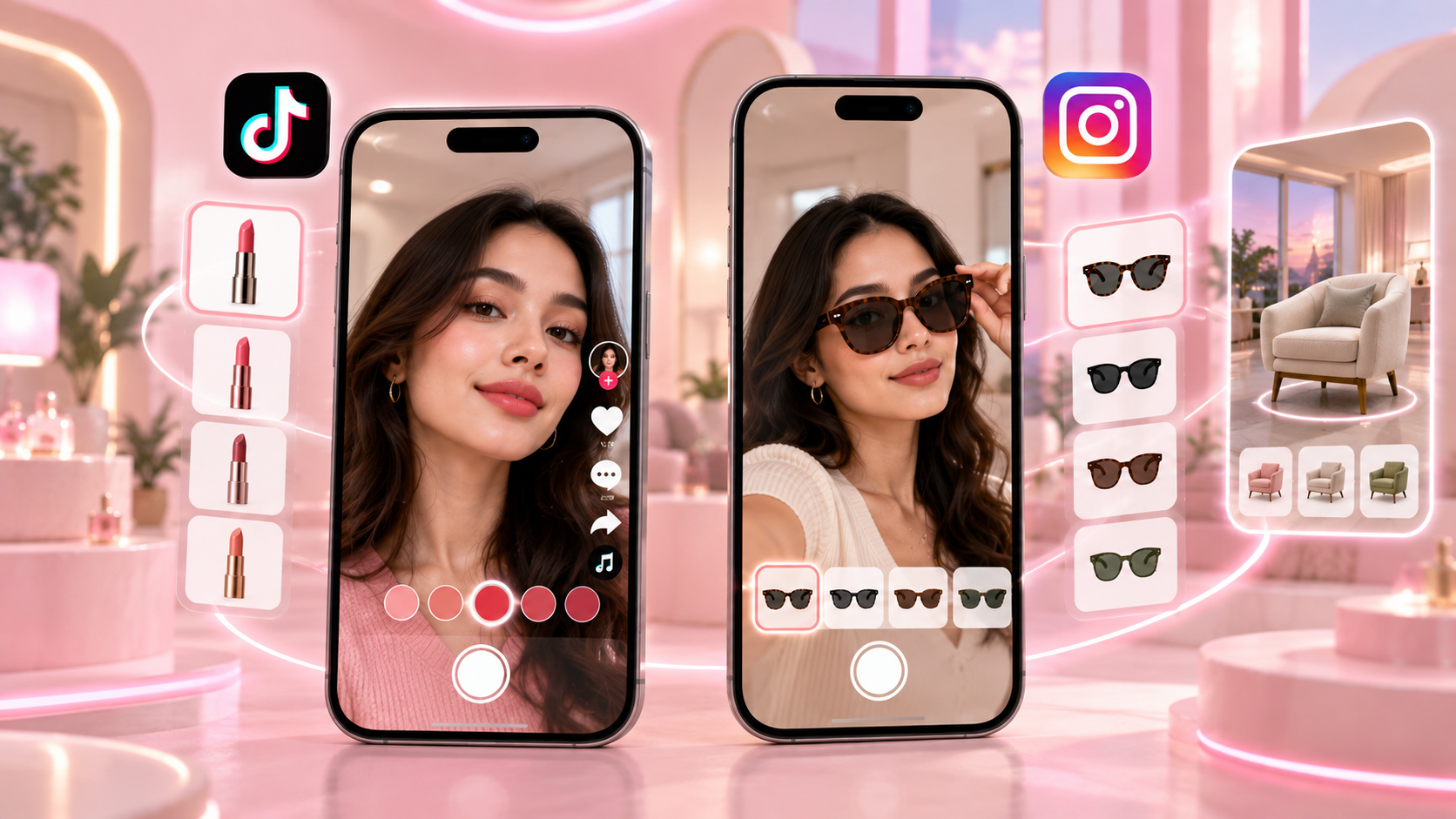
TikTok AR ads and Instagram AR ads are interactive paid placements that overlay branded 3D content, product try-on effects, or face filters onto a viewer's live camera feed inside the platform. They are the highest-engagement format available on either platform: AR advertising increases engagement rates by 35 to 40 percent compared with static digital ads, and average interaction time runs to 75 seconds against 2 to 3 seconds for a standard banner, according to research published by BrandXR in 2025.
For brand and media buying teams evaluating where to place interactive product content in 2026, TikTok and Instagram are no longer niche channels for AR. TikTok averages a 4.07 percent engagement rate across content (Brandwatch, 2025), roughly three times Instagram's 1.22 percent, and both platforms have matured their AR ad tooling to the point where a brand with a strong 3D asset set can run paid AR placements at scale. This guide covers how the formats work on each platform, where they differ, how to build a campaign, and the most common mistakes that waste budget.
What Are AR Ads on Social Platforms?
AR ads on social platforms are paid units that activate the device camera and place branded virtual content into the viewer's real-world environment in real time. The viewer does not download anything. They tap a prompt inside the feed, their camera opens, and the AR experience runs directly within the app.
Unlike standard video ads, which a viewer watches passively, an AR ad requires active participation. The user tilts their phone to see a product from different angles, moves their head to try on eyewear, taps to switch between shade options, or places a piece of furniture in their living room. That active participation is the mechanism behind the engagement and purchase intent numbers that make the format commercially compelling.
Social AR ads are distinct from web-based AR ads, which run in a mobile browser and are surfaced via a link or QR code rather than inside a platform feed. Both formats use 3D assets and AR rendering, but they live in different environments, require different creative specs, and reach audiences in different mindsets. For a full breakdown of web-based and QR-triggered AR ad formats, the GlamAR overview of 3D AR ads covers that landscape in detail.
On social platforms, the paid AR ad formats that matter for most brand and e-commerce teams in 2026 are Branded Effects on TikTok and AR ads via Meta's Spark AR on Instagram. Both are covered below.
How AR Ads Differ Across TikTok, Instagram, and Meta
The table below summarises the key differences across the three environments a media buyer needs to understand before allocating budget to social AR.
TikTok AR Ad Formats
TikTok's AR advertising unit is the Branded Effect, created and uploaded via Effect House, TikTok's proprietary AR authoring platform. Brands commission or build an effect (a face filter, product try-on, world AR experience, or interactive game), submit it for review, and then run it as a paid placement.
What distinguishes TikTok's format from Meta's is the creator amplification mechanism. When a Branded Effect goes live, TikTok users, including creators with large followings, can find and use the effect in their own content. If a creator uses a brand's Branded Effect in a video that performs well organically, the brand's AR experience spreads beyond the paid placement at no additional cost per view. This is the model that generated significant viral moments for beauty and fashion brands in 2024 and 2025.
TikTok AR ads perform best in categories with strong visual identity: beauty (makeup try-on, skincare filters), fashion and accessories (virtual try-on, outfit effects), footwear, eyewear, and consumer electronics where a 3D product placement experience is relevant. The platform's audience skews younger and more likely to create and share content, which amplifies the creative investment in a way that an Instagram placement typically does not.
For brands running tiktok ar ads for the first time, Effect House has a library of effect templates that reduce production time, but custom try-on effects with brand-specific 3D models require either an Effect House partner agency or a 3D asset provider that can prepare models to Effect House's technical specifications.
Instagram AR Ad Formats
Instagram AR ads are built and deployed through Meta Spark AR, the same authoring tool used for Meta's Facebook and Messenger AR placements. An effect created in Spark AR can run across Instagram Feed, Stories, and Reels as a paid placement via Meta Ads Manager.
Instagram's AR ad format is more mature in its commercial tooling than TikTok's. Meta Spark AR has been available to brands since 2019, and Meta has invested heavily in its shopping and try-on integrations. Instagram AR ads can be directly linked to a product catalog, allowing the try-on experience to surface directly against a specific product listing and send the user to a purchase URL within the same flow.
The platform's audience is broader across age demographics than TikTok, which matters for brands in categories like home furnishings, jewelry, and premium accessories where the buyer skews older. Instagram also benefits from Meta's targeting infrastructure, which gives media buyers more granular audience controls than TikTok Ads Manager currently offers.
The limitation of Instagram's format compared with TikTok's is that Meta Spark AR no longer allows consumer-generated effect uploads following a 2024 policy change that restricted AR effect publishing to verified business accounts and authorised partners. This concentrates the paid AR ad ecosystem more tightly on brands with verified accounts and the agency or platform partnerships to build and publish effects.
For brands already running AR ads on Meta through Facebook, extending that same Spark AR asset to Instagram is a straightforward expansion that uses the same effect file, the same Meta Ads Manager interface, and the same reporting dashboards.
Where GlamAR's AR Ads Fit In
GlamAR's AR ads solution is platform-confirmed for both Instagram and TikTok. The solution page explicitly lists Instagram and TikTok among the platforms where GlamAR's 3D assets and AR ad output can be integrated and deployed.
The practical implication for brand teams is that a single 3D asset production run, whether from existing photography, CAD files, or physical samples, can generate the foundational model set needed for a TikTok Branded Effect, an Instagram Spark AR try-on, a web-based AR experience, and a product page 360-degree viewer, without separate production for each channel. Asset reuse across platforms is one of the primary commercial arguments for working with a platform like GlamAR rather than commissioning each effect separately through individual platform partner agencies.
GlamAR's AR ads platform reports a 35 percent increase in conversion rate, 50 percent reduction in product returns, and a 3x return on ad spend across campaigns. For context on the broader 3D AR ad landscape and how brands like Nike, Adidas, and Estée Lauder have applied the format, the 3D AR ads campaign overview covers these in detail.
Why Brands Are Investing in Social AR Advertising
Engagement and Watch Time
The engagement gap between AR ad formats and standard video or static formats is the most consistently reported finding in social advertising research for 2025 and 2026.
AR advertising generates 3x higher brand lift at 59 percent reduced cost compared with non-AR campaigns, and delivers engagement time approximately 4x longer than mobile video, according to data compiled from Meta for Business and Snap's commissioned studies. On TikTok specifically, the platform averages a 4.07 percent content engagement rate, which sits well above Instagram's 1.22 percent and Facebook's 0.09 percent on the same measure (Brandwatch, 2025). AR placements on both platforms outperform the standard video benchmark within each platform's ad ecosystem.
The mechanism is the interaction model. A standard video ad is watched or skipped. An AR ad requires the user to tap, position their camera, and engage with the content. Users who interact with an AR experience spend significantly longer with the brand than users who view a video, and interaction time correlates more strongly with purchase intent than passive watch time does.
For brands allocating media budgets across formats, the 75-second average interaction time for AR ads versus 2 to 3 seconds for banner ads represents a qualitatively different kind of attention. The user has opted in, pointed their camera at themselves or their environment, and spent more than a minute exploring a product. That is not a metric that impression-based formats can replicate.
Conversion Impact vs. Standard Video Ads
The conversion impact of AR ads is measurable at both the awareness and direct-response stages of the funnel.
At the awareness stage, AR advertising raises purchase intent by 19 percent following positive AR brand experiences, and increases brand recall by 70 percent compared with passive ad exposure, according to BrandXR research (2025). These are brand-level effects that accrue over time and compound across repeat exposures.
At the conversion stage, brands running AR try-on experiences report conversion lifts of 20 to 90 percent over standard product pages, with cosmetics and eyewear categories seeing the highest lift, according to Meta for Business data cited in the AR and XR Ad Experiences brand playbook (2026). The range is wide because the lift depends heavily on category, creative quality, and how well the try-on experience mirrors the product accurately. A high-fidelity makeup try-on built from accurate 3D models outperforms a rough color overlay by a significant margin, which is why the quality of the underlying 3D asset matters as much as the platform placement.
For makeup virtual try-on and accessories virtual try-on categories specifically, AR ads on TikTok and Instagram function as the top-of-funnel activation layer that introduces the try-on mechanic before a customer arrives at the brand's own site or app, where the same model can power a product page try-on experience.
How to Plan and Launch an AR Ad Campaign
Creative and Asset Requirements
The most important decision in an AR ad campaign is made before the brief reaches the platform: what 3D assets will power the experience, and to what specification are they built?
TikTok Effect House asset requirements. Effects built for TikTok use glTF or GLB files as the primary 3D model format. Effect House supports face tracking, hand tracking, and world AR (surface placement). For product try-on effects, the model needs to be optimized for real-time rendering at mobile performance levels, which means polygon counts and texture sizes that balance visual quality with load speed. TikTok publishes size limits per effect type (typically under 5MB for the total effect package, though this varies by effect category). The Effect House template library provides starting configurations for face effects, hand effects, and interactive experiences.
Instagram Spark AR asset requirements. Spark AR also uses glTF and GLB as the primary import format. Meta's published limits for Spark AR effects include a maximum compressed file size of 4MB for effects distributed as Instagram ads, with a 1,024 x 1,024 pixel maximum texture resolution. Face tracking, body tracking, and world AR (plane detection) are all supported. Spark AR Studio, Meta's desktop authoring tool, handles the rendering and preview before submission.
Shared creative principles for both platforms. In both environments, the creative brief needs to answer: what does the user do with this effect for 75 seconds? A try-on effect that places a product on the user's face or wrist in one position with no interaction path will exhaust its utility in ten seconds. Effective AR ad creative includes a discovery element (shade switching, color variants, size comparison), a social sharing prompt, and a clear CTA surface either within the effect or in the accompanying ad copy.
Brands with existing product photography can use that as source material for 3D model creation. Brands with CAD files or existing 3D assets can prepare them for platform-specific export with relatively low additional effort.
Budget and Bidding Considerations
Neither TikTok nor Meta publishes a hard minimum spend for AR ad placements, but practical campaign floors based on reported brand budgets and agency guidance for 2026 are as follows.
Production cost. A basic Instagram AR effect with a single product model, built through a Spark AR partner or 3D asset provider, typically ranges from $8,000 to $15,000 for the production component. A TikTok Branded Effect with custom 3D product placement is in a similar range. More complex effects with multiple products, interactive elements, and custom animations run higher. This is the upfront creative cost, separate from media spend.
Asset reuse is the primary lever for reducing the per-channel production cost. A 3D model built to GlamAR's specifications for a product page try-on or a web AR experience can, with appropriate optimization, be reformatted for both TikTok Effect House and Spark AR without separate modeling work, which spreads the production cost across multiple placements.
Media spend. TikTok ads average a CPM (cost per thousand impressions) of around $9.16, meaningfully below Meta's average Facebook CPM of approximately $14.91 (WebFX, 2026). For AR placements specifically, CPMs vary by format, audience targeting depth, and competitive pressure in the auction. For initial test budgets, $50 to $100 per day is a workable floor for generating statistically meaningful interaction data. Scale once effect interaction rate and cost per AR interaction are established.
Bidding approach. For TikTok, optimizing toward "effect interactions" as the campaign objective gives the platform's algorithm a clear signal on who engages with AR content, which improves targeting efficiency over time. For Meta, Spark AR placements can be optimized toward reach and brand awareness objectives, or toward lower-funnel actions if a catalog link is active.
Measuring Performance
The measurement framework for social AR ads covers three layers: platform-reported engagement, brand lift, and downstream commercial impact.
Platform engagement metrics. Both TikTok Ads Manager and Meta Ads Manager report effect interaction rate (the percentage of people who tap and activate the AR experience), average interaction duration, shares, and reach from creator content (for TikTok Branded Effects). These are the primary indicators of creative quality and audience fit. An effect interaction rate below 1 percent on a standard in-feed placement warrants creative revision. Above 3 percent is strong for a paid placement in most categories.
Brand lift measurement. Both platforms offer brand lift studies for campaigns above certain spend thresholds. These measure awareness, recall, message association, and purchase intent via split-sample surveys. For AR campaigns where the awareness-to-intent journey is the primary objective, a brand lift study gives you the before/after data that effect interaction rate alone cannot provide.
Downstream commercial impact. For campaigns with a linked product catalog, track add-to-cart rate and purchase conversion from users who interacted with the AR effect versus users who only viewed the ad. This requires proper UTM tagging on the CTA link and attribution matching in your analytics platform. Return rate comparison between AR-assisted purchasers and standard purchasers is worth tracking over a 30 to 60-day window, particularly for try-on categories where AR has a documented return reduction effect.
Reporting cadence. Check effect interaction rate and cost per interaction daily for the first week of a new effect. Allow at least 7 days of data before making optimization decisions. Creative fatigue on AR effects is lower than on standard video (the interactivity sustains interest longer), but effects do plateau; plan for a creative refresh every 4 to 6 weeks for always-on programs.
Common Mistakes Brands Make with AR Ads
Mistake 1: Treating the 3D model as an afterthought.
The most common reason AR ad campaigns underperform is that the 3D asset driving the experience was built to the wrong specification, or built quickly from low-quality source material. A makeup try-on that misrepresents shade accuracy, or a product placement that looks flat or wrongly scaled, damages purchase confidence rather than building it. The fix: commission 3D assets to the highest specification the budget allows, with platform export in mind from the start, not as an afterthought after the model is built for a different purpose.
Mistake 2: Launching an AR effect with no interaction design.
An effect that places a product on screen with no additional path for the user to follow will see users drop off in seconds. Effective AR ad creative includes at least one discovery mechanic: shade switching, size variants, a color picker, an animated reveal, or a challenge prompt. The fix: brief the effect with a user journey, not just a visual output. Define what the user does at seconds 5, 15, and 30 of the experience.
Mistake 3: Running AR ads with no creator strategy on TikTok.
TikTok Branded Effects have organic amplification built into the format: if creators pick up and use your effect, the campaign scales beyond the paid placement at no additional CPM cost. Brands that pay for a Branded Effect but do not seed it with a small group of relevant creators leave the majority of the format's value unrealised. The fix: identify 5 to 10 creators in the relevant category, brief them on the effect before launch day, and give them early access so organic content is live at the same time as the paid placement.
Mistake 4: Using the wrong platform objective for the campaign stage.
Brands running AR try-on ads with a "conversions" objective on a cold audience who have no awareness of the product routinely see high CPMs and low ROAS, then conclude that AR ads do not work. AR ads build awareness and purchase intent; they are not a bottom-of-funnel direct response unit for unfamiliar audiences. The fix: match the platform objective to the funnel stage. Use reach or brand awareness for cold audiences; retarget users who interacted with the effect with a direct response unit once they have product familiarity.
Mistake 5: Failing to test effect variants.
Media buyers routinely test three or four video creative variants but launch a single AR effect without any creative testing. Two effects with different interaction designs or product presentations can produce measurably different interaction rates and downstream conversion. The fix: build at least two effect variants for any significant campaign, test them against each other using the platform's A/B test functionality, and let performance data drive the allocation before scaling.
Mistake 6: Ignoring the post-interaction CTA.
AR effects with no clear call to action after the interaction window closes waste the commercial intent they generate. A user who has just spent 60 seconds trying on a lipstick shade is in a high-purchase-intent state. If the only next step is a generic "learn more" link to the brand homepage, that intent dissipates. The fix: connect the effect directly to the specific product page, collection, or catalog entry that matches what the user was trying on. The product page should ideally surface the same try-on capability to close the loop.
How GlamAR Supports AR Ad Creation
GlamAR's AR ads solution supports both Instagram and TikTok as confirmed deployment platforms, alongside Snapchat, Google Ads, websites, and other channels. The end-to-end workflow covers three stages: 3D asset creation, AR experience build, and cross-platform deployment.
3D asset creation
GlamAR's team builds 3D models from brand-supplied source materials, including product photography, CAD files, or physical samples. Output formats include glTF, GLB, USDZ, FBX, and OBJ, with specific optimization for the polygon and texture specifications required by TikTok Effect House and Meta Spark AR. Brands do not need to supply existing 3D files. The 3D model creation service handles this from source materials alone.
AR experience build
Once assets are created, GlamAR builds the AR ad experience to platform spec, covering interaction design, face and world tracking integration, shade or variant switching, and CTA configuration. No-code setup means brand teams can customize and update elements without a developer dependency.
Cross-platform deployment
The same 3D asset set produced for an Instagram AR ad can be adapted for a TikTok Branded Effect, a web AR placement, a product page try-on, and a 360-degree viewer without separate production runs. This is the primary commercial argument for a unified asset strategy: the per-channel cost is spread across more placements, and the brand's product representation is consistent across touchpoints.
Platform performance data is available through GlamAR's analytics dashboard, which tracks user interactions with AR content and connects engagement data to downstream commercial outcomes. GlamAR's AR ads solution reports a 35 percent average increase in conversion rate, 50 percent reduction in returns, and 3x return on ad spend across deployed campaigns.
For beauty brands evaluating how AR ads connect to on-site try-on capability, the makeup virtual try-on solution and accessories virtual try-on solution cover how the same product try-on experience extends from social ad to product page. For a broader look at beauty filter apps and social AR filter formats, the best beauty filter apps guide covers the consumer-facing landscape in detail.
Conclusion
TikTok AR ads and Instagram AR ads are established, measurable media formats in 2026, not experimental placements. The engagement performance versus standard video and static formats is well-documented, and the platform tooling (TikTok Effect House, Meta Spark AR) is mature enough for brands of most sizes to build and deploy AR effects without specialist in-house capability.
The brands that get the most from social AR advertising are those who treat the 3D asset as infrastructure: built once, deployed across social AR, web AR, and product page try-on, with consistent visual quality across every touchpoint. The per-placement cost drops, and the brand's product representation stays coherent across every channel where a potential buyer might encounter it.
Talk to the GlamAR team about AR ad creation for TikTok and Instagram, or explore the GlamAR AR ads solution page to see the confirmed platform coverage and campaign data.
GlamAR delivers 3D models in glTF, GLB, USDZ, FBX, and OBJ. For TikTok Effect House and Meta Spark AR, glTF and GLB are the primary formats required. GlamAR optimizes models to the polygon and texture specifications of each platform, including the compressed file size limits (typically under 5MB for TikTok effects, 4MB for Spark AR ads). If you supply existing 3D files, the team can reformat and optimize them for platform spec without re-modeling from scratch.
Neither TikTok nor Meta publishes a hard minimum for AR ad placements specifically. Practical test budgets reported by agencies in 2026 start at around $50 per day for paid distribution on either platform. The larger cost driver is usually production: a custom AR effect built to platform spec from 3D assets typically ranges from $8,000 to $15,000 for the creative component. Brands with existing 3D assets from GlamAR can reduce this figure by reusing and optimizing existing models rather than building from scratch.
TikTok Branded Effects are submitted via Effect House and typically reviewed within 2 to 7 business days, depending on effect complexity and current review queue. Meta Spark AR effects submitted for Instagram ad placements typically review within 1 to 5 business days. Both platforms can reject effects that do not meet their technical specifications, content policies, or brand safety guidelines. Build in review time before campaign launch dates, and confirm that the effect passes technical validation in the authoring tool before submission.
Yes. GlamAR's 3D assets are built from your product catalog as the source. For Instagram, Meta Spark AR supports catalog-linked AR effects, where the try-on experience surfaces against a specific product ID and the CTA sends the user directly to the product page in the brand's catalog. This is particularly effective for makeup, accessories, and eyewear categories. For TikTok, catalog integration is available through TikTok Shop product links attached to the ad unit. Confirm your platform catalog setup with GlamAR during the brief stage so the integration path is configured before the effect is built.
Benchmarks vary by category, creative quality, and platform. Indicative reference points for planning: AR effect interaction rates of 1 to 3 percent for cold-audience paid placements on both platforms; average interaction duration of 30 to 75 seconds for well-designed try-on effects; conversion lifts of 20 to 90 percent over standard product pages for try-on categories, with cosmetics and eyewear at the higher end of this range (Meta for Business data, cited 2026). Brand lift studies typically show 10 to 20 percent purchase intent increases for AR-exposed audiences versus control groups. These are directional benchmarks, not guarantees; the quality of the 3D asset and the interaction design are the primary variables.
GlamAR's website and app try-on products sit on the brand's own product pages and are triggered by the customer during their own browsing session, typically at a high-intent stage when they are already considering a specific product. Social AR ads (tiktok ar ads and instagram ar ads) are paid placements that surface the try-on experience earlier in the funnel, to users who may not yet be aware of the product or brand. The two use the same underlying 3D assets and AR rendering technology, but serve different commercial purposes: social AR ads build awareness and drive traffic; on-site try-on converts that traffic into purchases and reduces returns. The most effective deployments connect both, so a customer who interacts with a TikTok or Instagram AR ad is retargeted to a product page that offers the same try-on capability.
Descubra como AR, VR e 3D podem impulsionar o crescimento das receitas em 2026
Agende uma chamada com a nossa equipa

.avif)