


What Is 3D Virtual Photography and How Does It Replace Product Photoshoots?


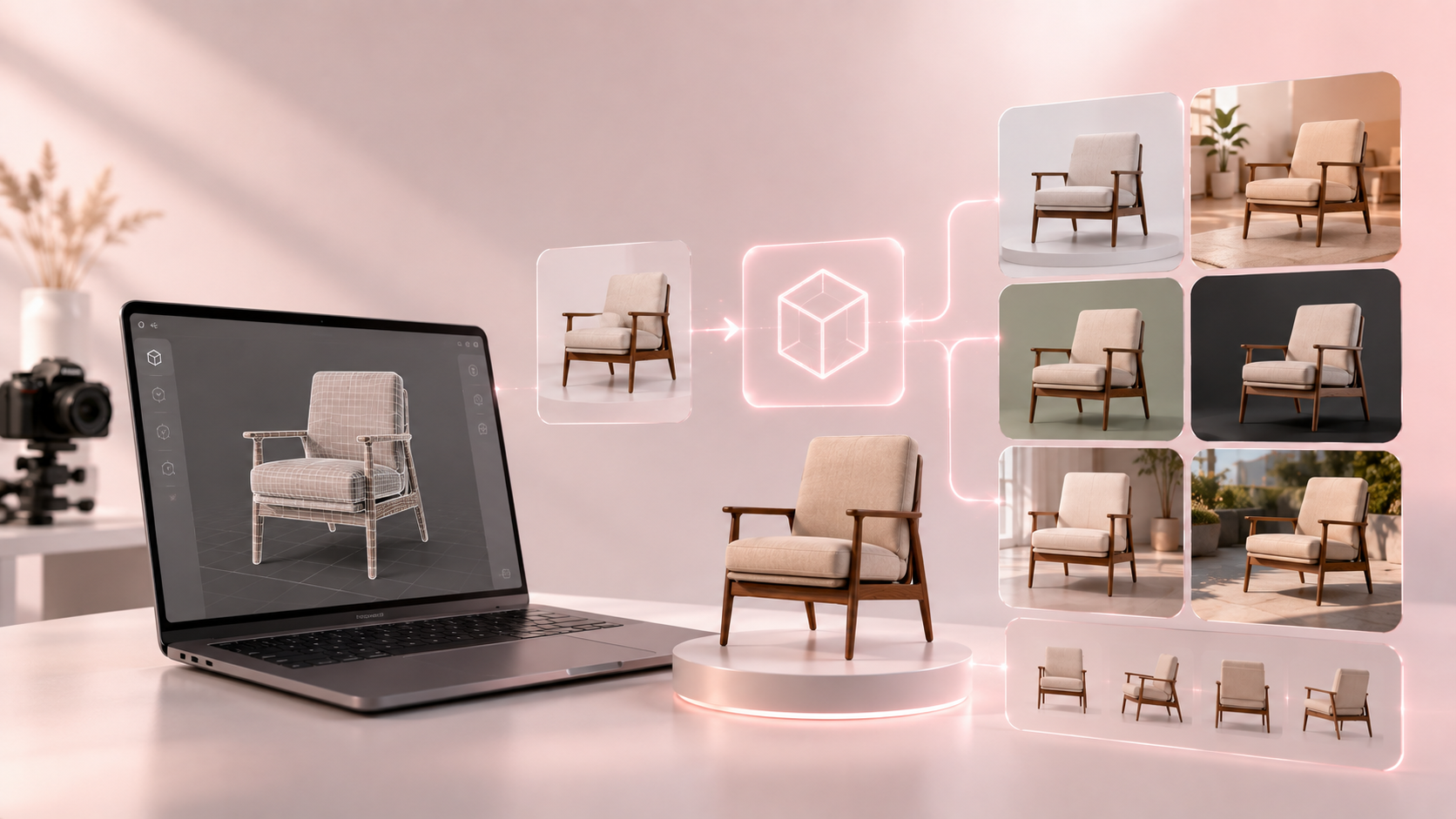
3D virtual photography is a process that turns a single 3D model of a product into unlimited product images - different angles, backgrounds, lighting, and lifestyle scenes - without a camera, studio, or photographer involved. GlamAR's own cost data puts the average traditional photoshoot for just five products at $3,250 to $7,800, depending on region - a cost that repeats every time a brand needs new angles or a fresh backdrop.
A 3D model doesn't repeat that cost. Once it exists, it becomes a reusable asset that keeps producing new images for as long as the product stays in the catalog.
The Hidden Cost of Product Photography
Every e-commerce brand runs into the same wall eventually: photography does not scale with the catalog. A brand with 50 SKUs and a brand with 5,000 SKUs both pay for the same studio day rate, the same photographer, and the same lighting setup - the only difference is how many times they have to repeat the process.
That repetition is where the real cost lives. A single photoshoot rarely covers everything a brand needs. New colorway launched? New shoot. Seasonal campaign with a different backdrop? New shoot. Marketplace listing needs a plain white background but the ad campaign needs a lifestyle scene? Two separate shoots, sometimes on two separate days.
GlamAR's cost analysis across regions shows why this adds up so fast. Shooting five products traditionally costs an average of $7,800 in higher-cost regions, $4,600 in mid-cost regions, and $3,250 even in the most affordable markets - for one shoot, covering one set of use cases. The line items behind that number rarely shrink: shipping and handling of physical samples, specialized lighting and camera equipment, studio or location rental, photographer and stylist fees, lifestyle props, and the post-production hours needed to retouch every single image.
None of those costs scale down with catalog size. That's why footwear, jewelry, accessories, and furniture brands - categories with high SKU counts and frequent variant changes - end up spending disproportionately more on visual content than smaller, simpler catalogs do.
What Is 3D Virtual Photography and How Does It Work?
3D virtual photography replaces the repeat shoot with a repeat render. Instead of photographing a product every time a new image is needed, a brand builds one 3D model of the product and generates new images from that model whenever it wants - a different angle, a new background, a seasonal scene - without booking a studio again.GlamAR's 3D virtual photography solution runs on three steps:
1. Upload product images. The brand sends in a set of high-quality photos of the product taken from different angles. No specialized 3D scanning equipment or design skills are required on the brand's side.
2. Transform into a 3D model. GlamAR converts those images into a photorealistic 3D model, optimized for use in virtual try-on, 360° viewers, and product configurators - not just static photography.
3. Generate ready-to-use visuals. From that single model, the brand receives multiple SILO scenes - clean, background-free product shots - and creative lifestyle renders per product, ready to use across the website, ads, and social channels.The output isn't a fixed set of images the way a traditional shoot delivers. It's a model the brand can keep coming back to. Want the product on a holiday-themed background next month? Want to preview a colorway that hasn't been manufactured yet? The model gets updated - not reshot.
The Business Case: What the Data Shows
6x cheaper, 100x faster. GlamAR's own platform data shows 3D virtual photography running at roughly 6 times lower cost and 100 times faster turnaround than a traditional photoshoot for the equivalent set of product images - because the marginal cost of a new image drops to near zero once the model exists.
The wider market is moving the same direction. Independent 2026 industry research values the global AI product photography market in the billions of dollars, with double-digit annual growth as more e-commerce operators shift budget away from repeat physical shoots and toward reusable, model-based image generation. That direction is consistent across market reports even where the exact valuation differs - the trend line, not just a single number, is the signal worth paying attention to.
360° and 3D formats are becoming standard, not a novelty. Industry analysis of leading e-commerce platforms shows 360° spin views and 3D-based product renderings now make up a substantial and growing share of advanced product listing formats among top online retailers - a sign that customers increasingly expect more than static photos before they buy.
Reusability compounds the savings. Because a single 3D model can generate an unlimited set of derivative images, the per-image cost keeps falling the more a brand uses it - website listings, ad creative, social content, and email campaigns can all draw from the same model instead of separate photo budgets for each channel.
Which Product Categories Benefit Most
Furniture and home decor. High per-shoot cost, bulky products that are expensive to ship to a studio, and constant demand for lifestyle scenes in different room settings make this one of the highest-impact categories for 3D virtual photography.
Footwear and accessories. Large color and material variant counts mean a traditional catalog shoot multiplies fast - one 3D model per silhouette can cover every colorway without a reshoot for each one.
Jewelry and watches. Small, detail-heavy products where lighting and macro photography are expensive to get right consistently across an entire range benefit from a model that renders every piece the same way, every time.
Large or fast-changing catalogs. Any brand adding new SKUs weekly, running frequent seasonal refreshes, or managing regional storefronts with different visual requirements gains the most from an asset it can reuse and adjust instead of reshooting from scratch.
3D Virtual Photography vs. Traditional Photoshoots
How to Start Replacing Photoshoots: A Practical Rollout
Moving from photography to 3D virtual photography doesn't have to mean switching the entire catalog at once. A phased rollout keeps the transition manageable and lets a brand prove the cost savings before committing further.
1. Audit the catalog for repeat-shoot pain. Identify which products get reshot most often - new colorways, seasonal campaigns, or frequent restyling - since these are the SKUs where a reusable 3D model pays back fastest.
2. Start with the highest-SKU or highest-return category. Footwear, jewelry, and furniture typically see the quickest payback because variant counts are high and the cost of repeat shoots is already a known pain point for the team.
3. Brief the initial image capture for reuse, not just one shoot. Since the resulting 3D model will serve the website, ads, social, and possibly in-store displays, plan the source photography with every channel in mind rather than just the immediate need.
4. Pair the model with other 3D use cases where relevant. If the product has color or material variants, the same model that generates photography can typically also power a 360° product viewer or a 3D product configurator - extending the value of the initial build.
5. Budget for updates, not reshoots. Once a model exists, ongoing costs shift from booking new shoots to requesting new scenes or backgrounds from the same asset - a smaller, more predictable line item than a recurring photography budget.
6. Track the metric that matters: cost per usable image. Rather than comparing shoot cost to shoot cost, compare the total cost of a photography cycle against the number of distinct images it produced. This is where the gap between traditional and 3D-based workflows becomes clearest over a full quarter or season.
Real Brands Already Making the Switch
IKEA has been one of the most public examples of this shift for over a decade. The company has steadily increased the share of its catalog imagery produced from 3D models rather than photography - from roughly 12% of product images in 2012 to around 75% today - specifically to avoid the cost and logistics of shipping products, including entire kitchen setups, to photo studios across every market it sells in.
Wayfair built its "Wayfair Next" R&D program around the same idea: once a product exists as a 3D model, the company can generate both product images and full lifestyle room photos without needing physical samples, a photo studio, or a styling team for every shot. Wayfair has documented this directly as a source of cost savings on photoshoots and physical samples, alongside the AR and VR experiences the same models power.
Mid-sized furniture retailers report similar results at a smaller scale. Furniture brands moving from multi-region photoshoot workflows to 3D-generated imagery have reported six-figure annual savings once a single set of 3D assets replaced ongoing photography budgets across catalogs, social media, and retail partner listings - savings that come specifically from not having to rebook a shoot for every fabric, finish, or configuration.
The pattern across all three is the same: the savings show up the moment a brand stops paying per shoot and starts paying once for a model it can keep using.
Conclusion
The math behind 3D virtual photography is simple once the repeat costs of traditional photography are laid out clearly: a photoshoot is a one-time, single-use expense, while a 3D model is a reusable asset that keeps generating new images long after the initial investment. For brands with high SKU counts, frequent variant changes, or catalogs that need to serve multiple channels, that difference compounds fast.
Brands don't need to replace 100% of their photography overnight to see the benefit. Starting with the highest-SKU-count or highest-return category - footwear, jewelry, furniture, accessories - and expanding from there is usually where the payback shows up fastest.
Explore the 3D virtual photography solution page or contact the GlamAR team to see what it looks like with your own product catalog.
It works best for products with a stable physical shape - footwear, accessories, jewelry, watches, furniture, and electronics. Categories that depend heavily on fabric drape or human movement, like apparel worn by a live model, may still need some traditional or hybrid photography.
Once the initial product photos are uploaded, GlamAR converts them into a 3D model and delivers ready-to-use SILO and lifestyle renders - a process built to run far faster than booking, running, and post-producing a traditional shoot.
Yes. A single model can generate assets for product listings, paid ads, social posts, and email campaigns, which removes the need for separate content budgets for each channel.
No. The process starts with uploading standard product photos. GlamAR handles the conversion into a 3D model and the generation of the final images.
Text-to-image AI tools generate an approximation of a product, which risks inaccuracies in shape, proportion, or detail. 3D virtual photography starts from the brand's actual product, converted into a model, so the resulting images reflect the real item - important for categories where visual accuracy affects return rates.
Yes. Because the 3D model is a reusable asset, changing the background, lighting, or setting for a new campaign doesn't require rebuilding the model from scratch.
Descubra como AR, VR e 3D podem impulsionar o crescimento das receitas em 2026
Agende uma chamada com a nossa equipa

.avif)