


3D Content Creation for Ecommerce: A Practical Guide for Brands in 2026


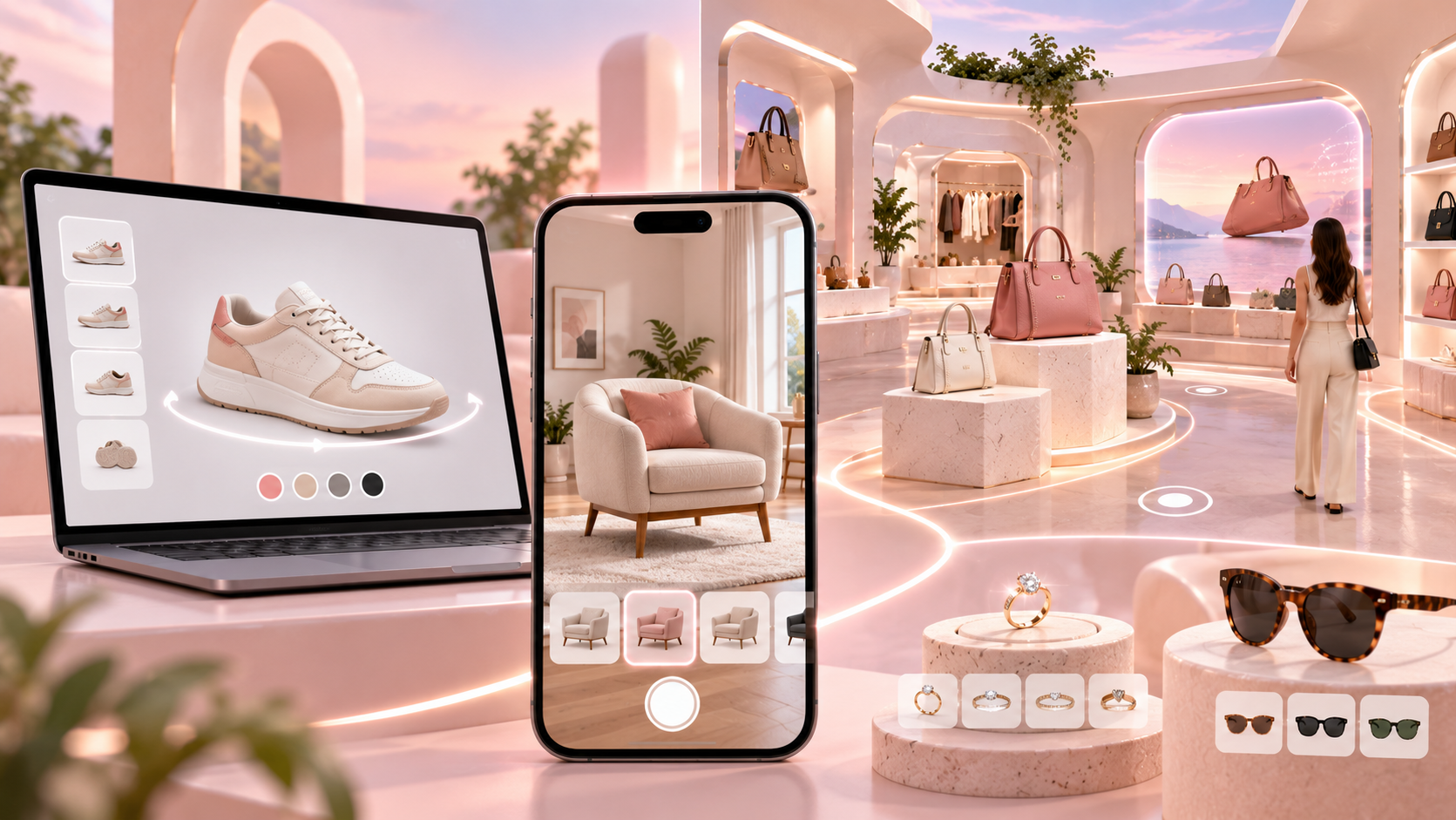
3D content creation for ecommerce is the practice of converting product assets into interactive digital experiences (shoppable showrooms, 360-degree viewers, and virtual try-on) that sit on product pages, in virtual stores, and across marketing channels. For e-commerce and product marketing managers evaluating where to invest in product content, the commercial case is direct: interactive 3D visualization boosts conversion rates by 25 to 40 percent compared with standard photography, with AR-enabled categories seeing even larger lifts.
The format is no longer experimental. 66 percent of retailers who have implemented 3D content report increased engagement, and 89 percent say it is important for reducing returns. The decision most teams face in 2026 is not whether to invest in 3D content creation for ecommerce, but how to structure the strategy and which deployment formats to prioritize first.
What Is 3D Content Creation for Ecommerce?
3D content creation for ecommerce is the end-to-end process of building interactive product experiences from 3D assets, covering how those assets are deployed as shoppable interfaces on product pages, inside digital showrooms, in virtual try-on flows, and across marketing surfaces.
The output is not a file. It is a customer-facing experience: a product page where a shopper can rotate a bag through 360 degrees, a virtual showroom where a buyer can browse a collection, an AR surface where a customer can place a sofa in their living room before purchasing. Each of these experiences is built from a 3D model, but the model itself is an input, not the finished work.
This distinction is important for teams planning investment. Commissioning 3D models without a deployment strategy produces assets that sit in a folder. A 3D content strategy defines which experiences those assets power, which channels they appear in, and how their commercial performance is tracked.
3D Content Creation vs. 3D Model Creation: What's the Difference?
This is one of the most commonly confused distinctions in ecommerce product content, so it is worth stating precisely:
3D model creation is the technical production process of converting a physical product into a digital 3D file. It covers source materials (photography, CAD files, physical samples), model specifications (polygon count, file format, PBR textures), and output formats (glTF, GLB, USDZ, FBX, OBJ). The output is a 3D asset. It answers the question: does this product exist as an accurate 3D file?
3D content creation for ecommerce is the strategic and deployment layer that sits above model creation. It covers how 3D assets are activated as customer-facing experiences: which viewer or SDK renders them, where they appear in the purchase flow, how they integrate with the checkout, what engagement data they generate, and how they connect to other formats (AR placement, virtual showrooms, try-on). It answers the question: is this 3D asset earning its way on a product page and across channels?
Put simply: 3D model creation produces the asset. 3D content creation for ecommerce puts that asset to work.
A brand that invests in high-quality 3D model creation but skips the content strategy ends up with an asset library it cannot deploy commercially. A brand that has a clear 3D content strategy knows exactly which models to commission, in which specifications, for which deployment surfaces, and in which order across its catalog.
The two are sequential, not interchangeable. GlamAR's 3D model creation service handles the production stage; GlamAR's 3D content creation for ecommerce solution handles the activation and deployment stage.
Core Use Cases
Shoppable Digital Showrooms
A shoppable digital showroom is a navigable 3D environment that mirrors the browsing logic of a physical store. Customers move through the space, interact with products, and add items to cart without leaving the immersive experience.
For brands, this format is most commercially effective when the catalog has depth: multiple products in a category that benefit from being seen together, or a collection where the relationship between items matters as much as any individual SKU. A furniture brand showing a living room range, a jewelry brand presenting a seasonal collection, or an eyewear brand organising frames by style all benefit from the spatial context a showroom provides.
The commercial advantage over a standard category page is dwell time. A navigable 3D showroom keeps shoppers inside the brand environment longer than a grid of product thumbnails. Longer dwell time correlates directly with higher add-to-cart rates. Customers also tend to add more items per session when they browse spatially rather than linearly.
GlamAR's platform supports building virtual stores and digital showrooms with high-quality 3D models, including the full integration from product 3D asset to shoppable environment.
360-Degree Product Views
A 360-degree product viewer embeds an interactive spin directly on the product page. Shoppers rotate the product through every angle, zoom in on surface detail, and examine features that a flat photograph cannot show accurately: the seam construction on a shoe, the hinge mechanism on a pair of glasses, the hardware finish on a bag.
This format has the lowest deployment friction of any 3D content type. It requires a single product page change, no SDK integration, and no user behaviour change. Shoppers already expect to interact with product images. The lift in conversion and reduction in returns is well established across categories.
For brands with large catalogs, 360-degree views are typically the right starting point for a 3D content rollout. The asset specification (usually a set of rendered frames or a GLB file with embedded spin behaviour) is simpler than a full AR experience, the per-SKU cost is lower, and the integration into most ecommerce platforms is a standard feature. Building 360-degree coverage across a catalog creates the asset foundation that more advanced formats (AR placement, try-on) then build on.
The best 360 product viewer platforms guide covers provider options and technical requirements for brands evaluating this format specifically.
Virtual Try-On Integration
Virtual try-on surfaces a 3D product against the shopper's live camera feed in real time. The shopper sees how eyewear sits on their face, how a watch looks on their wrist, how a piece of jewelry reads against their outfit, or how a hat fits their head, before making a purchase decision.
For brands, the key commercial variables are the product categories where try-on has the strongest impact on purchase confidence, and the integration path that delivers the experience within the existing product page rather than as a separate tool. Eyewear, jewelry, accessories, and makeup are the categories where virtual try-on has the most direct effect on conversion and return rates.
Rebecca Minkoff reported that customers were 65 percent more likely to place an order after interacting with AR try-on compared with standard product page views. GlamAR's own platform data across accessories customers shows an average 94 percent increase in conversion and 40 percent decrease in returns for products with AR try-on enabled.
Virtual try-on requires higher-quality 3D assets than a 360-degree viewer, because the model is being rendered in real time against a live camera input. Asset specification matters more, and the SDK integration is more involved than a basic embed. For brands new to 3D content, starting with 360-degree views and scaling to try-on as the asset library grows is a lower-risk sequencing approach.
How to Build a 3D Content Strategy
Auditing Your Current Product Catalog
Before commissioning any 3D assets, map the catalog against commercial priority and content format fit. A structured audit covers four things:
Revenue weight
Which SKUs or categories drive the highest share of revenue? These are the products where improved conversion rates have the most direct impact on total sales. Start the 3D content rollout here, not with low-margin or low-volume lines.
Return rate by category
Which product categories have the highest return rates? High-return categories (typically apparel, footwear, accessories, furniture) are where 3D content has the strongest business case, because the return reduction benefit is largest. Cross-referencing revenue weight and return rate gives you a priority matrix for which products to model first.
Content format fit
Not every product category benefits equally from every 3D format. Structured products with distinctive shape and surface detail (watches, eyewear, furniture, bags) suit 360-degree views and virtual try-on. Apparel suits fit visualization and try-on. Home furnishings suit AR placement. Map each category to its highest-value content format before commissioning assets.
Existing asset inventory
Do you have product photography, CAD files, or any existing 3D files? Photography can be used as source material for 3D model creation. CAD files accelerate the modeling process significantly. Understanding what exists avoids duplicate work and can reduce the per-model cost substantially.
Choosing the Right Format and Platform
Once the catalog audit is complete, choose deployment formats in order of implementation effort and commercial impact:
- Start with 360-degree views for priority SKUs. Lowest integration effort, proven conversion lift, and the asset production is fast relative to AR-grade models. This gets 3D content on product pages quickly and starts generating performance data.
- Layer in AR placement or try-on for high-return categories. Once 360-degree coverage is established, the same assets can often be extended to AR placement (for furniture and home products) or try-on (for wearables and accessories) with higher-specification models. This is where the return-rate reduction benefit is largest.
- Build toward a digital showroom for collections. If the brand has a catalog depth that benefits from spatial browsing, a digital showroom becomes the next investment layer. This requires more assets but generates the highest dwell time and multi-SKU basket sizes.
When evaluating platform providers, apply these criteria: model creation capability (can the provider build from your source materials?), deployment format coverage (does the platform support the formats you need?), ecommerce platform integration (Shopify, custom, headless?), analytics (can you track interactions and attribute conversion by SKU?), and asset reuse (can a model produced for one format be deployed in another without re-commissioning?).
The best 3D product visualization platforms guide covers the provider landscape in more detail for teams at the evaluation stage.
How GlamAR Supports 3D Content Creation
GlamAR's 3D content creation for ecommerce solution covers three confirmed deployment formats: AR and VR experiences (including AR placement and virtual try-on), virtual stores with 3D models (shoppable digital showrooms), and 360-degree product viewers.
The underlying 3D model creation service produces assets in all major formats: glTF, GLB, USDZ, FBX, and OBJ, across three specification tiers (low poly for web AR, high poly for photorealistic visualization, and custom for platform-specific requirements). Brands supply product photography, CAD files, or physical samples; GlamAR's team handles the model production in-house.
Asset reuse is built into the platform architecture. A model created for a 360-degree viewer can be extended to AR placement, virtual try-on, a digital showroom, or 3D advertising without separate production. This matters for catalog-scale rollouts where the per-model cost needs to be justified across multiple deployment formats, not just one.
The platform includes an analytics dashboard that tracks user interactions across deployed 3D content. This covers engagement by SKU, time spent with each format, and the behavioral data that tells a product marketing team which content formats are driving the most commercial impact in their specific catalog.
GlamAR holds SOC 2, GDPR, and ISO certifications, which is relevant for brands operating in the UK and EU where data handling requirements apply to customer-facing technology.
Conclusion
3D content creation for ecommerce is a structured discipline, not a one-off project. The brands that see the strongest commercial results (conversion lifts, return rate reductions, and higher average order values) approach it with a catalog audit, a clear format sequencing plan, and a platform that can deploy assets across multiple surfaces without re-commissioning models for each one.
The sequence matters: 360-degree views on priority SKUs first, try-on and AR placement in high-return categories second, digital showrooms for catalog-depth brands third. Each stage generates performance data that justifies the next.
Talk to the GlamAR team to scope a 3D content strategy for your catalog, or explore the 3D content creation for ecommerce solution page to see the confirmed platform capabilities.
GlamAR delivers 3D models in glTF, GLB, USDZ, FBX, and OBJ. For web AR and ecommerce platforms, glTF and GLB are the standard formats and offer the best performance balance. USDZ is required for native AR on iOS devices. FBX suits pipeline and advertising use cases. If you are deploying across multiple surfaces, the team can deliver multiple formats from the same model production. Specify your deployment targets during the briefing so the right formats are included in the delivery.
No. Brands can start with a small number of priority SKUs rather than committing to a full catalog rollout upfront. Starting with the five or ten products with the highest revenue weight and return rate gives you performance data before scaling the program. The per-model cost structure makes it practical to build incrementally.
GlamAR's 3D content deploys via embed code (typically two to three lines) for viewers and product pages, and via SDK integration for try-on experiences. Shopify is supported natively. Custom and headless platforms can integrate via the API. Confirm your platform setup during the scoping conversation so the integration path is established before build begins.
Pricing depends on the number of SKUs, the model specification tier required (low poly, high poly, or custom), and the deployment formats activated. GlamAR's pricing page at glamar.io/pricing/3d-model-creation gives an overview. For a catalog-scale program or multi-format deployment, a scoping conversation with the team is the most practical way to get an accurate cost structure.
Model creation for a small set of SKUs typically takes two to five days from when source materials are supplied. Integration and QA add time depending on platform complexity. For a straightforward Shopify deployment with existing product photography as source material, live content can be achievable within a week of brief confirmation. More complex integrations or larger catalog volumes require a timeline discussion during scoping.
GlamAR's 3D models are optimized for web delivery, with low-poly formats specifically designed to load quickly on mobile browsers without degrading the visual quality that drives the conversion lift. Heavy unoptimized 3D files are a known issue with poorly built implementations; model optimization is part of GlamAR's production process. You can verify mobile performance during the preview and QA stage before the content goes live on any product page.
Discover how AR, VR and 3D can drive revenue growth in 2026
Schedule a call with our team

.avif)