


How Virtual Try-On for Clothes Works


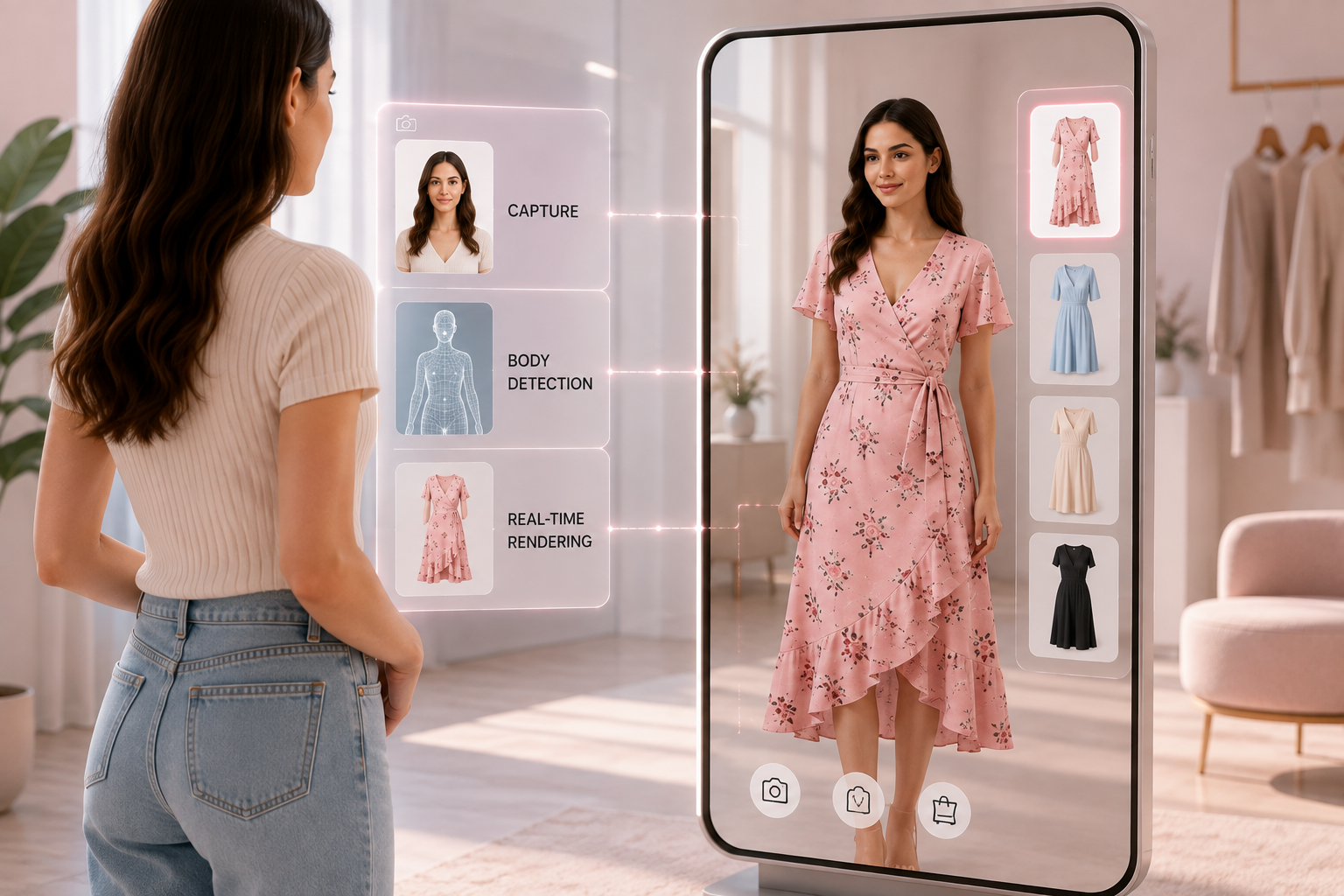
Virtual try-on for clothes works by capturing a representation of the shopper, whether a default model, a live camera feed, or their own uploaded photo, then rendering a specific garment onto that representation with software that simulates how the fabric would actually drape and fit. Below is how each stage of that process actually works, what it can and can't tell a shopper about fit, and what a brand needs to know before adding it to a store.
Fit uncertainty is the single biggest source of hesitation in online apparel shopping, and it's the reason clothing carries some of the highest return rates in ecommerce. Virtual fitting room technology exists to close part of that gap before a shopper ever clicks buy, not by replacing the physical fitting room entirely, but by giving a shopper a meaningfully better preview than a flat product photo ever could. This guide walks through the actual mechanics behind AI clothes try on, since understanding how the technology works is what lets a brand set the right expectations, both for its own team and for the shoppers using it.
Capture and body input methods
Every virtual try-on session starts with some representation of the shopper's body, and the method used shapes both the realism of the result and how much friction the shopper experiences before seeing it.
Default or reference model. The simplest input method skips the shopper's own body entirely, showing a garment on a standard model instead. This removes any friction, no photo, no camera permission, but it also gives the shopper the least personalized result, since they're seeing the garment on a generic figure rather than something resembling their own proportions.
Live camera capture. A shopper grants camera access, and the system detects their body in real time, overlaying the garment as they move. This is the most immediate and interactive option, closest to standing in front of a mirror, and it's the method GlamAR's Magic Mirror uses in-store, where a single photo captures a shopper's body and proportions using a high-resolution camera before rendering garments life-size against their actual reflection.
Uploaded photo. Rather than a live feed, a shopper uploads a photo of themselves, and the system renders the garment onto that image. This is the method GlamAR's online clothing try-on supports specifically for a true-to-shape result, letting a shopper see a garment against their own actual body rather than a generic model, without needing to grant ongoing camera access during the session.
Why the input method matters beyond convenience. Each of these three paths trades off differently between friction and personalization. A brand shouldn't assume one input method is universally best. A shopper comparing color and style quickly may prefer the speed of a default model. A shopper making a considered, higher-value purchase is more likely to invest the extra step of uploading a photo for a more personalized result. Offering more than one input method, as GlamAR's clothing try-on does with its three distinct modes (single-garment, full-outfit, and photo-based try-on), covers more of your actual shopper base than committing to a single approach.
Garment asset requirements
Before any of this works, the system needs a digital representation of the actual garment, and this is where a lot of brands assume the barrier to entry is higher than it actually is.
1. Standard product photography is the input, not a specialized 3D scan or a new photoshoot
GlamAR's clothing try-on is built specifically around this: standard product images go in, and try-on comes out, with no requirement for expensive photo shoots or dedicated 3D modeling before launch. This is a meaningfully lower barrier than technology built around full 3D garment scanning, since most brands already have usable product photography sitting in their existing catalog.
2. Image quality still affects the final result, even without a specialized shoot
Clear, well-lit, front-facing product photography produces a more convincing render than an inconsistent or low-resolution image. Brands don't need a new photoshoot, but it's worth auditing existing product images against basic quality standards, consistent lighting, minimal shadow, a clear view of the garment's actual color and pattern, before assuming every SKU in a catalog is equally ready.
3. Catalog scale matters for onboarding, not just individual asset quality
A brand with a small, stable catalog can onboard product by product without much friction. A brand with a large, fast-changing apparel catalog needs bulk onboarding support, which is exactly why this is worth confirming directly with any vendor rather than assuming a workflow built for ten SKUs scales cleanly to a thousand.
Segmentation and drape: how the technology handles fabric and fit
This is the technical core of virtual clothing try-on, and it's worth understanding at a conceptual level even without a development background, since it explains both what the technology does well and where its real limits sit.
Body segmentation identifies where the body actually is
Whether working from a live camera feed or an uploaded photo, the system first needs to detect the shopper's body shape and pose, separating the person from the background and identifying key landmarks (shoulders, waist, arm position) that determine where and how a garment should sit.
Garment warping maps the flat product image onto that body shape
Once the body is segmented, the system needs to reshape the garment image to follow the body's actual contours and pose, rather than simply overlaying a flat rectangle. This is where a convincing result depends on more than just detecting the body correctly, since the garment itself needs to bend, fold, and follow the body's specific posture.
Drape simulation is what separates a convincing render from an obviously flat overlay
Real fabric doesn't sit rigidly against the body. It folds, stretches, and moves differently depending on the material, a stiff denim jacket behaves differently than a flowing silk dress. Software handling this well accounts for these differences to produce what GlamAR describes as true-to-life rendering, with realistic drape, fit, and fabric texture rather than a garment that looks pasted on.
This is fundamentally a simulation, not a physical measurement
It's worth being precise about what's actually happening here. The system is estimating how a garment would likely look and move based on visual and pose data, not physically measuring how the actual fabric interacts with the shopper's actual body. That distinction is exactly why the next section on fit versus visualization matters as much as it does.
Fit versus visualization: what the technology shows, and what it doesn't guarantee
This is the single most important distinction for any brand to understand and communicate honestly to shoppers, since overstating what virtual try-on can tell a customer is the fastest way to turn a helpful feature into a source of post-purchase disappointment.
What virtual try-on shows well: style, color, and general silhouette
A shopper can see how a garment's color looks against their own skin tone, how a pattern reads at actual scale, and roughly how a silhouette sits on their general body shape. This directly addresses the expectation-mismatch problem, a garment looking different than expected, which is a major driver of returns tied to style dissatisfaction rather than sizing.
What virtual try-on does not guarantee: precise physical fit
No virtual try-on technology, however well built, can tell a shopper whether a specific size will feel comfortable, whether a waistband will be snug, or how a fabric will feel against their skin. These are physical sensations tied to the shopper's exact body measurements and the garment's actual construction, not something a camera-based rendering can measure directly.
Brands should communicate this distinction directly, not let marketing language imply otherwise
A product page that treats virtual try-on as a complete substitute for a sizing chart sets shoppers up for disappointment when a garment that looked right on screen doesn't fit as expected on arrival. The more honest and ultimately more trust-building framing is that virtual try-on helps a shopper choose the right style and color with more confidence, while a sizing chart and clear exchange policy remain the tools that actually address precise fit.
This distinction doesn't diminish the technology's value, it focuses it correctly
Reported figures from GlamAR's clothing try-on show a 45 percent increase in conversion when shoppers see a garment on themselves before buying, and a 40 percent decrease in returns, alongside a 94 percent increase in product-page engagement. These numbers reflect the real, measurable value of solving the style and color confidence problem specifically, not a claim that virtual try-on has eliminated fit-related returns entirely.
Web versus app delivery: where shoppers actually experience this
How virtual try-on reaches a shopper matters as much as how convincing the render itself looks, since even excellent technology delivers no value if a shopper never engages with it.
Web-based delivery removes the biggest access barrier. GlamAR's clothing try-on runs directly in a mobile or desktop browser, with no app download required. A shopper taps "Try on" and the experience starts immediately, which matters enormously for a first-time visitor arriving from a search result or a social media link, since requiring an app install before they can even see the feature would lose the large majority of that traffic before it ever engaged.
Cross-device consistency extends this further. The same underlying try-on technology works across web, mobile, and in-store screens, giving a brand one consistent experience regardless of how a shopper is accessing the catalog at that moment, rather than a fragmented experience that behaves differently on different devices.
In-store delivery through a physical mirror is a genuinely different surface, not just the same web experience on a bigger screen. GlamAR's Magic Mirror brings the same underlying try-on technology onto the retail floor as a full-length, AI-powered display. A shopper stands in front of it, a single photo captures their body and proportions, and they can browse the brand's entire digital catalog, not just what's physically on the rack, trying on garments life-size against their own reflection. The full flow, from capture through browsing, try-on, styling multiple pieces together, and ordering, is designed to run in about 90 seconds.
In-store delivery solves a different problem than online delivery. Where the web experience addresses a shopper's uncertainty before they ever visit a store, the Magic Mirror addresses fitting-room queues, limited rack space, and out-of-stock sizes on the shop floor, letting a shopper try on far more of a catalog than physical inventory alone could support. A brand evaluating this technology should think about these as complementary, not redundant, deployment options depending on whether the priority is online conversion, in-store experience, or both.
Privacy considerations
Virtual try-on for clothes involves capturing an image of the shopper, whether a live camera feed or an uploaded photo, which is data that deserves direct, specific attention rather than a general assurance of "we take privacy seriously."
Confirm exactly what happens to captured images, and get it in writing - For its in-store Magic Mirror specifically, GlamAR's stated policy is that photos are processed in real time and not stored, with no images saved to disk or cloud, and session data discarded once the shopper walks away. This is a meaningfully lower-risk data handling architecture than a system that retains raw images by default, and it's worth confirming the equivalent commitment for whichever specific delivery method, web, app, or in-store, your brand is actually deploying.
Ask about certifications, not just policy statements -Independent certifications like SOC 2, GDPR compliance, and ISO 27001 require external audit, which is a materially stronger signal than a self-declared privacy policy. Confirming a vendor holds these certifications is a reasonable, concrete step during evaluation rather than accepting a general claim of secure handling.
Consent should be clear at the point of capture, not buried in general terms - Whether a shopper is granting live camera access or uploading a personal photo, the request should be specific and understandable in the moment, not folded into a broader terms-of-service acceptance the shopper clicked through earlier without necessarily reading closely.
Integration overview
Getting virtual try-on onto an actual storefront involves a fairly consistent sequence of steps across most implementations, and it's worth understanding this before assuming it requires a large development project.
Catalog submission - A brand shares its product images and line sheets, and the vendor processes that catalog specifically for try-on. GlamAR handles this preparation on its side once a brand shares its existing apparel catalog, rather than requiring the brand's own team to build try-on-ready assets themselves.
Storefront integration - For a Shopify store specifically, this can be a no-code installation through a dedicated app. For a custom storefront, an SDK and API give a development team the components to build a more tailored integration. Either path connects the try-on experience directly to existing product pages rather than requiring a separate, disconnected tool.
Launch timeline - Reported turnaround for GlamAR's clothing try-on is roughly 3 days from when a brand shares its catalog to when the experience is live for shoppers, a notably fast timeline compared to technology requiring new photography or 3D asset production before launch.
Ongoing catalog updates - A fashion brand's assortment changes constantly, new styles, discontinued lines, seasonal refreshes. Confirm how ongoing updates flow into the try-on experience, since this affects the real operational cost of running the feature well past the initial launch, not just the first rollout.
Evaluation checklist for brands
Before committing to a virtual try-on vendor for clothing specifically, work through these questions directly rather than relying on a demo alone.
- Which input methods does the platform support, default model, live camera, uploaded photo, and does that match how your actual shoppers prefer to engage?
- What source assets does it actually require, standard product photography or something more specialized, and does that match what your catalog already has?
- How convincing is the drape and fit rendering on your own garments specifically, tested against your actual fabric types and silhouettes, not just a vendor's demo catalog?
- Does the vendor communicate the fit-versus-visualization distinction honestly, both in its own materials and in how the try-on experience is presented to shoppers, or does it imply a level of fit accuracy the technology can't actually deliver?
- Which delivery methods does it support, web, app, and in-store, and do those match your actual channel priorities?
- What happens to captured images, and can the vendor confirm this in writing, including specific retention policies and relevant certifications?
- What does the integration path actually look like for your platform, a no-code plugin, an SDK, or a custom project, and what's the realistic timeline?
- How does the platform handle ongoing catalog updates, not just the initial launch, given how frequently a typical apparel catalog changes?
If you want to see this running against your own catalog rather than a generic demo, talk to the GlamAR team about a clothing-specific demo, or explore the virtual try-on for clothes solution directly.
Both are common. GlamAR's clothing try-on supports single-garment try-on from a product image, full-outfit try-on, and try-on using a shopper's own uploaded photo for a result closer to their actual shape, without requiring live camera access.
No, at least not with every implementation. GlamAR's approach launches from standard product images already in a brand's catalog, without requiring a dedicated photoshoot or 3D asset production.
No. It shows style, color, and general silhouette convincingly, but it doesn't measure precise physical fit. A sizing chart and clear return policy remain necessary alongside any virtual try-on feature.
Both. The same underlying technology can run on a website or app, and separately through an in-store solution like GlamAR's Magic Mirror, which lets shoppers try on a brand's full digital catalog on the shop floor using a full-length AI display.
This guide explains the underlying mechanics, capture, garment prep, drape simulation, and delivery, rather than comparing vendors. For a provider-by-provider comparison of AR clothing try-on software, see our guide to AR clothing try-on providers. For a look at consumer-facing try-on apps specifically, see our comparison of virtual clothing try-on apps.
Discover how AR, VR and 3D can drive revenue growth in 2026
Schedule a call with our team

.avif)