


What Is a 3D Product Configurator and How Does It Increase E-commerce Sales


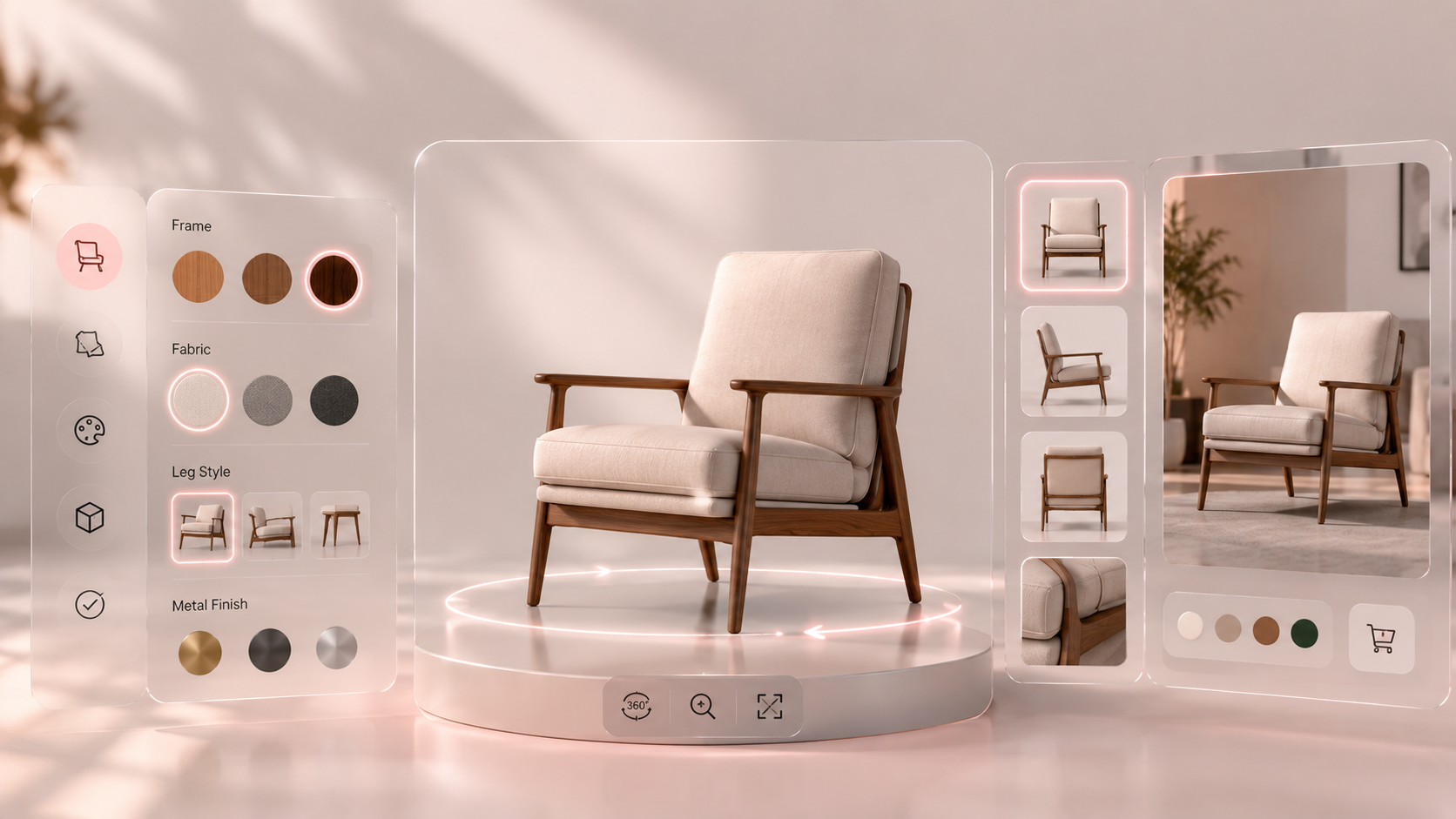
A 3D product configurator is an interactive tool that lets customers customize a product - changing colours, materials, sizes, components, or finishes - and see those changes update in photorealistic 3D in real time, directly on a product page. Instead of choosing from a dropdown and hoping the result looks right, customers interact with an accurate 3D model of exactly the product they are building.
Shopify data shows a 40% increase in conversion rates for products with 3D visualization versus standard images. For brands selling customizable or complex products, that is not a marginal improvement. It is a structural change in how customers experience and decide on a purchase.
This guide explains exactly what a 3D product configurator is, how it works, what it does to conversion and returns, and which product categories benefit most.The
Problem It Solves
Online shopping has a fundamental limitation: customers cannot interact with what they are buying. They see a product in one colour, in one configuration, from one or two angles. If they want it in a different colour, they click a swatch and hope the product image updates to something close. If they want to know what a leather sofa looks like in dark walnut and ivory fabric together, they might find a lifestyle photograph - or they might not.
This uncertainty is expensive for brands. Customers who are not confident about what they are getting either abandon the purchase or place an order and return the product when it does not match what they imagined.A 3D product configurator eliminates this by making the product page interactive. Customers become active participants - building the exact version of the product they want, seeing it update in real time, inspecting it from every angle, and placing the order for exactly what they have designed.
The outcome is a fundamentally different kind of purchase: one where the customer has seen what they are getting before they buy it.
How a 3D Product Configurator Works
The technology behind a 3D configurator combines three components working together:
1. High-fidelity 3D models. The product is digitised as a 3D model - a precise virtual representation including geometry, texture, material properties, and lighting response. A well-made 3D model shows polycarbonate shell texture, leather grain, fabric weave, brushed metal finish, matte paint - at a level of fidelity that photographs cannot match for every configuration variant.
2. A real-time rendering engine. When a customer selects a different colour, material, or component, the rendering engine updates the 3D model instantly - recalculating how light interacts with the new material, how the new colour reads in the current lighting, how the configuration changes the overall appearance of the product. This happens in the browser, on any device, without loading a new page.
3. A configuration rules layer. Behind the visual experience, a rules layer determines what combinations are available, how pricing updates when options change, what component combinations are valid, and what inventory is available. This is what turns a 3D viewer into a sales tool - the customer is always choosing from options the brand can actually produce.
The result: a customer can move through every available configuration of a product - seeing each option rendered accurately - and arrive at an order that precisely reflects what they designed.
The Commercial Impact - What the Data Shows
Conversion rate: up to 40% increase. Shopify's own research confirms that products with 3D visualization see up to a 40% higher conversion rate than products with standard product photography. The mechanism is straightforward: customers who can see exactly what they are ordering are more confident and more likely to complete the purchase.
Purchase confidence: 80% of shoppers report higher confidence. 3D Cloud's 2025 Furniture Shopping Trends Study found that 80% of qualified furniture shoppers said 3D product models increased their confidence in purchase decisions. Among shoppers who had used a 3D configurator specifically, the figure rose to 90%.
Return rate: up to 35–40% reduction. When customers order exactly what they configured - not an approximation - the gap between expectation and reality that drives returns closes. Brands deploying 3D configurators consistently report meaningful reduction in returns, particularly for customizable products where the customer had previously been guessing what the final product would look like.
Average order value: increases through premium option selection. When customers can see premium material options rendered accurately - comparing standard fabric against premium leather, or matte finish against gloss - they make more informed decisions and frequently select higher-value configurations. The configurator makes the premium option visible rather than a leap of faith.
Session time: longer engagement. Interactive experiences keep customers on product pages longer than static images. Customers exploring a configurator are engaged in the purchase decision - testing options, comparing combinations, building the product to their specification. This active engagement is a strong predictor of purchase completion.
Why It Works: The Psychology Behind Configurators
Three psychological mechanisms explain why 3D product configurators drive conversion more effectively than standard product pages:
1. The endowment effect. When customers invest time building a custom configuration - choosing the colour, the material, the finish - they develop a sense of ownership over the result before they have paid for it. Research in behavioural economics shows that people place higher value on things they feel ownership over. A customer who has designed their own sofa configuration is psychologically more attached to completing that purchase than a customer who has browsed a pre-styled product listing.
2. Reduction of uncertainty. The primary reason customers abandon purchases without buying is uncertainty about the product - whether it looks right, whether the colour matches their expectations, whether it fits their space. A 3D configurator directly addresses each of these by giving the customer complete visual information about the exact product they are ordering. Less uncertainty means more purchases.
3. Sense of control. Customers who feel in control of a purchase make more confident decisions. A configurator gives customers agency - they are not choosing from what the brand has already decided looks good together, they are building what works for them. That agency translates into purchase confidence.
What Products Benefit Most From a 3D Configurator
Not every product needs a configurator. The investment pays off most clearly in specific product types:
Furniture and home decor - The highest-impact category. Furniture is expensive, purchased infrequently, and extremely difficult to visualize accurately from photography. Customers choosing between oak and walnut finish, between fabric and leather upholstery, between different sizes - all benefit directly from seeing the accurate 3D result. Combined with AR room placement (placing the configured furniture in the customer's actual room), the conversion impact is among the highest of any product category.GlamAR's 3D configurator is deployed for furniture brands, enabling customers to customize materials, colours, and finishes in real time with a 360° view and optional AR room placement.
Eyewear - Frame colour, lens tint, temple material, and size configuration. Customers choosing eyewear online face significant uncertainty about how a frame will look on their face in different colours. A configurator that lets them change frame colour and see the accurate result - combined with AR face try-on - removes the guesswork that drives eyewear returns.
Jewellery - Metal type, stone selection, band width, engraving options. Custom jewellery purchases - engagement rings, anniversary pieces, bespoke gifts - are high-value and high-consideration. A configurator that renders each combination accurately, showing how diamond cut interacts with metal choice and band style, gives customers the visual certainty they need to commit to a significant purchase. Brands using jewellery configurators report up to 35% reduction in returns and meaningful increases in conversions.
Fashion and accessories - Shoe colourways, bag materials and hardware, clothing fabric and trim options. Nike's "Nike By You" platform - one of the most well-known product configurators in consumer retail - lets customers design custom sneakers with complete control over materials, colours, and personalization. The configurator experience is a core part of Nike's DTC strategy, turning product customization into a creative engagement that drives both conversion and brand loyalty.
Automotive - BMW's configurator is the benchmark for the category - letting customers specify exterior colour, wheels, interior trim, and features with photorealistic 3D rendering, extended by AR visualization that places the configured vehicle in the customer's real environment at full scale. The automotive category is the originator of mass-market product configurators, and its influence on furniture, fashion, and consumer electronics is direct.
B2B and industrial products - Complex products with many configuration options - manufacturing equipment, custom furniture for commercial spaces, technical components - have historically required lengthy back-and-forth with sales teams to specify correctly. A 3D configurator that lets B2B buyers configure their requirements and generates an accurate visual and automatic pricing eliminates that sales cycle friction. Industrial configurator deployments have reduced quote-to-order sales cycles from weeks to minutes.
3D Configurator vs. Static Product Images - A Direct Comparison
3D Configurator + AR Room Placement: The Combination That Moves Furniture and Home Decor
For furniture and home decor brands specifically, the 3D configurator is most powerful when combined with AR room placement - the ability to place the configured product in the customer's actual physical environment.
The customer designs their sofa configuration (fabric, colour, size, leg finish). They then tap "View in My Room" and place the configured sofa on the floor of their living room through their phone camera. They see it at true-to-life scale, in their actual space, in the exact configuration they built.
This combination - configure then place - addresses every major uncertainty that prevents furniture purchase online: appearance uncertainty (the 3D model shows the accurate colour and material), size uncertainty (AR room placement shows the actual dimensions in the customer's space), and style uncertainty (the customer can see whether it works with their existing decor).
GlamAR's platform combines 3D configurator, 360° product viewer, and AR room placement in one integration. Brands deploy all three from a single set of 3D assets - the same model that powers the configurator also powers the 360° viewer and the AR room placement, with no additional assets required.
How to Get Started With a 3D Product Configurator
Step 1: Define your configuration options - Before any technical work, map out what customers can actually configure. Colours, materials, sizes, components, finishes, personalisation text - list every option available for each product you want to configure. This becomes the specification for both the 3D model build and the rules layer.
Step 2: Identify your priority SKUs - Start with your highest-revenue or highest-return products. Configurators have the most commercial impact on products where configuration options are important to the purchase decision and where return rates are currently high.
Step 3: Get your 3D models built - 3D models for a configurator need to support all configuration variants from a single model - the renderer changes material and colour properties on the base model rather than loading separate models for each variant. This requires professional 3D model creation with configurator-ready asset structure. GlamAR includes 3D model creation as part of configurator onboarding, building models from product photography or CAD files.
Step 4: Choose your integration path -
- Shopify brands: GlamAR's Shopify visual product configurator deploys via the Shopify app with minimal developer involvement
- Magento brands: GlamAR's Magento visual product configurator integrates directly with Magento storefronts
- Custom builds: The GlamAR Web SDK allows configurator integration into any custom-built storefront with a 2–3 line embed
Step 5: Enable optional AR room placement - For furniture, home decor, and large accessories where size in the customer's space is a key concern, enable AR room placement alongside the configurator. GlamAR supports this from the same 3D assets - no additional model building required.
Step 6: Measure the right metrics after launch -
- Configuration engagement rate: What percentage of product page visitors interact with the configurator?
- Configuration completion rate: What percentage of customers who start configuring complete a configuration?
- Conversion rate: configurator users vs. non-users
- Average order value: configurator orders vs. standard orders
- Return rate: configured purchases vs. non-configured
Brands Already Using 3D Product Configurators
Nike - Nike By You - Nike's custom sneaker configurator lets customers design shoes with full control over material, colour, and personalisation. Once a configuration is complete, Nike automatically updates all product images on the page to show the exact chosen configuration. Customers can save multiple designs and compare them - turning customization into an ongoing creative engagement that drives both conversion and repeat visits.
BMW - BMW's vehicle configurator is the most advanced example in consumer retail - full 3D rendering of every colour, trim, and feature combination, extended by AR technology that places the configured vehicle in the customer's real environment at full scale. The configurator handles the complete specification and pricing process, reducing dealership dependency for configuration-stage decisions.
IKEA - IKEA Place combines 3D product visualization with AR room placement - letting customers configure furniture colour and finish options and place the result in their actual room. Originally launched as a standalone app, the technology is now integrated into IKEA's main e-commerce experience across markets.
Fender (Mod Shop) - Fender's guitar configurator lets musicians design custom instruments - body colour, neck profile, pickups, pickguard, and hardware - with full 3D rendering of each combination. The Mod Shop demonstrates that configurators work beyond traditional home and fashion categories, applicable wherever product customization is part of the brand's offering.
Conclusion
A 3D product configurator changes the product page from a static display into an active sales tool. Customers who configure their exact product are more confident, more attached to their choice, and significantly more likely to complete the purchase. The data is consistent: up to 40% higher conversion, up to 35% fewer returns, and higher average order value as customers select premium configurations they can actually see.
For brands selling customizable products - furniture, eyewear, jewellery, fashion, accessories, or any product where colour, material, or feature choice matters to the purchase decision - a 3D configurator is not a premium add-on. It is the most direct available investment in conversion rate and return rate simultaneously.
GlamAR's 3D product configurator supports colour, material, and finish configuration with 360° viewing, optional AR room placement, and 3D model creation included - deployable on Shopify, Magento, and custom storefronts.
Explore the 3D configurator solution page or contact the GlamAR team to discuss implementation for your product catalogue.
A 3D product configurator is an interactive tool embedded in a product page that lets customers customize a product - changing colours, materials, sizes, components, or finishes - and see those changes rendered accurately in 3D in real time. Instead of browsing static images for each variant, customers build the exact version of the product they want and see a photorealistic preview of the result before placing their order.
A 3D configurator increases conversions by reducing purchase uncertainty. Customers who can see exactly what they are ordering - in their chosen configuration, from every angle - are more confident in completing the purchase. Shopify data shows a 40% conversion rate increase for products with 3D visualization versus standard images. The configurator also creates the endowment effect: customers who have invested time building a configuration feel ownership over the result and are more motivated to complete the purchase.
Returns happen when the product a customer receives does not match what they expected based on the product listing. A 3D configurator eliminates this gap by showing the accurate 3D rendering of the exact configuration the customer is ordering. There are no surprises about colour, material, or appearance - the customer has already seen the exact product. Configurator deployments consistently report 35–40% reduction in returns for configured products.
The categories with the highest impact are furniture and home decor (where colour, material, and size configuration is central to the decision), jewellery (where metal type, stone selection, and design elements combine in complex ways), eyewear (where frame colour and material matter significantly), fashion and footwear (where colour and material customization drives engagement), and B2B industrial products (where configuration complexity previously required lengthy manual quoting processes).
A 360° product viewer lets customers rotate and zoom a product in 3D - but the product itself is fixed. It is a better way to display a product as it exists. A 3D configurator goes further: it lets customers change the product - selecting different colours, materials, or features - and see those changes rendered in real time. Both tools use 3D models, but the configurator adds interactive customization on top of the 3D viewing experience.
Yes. GlamAR's 3D product configurator supports colour, material, and finish customization with real-time 3D rendering, 360° product viewing, and optional AR room placement - all from a single set of 3D assets. It is available for Shopify (via the GlamAR Shopify app), Magento (via the Magento visual configurator), and custom storefronts (via the GlamAR Web SDK). 3D model creation is included as part of onboarding. See the 3D configurator solution page for details or contact the team to discuss your specific products and integration requirements.
Discover how AR, VR and 3D can drive revenue growth in 2026
Schedule a call with our team

.avif)