
Come l'analisi della pelle di AI gestisce diversi toni della pelle - un aspetto tecnico


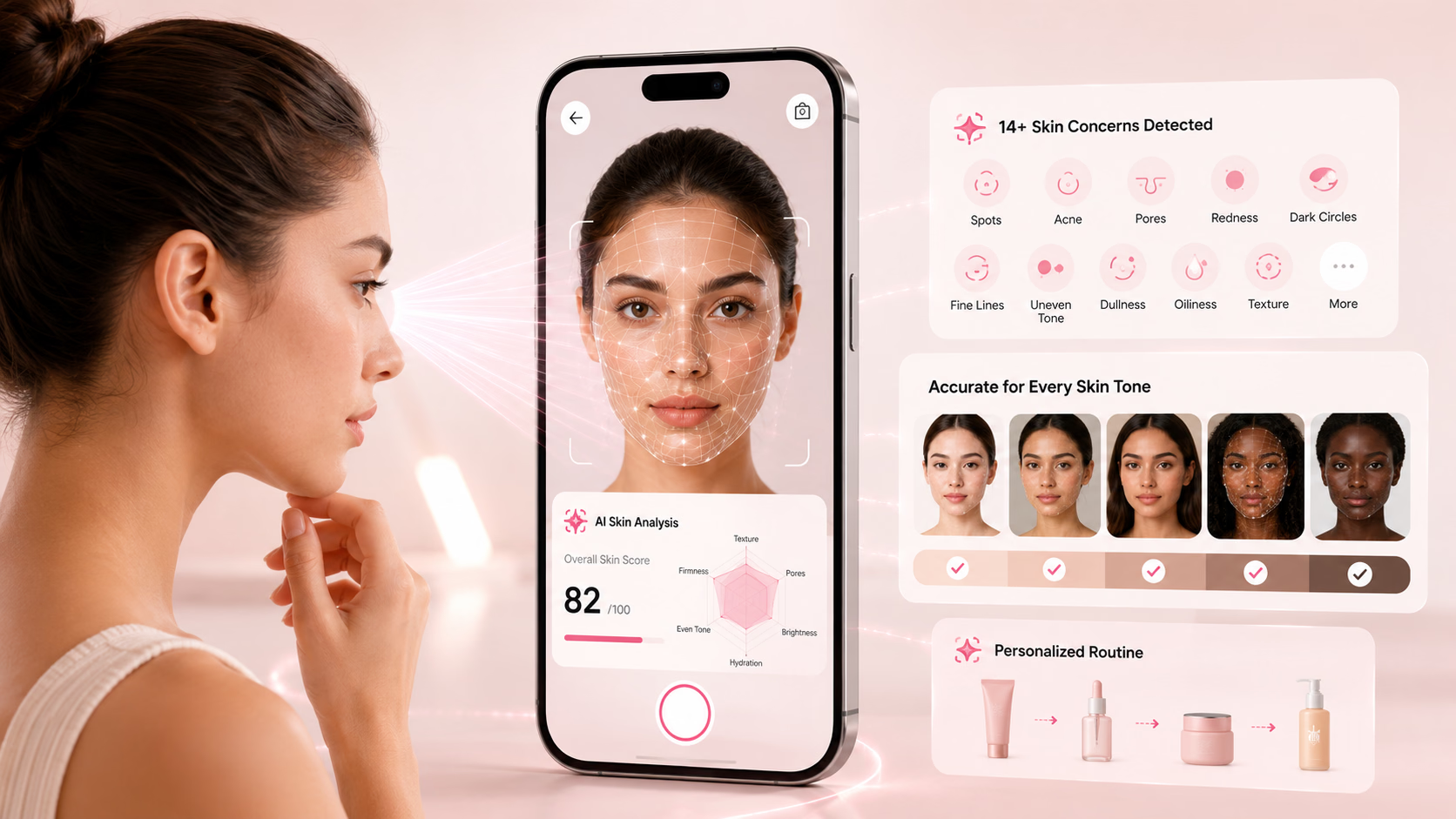
AI skin analysis handles different skin tones well when the underlying model has been trained on genuinely diverse data - and poorly when it hasn't. For beauty brands, this is not an abstract technical problem. It is a commercial and reputational one. A skin analysis tool that gives inaccurate results for darker skin tones will recommend the wrong products to a significant portion of your customers. That drives returns, erodes trust, and signals that your brand does not understand its own audience.
This article explains exactly how AI skin analysis works, why skin tone creates specific technical challenges, what the research says about where current tools succeed and fail, and what to look for when choosing a provider.
What AI Skin Analysis Actually Does
Before getting into skin tone specifically, it helps to understand how the technology works at a basic level.
When a customer takes a selfie or opens their camera for a live scan, the AI system does three things in sequence:
1. It detects and maps the face. The AI identifies the face in the image and maps specific landmark points - the position of eyes, nose, mouth, cheekbones, jawline, forehead. This gives the system a spatial reference so it knows where on the face to look for specific conditions. This step uses a technology called computer vision, which is the same category of AI that allows a phone to unlock when it recognises your face.
2. It analyses the skin layer by layer. Once the face is mapped, the AI examines different areas of the skin - forehead, cheeks, nose, under-eye area, chin - and looks for specific characteristics: pore visibility, redness, pigmentation patterns, fine lines, hydration levels, acne markers. GlamAR's AI Skin Analysis detects 14+ skin conditions in a single scan. It does this by comparing what it sees in the image against patterns learned from millions of training images.
3. It generates a report and recommendation. Based on what it detects, the system produces a skin score, identifies the customer's skin type (oily, dry, combination, sensitive), and maps to their skin tone category. It then links those findings to product recommendations from your brand's catalogue.All of this happens within seconds, on a standard smartphone camera, with no specialist hardware required.
Why Skin Tone Makes This Technically Harder
Skin tone affects how AI reads skin in three specific ways. Understanding each one explains why not all skin analysis tools perform equally across the range of skin tones.
1. Melanin changes how the camera sees the skin
Melanin is the pigment that gives skin its colour. Darker skin tones have more melanin, which absorbs more light and reflects less back to the camera. This creates a fundamentally different image signal compared to lighter skin tones, which reflect more light and tend to produce higher-contrast images of surface features.
In practical terms: fine lines, pores, and uneven texture are easier to detect in high-contrast images. On darker skin, the reduced contrast between features and background skin makes these details harder for a camera to pick up and harder for an AI to reliably identify. An AI trained primarily on lighter skin images will have learned to detect these features from high-contrast visual signals - and will struggle when that contrast is reduced.
2. Skin conditions look visually different across skin tones
Redness is one of the most common skin concern markers. On fair skin, redness appears as a visible pinkish or red discolouration. On darker skin, the same level of inflammation or irritation may not appear as redness at all - it shows up as deepening of the skin's natural tone, subtle discolouration, or post-inflammatory hyperpigmentation (dark spots that appear after a blemish or irritation heals).
An AI model that has learned to identify redness from the visual signal of pink or red patches will simply miss it on darker skin. It will report no redness not because the skin has no irritation but because the AI has not learned what irritation looks like at darker Fitzpatrick types.
The same problem applies across other conditions:
- Acne: On lighter skin, active acne shows as red inflammation. On darker skin, it often presents as dark spots with less surface redness
- Hyperpigmentation: Melanin-rich skin produces more post-inflammatory pigmentation after any skin trauma - blemishes, friction, sun damage - and this manifests differently visually than pigmentation on lighter skin
- Uneven skin tone: The definition of "uneven" itself depends on the baseline expectation for that skin tone - a model trained without adequate diverse representation may flag natural characteristics of darker skin as conditions rather than normal variation
3. Lighting affects dark skin more severely
Photography of darker skin tones is technically more demanding. In lower-light conditions, a camera captures less reflected light from darker skin, which reduces image quality and increases the likelihood of the AI misidentifying or missing features entirely. An AI trained without images captured under varied lighting conditions will have inconsistent accuracy depending on where and how the customer uses the tool.
This matters practically because customers use skin analysis tools in their bathrooms, at their desks, on their phones, in all kinds of lighting - not in controlled studio conditions. A robust system needs to handle real-world variation.
The Training Data Problem - And Why It Matters
The core reason many AI skin analysis tools underperform for darker skin tones comes down to one thing: training data.AI models learn by example. They are shown millions of images of skin, with labels telling them what they are seeing - "this is a pore," "this is acne," "this is hyperpigmentation." The quality and diversity of those examples directly determines what the model learns to recognise accurately.
Research published in the Journal of the European Academy of Dermatology and Venereology found that leading AI models significantly underrepresented dark skin in their outputs - across 4,000 AI-generated dermatological images, only 10.2% reflected dark skin. A 2025 narrative review in Cureus concluded that AI models demonstrate lower accuracy in recognising skin conditions in darker skin tones (Fitzpatrick types IV-VI) across the majority of studies reviewed.
The widely used ISIC dermatology dataset - one of the most common training sources in skin AI - has over 70% of its images depicting light skin and fewer than 8% depicting darker skin tones.
For a beauty brand, this has a direct commercial implication: if the skin analysis tool you offer to customers has been trained on a dataset that looks like this, it will systematically give less accurate results to customers with darker skin tones. Those customers will receive product recommendations that do not match their skin situation, and they will not come back.
The Fitzpatrick Scale - The Standard for Skin Tone Classification
Most AI skin analysis systems use the Fitzpatrick Scale as the framework for classifying skin tone. It is worth understanding what this is, because it affects how the AI categorises your customers.
The Fitzpatrick Scale was developed by dermatologist Dr. Thomas Fitzpatrick in 1975 to classify how skin responds to UV exposure. It defines six skin types:
Fitzpatrick TypeDescriptionSun reactionType IVery fair, often frecklesAlways burns, never tansType IIFairUsually burns, sometimes tansType IIIMediumSometimes burns, gradually tansType IVOlive/light brownRarely burns, always tansType VBrownVery rarely burns, tans easilyType VIDeep brown/blackNever burns, deeply pigmented
The scale was originally designed for dermatological and medical use - specifically to determine laser therapy settings and assess skin cancer risk. It was not designed as a comprehensive beauty tool, and it has limitations when applied to cosmetic skin analysis: it captures six broad categories where the real-world spectrum of human skin tones is far more continuous.
More recent frameworks, like the Monk Skin Tone Scale (developed with Google and released as open-source in 2022), extend to 10 tones and are designed specifically for technology applications. Some AI systems are beginning to adopt broader scale frameworks for more granular and inclusive skin tone detection.
GlamAR's AI Skin Analysis for skin tone detects and classifies across six skin tone categories - fair, light, medium, olive, tan, and deep - matching the core Fitzpatrick framework, and is designed to provide accurate skin reports and product recommendations across that full range. The model is trained on a geographically diverse dataset covering many skin tones and ethnicities.
How Good AI Skin Analysis Handles Skin Tone Accurately
The technical approaches that produce accurate results across the full skin tone spectrum share several characteristics:
Diverse, geographically representative training data
The most impactful factor. A model trained on skin images from diverse populations - across skin tones, ethnicities, geographies, ages, and genders - will learn to recognise conditions as they actually present on each skin type, not as they present on the majority demographic in the training set.
GlamAR's AI Skin Analysis model is rebuilt with an EfficientNetB0 backbone and trained on a geographically diverse dataset covering many skin tones and ethnicities, with specific attention to smarter region-wise skin type classification across T-zone, U-zone, and full face - delivering more precise and personalised results across the skin tone spectrum.
Lighting variation augmentation
Rather than training only on studio-quality images, robust models include training images captured under varied and imperfect lighting conditions. This teaches the model to correctly identify skin features even when the image is not optimally lit - which is most of the time in real consumer use.
Melanin-aware feature detection
Instead of relying purely on colour contrast signals (which are reduced in darker skin), advanced models incorporate melanin index analysis - looking directly at melanin distribution rather than simply at surface colour variation. This allows the model to detect features that are present in the skin even when they do not produce a high-contrast visual signal in a standard photograph.
Condition-specific recalibration
Because conditions look different on different skin tones, good models are not trained on a single set of condition definitions applied uniformly. They are trained with condition-specific examples across skin types - learning that acne on Fitzpatrick Type VI looks different from acne on Fitzpatrick Type II, and that both representations of acne are valid and should be correctly identified.
What to Ask Your AI Skin Analysis Provider
If you are evaluating AI skin analysis tools for your brand, the skin tone accuracy question should be central to that evaluation. Here are the specific questions to ask:
1. What is the Fitzpatrick or skin tone distribution of your training data? A provider that cannot tell you the answer to this question has not prioritised skin tone diversity in their model development. A good answer includes a specific breakdown - percentage of training images across Fitzpatrick types, and whether the data includes geographically diverse populations.
2. How does the model perform on Fitzpatrick Type IV, V, and VI specifically? Ask for accuracy metrics stratified by skin tone, not just an overall accuracy figure. A model with 92% overall accuracy that performs at 70% accuracy for darker skin tones is not serving a significant portion of your customer base adequately.
3. Has the model been tested with lighting variation? Ask whether accuracy data has been tested under varied lighting conditions, not just controlled environments.
4. How often is the model retrained, and is skin tone diversity part of the retraining criteria? Skin analysis models should be continuously improved. A provider that retrained once two years ago is not keeping pace with improvements in inclusive AI.
5. Can I test it on my own team's skin tones before deployment? Before deploying to your customers, run the tool across a team that includes diverse skin tones. Test the analysis outputs for accuracy, relevance of condition identification, and quality of product recommendations. If the results are inconsistent or clearly less accurate for certain skin tones, that will be the customer experience too.
What This Means for Your Brand
For beauty brands, AI skin analysis is only as valuable as its accuracy across your actual customer base. If your customers span a range of skin tones - and for any brand targeting global markets, especially the Middle East, Africa, South Asia, and Southeast Asia, they do - then skin tone accuracy is not a nice-to-have. It is the baseline requirement for the tool to deliver commercial value.
The good news is that the technical problem is solvable. The same AI approaches that produce accurate results for lighter skin tones produce accurate results for darker skin tones when the training data is diverse and the model is built with that goal in mind. The question is whether the provider you choose has made that investment.
GlamAR's AI Skin Analysis is designed with geographic diversity and skin tone accuracy as core requirements - trained on geographically diverse data, built with a significant reduction in false positives, and regularly updated to improve accuracy across the full range of skin tones GlamAR's global customer base spans.
To see the skin analysis in action across different skin tones, try the live AI Skin Analysis demo or contact the GlamAR team to discuss how it performs for your specific audience.
Related reading:
- AI Skin Analysis for skin tone - detect and classify your customers' skin tone in real time
- SkinGPT for beauty brands - what it is, how it works, and why it converts
- Best AI skin analysis tools for skincare brands in 2026
- AI skin analysis for pigmentation - how it works
- AR Try-On for Middle East E-Commerce: What Retailers Are Doing Differently in 2026
Ready to offer accurate skin analysis across all skin tones? Talk to the GlamAR team or try the live demo.










