


SkinGPT for Beauty Brands: What It Is, How It Works, and Why It Converts


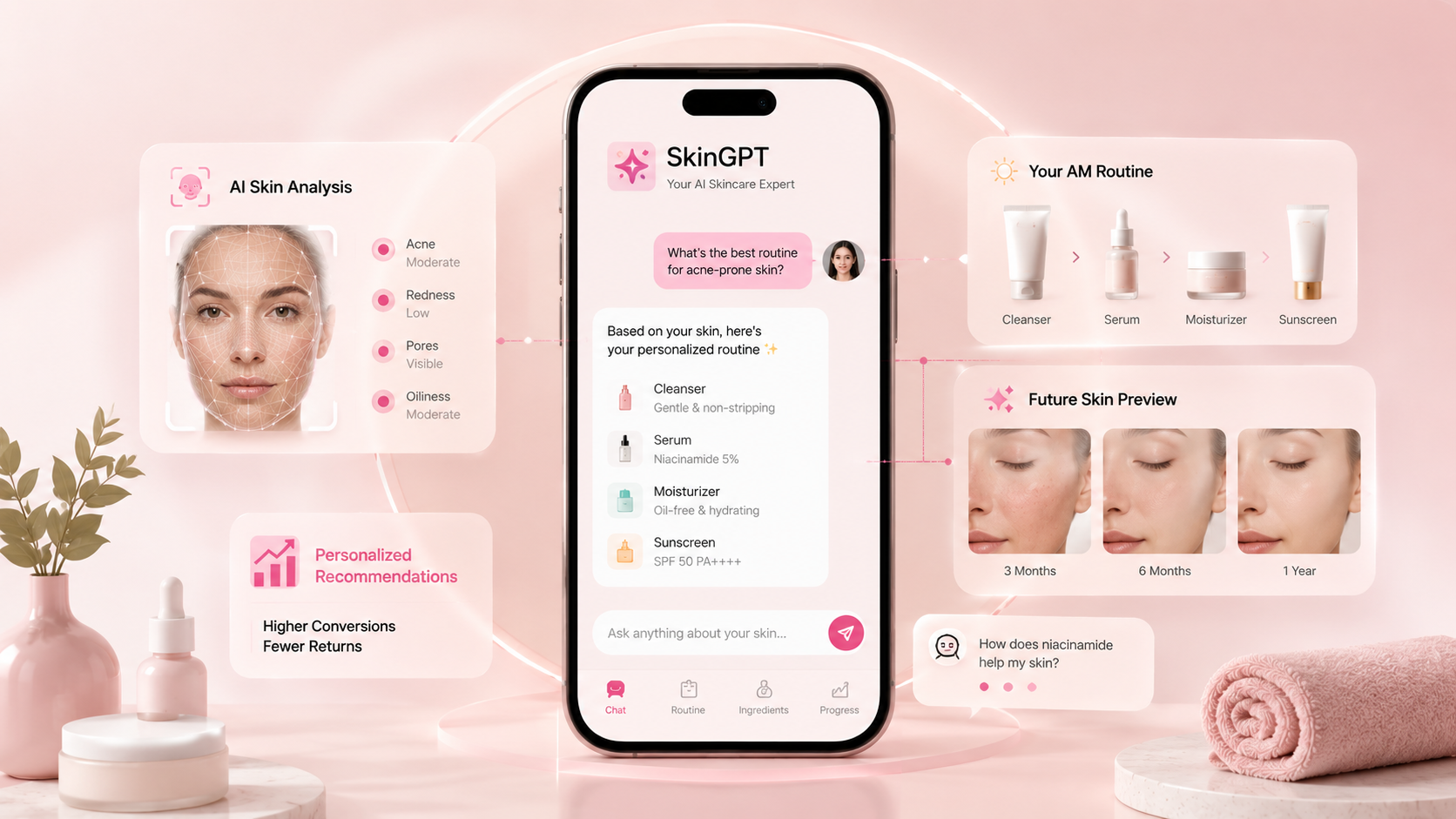
SkinGPT is an AI-powered skincare chatbot that beauty brands embed into their website or app to give customers personalized skincare routines, product recommendations, and ingredient explanations, through a real-time conversation. It turns a static product catalogue into an interactive, personalized skincare consultation that runs 24/7 without a human on the other end.
This guide explains exactly what SkinGPT does, how it works, what it delivers for beauty brands, and how to decide if it's right for your platform.
The Problem SkinGPT Solves
Most beauty brand websites have the same fundamental problem: customers land on a product page, see a list of ingredients and marketing claims, and have no reliable way to know if that product is right for their specific skin.
The result is predictable:
- Customers buy the wrong products and return them
- Customers don't buy at all because they're unsure
- Customers buy once, get disappointing results because the product didn't suit their skin, and don't come back
The traditional solution is a quiz - a static set of questions that places customers into broad skin type categories and recommends a fixed set of products. But quizzes don't answer follow-up questions. They don't explain why a product was recommended. They can't adjust if the customer says "I'm also dealing with sensitivity." And they go stale the moment a customer's skin condition changes.
SkinGPT is the conversational replacement for the skincare quiz. It reads each customer's actual situation and responds in real time, adapting to follow-up questions, explaining product ingredients on demand, and building a customized AM/PM routine that reflects the customer's specific skin goals.
What SkinGPT Actually Does
1. Conversational skin consultation
SkinGPT opens a conversation with the customer, asking about their skin type, concerns, environment, lifestyle, and goals. It's not a fixed questionnaire. The conversation adapts based on what the customer says. If they mention sensitivity, SkinGPT adjusts. If they ask about a specific ingredient, it answers. If they want to know whether two products can be layered together, it explains.
This conversational format does something static quizzes can't: it builds the kind of trust that leads to purchase. Customers who understand why a product is recommended for their skin are more likely to buy it and less likely to return it.
2. Personalized product recommendations
Based on the conversation, SkinGPT recommends products from your brand's own catalogue, not generic suggestions from a universal database. You configure it with your product range, and SkinGPT maps each customer's skin profile to the right products from what you actually sell.
This is a direct sales mechanism. Every recommendation is a link to a product on your platform. Every confident recommendation from a trusted source is a conversion opportunity.
3. AM/PM routine building
Customers can ask SkinGPT to build them a morning and evening skincare routine using your brand's products. SkinGPT sequences the products correctly, cleanser before toner, vitamin C in the morning, retinol at night, and explains the reasoning behind the order. Customers who understand their routine stick to it, see results, and come back to repurchase.
4. Ingredient education
One of the most frequent barriers to skincare purchase is ingredient anxiety, customers who don't know what niacinamide, hyaluronic acid, or AHA does, and whether it's right for their skin. SkinGPT answers these questions in plain language, in the moment, without the customer having to leave your site to search.
This matters for conversion: a customer who understands what they're buying and why it's suitable for them is significantly more likely to complete the purchase than one left to guess.
5. Future skin simulations
SkinGPT can show customers an AI-generated simulation of how their skin could look if they follow the recommended routine consistently, at 3 months, 6 months, and 1 year. This is a powerful conversion tool because it makes the outcome of the product purchase visible before the customer has spent anything. They're not just buying a product, they're buying a predicted result they can see.
6. Scan data integration
When used alongside GlamAR's AI Facial Skin Analysis tool, SkinGPT reads the customer's actual scan results -the 14+ skin conditions detected through the live camera scan, and uses that data as the foundation for its recommendations. Instead of asking the customer to self-report their skin type (which is often inaccurate), SkinGPT starts from real skin data.
SkinGPT vs. a Skincare Quiz: The Key Differences
What SkinGPT Delivers for Beauty Brands
Higher conversion on product pages
Customers who receive a personalized product recommendation through a conversation convert at meaningfully higher rates than those browsing generic product listings. The recommendation creates confidence, they know this product was suggested for their specific skin, not just the best-selling option.
Lower return rates
Returns in skincare happen when customers buy the wrong product for their skin, the wrong formula for their skin type, an ingredient that conflicts with an existing condition, or a product that doesn't address the concern they actually have. SkinGPT reduces these mismatches before purchase. Customers who understand exactly what they're buying and why return less.
First-party customer data
Every SkinGPT conversation is a consented data collection event. Customers share their skin type, concerns, routines, goals, and preferences through the conversation. With the customer's consent, this data flows back to your brand, giving you a detailed understanding of your customer base that purchase history alone can't provide.This first-party data is increasingly valuable as third-party cookies disappear. Brands that build direct insight into their customers' skincare needs through tools like SkinGPT are building a data asset that compounds over time.
Reduced customer service load
"Which product is right for my combination skin?", "Can I use this with retinol?", "I have sensitive skin, will this irritate me?" - SkinGPT handles all of these at scale, 24 hours a day, without a human support agent. Brands that deploy SkinGPT consistently report a reduction in skincare-related customer service queries because customers get their answers through the chatbot before they need to contact support.
Customizable to your brand tone
SkinGPT's conversational tone is configurable. You can set it to match your brand voice - clinical and precise, warm and approachable, or educational. You can also upload your brand's own FAQ content so SkinGPT answers brand-specific questions accurately rather than giving generic responses.
How SkinGPT Works With GlamAR's AI Skin Analysis
SkinGPT and GlamAR's AI Facial Skin Analysis are designed to work together as a complete personalisation stack:
Step 1: The customer takes a live skin scan through their device camera. GlamAR's AI Skin Analysis detects 14+ skin conditions - acne, pigmentation, dark circles, pores, dryness, wrinkles, and more - and generates a skin report in seconds.
Step 2: The customer's scan data is passed to SkinGPT (with their consent). SkinGPT uses the actual detected conditions as the starting point for the conversation - rather than asking the customer to self-report what they think their skin type is.
Step 3: SkinGPT opens a conversation based on the scan results. It might ask: "I can see you're dealing with some pigmentation around your cheeks and mild dehydration. Are you looking to focus on brightening, or would you like a routine that addresses both?" The conversation continues from there.
Step 4: SkinGPT recommends specific products from your catalogue, builds an AM/PM routine, explains the ingredients, and optionally shows the customer a future skin simulation based on consistent use.This combined flow - scan, chat, recommend, simulate - is significantly more powerful than either tool used alone. The scan provides objective data. SkinGPT turns that data into a conversation the customer actually finds helpful.
Who SkinGPT Is For
Skincare brands with a range of products across different skin concerns - SkinGPT can map a complex product catalogue to individual customers accurately, making it easier for customers to find the right products without needing to browse everything.
D2C beauty brands looking to reduce returns and increase repeat purchases - SkinGPT's personalized recommendations create customers who understand their routine, stick to it, and come back for replenishment.
Beauty retailers carrying multiple brands - SkinGPT can be configured to recommend across a multi-brand catalogue, helping customers find the right product regardless of which brand makes it.
Clinics and dermatology platforms - SkinGPT can be deployed in clinical settings to provide patients with skincare education and pre-consultation information, reducing consultation time and improving patient preparation.
How to Deploy SkinGPT on Your Platform
Step 1: Connect your product catalogue SkinGPT is configured with your product range — SKUs, product descriptions, key ingredients, skin concerns each product addresses. This is the foundation of its recommendation engine. Accurate, complete product data produces more accurate recommendations.
Step 2: Upload your brand FAQs and configure tone. Add your brand's frequently asked questions and set the chatbot's conversational tone to match your brand voice. This ensures SkinGPT gives brand-consistent responses, not generic answers.
Step 3: Decide where SkinGPT appears on your platform. SkinGPT can appear as a floating chat widget across your site, as an embedded experience on specific pages (skincare quiz page, product category pages), or as part of a dedicated "Skin Consultation" flow. The placement that drives most engagement is typically a prominent "Get Your Skin Routine" entry point on the homepage or skincare category page.
Step 4: Integrate with AI Skin Analysis (optional but recommended). Connect the skin scan experience to SkinGPT so that scan data informs the conversation from the start. This integration removes the self-reporting step and makes the recommendations more accurate.
Step 5: Configure consent and data collection. Set up the consent flow so customers can choose to share their scan data and conversation data with your brand. This data flows into your CRM or analytics platform for use in segmentation and personalised marketing.
Step 6: Track the right metrics after launch
- Chatbot engagement rate - what percentage of site visitors open a SkinGPT conversation?
- Conversation completion rate - what percentage of opened conversations reach a product recommendation?
- Conversion rate: SkinGPT users vs. non-users - the primary ROI metric
- Return rate: SkinGPT-assisted purchases vs. unassisted - measures quality of purchase decisions
- Customer service query volume - track the reduction in skincare-related support tickets
Conclusion
Generic skincare recommendations - one-size-fits-all quizzes, best-seller lists, and editorial edits - are losing ground to personalization. Customers now expect to be understood as individuals, not assigned to a skin type category and handed a fixed product list.
SkinGPT delivers personalization at scale. Every customer gets a conversation that responds to their actual skin situation, recommends products from your catalogue that are genuinely suited to their needs, explains the reasoning behind those recommendations, and can show them what consistent use could look like over time.
The brands that build this kind of personalized experience are the ones building customer relationships that go beyond a single transaction. Customers who trust that a brand understands their skin come back - for replenishment, for new launches, and for the next concern they want to address.
To see SkinGPT in action or talk through how it could work with your product catalogue, contact the GlamAR team or explore the AI Skin Analysis demo to see the scan and chatbot experience firsthand.
Related reading:
- AI facial skin analysis — how it works for beauty brands
- How Foxtale increased conversion rate using AI facial skin analysis
- Best AI skin analysis tools for skincare brands in 2026
- 5 best AI customized skincare recommendation software for beauty ecommerce
Ready to add SkinGPT to your platform? Talk to the GlamAR team.
SkinGPT is an AI-powered skincare chatbot developed by GlamAR. It provides beauty brand customers with personalized skincare routines, product recommendations, ingredient explanations, and future skin simulations through a real-time conversation, embedded directly in a brand's website or app.
Yes. SkinGPT can operate as a standalone chatbot, gathering skin information through conversation questions. However, it works most accurately when integrated with GlamAR's AI Facial Skin Analysis, the scan provides objective skin condition data that replaces self-reporting and produces more accurate recommendations.
Yes. SkinGPT is configured with your brand's product range and maps recommendations specifically to products you sell, not a generic third-party database. This makes every recommendation a direct sales opportunity within your own platform.
SkinGPT can handle conversations across all common skin concerns, acne, pigmentation, dryness, oiliness, sensitivity, dark circles, uneven skin tone, fine lines, enlarged pores, and more, as well as ingredient questions, routine sequencing, and product layering queries.
SkinGPT operates with explicit customer consent for data collection. Customers choose whether to share their scan data and conversation data. GlamAR is SOC2, GDPR, and ISO certified, data handling meets enterprise-grade security standards. Customers should always review the brand's own privacy policy for specifics on data retention and use.
Deployment timeline depends on the complexity of your product catalogue and the integrations required. For a Shopify-based brand, GlamAR's Shopify app significantly reduces integration time. Contact the GlamAR team for a timeline specific to your platform.
Discover how AR, VR and 3D can drive revenue growth in 2026
Schedule a call with our team

.avif)