


AR Try-On for Middle East E-commerce: What Retailers Are Doing Differently in 2026


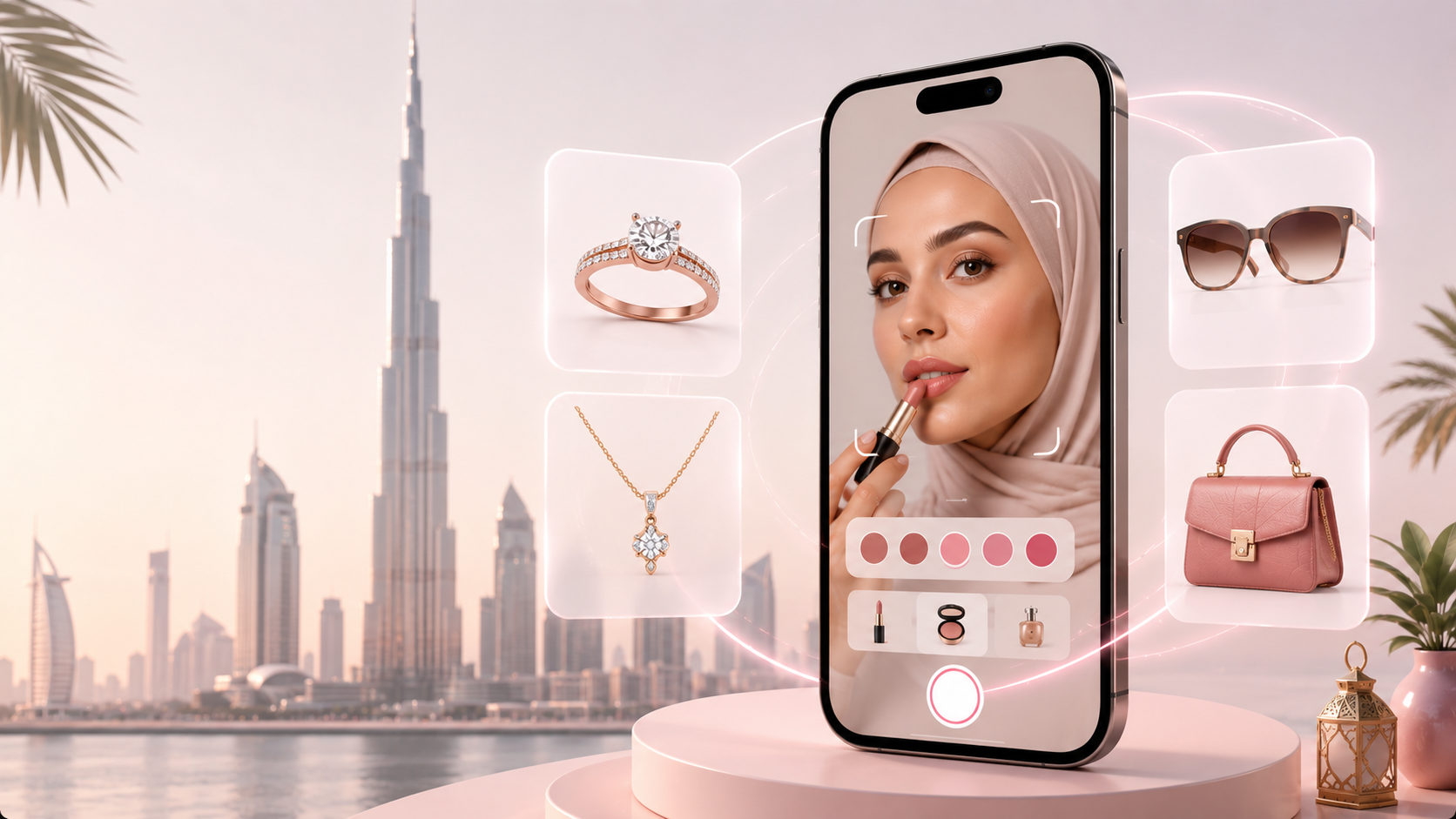
The Middle East is one of the fastest-growing e-commerce markets in the world - and it is also one of the most AR-ready consumer populations on the planet. In 2026, leading retailers across the UAE, Saudi Arabia, and the wider GCC are using AR try-on not as a novelty feature but as a core conversion tool. This article covers what is driving that adoption, which categories are leading the way, what real brands are doing, and what it means for e-commerce businesses targeting this market.
The Middle East E-Commerce Market in 2026: The Numbers
The Middle East and Africa e-commerce market was valued at USD 176.68 billion in 2026 and is projected to reach USD 338.08 billion by 2031, growing at a CAGR of 13.85%. Within that, fashion and apparel led B2C product categories with a 25.96% market share in 2025, and smartphones accounted for 71.78% of all B2C transactions.
Saudi Arabia is the single largest market. Saudi Arabia holds the largest market share, at 35%, driven by high disposable income, government digitalization initiatives, and a tech-savvy young population.
The UAE is the most technologically advanced. Dubai alone accounted for roughly 60% of UAE e-commerce in 2025, supported by 90% internet penetration and more than 100 fulfilment centres.
Three structural factors make this region specifically high-potential for AR try-on:
1. A mobile-first, camera-native consumer base. Smartphones captured 71.78% of Middle East and Africa e-commerce transactions in 2025 and are advancing at a 15.36% CAGR through 2031. Consumers in this market are already shopping on the devices that AR try-on runs on. The adoption barrier that exists in less mobile-dominant markets is structurally lower here.
2. One of the highest AR consumer readiness scores globally A joint study by Deloitte Digital and Snap found that 90% of shoppers in Saudi Arabia and 87% in the UAE say they are likely to use AR when they come across it, and nearly 3 in 4 consumers in both countries say they are willing to pay more for a product that promises the transparency AR can provide. These are among the highest AR adoption intent scores recorded globally.
3. High-value product categories where try-on directly addresses the purchase barrier The Middle East's dominant e-commerce categories - jewellery, luxury fashion, beauty, and accessories - are exactly the categories where virtual try-on has the highest commercial impact. A customer considering a luxury watch, a diamond necklace, or a high-end abaya cannot assess fit, proportion, or appearance from flat images alone. AR removes that barrier.
What Middle East Consumers Specifically Want From AR
The Deloitte and Snap research provides insight into what Middle East consumers are actually looking for when they encounter AR in retail.
Approximately 68% and 65% of shoppers in Saudi Arabia and the UAE respectively agree that AR gives them more confidence about product quality.
47% of tech-adept shoppers in Saudi Arabia already use AR to decide on their purchases.AR delivers almost twice the level of visual attention compared to its non-AR equivalent, leading to improved memory retention and more powerful brand responses from consumers.
The social dimension matters distinctively in this market. 41% of AR users in Saudi Arabia say they are more likely to share their AR try-on experience with family and friends - a word-of-mouth multiplier that is particularly significant given the role of family and community in GCC consumer decision-making.
While 94% of brands consider AR to be primarily for entertainment, only 53% of consumers in Saudi Arabia see it that way - the majority of consumers already view AR as a practical shopping tool, not a novelty. Brands that position AR try-on as a core purchase aid rather than a marketing gimmick are better aligned with what consumers actually want.
The Categories Driving AR Try-On Adoption in the Middle East
Jewellery - the highest-intent category in the region
Jewellery is the dominant AR try-on category in the Middle East. The GCC jewellery market is among the most valuable per capita in the world - gold, diamond, and luxury jewellery purchases are deeply embedded in the culture around weddings, gifting, and personal adornment.
The challenge online is acute: a diamond ring or a gold necklace is a high-commitment purchase. Price points are high. The appearance on the customer's body - how a ring looks on their finger, how a necklace falls on their collarbone - is central to the decision. Static photography cannot answer those questions.
AR virtual try-on for jewellery overlays true-to-scale 3D models of rings, necklaces, bracelets, and earrings onto the customer's hands, neck, and ears in real time. Customers can move, rotate, and zoom. They can see the sparkle of a stone under their current lighting. They can compare two designs on their own hand without visiting a physical store.The result is a purchasing dynamic that aligns with how GCC jewellery consumers actually buy - with high consideration, high engagement, and a strong preference for seeing before committing.
Beauty and skincare - fastest-growing AR category
The Middle East beauty and personal care market is set to grow from USD 31.11 billion in 2025 to USD 40.49 billion by 2030, with the e-commerce share rising even faster, fuelled by younger mobile-first consumers.
The beauty category in the Middle East has specific dynamics that make AR try-on particularly impactful:
Modest beauty conventions: A significant portion of the GCC female consumer base wears hijab. Eye makeup, eyebrows, skincare, and lip products worn under the niqab or visible above it are the primary focus of beauty investment. These are precisely the categories where AR makeup try-on - foundation matching, eyeshadow, liner, lip colour - provides the most accurate preview of the actual worn result.
Skin tone diversity: The Middle East and North Africa region encompasses a wide range of skin tones. AR skin analysis and makeup try-on that accurately accounts for skin tone differences - rather than defaulting to lighter skin-tone calibration - is a meaningful differentiator for brands targeting this market.
The halal beauty segment: The halal haircare market alone is valued at nearly USD 350 million in Saudi Arabia and around USD 300 million in the UAE. Consumers in this segment make considered, deliberate purchase decisions. The ability to try a product's appearance before committing - without physical contact - aligns with both the practical and cultural dimensions of halal beauty purchasing.
Fashion and accessories - mobile commerce leaders
Mobile transactions account for nearly 80% of total e-commerce activity in the Middle East fashion market. Fashion and apparel is the largest B2C e-commerce category in the region by market share.
The fashion category in the Middle East presents a specific challenge for online retail: clothing that includes modest fashion (abayas, kaftans, modest swimwear) is difficult to evaluate from model photography because the fit and drape on the customer's own body is the primary consideration - not how it looks on a standardized model figure.
AR clothing and accessories try-on enables customers to see how pieces look on their own body type, in their own environment, before purchasing. This directly addresses the return rate problem that all fashion e-commerce platforms experience, but which is amplified in a region where the social context of clothing choices - including modesty standards - makes returns more likely when the online purchase does not meet expectations.
Luxury goods - AR as a premium experience signal
The UAE in particular is a global luxury retail hub. Advanced augmented reality mirrors and virtual fitting rooms are enabling luxury shoppers to preview items digitally before purchasing, reducing return rates by 30% while offering the convenience that appeals to tech-savvy consumers accustomed to seamless mobile transactions.
Luxury brands across the region have recognized that AR is not just a conversion tool - it is a brand positioning signal. A brand that offers AR try-on signals modernity, technology investment, and customer-first thinking. In a luxury retail environment where brand perception drives purchase, that signal has commercial value beyond the direct conversion impact.
What Leading Brands in the Region Are Doing
Max Fashion - UAE's first generative AI try-on at scale
Max Fashion, one of the Middle East's leading value fashion retailers and part of the Landmark Group, unveiled a major AI-driven upgrade to its digital shopping experience in partnership with Google Cloud. The rollout introduced Google Cloud's Virtual Try-On API, positioning the brand among the first in the MENA region to deploy generative AI at scale to solve one of e-commerce's most persistent challenges: product fit uncertainty.
Max's deployment is significant because it is a mass-market retailer, not a luxury brand. It demonstrates that virtual try-on adoption in the Middle East is no longer confined to premium brands - it is moving into mainstream fashion retail.
Gucci - AR try-on via Snapchat in UAE and KSA
Gucci collaborated with Snapchat, allowing consumers to use Snapchat filters to virtually try on Gucci shoes, with the campaign available in the UAE and KSA alongside the UK, US, France, Italy, Australia, and Japan.
The Snapchat channel choice is strategic. On Snapchat alone, users in Saudi Arabia played with AR Lenses more than 210 million times each day in 2022 - making it one of the highest-engagement AR platforms available to reach GCC consumers.
Bvlgari and Cartier - luxury watch and jewellery try-on
Both Bvlgari and Cartier offer virtual try-on for watches and jewellery in the Middle East market - Bvlgari via QR code on their website, Cartier through wrist AR that lets customers see timepieces on their wrist in real time. The focus in both cases is on showing proportion, presence, and scale on the customer's own wrist and body - the single most significant barrier to luxury watch and jewellery purchase online.
IKEA - AR furniture in Kuwait, Jordan, and Morocco
IKEA created virtual reality pop-up stores in Kuwait, Jordan, and Morocco to provide an immersive shopping experience for clients unable to visit physical stores. Since launch, the brand experienced a 19% rise in footfall. The IKEA example demonstrates how AR drives offline behaviour as well as online conversion - customers who engaged with AR in the Middle East context became more likely to visit physical stores, not less.
Araya Solutions - AR mirror deployments across GCC
Araya Solutions has deployed AR mirror experiences across 10 cities in the UAE, KSA, Egypt, Zanzibar and Pakistan - including activations for VISA at GITEX, Nayomi at Dubai Mall. The Nayomi deployment is particularly relevant - a Saudi lingerie and fashion brand using AR try-on mirrors in physical retail to bridge the gap between digital discovery and in-store purchase.
Specific Considerations for Brands Targeting the Middle East With AR Try-On
Arabic language and RTL interface support
Any AR try-on experience deployed in the Middle East needs to support Arabic language and right-to-left (RTL) interface layouts. An English-only experience on a platform where 70%+ of the customer base prefers Arabic immediately signals a lack of market investment and reduces adoption rates.
GlamAR supports multilingual deployment - the SkinGPT and AI Skin Analysis solutions are available in Arabic among other languages, and the platform can be configured with Arabic-first interfaces for Middle East market deployments.
Skin tone accuracy matters more here
AR makeup and skin analysis products that are calibrated primarily on lighter skin tones produce inaccurate results for the range of skin tones present across the GCC, Levant, and North African consumer base. Brands deploying AR beauty try-on in this market need to verify that the underlying model is trained on a diverse, geographically representative dataset.
GlamAR's AI Skin Analysis is trained on a geographically diverse dataset covering many skin tones and ethnicities - a specific technical decision that makes the product more accurate for Middle East consumers than tools calibrated primarily on Western consumer datasets.
Mobile web performance is the priority
Smartphones captured 71.78% of B2C e-commerce transactions in the Middle East and Africa in 2025. The AR try-on experience must be web-based and perform well on mid-range Android devices - not just flagship smartphones. A significant portion of the consumer base outside the UAE's urban centres uses mid-range Android phones, and an AR experience that only runs smoothly on premium devices will miss a large share of the addressable market.
Modest fashion and coverage considerations
For fashion try-on specifically, the experience should account for modest fashion conventions. This means the try-on experience for clothing should not require the customer to expose body parts they would not typically expose - the camera-based AR should work for customers in hijab, with a focus on the visible face and hands rather than full-body exposure.
Why 2026 Is the Right Time to Act for Middle East Brands
Several factors converge in 2026 to make this the most commercially important year to deploy AR try-on in the Middle East:
Consumer readiness is at a tipping point. Saudi Arabia's retail market is at a tipping point. Companies and brands that adopt a winning AR strategy now will enjoy a meaningful competitive advantage in the coming years. That observation, made by Snap's MENA GM, is playing out: brands that deployed AR in 2024–2025 are now seeing sustained competitive advantage over peers who are still evaluating.
Government infrastructure investment is accelerating. Saudi Vision 2030 and the UAE's National AI Strategy explicitly prioritize digital commerce innovation. Saudi Arabia and the UAE are leading the AR deployment wave with smart city programs, digital government agendas, and Industry 4.0 investments. This creates a regulatory and infrastructure environment that actively supports technology adoption.
The competitive window is still open. While almost all of Gen Z and Millennials in Saudi Arabia are expected to be frequent AR users, 94% of brands still consider AR to be primarily for entertainment rather than a commercial tool. The gap between consumer readiness and brand deployment means that brands who move now enter a market where AR is expected by consumers but not yet provided by most competitors.
Conclusion
The Middle East is not an emerging AR market - it is an arrived one, from the consumer side. 90% of shoppers in Saudi Arabia say they are likely to use AR when they come across it. The gap is on the brand side: most e-commerce brands in the region have not yet deployed the technology that their own customers are ready to use.
The categories with the highest immediate ROI for AR try-on in this market are jewellery (high value, high consideration, AR removes the key purchase barrier), beauty (mobile-first consumers, skin tone accuracy matters, halal purchasing dynamics), and fashion (modest fashion conventions create specific return-rate challenges that AR addresses directly).
Brands that deploy AR try-on in the Middle East in 2026 are not experimenting. They are meeting a consumer expectation that already exists - and building a conversion advantage over peers who are still treating AR as a marketing option rather than a commercial necessity.
To explore how GlamAR's virtual try-on, AI Skin Analysis, and SkinGPT solutions can be configured for the Middle East market - including Arabic language support and diverse skin tone accuracy - contact the GlamAR team or explore the jewellery and accessories demo stores.
Related reading:
- Best AR Try-On Solutions for Furniture Brands in 2026
- Virtual Try-On for Watch Brands: How to Increase Online Sales and Reduce Returns
- 9 Best Virtual Jewelry Try-On SDKs for E-commerce Brands
- Top Brands Using AR in Retail: 10 Case Studies That Work
- SkinGPT for Beauty Brands: What It Is, How It Works, and Why It Converts
Ready to deploy AR try-on for your Middle East e-commerce customers? Talk to the GlamAR team.
The UAE and Saudi Arabia are the two most advanced markets for AR try-on adoption, driven by high smartphone penetration, tech-savvy young populations, and government digital transformation initiatives. Both countries have among the highest AR consumer readiness scores globally, with 90% of Saudi shoppers and 87% of UAE shoppers saying they are likely to use AR when they encounter it.
Jewellery, beauty and skincare, luxury fashion, and watches deliver the highest commercial impact from AR try-on in the Middle East. These are the region's dominant e-commerce categories and the ones where purchase uncertainty - about fit, appearance, and scale - is highest without the ability to try before buying.
Yes. AR try-on for accessories (jewellery, eyewear, hats, scarves) works without requiring customers to expose any body parts they would not typically expose. Makeup and skin analysis AR works with hijab-wearing customers on the face and eyes. Fashion try-on technologies are increasingly being developed to support modest fashion silhouettes.
Yes. GlamAR's platform supports multilingual deployment, including Arabic, for brands targeting the Middle East market. The interface and chatbot (SkinGPT) can be configured in Arabic, and the AI Skin Analysis is trained on a geographically diverse dataset that includes Middle Eastern and North African skin tones.
Smartphones account for over 70% of B2C e-commerce transactions in the Middle East and Africa. The consumer base is already shopping on the devices that AR try-on runs on, and mobile internet penetration in GCC countries exceeds 90%. This infrastructure makes web-based AR try-on - which requires no app download - immediately accessible to the overwhelming majority of online shoppers in the region.
Data from AR deployments in the region shows consistent patterns: conversion rate uplifts of 20–40% on AR-enabled product pages, return rate reductions of up to 40% on AR-assisted purchases, and AR delivering almost twice the level of visual attention compared to standard product photography. In the UAE luxury segment specifically, virtual try-on has been associated with a 30% reduction in return rates.
Discover how AR, VR and 3D can drive revenue growth in 2026
Schedule a call with our team

.avif)