
How D2C jewelry brands can use virtual try-on to increase conversions


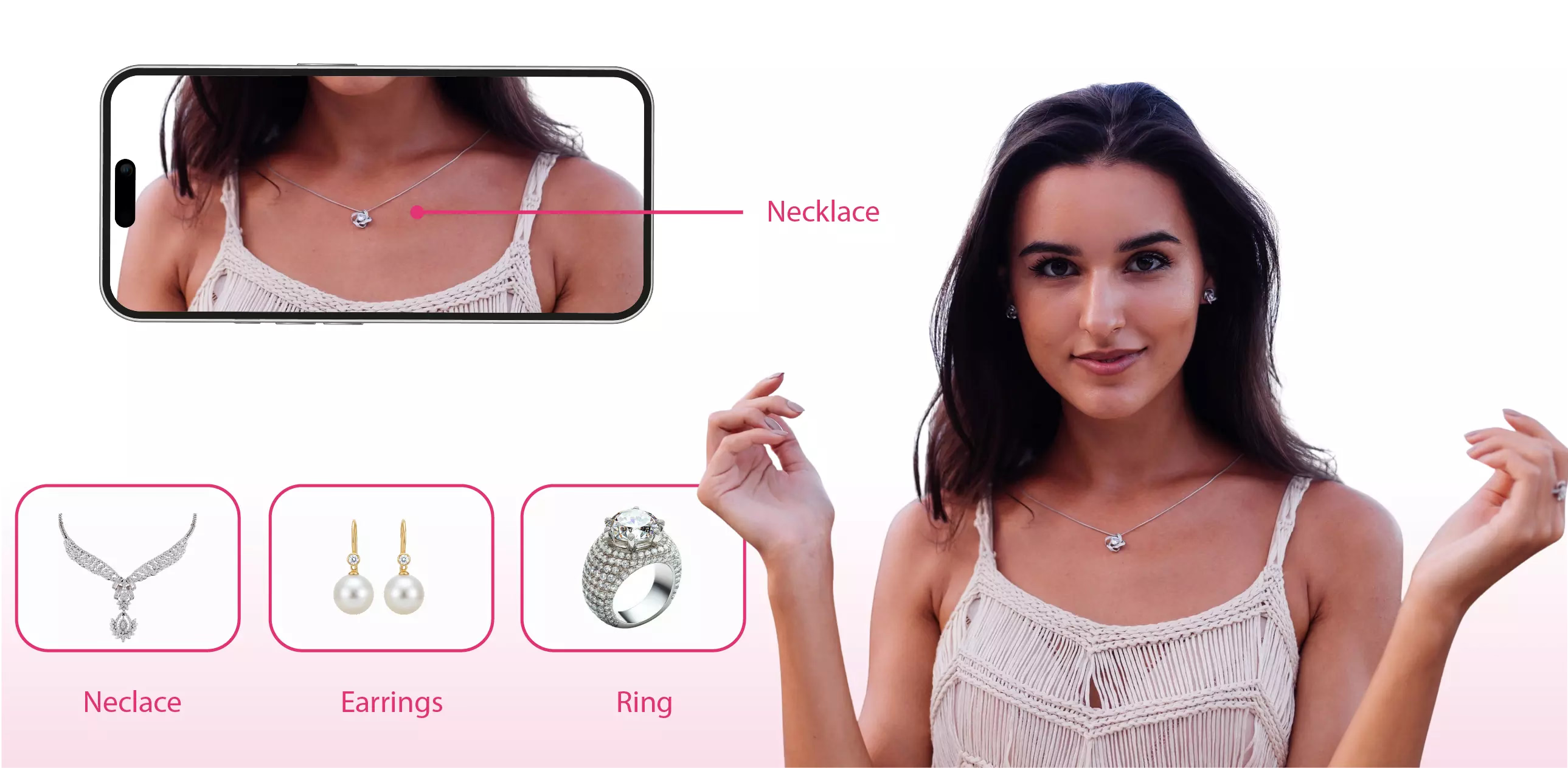
Nowadays, the e-commerce industry has seen immense growth and a wider audience base due to the use and implementation of advanced technologies, like augmented reality and artificial intelligence. These technologies have been helping e-commerce companies from different industries, such as jewelry, clothes, footwear, furniture, and beauty products, to provide their customers with an engaging and immersive online shopping experience.
Among these industries, the jewelry industry has also implemented the virtual try-on technology that will help online brands and sellers to showcase their products virtually by using 3D models, 360-degree viewers, and a try-on facility, providing their customers with a lifelike experience. Due to this, the global jewelry market size was estimated at USD 366.79 billion in 2024 and is projected to reach USD 578.45 billion by 2033, growing at a CAGR of 5.3% from 2026 to 2033.
Since using the virtual jewelry try-on helps businesses to display their products engagingly, have you ever wondered how these virtual try-ons help brands and sellers to increase their conversion rates? In this blog, I will help you understand how a D2C jewelry brand or seller can use a virtual try-on in different ways so that they can see an increase in their sales and conversion rates.
What is a virtual jewelry try-on?
A virtual jewelry try-on is an online tool that helps users explore and try different jewelry items, such as rings, earrings, necklaces, and maang tikkas, providing them with a realistic and lifelike shopping experience. To explore products virtually, users can upload an image or use the live camera feed with advanced technologies, such as augmented reality, 3D modeling, and computer vision, so that they can overlay the product on a live camera feed or photo.
It also offers some optional yet advanced features, such as detailed tracking of facial and hand features for accurate placement, social sharing to discuss with family and friends, and multiple-item visualization for a better experience. Users can use this feature by using a smartphone, tablet, or desktop that provides a camera so that the virtual try-on can detect key points on their face or hand, then overlay a realistic, scaled 3D model of the jewelry that moves with the user.


Key features
- Augmented reality: It provides users with a lifelike shopping experience by overlaying the 3D model of the jewelry onto their live video or photo through their device's camera using the augmented reality technology.
- Computer vision: It helps the brand to provide its customers with a realistic experience by detecting their key facial and hand points to accurately map the jewelry to their body, such as the lobes for earrings or fingers for rings.
- 3D modeling and rendering: It provides users with a 3D model and a 360-degree preview of the jewelry virtually, offering them a realistic-looking digital version of the product that they can explore and view from multiple angles.
- Real-time tracking: It helps the user to understand the accurate placement of the product by tracking the movement of their head and hands, offering them a real-time shopping experience with appropriate tracking
How does it work?
- Access the camera: To provide users with a real-time and lifelike shopping experience, it requires access to the device's camera so that the user will get a live view of the product on the live feed or the image.
- Detect key points: It uses advanced computer vision algorithms to help the user analyze the camera feed to find specific landmarks on their face or hands, including the earlobes, neck, or fingers.
- 3D model rendering: It provides users with a 3D model rendering so that they will get an in-store-like shopping experience with a 3D model and a 360-degree preview of the product from various angles and perspectives.
- Overlay the model: It provides users with the try-on feature virtually by enabling them to explore products with AR overlays that are superimposed onto their image in real-time, scaled to fit the specific area where it should be worn.
- Tracking and mapping: It tracks and maps the movement of users by tracking the key points and adjusting the position, size, and angle of the 3D model to ensure it stays accurately placed and moves naturally.

How virtual try-on helps businesses to elevate their shopping experience

Nowadays, customers demand a seamless and enhanced experience for online shopping, as it provides them with an innovative and personalized way to explore products. With the help of virtual try-on technology, brands can provide their customers with an elevated online shopping experience so that they can get a lifelike shopping journey by virtually trying objects with AR overlays and 3D models.
In this section, I will provide you with a brief overview of how virtual try-on helps businesses to provide their customers with an enhanced shopping experience and helps them boost their conversions and sales.
1. Enhanced personalization options
It provides customers with a personalized shopping experience by decoding their shopping patterns and providing them with tailored jewelry recommendations when combined with AI algorithms based on their previous purchases and product try-on history. With the help of advanced AI algorithms, brands can also increase their conversion rate by offering their customers various customization options to help them add sentimental value and meaning to their purchases.
2. Bridges the gap between online and offline shopping
With the help of advanced technologies such as augmented reality and 3D modeling, brands can provide their customers with a lifelike shopping experience by enabling them to explore products from all over the world with real-time visualization. It also helps the brand to reduce its product return rate by reducing the uncertainty of product mismatch among its customers and providing them with appropriate products according to their needs and preferences.
Benefits of using a virtual try-on for both brands and customers
Using a virtual jewelry try-on provides advantages to both brands and customers because it helps them to build stronger and more trusted relationships with each other by fostering trust, loyalty, and satisfaction. When it comes to understanding the benefits of using a virtual try-on, it is very important to understand these from the perspectives of both buyers and sellers because it will also help you to select the best try-on for your business.
Therefore, in this section, I will provide you with a brief knowledge of the advantages of using a virtual jewelry try-on for both buyers and sellers, telling you how it will help you to foster their trust and loyalty.
For customers
- Greater purchase confidence: It helps buyers to explore and see how products look on them with the help of AR overlays and 3D models, which will reduce their hesitation and the uncertainty of product mismatch.
- Convenience and time savings: It helps customers to try on several products with the accessibility of making purchases anytime and anywhere, without any geographical limitations, and reduces the need to visit a physical store.
- Reduced product return: It helps customers to make more informed and confident purchase decisions by helping them to explore the product from different angles and perspectives, reducing the need for product returns due to size, color, and style mismatch.
- Personalized shopping journey: It provides users with a customized shopping experience by offering them product recommendations based on their shopping patterns and product selection, which makes it easier for them to find the right style and size.
For brands
- Higher conversion rates: It helps businesses boost their conversions by helping their customers explore products from different angles with the help of 3D models and 360-degree viewers, enabling them to make more confident and firm purchasing decisions.
- Lower return rates: It reduces the product return rate for brands by providing their customers with a real-time shopping experience along with customization options, enabling them to reduce the return of the item, which saves the brand on return processing costs.
- Enhanced customer engagement: It helps the business to increase customer engagement because the virtual try-on provides its customers with interactive and immersive shopping experiences that keep them engaged with products.
- Data-driven insights: It provides businesses with data-driven insights that they can use to understand the shopping patterns of their customers to provide them with personalized product recommendations and enhance their market strategies and future product offerings.
- Competitive differentiation: By integrating the virtual try-on feature on their e-commerce platforms, brands can stand out from their competitors by providing their customers with an appealing way to explore a more modern, tech-savvy customer base.
GlamAR’s virtual jewelry try-on for online sellers and brands
GlamAR is a virtual try-on SDK provider for brands that offer virtual try-on for different industries, such as makeup, jewelry, watches, eyewear, and nails, helping them to provide their customers with a real-time shopping journey by using AR overlays and 3D models. With the help of the virtual jewelry try-on, brands can provide their customers with an engaging and interactive shopping experience by enabling them to explore different types of jewelry, such as maang tikka, earrings, necklaces, bracelets, and rings.
It provides businesses with the feature of cross-platform compatibility and seamless integration so that they can integrate the SDK on various platforms, such as Android, iOS, web browsers, and AR devices, providing their customers with a similar shopping experience across different devices. By using this online tool, online businesses can provide their customers with a personalized shopping experience with 3D modeling and rendering capabilities, enabling them to select the best products according to their needs and preferences.
By using GlamAR’s virtual try-on, online sellers and businesses can see an increase of up to 45% in the conversion rates because it makes their customers feel more confident and satisfied with their decisions during online shopping. With the help of its engaging features, such as real-time 3D rendering, customizable assets, and more, brands can increase their engagement rate by 94% because it keeps their customers engaged on their website or app by turning passive browsing into active interest.
Apart from that, it also offers three different ways for users to try on different jewelry items virtually, which include model, image upload, and live camera feed, enabling them to understand the jewelry in multiple environments. Therefore, using GlamAR’s virtual jewelry try-on will help online sellers and businesses to increase their overall revenue, boost online presence, and reduce return rates while fostering trust and loyalty of their customers.
Future trends of the global jewelry industry
With the implementation and integration of technological advancements, the global jewelry industry has seen multiple trends, which will help brands and sellers to enhance their customer base. After technological advancements, the global jewelry industry is projected to grow at a CAGR of 4.6% during the forecast period of 2026 to 2033, which is expected to reach USD 534.17 billion by 2033.
It has also seen several future trends that come into practice with the implementation of AR and AI technologies, which include sustainability and ethical sourcing, personalized designs and customization options, and digital integration. In this section, I will help you understand these future trends and how they are helping the jewelry industry to grow and provide its customers with better services and experiences.
Technology and digital integration
- Augmented reality: It helps brands and businesses to provide their customers with an engaging shopping experience by offering them a virtual try-on facility, which will enable them to increase their customer base and help them make more informed decisions.
- Blockchain: With the help of this technology, brands can provide their customers with the ability to transparently track the jewelry's origin and authenticity, with a significant percentage of luxury brands expected to adopt it.
- Artificial intelligence: By using artificial intelligence technology, brands can provide their customers with hyper-personalization, which will help them provide their customers with tailored product recommendations and AI-driven custom design platforms.
- 3D printing: It helps brands to perform rapid prototyping and the creation of intricate, customized designs at a lower cost, enabling them to provide their customers with instant, real-time changes on their screen according to their needs and preferences.
- Immersive experiences: It helps brands to foster trust and loyalty from their customers by creating engaging online and in-person experiences, such as virtual showrooms and immersive exhibitions, enabling them to connect with their customers.
Sustainability and ethical practices
- Eco-friendly materials: One of the most loved trends that the jewelry industry will experience in the upcoming years is the use of recycled and responsibly sourced gemstones for making new products and jewelry items.
- Ethical sourcing: During online shopping, customers demand transparency in the entire supply chain, from raw materials to labor practices, because it helps them to understand that the jewelry pieces are not harmful to the environment.
- Growing market for used goods: Digital marketplaces are seen as a sustainable option for buyers because they enable them to purchase pre-owned and vintage jewelry, and they will be considered the trusted option.
Personalization and design
- Unique and meaningful pieces: From generic designs to personalized ones, the jewelry industry has seen a shift away from logos towards unique pieces that help users to reflect their individual identity, driven by younger consumers.
- Customization options: It provides users with a tailored experience and shopping journey by offering them customization options, which will allow them to personalize items by enabling them to engrave or add birthstones, which will remain a major attraction.
- Layering and mixing: It helps customers to perform layering necklaces and bracelets so that they can create a personal and evolving look while enabling them to mix delicate and bold pieces available in different metals with sentimental items.
Conclusion
Virtual jewelry try-on works as a beneficial feature for both buyers and sellers because it helps them to build stronger relationships with their customers and provide them with better services. Therefore, there are various D2C brands that are using these try-ons to help their customers make more informed decisions, which in the end helps brands to increase their conversion rates.
You can also use GlamAR’s virtual try-on for jewelry products and items, as it will provide you with multiple benefits, such as seamless integration, cross-device compatibility, increased sales and conversions, and reduced returns. Therefore, to provide your customers with a better and enhanced online shopping journey, you can contact the GlamAR team by filling out the contact form, dropping an email, or making a phone call.










