


10 Best Virtual Earring Try-On SDKs for Jewelry Brands in 2026


Virtual earring try-on for jewelry brands means licensing an AR SDK or plugin that overlays a 3D earring model onto a customer's own face in real time, directly on your product page. Below is a comparison of 10 options, from full SDKs a development team integrates to reference implementations already running on live jewelry retailers, evaluated on integration effort, pricing model, platform support, and catalog onboarding rather than how the experience feels to a shopper.
Jewelry is a category where a customer's inability to physically handle a product before buying drives a meaningfully higher return rate than general ecommerce, since scale, drop length, and how a piece actually catches light are hard to judge from a flat photo alone. Industry benchmark data puts average jewelry ecommerce return rates noticeably above the general ecommerce average, and conversion rates below it, which is exactly the gap virtual try-on is built to close. That said, any specific conversion or return-rate lift a vendor advertises should be validated against your own catalog and traffic, not assumed from a published case study, a point worth keeping in mind throughout the comparison below.
This guide is written for the person actually making the buying decision, an ecommerce manager or brand owner evaluating vendors, not a shopper deciding whether to try on a pair of earrings. That distinction matters because most existing comparisons in this space describe the experience from the shopper's point of view, how realistic it looks, how fun it is to use, without addressing the questions that actually determine whether a specific vendor is viable for your business: what does integration actually require from your team, how is pricing structured, which platforms are genuinely supported, and how does your existing catalog get onboarded.
There are plenty of platforms available: I have been researching them lately, and I can strongly recommend those as ideal ones for businesses. For this article, I spent ample time trying and testing these virtual earring try-on solutions. Here are my final findings of the best 10 virtual earring try-on solutions in 2026:

10 Best virtual earring try-on solutions
- GlamAR (Best for adjustment options)
- MirrAR (Best for accurate placement)
- Camweara (Best for 3D try-on)
- Candere (Best for before-and-after results)
- Perfect Corp (Best for 2D & 3D try-on)
- AI Ease (Best for AI replacer)
- PRMAL (Beat for compare option)
- Banuba (Best for gift selection)
- Kivisense (Best for real-time interaction)
- FaceCake(Best for easy-to-use format)
Glance at the best virtual earring try-on solutions
{{tab7="/internal/widgets"}}
What virtual earring try-on actually requires from a brand
Before comparing vendors, it helps to separate the technology into what a brand's team actually has to manage. A live AR try-on needs a 3D model of each earring, a tracking engine that detects ear or facial landmarks in real time, a delivery method (SDK, web widget, or plugin) that puts that experience on your product page, and some way to onboard new SKUs as your catalog changes. Every vendor below handles these four pieces differently, and that difference matters more to your implementation timeline and cost than any single feature on a marketing page.
It's also worth deciding upfront which of these four pieces you're willing to build in-house versus which you need a vendor to fully handle. A team with existing 3D production capability may only need tracking and delivery from a vendor, while a team with no 3D experience at all needs a vendor that also solves the asset-creation problem, whether through a managed modeling service or a 2D-to-3D conversion path. Getting clear on this before your first vendor call saves a meaningful amount of back-and-forth during evaluation.
Top 10 virtual earring try-on solutions
I have tested almost 30 virtual earring try-on tools to find out the best ones that will truly serve your purpose and experimented with realistic simulations on every platform. Here are the top 10 virtual earring try-on solutions I have found useful for brand owners:
1. GlamAR

GlamAR is delivered as an SDK covering web, Android, and iOS, so a development team can embed real-time earring try-on into an existing site or app without building tracking from scratch. Its earring-specific controls let a brand's shoppers adjust scale and position independently, which matters for evaluation since a fixed-placement overlay is a common source of unrealistic results in this category.
GlamAR also covers jewelry, makeup, eyewear, and other accessories from the same platform, so a brand selling earrings alongside other categories can extend one integration rather than licensing a separate vendor per product line. Onboarding follows GlamAR's standard SKU upload and preview flow, and the earring virtual try-on solution page documents scaling, lighting, and 360-degree angle support in more detail. You can test the experience directly on the jewelry demo store.
For a brand weighing GlamAR specifically against a single-purpose earring tool, the practical case for consolidation is straightforward: a jewelry brand that also sells eyewear, watches, or other accessories can extend the same vendor relationship, analytics, and catalog pipeline across every category it sells, rather than managing separate contracts and separate technical integrations for each product line.
Features:
- Compatible solution: GlamAR works on websites, Android, and iOS, so you can easily add its AR features to your existing app or platform.
- Face tracking technology: GlamAR uses smart technology to follow faces and expressions. This lets your customers try on makeup or jewelry virtually using their phones or other devices.
- Interactive shopping: With the help of its virtual try-on tools, you can support your customers with quick purchasing decisions and interactive shopping fun. It results in reduced return rates.
- Use cases: If you are running a jewelry business, you can check GlamAR’s use cases to see how its virtual try-on technology enhances customer engagement for the long term. With its VTO tools, you can amplify your product range and meet the demands of diversified customers, which will lead to increased revenue.
{{component="/internal/widgets"}}
2. MirrAR

MirrAR delivers virtual earring try-on as a web-based AR solution with no app install required, running across desktop, tablet, and mobile from the same integration. Its tracking is built to detect anatomical landmarks specifically, which is the technical detail that determines whether an earring sits convincingly at the actual piercing location rather than a generic estimated position.
MirrAR also offers a physical smart mirror product for brands with retail locations wanting the same try-on experience in-store, which is worth asking about directly if omnichannel deployment is part of your roadmap. MirrAR is the technology behind Candere's live storefront implementation, covered later in this list as a reference example, which is worth reviewing directly since it's a working example rather than a controlled demo environment.
Features:
- Easy-to-use interface: Its user-friendly interface can easily blend with desktops, tablets, and mobile irrespective of the type of device or browser your customers use. Users can try hyper-realistic jewelry designs without going to retail stores with MirrAR’s virtual try-on solutions.
- Accessible solution: With no installation of your company’s app, users can access its virtual try-on tools to experiment with how the jewelry pieces would look on them in real-time.
- Accuracy: Its AR-powered software can detect the anatomical features of the particular body part and offer accurate jewelry placement with a realistic result. Simulated motion physics, rigid body dynamics, and occlusion culling make sure your 3D jewelry designs look and move naturally on your branded app.
- Smart mirror: Introducing the in-store smart beauty mirror, it would be convenient for retail owners to showcase jewelry pieces that perfectly suit the customers. It can capture videos or images to measure users’ facial dimensions for virtually trying 3D jewelry in real-time.
3. Camweara

Camweara's stated onboarding process is one of the more specific claims in this category worth verifying directly: its dashboard scans a brand's existing catalog for products missing virtual try-on and reports being able to implement try-on across thousands of SKUs within four to five days. For a brand with a large or fast-changing earring catalog, this onboarding speed is arguably a bigger evaluation factor than rendering quality alone, since a slower onboarding process delays your entire launch regardless of how good the final result looks. Camweara supports GLB-format 3D assets and reports processing at 30 frames per second across Android and iOS, alongside a dashboard tracking button clicks and top-tried products for basic analytics.
This analytics layer is worth pressing on specifically during evaluation, since basic click and top-product tracking is a meaningfully thinner data set than a platform offering conversion attribution or return-rate comparison. A brand that needs to build an internal ROI case for the investment should confirm exactly what reporting a vendor's dashboard exposes before assuming it will support that case on its own.
Features:
- 3D effect: It is a fast and efficient jewelry try-on software that works on a live video and helps users try on 2D and 3D assets of earrings. Camweara enables consumers to have a 360-degree view of jewelry like earrings, rings, etc., using its 3D models in GLB format.
- Dashboard assistance: Camweara's dashboard assists the brand owners in tracking VTO’s impact on their sales. It provides in-depth analytics, including the number of users, button clicks, and top tried products.
- Accurate results: Camweara ensures intense accuracy while producing results for Android and iOS devices, day and night lighting.
- Speed efficiency: With its high loading speed under 4G & 5G, it can process 30 frames per second for Windows, iOS, and Android devices.
4. Candere

Candere is an online jewelry retailer, not a licensable AR vendor, and it's worth including here as a reference implementation rather than a comparison option. Its live try-on experience runs on MirrAR's underlying technology, giving a brand evaluating MirrAR a real, functioning example of the technology deployed on an active jewelry storefront, including model-based try-on and a before-and-after comparison view.
Features:
- Multiple product range: Consumers can select their favorite pieces of earrings, depending on their gender, occasion, gemstone type, weight & price range, kind of material, and design they would love to wear, etc.
- Real-time effect: It is an online jewelry shopping site, offering virtual try-on experiences to consumers for a quick and confident purchase. Using MirrAR’s virtual try-on solutions, Candere ensures realistic results.
- Convenient solution: Its virtual try-on solutions allow customers to try numerous jewelry products at a time with one click.
- Multi-platform compatibility: Customers can try jewelry from their device, no matter whether it is a desktop or smartphone.
5. Perfect Corp

Perfect Corp's relevant technical detail for a brand evaluating 3D asset costs is its 2D-to-3D conversion path: rather than requiring a full 3D model built from scratch for every SKU, its engine can generate a try-on-ready asset from a 2D product image. This lowers the production cost of onboarding a large catalog, though a brand should test this conversion against their own most detailed or reflective pieces before assuming uniform quality across a full assortment, since 2D-to-3D generation tends to perform less consistently on complex geometry than a purpose-built 3D model does. Perfect Corp delivers through a .vto file format and its own VTO engine across web and mobile.
Perfect Corp's broader scale across the beauty and fashion tech space, serving numerous global brand partners, is also worth factoring into a pricing conversation, since enterprise-oriented vendors in this category sometimes carry a corresponding enterprise-level pricing structure that a smaller jewelry brand should confirm fits its budget before assuming feature access alone determines cost.
Features:
- AI-powered simulator: Perfect Corp offers an AI ear-piercing simulator for virtual earring try-on and virtual piercing try-on. With advanced lighting effects and physically accurate motions, its upgraded programmes generate true-to-life VTO earring SKUs.
- Dynamic effect: Users can experience try-on tech with filter effects on this platform for a range of golden, diamond, and pearl earrings. From a 2D image, you can create an ultra-realistic and dynamic earring virtual try-on without any expensive 3D modelling.
- Ensuring accuracy: It provides accuracy in a realistic ear piercing placement simulation with 13 earrings and an ear piercing placement planner. Perfect Corp’s virtual ear piercing planner can support earlobe and exterior ear placements.
- Smart beauty mirror: Customers can virtually try on every earring and ear piercing straight from your website or e-commerce platform. As a jewelry brand, you can incorporate its in-store smart beauty mirror for the shoppers so that they can try on 3D virtual earrings before making a purchase.
6. AI Ease

AI Ease is a browser-based AI image editing tool, not a live AR try-on SDK, and it's included here specifically to draw that distinction clearly. It generates a static image of jewelry placed onto an uploaded photo using a text-prompt-driven replacement tool, which makes it a reasonable option for a marketing team producing on-model product imagery at low cost, but it is not something a brand can embed as an interactive, real-time try-on feature on a live product page. Evaluate it as a content-generation tool for campaign assets, not as an alternative to the SDKs elsewhere on this list.
Features:
- AI replacer: Its AI replacer can make your expensive dream into reality. Using advanced AI, it will convert your descriptions into realistic jewelry.
- Image replacer: AI Ease’s virtual jewelry try-on tools make it easy to create a perfect look for an occasion with its image replacer.
- Compatibility: AI Ease supports any type of image format, like JPG, JPEG, PNG, BMP, and WEBP. So, it is a convenient and user-friendly tool.
- Object replacer: your customer can use its object replace tool to try a pair of trendy earrings and compare the before-and-after effects.
7. PRMAL
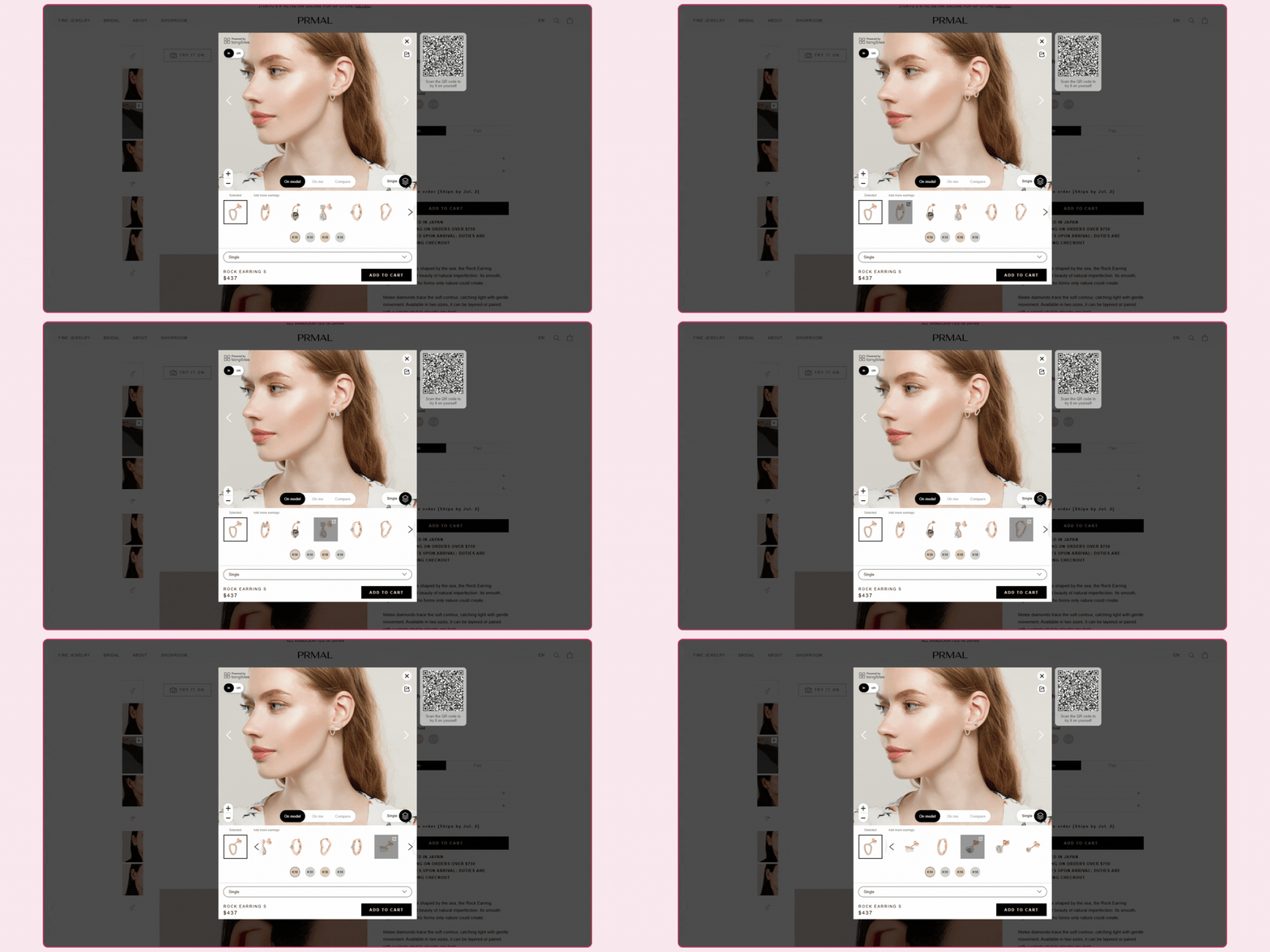
PRMAL is a direct-to-consumer jewelry brand, also not a licensable AR platform, included as a second reference implementation. Its try-on flow activates through a QR code scanned with a customer's phone camera, and it includes a measurement comparison feature letting a shopper check an earring's stated length against a familiar object like a ruler. This QR-code activation pattern is a useful reference point if your own brand is weighing QR-based activation against a directly embedded product-page button, a real integration decision most of the SDK vendors above will ask you to make regardless of which underlying technology you choose.
Features:
- Transparency: PRMAL maintains transparency while interacting with customers while selling their products online straight from their store. Following this, they integrate virtual try-on to change the approach of online shopping with the ‘try before buy’ concept.
- Accurate effects: Consumers can view the exact measurement of the earring they have chosen and drag it according to their piercing position.
- Convenient-to-use: Customers can directly browse their collection from the website and explore the ‘TRY IT ON’ option: No need to sign up or install any app.
- Customization available: A customization option is available for the buyers. Thus, their virtual earring try-on reduces return rates, though they accept returns only for defective items.
8. Banuba

Banuba is positioned around integration speed specifically, with a stated plugin setup time of around five minutes through CMS marketplaces including Shopify and WordPress, requiring no custom code for a standard deployment. For a brand without in-house development resources, this low-code path is the clearest differentiator versus a full SDK integration, though it also means less flexibility to customize the try-on interface beyond what the plugin exposes. Its admin panel supports self-service product updates, and its interface is stated to be customizable to match brand identity within the plugin's configuration options.
This tradeoff between setup speed and interface control is worth weighing honestly against your own team's priorities. A brand prioritizing a fast, low-risk launch over deep visual customization is a better fit for Banuba's plugin model than a brand wanting the try-on experience to match a highly specific, non-standard brand aesthetic.
Features:
- Easy-to-integrate: Banuba provides an easy-to-integrate virtual try-on plugin. It offers a 5-minute AR try-on plugin setup that helps big online brands retain their customers. You can install the plugin through the CMS marketplace - no coding is required. Then, upload your SKUs and select AR attributes like color, texture,& shape for each item.
- Customizable UI: Get a completely customizable UI that will match your brand identity, and multiplatform compatibility facilitates your consumers. Customers will get a tailored and lifelike shopping experience for different product categories such as jewelry, eyewear, makeup, etc.
- Global user interface: Its multilingual user interface is available 24/7 for global consumers. You can access its ultra-realistic and high-resolution product models for free and give your users a straightforward try-on solution.
- Self-digitization: You can access self-service product digitization with the Admin Panel to update the product without delays.
9. Kivisense

Kivisense combines web, mobile, and tablet try-on with a physical AR smart mirror product, aimed at brands wanting consistent try-on technology across online and in-store channels rather than treating them as separate systems. Its tracking is built around real-time face and body detection intended to hold up under camera movement, which is a reasonable technical question to test directly during a demo rather than accept from a features list, since motion stability is one of the more common failure points in live AR try-on generally.
Brands with an active retail footprint should specifically ask how the online and in-store versions share catalog data, since separate systems requiring duplicate SKU management defeat much of the operational benefit an omnichannel platform is meant to provide.
Features:
- Multiplatform try-on: Your consumers can try it on any camera-equipped device, including desktops, mobiles, tablets, etc.
- 3D rendering: Your customers can experience a real-time outcome with its advanced 3D solutions for gems, clothes, leather, and so on. It provides a true-to-life experience, replicating real-world lighting, material reflections, and complex details of every gem.
- Accurate AR tracking: Kivisense features instant motion response, an extremely accurate AR tracking solution that enables consumers to engage in interactive shopping. It sets a standard in virtual jewelry shopping with its real-time face and body tracking technology.
- AR smart mirror: Elevate your in-store presence with AR virtual try-on mirrors. This magic mirror can capture the authentic measurements of different body parts of your customer. Through an AR smart mirror, you can display a diverse range of jewelry designs without stuffing your inventory. It results in no customer disappointment over product shortages.
10. FaceCake

FaceCake bundles virtual try-on with an AI-driven style recommendation layer called AVA, built in partnership with Google Cloud, which is a meaningfully different value proposition than a pure try-on SDK. For a brand wanting try-on paired with personalized product recommendations based on a shopper's detected features, this combination is worth evaluating specifically, though a brand only needing the try-on layer itself should confirm whether the recommendation engine can be disabled or unbundled from pricing.
Features:
- Social sharing option: Its shopping platform offers an integrated social sharing component. Through this, users can take selfies and share them on their feed and get feedback from friends.
- Easy-to-use solution: Consumers can gain a flawless product interaction and built-in links to buy their favorites easily. Its in-store and at-home solutions are compatible across devices like mobile phone, tablet, desktop, etc. So, users can access their VTO experiences from anywhere.
- User-friendly interface: You can easily integrate this AR shopping platform into your site by copying a small code snippet. Your online shoppers can view products in an AR environment straight from your e-commerce website’s product detail page.
- Exact outcome: It is built for realism, while providing exact sizing and motion-responsiveness following your customer’s movements.
Other platforms you can explore for virtual earring try-on
Apart from these top 10 virtual earring try-on platforms, there are some other Which I have checked out recently. While assessing those platforms to test if they meet the criteria, I have been looking for their free trials and got straight into the virtual earring try-on section. Here is a round-up of the platforms I have tried recently:
1. Plushvie: It is an AR video shopping platform for luxurious brands. While exploring Plushvie, I was particularly concerned about the interactive experience through virtual earring try-on. If you are the owner of a jewelry brand, this is one of the best options to flaunt your innovative jewelry designs with accuracy and convenience. With its virtual try-on, your customer can easily find out the right pair of earrings for them.
2. Tasaki: It is a Japan-based jewellery brand that produces creative accessories, made of gold, diamond, pearl, gemstone, etc. Tasaki connects its customers directly through the virtual try-on tools, straight from its website. I have experimented with its ready-to-wear earring collections by just using my smartphone and opening the webcam. Customers can also select a photo from the gallery and try on jewelry. Otherwise, select a model to try on its unique products.
3. Wanna: If you are looking for a digital transformation expert for your fashion brand, your search ends here. Wanna provides 3D and AR solutions to empower your brand and give your shoppers a chance to discover their ideal products. After successfully experiencing its jewelry try-on, I have found that it only offers try-ons for rings and bracelets, not for earrings. Still, to get a new prospect on your list, you can try their free demo and avail of their free consultation to know further.
4. Tryndbuy: It provides your customers with a virtual trial room to try on accessories, jewelry, and makeup before buying, just like the experience of a trial room in a shopping mall. Consumers can try as many products as possible until they find the ideal one. I have requested a live demo and tried its virtual earring try-on, following the user guide available on its website. Hence, Tryndbuy offers an engaging experience to your consumers with every detail regarding the product.
5. Trillion: Trillion’s virtual try-on tools help drive sales for your e-commerce or digital marketing platform. It is easy to access just put your business email and get the free trial. Here, your customers will find exclusive 3D and AR solutions along with helpful prompts on how to use them. I was impressed by its virtual earring try-on option, which ensures accurate placement while in motion. Its cross-platform compatibility allows your consumers to use its virtual try-on option from any device they have.
How to experience virtual try-on earrings with accuracy?
Augmented reality on e-commerce platforms is now able to bring an extensive experience to try jewelry on digital platforms for their consumers. Without the installation of any apps, consumers directly go to the website and try jewelry like earrings, bracelets, rings and necklaces.
Users can browse virtual jewelry try-on platforms from any mobile device, desktop, or any kind of web browser. When it comes to trying out earrings, you can easily use these AR solutions to get a real-time experience before purchasing. Discover how you can try on earrings online:
AR technology behind virtual try-on software
Integrating augmented reality technologies in try-on software develops some significant features to represent the virtual world as the real world. Now, your customers can enjoy the virtual try-on earrings by using a webcam or uploading still photos. You can access any platform of virtual jewelry try-on, like GlamAR’s earring try-on category, to showcase a range of products with distinct designs to the customers.
Use perfect lighting for precise recognition.
To witness the precise face recognition, perfect lighting effect is needed for virtual try-ons. Dull lighting or sparkling light disrupts face recognition. When I was trying the demo try-on on my face, there was poor lighting in my space. So, my face seemed blurred, and the software didn't provide accurate recognition.
Select the absolute style of earrings for your face shape
It is necessary to know the particular face shape of individuals. Virtual try-ons are able to help consumers find the right designed earrings that can match their face shape. For instance, during virtual earring try-on, I have found some symmetrical styles fit quite well, as I have a heart-shaped square face.
Use high-resolution pictures
Virtual try-ons require high-resolution images for a perfect experience of styling earrings and other jewelry. If users are uploading blurry or pixelated still images, it will not bring accurate recognition of their faces or the real representation of the earrings.
{{component="/internal/widgets"}}
Popular brands (examples) using virtual earring try-on solutions
With over 345 million online shoppers in 2023, India’s digital buyers are likely to grow beyond 400 million by 2027. Still, there are a handful of consumers who prefer to visit stores to purchase products, especially jewelry. So, jewelry brand owners are keen to invest in AR solutions, particularly virtual try-on tools, as a game-changer. Here are some renowned jewelry brands that are offering virtual jewelry try-on experiences:
1. Tanishq

To engage and interact with a large audience, Tanishq adopted AR solutions (hybrid reality campaigns) at Delhi and Bengaluru airports in 2019. Using Vossle’s platform allows its online customers to try on Tanishq’s bridal Polki collection: the latest one. Vossle’s AI engine ensures the perfect fit of the virtual jewelry. From necklace to earrings, Tanishq has opted for the web-based AR solutions to provide its consumers a top-tier user experience.
Tanishq uses AR try-on at airport kiosks.
A prospective customer tries on Tanishq Jewellery at Bridal Asia 2018
2. Reliance Jewels

Reliance Jewels offers its online consumers an easy-to-navigate virtual jewelry try-on, powered by Plushvie. They aim to build trust with potential shoppers with their ‘Try Now’ option that provides them an additional insight about what they will buy and if it will suit them well in real-time. I have kept my face to try on its virtual earrings instead of choosing a model and getting a satisfactory result.
3. EPPLI

EPPLI is an online shop for fashion and beauty collections, displaying a diverse range of costume jewelry earrings. It uses AR VTO solutions to boost customer engagement and unique shopping experiences. Following the user guide, available on its website, customers can try on multiple pieces of jewelry, as I have tried its dazzling earrings.
4. M.S.Rau

It is a brand of fine art, antiques, and jewelry collections. M.S. Rau offers a wide assortment of jewelry, made of gold, diamond and gems. With vivid product descriptions, it offers a virtual try-on option for digital shoppers so that they can make a confident purchase with less tendency to return. Using a smartphone camera, consumers can view how the earrings or rings would look on them.
5. Kalyan Jewellers

Kalyan Jewellers has launched ‘Candere’: A virtual try-on platform. It allows customers to get a virtual trial of jewelry. With its ‘TRY ON’ features, online buyers can explore its various suites of collections and choose the best one for them. It gives them a scope to try before buy with its AR solutions.
Advantages & limitations of virtual earring try-on
Nowadays, we are bound with AI and AR-empowered technologies. The execution of augmented reality and the growing virtual try-ons impact the present and future of the fashion and beauty industries.
Naturally, try-on solutions dispense so many positive possibilities and challenging situations for their consumers. Let's find out how these virtual earring try-ons provide facilities and pose limitations to their users:
Advantages of virtual earring try-on
According to the global population, Augmented Reality is the top-notch technology they want to help make their everyday lives easier and better. In fact, more than half (51%) said that they would be willing to use AR to try out or check products before buying them. 43% of global survey participants are willing to use in-store navigation or recommendation apps while shopping. Have a look at the following benefits of VTOs:
- Increase shopping trends: AR jewelry platforms always try to introduce new shopping trends and make it more convenient for global shoppers. They can use these try-ons to experience real-time, trendy hauls before purchasing.
- Boost sales and conversions: These virtual try-ons allow enhancements to their sales and conversion rate. If consumers are satisfied with their try-on, it's common for them to be willing to buy the products that increase the conversion rate.
- Enhance consumer satisfaction: Who doesn't want to experiment with jewelry before purchasing? These virtual earring try-ons allow your customers to experiment with their looks using a wide array of products. Thus, jewelry brands are adopting these AR solutions to elevate the shopping experience of their consumers.
Limitations of virtual earring try-on
Despite the merits of AR-empowered VTOs, some technical and other challenges can limit their extensive prevalence:
- Absence of physical Touch: Since it is a virtual try-on, it doesn't give your customers any human touch, which is required to know the quality of materials, if it is suitable for their skin or not. As a result, users can be adversely affected after the final purchase.
- Technical problems: All these try-ons were executed based on technologies. So, it's common to have a technical fault and get a poor experience using older models of phones or webcams.
- Lack of data security: These try-ons work using personal videos and still images. Hence, no one can ensure where all that data will be stored and lead to data privacy issues. Don’t worry! There is always a space to enhance advantages or sort out challenges for these virtual earring try-ons, as technology is evolving every minute.
How to shortlist a vendor for your catalog
Start by defining your actual catalog size and update frequency, since this determines whether onboarding speed (Camweara's stated four to five day turnaround, for instance) or 2D-to-3D conversion cost (Perfect Corp's approach) matters more to your launch timeline than a marginal difference in rendering fidelity between vendors. A brand with 50 hero SKUs updated twice a year has different priorities than one adding hundreds of new pieces monthly.
Next, confirm your actual development capacity honestly. A full SDK integration, as GlamAR, MirrAR, Camweara, and Kivisense all offer, gives more control over the final experience but assumes a development team with time to build it. A low-code plugin path, closer to what Banuba offers, gets a brand to launch faster with less engineering involvement, at the cost of some interface flexibility.
Third, test tracking accuracy on your own product photography or a live demo, not a vendor's own showcase reel. Earring placement depends on detecting the actual piercing location accurately, and this is exactly the kind of detail that looks fine in a curated demo video and behaves differently once real customers with real lighting and real camera quality start using it.
Finally, separate the vendors on this list that are genuine licensable platforms, GlamAR, MirrAR, Camweara, Perfect Corp, Banuba, Kivisense, and FaceCake, from the reference examples and adjacent tools, Candere, PRMAL, and AI Ease. Only the first group is actually available for your brand to integrate directly, and confusing a retailer's own deployment with a vendor you can license is a common and avoidable mistake when researching this category from marketing content alone rather than direct vendor outreach.
This varies significantly by vendor and catalog size. Camweara reports being able to implement try-on across thousands of SKUs in four to five days, while a full custom SDK integration with extensive UI customization can take considerably longer. Confirm a realistic timeline against your specific catalog size before committing to any vendor.
It depends on the vendor. Some, including Perfect Corp, offer 2D-to-3D conversion from existing product images, which lowers production cost but should be tested against your most detailed pieces before assuming consistent quality. Others expect a purpose-built 3D model per SKU, which produces more reliable results but adds production time and cost.
Pricing varies by vendor and typically scales with catalog size, traffic volume, or both, rather than a single flat rate. Several vendors, including Banuba, offer a free trial period before requiring a paid subscription plan. Request a quote scoped to your specific SKU count and expected traffic rather than comparing published starting prices alone.
Most vendors on this list support web, iOS, and Android from a single integration, though the depth of native platform support varies. Confirm platform-by-platform performance directly rather than assuming uniform capability, since web-based delivery and native app support don't always perform identically.
This varies by vendor and should be confirmed in writing before integration, including whether processing happens on-device or on a server, whether any images are retained after the session ends, and whether the vendor holds independent certifications like SOC 2, ISO 27001, or documented GDPR compliance.
Yes, and this should be a baseline requirement rather than a bonus feature. Every genuine SDK vendor on this list, including GlamAR, MirrAR, Camweara, Perfect Corp, Banuba, Kivisense, and FaceCake, delivers try-on through a web browser without requiring a customer to install a separate app.
Discover how AR, VR and 3D can drive revenue growth in 2026
Schedule a call with our team

.avif)