Face analysis


Turning analysis into data insights


Fluent real-time interaction
AI-powered facial mapping
Frequently asked questions
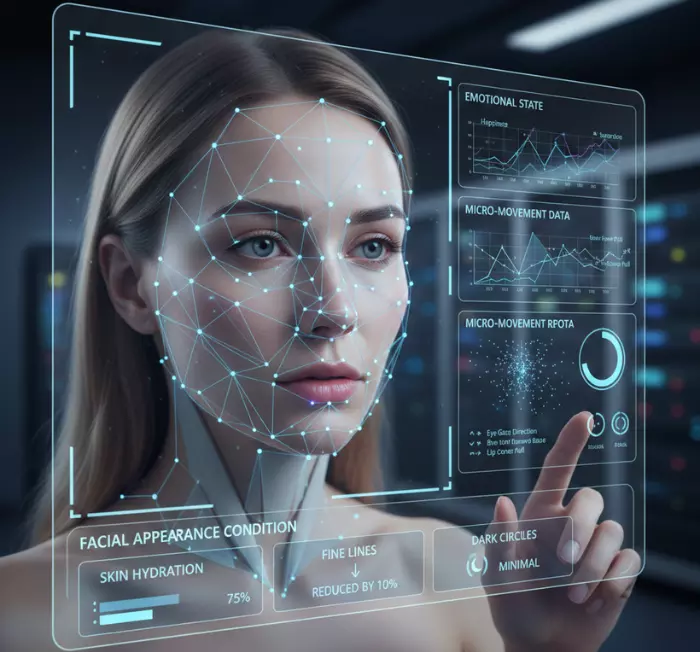
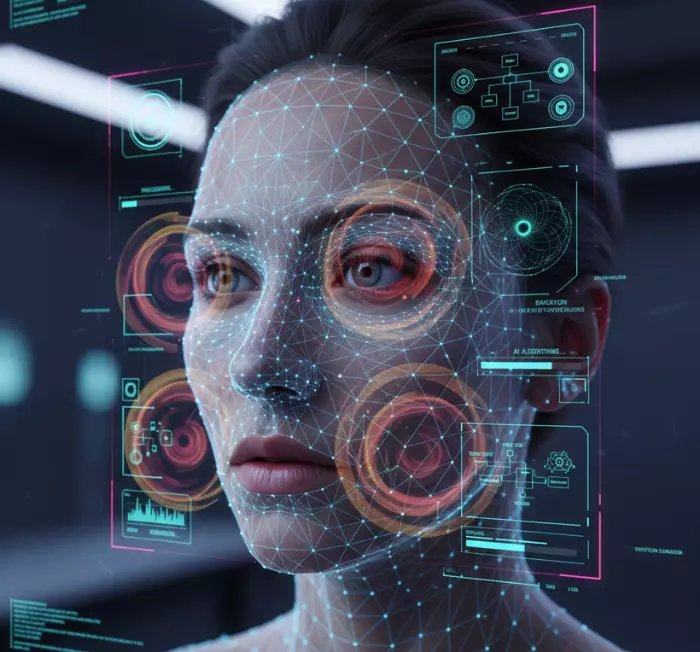
Face analysis is an AI-powered process that finds, maps, and analyzes face features in photos or live video to learn more about how someone looks and how they are feeling. Facial features (like eyes, nose, and mouth geometry), skin traits (like texture, pores, fine lines, and pigmentation), and emotional signs (like happiness or surprise) are some of the usual outputs. Some systems try to guess the person's age, level of attention, and head position. Others use images to get skin measures like hydration models or color indices. It's important to note that face analysis is not the same as medical evaluation. It only gives you clues and trends, not professional opinions. Most of the time, vendors show results through screens, PDFs, or API fields that you can store in an EHR or CRM with permission.
Capture, identify, analyze, and report are the four steps that most processes take. To begin, a camera records RGB images and sometimes IR/UV or polarized images as well. A computer-vision model finds the face and its markers, like the eyes, pupils, nose bridge, and lip contours. It then makes the picture normal in terms of size and lighting. Deep learning models (CNNs/transformers) take out traits to sort emotions into groups, guess a person's age or skin type, or divide up areas (like the face or cheeks) for more accurate readings. The results are added up, the video results are smoothed over time, and confidence numbers are given so operators can choose what to trust and when to do another scan.
How accurate it is relies on the camera, the lighting, the number of different skin tones in the training data, the head pose, and whether the person is wearing makeup, glasses, or a mask. Some examples of good systems that report error are mean absolute error for estimating age, F1 for mood classes, and pixel-level IoU for skin segmentation. You can be more sure of the face if it is looking forward, well-lit (diffuse, even light), and shot at 720p or higher. When there is motion fuzz, sharp shadows, extreme angles, or too much exposure, the accuracy goes down. To avoid coming to the wrong decision, you should always look over your confidence numbers and set up workflows like "re-scan if confidence < 0.7."
Most AI-based tools can be used with a smartphone, tablet, or webcam. For professional use, kiosks with ring lights and uniform backgrounds need to be available. For skin research, results are better when there is a constant distance (30–50 cm) and diffuse lighting (a softbox or ring light). Some vendors offer multispectral or UV devices that make it easier to see sun damage or pigmentation. A stable frame (tripod or stand), a neutral background, and items that reflect light should all be taken away. If you are constantly analysing things, like in a store, put the cameras where people can see them and decide how much light comes in from the outside.
Be careful with face info. Always give clear permission that says what is being recorded, why, for how long, and who can see it. You have to respect people's rights to access and delete their data (GDPR/CCPA) and collect as little data as possible (whenever possible, store derived measures instead of raw pictures). If the use case includes U.S. healthcare data, make sure it is protected by HIPAA (BAA, encryption at rest and in transit, audit tracks). If processing needs to happen in the cloud, use regional data centres, strict retention rules, and pseudonymization. On-device processing or temporary files are better. For high-risk operations, put out a DPIA or PIA.
Some models may not be accurate for all skin tones, ages, or genders if they were trained on datasets that are not representative of the population as a whole. Ask the provider or vendor to give you performance results that are broken down by demographic group and tests of fairness across those groups. Balanced data, ongoing re-evaluation, and boundary tuning per group can all help. If you're not sure about a choice or it's sensitive, have a person look it over. Also, never use emotion inference for high-stakes results (like hiring) without strong validation and legal advice. Tell end users about the doubt.
Discover how AR, VR and 3D can drive revenue growth in 2026
Schedule a call with our team

.avif)