


Inside GlamAR's AI Stylist: How Outfit Recommendations Work


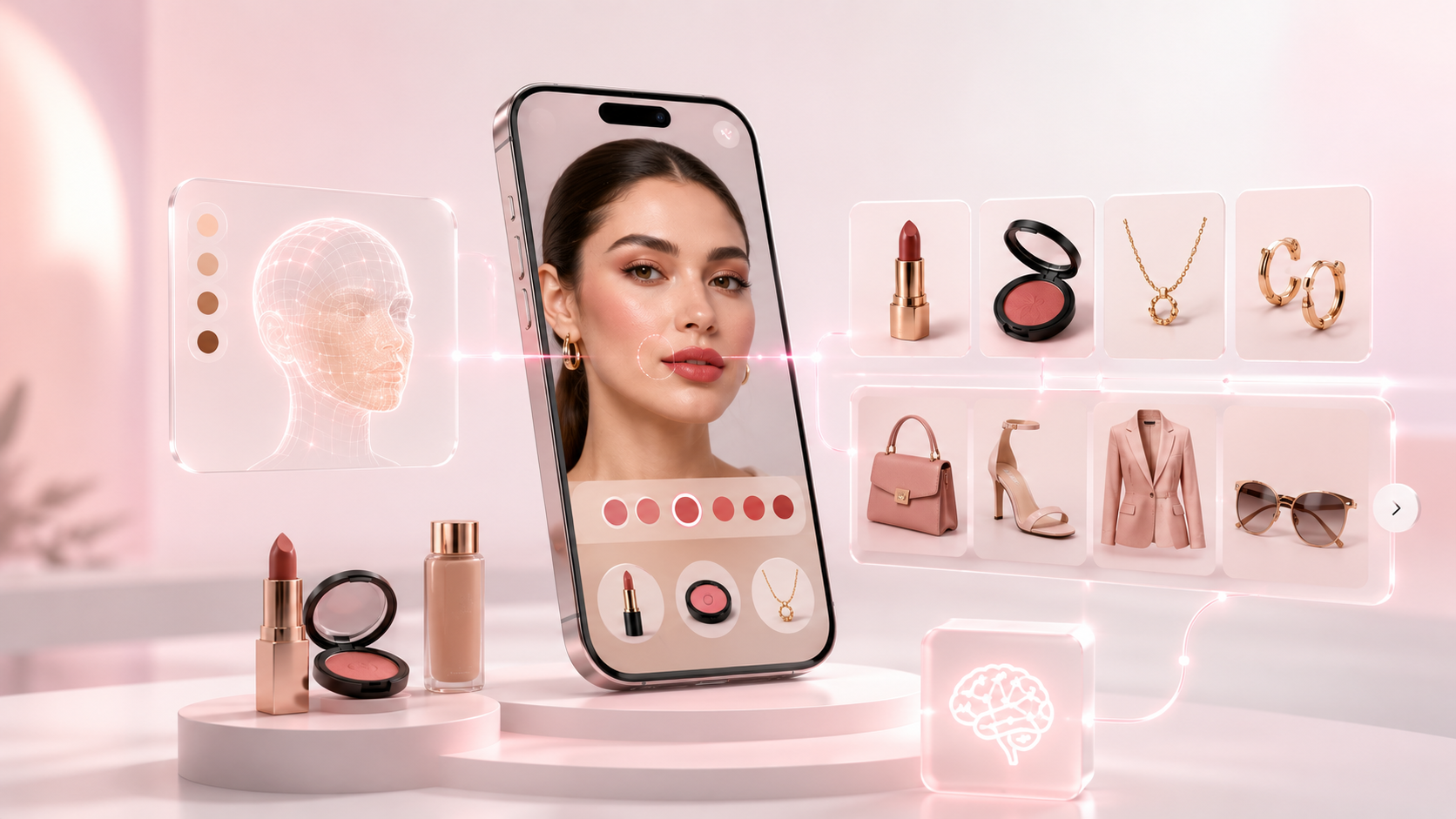
GlamAR's AI Stylist gives customers smart product suggestions based on what they've tried on, their skin tone, and their behaviour on your platform. It turns a single product try-on into a personalised shopping session - recommending complementary products, complete looks, and items suited to the customer's individual profile, all within the same experience.
This post explains how it works, what signals it uses, how it fits into a brand's e-commerce experience, and what it delivers commercially.
The Problem It Solves
Most e-commerce experiences work like this: a customer lands on a product page, tries on or views an item, and then either buys it or leaves. The transaction is one item, one decision, one interaction.That is a missed commercial opportunity for two reasons.
First, customers who are actively engaged - who have just virtually tried on a lipstick shade, a piece of jewellery, or a clothing item - are at peak purchase intent. They have already found something they like. That is exactly the moment to show them what goes with it, what else they might like, or what other customers with similar profiles bought.
Second, fashion and beauty purchases are rarely isolated. A customer who tries on a blush shade wants to know what lipstick complements it. A customer who tries on a necklace is thinking about whether it works with what they already own. A customer who tries on a pair of sunglasses might be interested in a hat that completes the look. Without an AI Stylist, those connections have to be made by the customer alone - browsing, searching, filtering. With one, they are made instantly and served contextually.
This is what GlamAR's AI Stylist is built to do.
What GlamAR's AI Stylist Actually Is
GlamAR's AI Stylist is a post-try-on recommendation engine built into the GlamAR platform. It delivers smart product suggestions based on three inputs:
- What the customer just tried on
- Their detected skin tone (from GlamAR's AI Skin Analysis, where integrated)
- Their browsing behaviour and interaction history on the brand's platform
The result is a set of personalised product recommendations served immediately after - or alongside - the try-on experience. Customers don't have to search for complementary products. The AI Stylist surfaces them.
GlamAR also has a dedicated "Looks" experience - a curated demo store where complete outfit and look combinations can be explored. For fashion brands, this extends the AI Stylist from a single-product recommendation engine into a full look-building tool, where customers can discover and virtually try on complete outfits rather than individual items.
How the Recommendation Engine Works
Step 1: The try-on creates the signal
When a customer uses GlamAR's virtual try-on - for makeup, jewellery, eyewear, clothing, or accessories - that interaction generates a signal. The system records what was tried on, in which colour or variant, for how long, and what actions the customer took (did they save it? compare with another product? return to try a different shade?).
This interaction data is the starting point for the AI Stylist's recommendation logic. It knows what the customer found interesting enough to try on. That is more reliable behavioural data than a page view or even a product save - a try-on is an active, deliberate engagement.
Step 2: Skin tone calibration
Where GlamAR's AI Skin Analysis is integrated alongside the AI Stylist, the recommendation engine incorporates the customer's detected skin tone into its logic. This matters most in beauty - recommending a foundation shade that complements the customer's specific undertone, a blush that reads correctly on their skin type, or a lip colour that flatters their particular complexion rather than just returning the platform's bestsellers.
Without skin tone calibration, product recommendations in beauty are generic. A customer with cool undertones and a deep skin tone is not well-served by the same foundation recommendation as a customer with warm undertones and a light complexion. The AI Stylist, informed by skin analysis data, can differentiate.
Step 3: Behavioural pattern matching
Beyond the individual try-on session, the AI Stylist learns from broader behavioural patterns - what products the customer has browsed, which try-ons they have done in previous sessions, which items they have added to cart or saved, and which they have skipped over. This builds a profile over time that makes subsequent recommendations more accurate.
For a returning customer, the AI Stylist uses their history to refine what it surfaces. A customer who consistently tries warmer eyeshadow tones will not be recommended cool-toned palettes. A customer who regularly browses minimalist jewellery will not be served statement pieces.
Step 4: Catalogue mapping
The AI Stylist maps its recommendations to the brand's own product catalogue - not a generic product database. Every recommendation it surfaces is an item the brand actually sells and has in stock. This is what makes the recommendations commercially useful rather than aspirational.
The brand configures their catalogue in the GlamAR Console, including product categories, complementary product relationships, and any manual overrides (for example, always pair a specific lipstick collection with the matching liner). The AI Stylist works within these parameters.
Step 5: Serving the recommendation
Recommendations are served at the point of maximum intent - immediately after or alongside the try-on experience. Placement options include:
- Post-try-on modal: After completing a try-on, the customer sees "You might also like" or "Complete the look" suggestions before returning to the product page
- Inline within the try-on: As the customer tries on a product, complementary suggestions appear alongside the AR view
- On product pages: The AI Stylist can power the "Recommended for you" section on product pages, replacing static bestseller lists with personalised suggestions
What "Complete the Look" Actually Means
The most commercially valuable AI Stylist use case for fashion and beauty brands is the "Complete the Look" format - where a customer's try-on of one item triggers a curated set of complementary products that form a complete look.
For beauty brands: A customer tries on a lipstick shade. The AI Stylist surfaces a blush that complements it, a highlighter that works with their skin tone, and a setting powder that is relevant to their detected skin type. Instead of a single product purchase, the customer sees a complete face look using the brand's own products.
For jewellery brands: A customer tries on a necklace. The AI Stylist recommends the matching earrings, a bracelet in the same metal, and a ring that works with the same aesthetic. The try-on becomes the entry point to a coordinated jewellery set rather than a single-piece transaction.
For fashion brands: A customer virtually tries on a dress. The AI Stylist suggests a belt that works with the silhouette, shoes in a complementary colour, and a bag that fits the aesthetic. The customer can try on each suggested item in sequence, building and previewing a complete outfit within the GlamAR experience.
GlamAR's dedicated "Looks Demo Store" illustrates this full look-building approach - where complete outfit combinations are curated and each item in the look can be individually tried on. For fashion brands wanting to move beyond individual product try-on into full outfit discovery, this is the format to understand.
The Commercial Impact
Basket size
The most direct metric. A customer who discovers and tries on three complementary products in a single session is more likely to add multiple items to cart than a customer who views one product page and leaves. AI Stylist recommendations that surface relevant complementary products at the moment of peak engagement directly increase average order value.
Session depth
Customers who receive personalised recommendations during a try-on session spend more time on the platform. Each recommendation is a new try-on opportunity, which extends engagement and keeps the customer in an active shopping mindset rather than passive browsing.
Return rate reduction
When customers buy products that are recommended based on their specific skin tone, behavioural preferences, and complementary relationship to what they have already chosen - rather than just the bestsellers or editorial picks - they are more likely to be satisfied with what arrives. Accurate personalisation reduces the "this wasn't what I expected" returns that drive up operational costs for fashion and beauty brands.
Repeat purchase rate
A customer who discovers a complete look through the AI Stylist and buys multiple complementary products has a different relationship with the brand than one who buys a single item. They have engaged with the brand's curation, not just a product. Customers with higher basket depth on a first purchase typically return at higher rates.
AI Stylist vs. Standard Product Recommendations
Most e-commerce platforms have a "You might also like" or "Customers also bought" module on product pages. These work from purchase co-occurrence data - items that have historically been purchased together. They are useful. But they have three significant limitations:
They are not try-on-aware. A standard recommendation engine doesn't know the customer just spent two minutes trying on a specific shade of lipstick. The AI Stylist does - and it uses that signal.
They are not skin-tone-aware. A standard recommendation engine cannot calibrate a beauty suggestion to the customer's specific skin tone. The AI Stylist can, where AI Skin Analysis is integrated.
They are generic across users. A standard recommendation engine serves the same "top recommendations" to most customers. The AI Stylist personalises to each customer's interaction history and physical profile.The AI Stylist is not a replacement for standard recommendation modules - it is a complementary, more powerful tool that operates specifically within the virtual try-on context.
How to Set Up GlamAR's AI Stylist for Your Brand
Step 1: Configure your catalogue in GlamAR Console
Log into the GlamAR Console and ensure your product catalogue is fully mapped - all SKUs, product categories, variants, and availability. The AI Stylist can only recommend products that are in the catalogue. Incomplete catalogue data produces incomplete recommendations.
Step 2: Define complementary product relationships
For each product category, configure the relationships the AI Stylist should understand. For beauty: which blush families complement which lip colour families. For jewellery: which collections are designed to be worn together. For fashion: which categories form complete looks (tops → bottoms → footwear → accessories).GlamAR's Console allows both automated relationship inference (the system learns from co-try-on data over time) and manual relationship overrides (the brand explicitly defines which products should appear together).
Step 3: Integrate with AI Skin Analysis (recommended for beauty brands)
For beauty brands, connecting GlamAR's AI Skin Analysis to the AI Stylist produces the most accurate recommendations. The skin tone and skin condition data from the scan informs the Stylist's shade and product type suggestions. Integration is configured within the GlamAR Console - no separate SDK implementation is needed if AI Skin Analysis is already deployed.
Step 4: Configure placement and display format
Decide where AI Stylist recommendations appear: post-try-on modal, inline alongside the AR view, or on product pages. For most brands, starting with the post-try-on modal is the quickest way to test impact - it appears immediately after the highest-intent moment in the customer journey without requiring changes to the product page layout.
Step 5: Track the right metrics
Set up GA4 event tracking to measure AI Stylist impact specifically:
- Recommendation click-through rate: What percentage of customers who see AI Stylist recommendations click on at least one?
- Average order value: AI Stylist session vs. non-AI Stylist session: The primary commercial metric - are sessions that include AI Stylist recommendations producing higher basket sizes?
- Items per order: AI Stylist vs. standard: Are customers who engage with AI Stylist recommendations adding more items to cart?
- Return rate: AI Stylist-assisted purchases vs. standard: Are personalised recommendations reducing returns?
Conclusion
Standard e-commerce product pages are designed for customers who already know what they want. Virtual try-on extends that - it helps customers discover what they want. The AI Stylist extends it further - it connects what the customer has discovered to everything else that could complete their look or serve their style.
For fashion and beauty brands, this is not an incremental improvement. It is a different kind of shopping experience. One where a single try-on becomes a curated session. Where a customer who came to try one lipstick shade leaves with a complete face look. Where the platform works like a personal stylist rather than a product catalogue.To explore GlamAR's AI Stylist and see how outfit and look recommendations work in practice, visit the Looks Demo Store or contact the GlamAR team to discuss how it can be configured for your catalogue.
Related reading:
- SkinGPT for Beauty Brands: What It Is, How It Works, and Why It Converts
- How AI Skin Analysis Handles Different Skin Tones - A Technical Look
- How to Add GlamAR Virtual Try-On to Your E-commerce Store: A Complete Integration Guide
- Best AI Skin Analysis Apps for Beauty Brands
Ready to add AI Stylist recommendations to your virtual try-on experience? Talk to the GlamAR team or explore the Looks Demo Store.
GlamAR's AI Stylist is a personalised product recommendation engine built into the GlamAR platform. It delivers smart product suggestions after a customer completes a virtual try-on, based on what they tried on, their detected skin tone, and their browsing and interaction behaviour. It is designed to surface complementary products and complete looks at the moment of highest purchase intent - immediately after a try-on.
The AI Stylist uses three signals: the product the customer just tried on, their skin tone (from GlamAR's AI Skin Analysis, where integrated), and their browsing and interaction history on the brand's platform. It maps these signals against the brand's own product catalogue to surface relevant, in-stock recommendations.
Yes. The AI Stylist is configured per brand catalogue and works across GlamAR's full range of supported categories - makeup, skincare, jewellery, eyewear, accessories, watches, clothing, footwear, and home decor. The "Complete the Look" use case applies differently per category: in beauty it surfaces complementary shades and product types; in fashion it surfaces items that form complete outfits; in jewellery it surfaces coordinated pieces from the same collection.
Yes, in three important ways. Standard recommendation modules are not try-on-aware, not skin-tone-aware, and not individually personalised beyond purchase co-occurrence data. GlamAR's AI Stylist uses the customer's specific try-on session data, their skin tone profile (where AI Skin Analysis is integrated), and their individual behavioural history - making recommendations that are contextually relevant to that specific customer at that specific moment.
GlamAR's AI Stylist focuses on post-try-on product recommendations - surfacing complementary products and looks after a customer tries something on. SkinGPT is a conversational AI skincare chatbot - customers ask it questions, it responds with personalised skincare advice, routine building, and ingredient explanations. The two work together in beauty contexts: SkinGPT handles the skincare consultation, the AI Stylist handles the fashion and makeup product discovery and look-building.
No. The AI Stylist works independently of AI Skin Analysis for all non-beauty categories (fashion, jewellery, accessories, home decor). For beauty brands, integrating AI Skin Analysis alongside the AI Stylist produces more accurate shade and product type recommendations by calibrating suggestions to the customer's specific skin tone and conditions - but it is an enhancement, not a requirement.
Discover how AR, VR and 3D can drive revenue growth in 2026
Schedule a call with our team

.avif)