
5 AR for eyewear brands (eyeglasses/sunglasses) in 2026


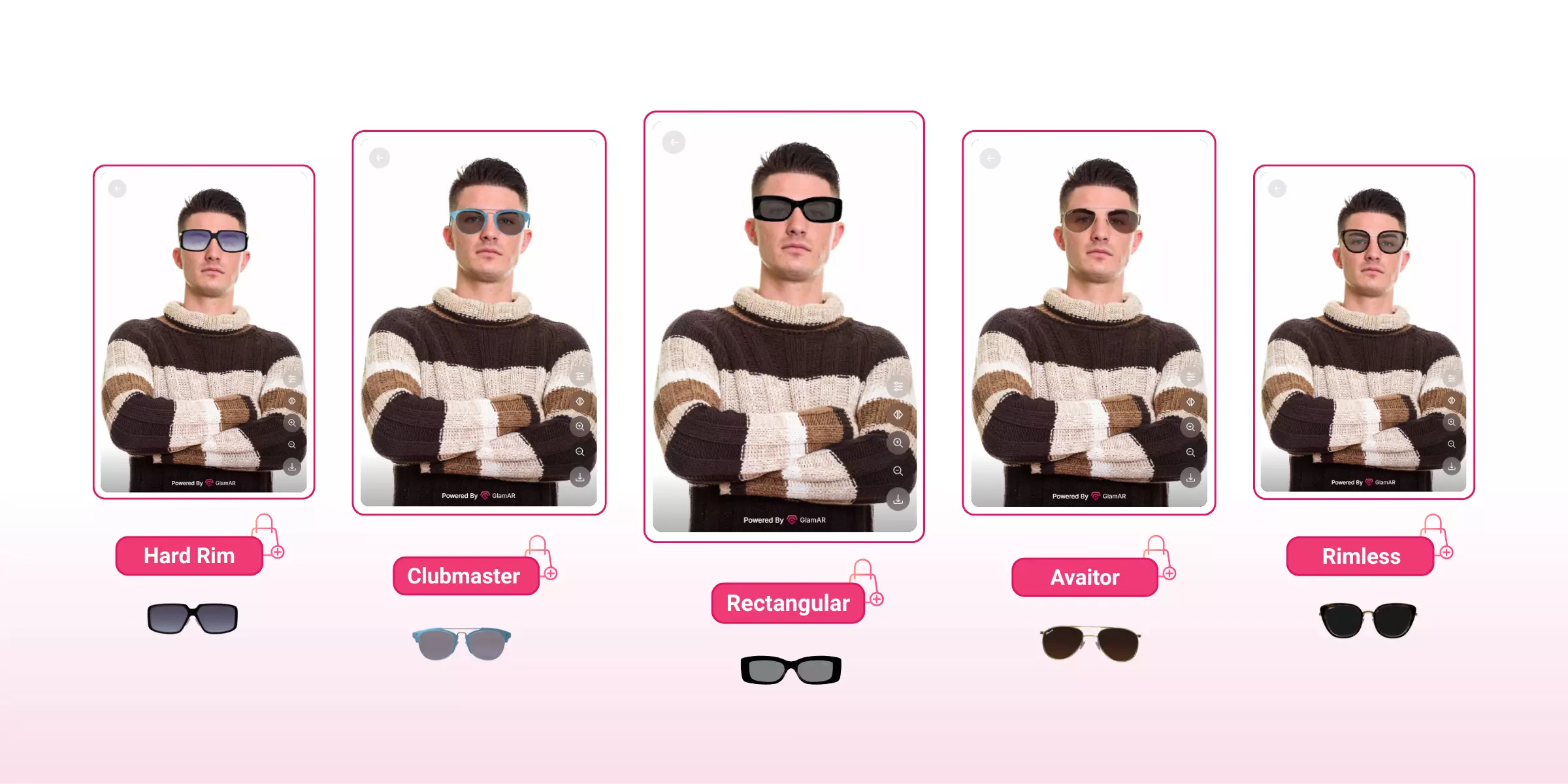
Do you have an eyewear brand? AR try-ons can transform the way your customers shop for your eyewear products. Integrating it allows them to see how different frames will look on their faces from their comfortable space. Thus, it can help shoppers make confident decisions about their eyewear choices.
According to industry reports, the global eyewear market is expected to grow steadily through 2030. To keep pace with this rising trend, eyewear brand owners should invest in AR solutions. Industry surveys indicate that online eyewear purchases have increased significantly over the last two years as consumer preferences evolve.
AR technology can meet the demands of your digital customers. It can give them a personalized and smooth eyewear shopping experience. Thus, AR-powered virtual eyewear try-on tools impact the purchasing patterns of consumers. It can help them buy with greater confidence and reduce the likelihood of returns. As a result, buying eyeglasses online has become far more reliable. Instead, AR connects shoppers with eyewear in a more interactive and engaging way.
In this blog, I will walk you through how eyewear brands are adopting and using AR solutions to step up their digital game:


What is AR in eyewear?
AR eyewear shows digital information, such as text, images, or 3D objects, directly on see-through glasses, layered over the real world. Using cameras and sensors, AR glasses understand your surroundings. They can display helpful content like navigation arrows or live translations, while AR technology also enables virtual try-ons on compatible devices. Most importantly, AR glasses are designed to be hands-free and are increasingly being explored for everyday use.
AR-powered virtual try-on for eyewear uses your customers’ devices’ cameras. It will place virtual 3D glasses on their faces in real time. It can help them see how different frames fit and look. AR technology places a virtual frame on their live camera views and keeps it aligned with their faces as they move, giving a realistic preview. Thus, it makes online eyewear buying easier and more confident.
Glance at the table of popular brands that are using virtual eyewear try-ons
Popular brands that are using virtual eyewear try-ons
AR brings innovation to the eyewear industry. Virtual try-on is one of the most important and widely adopted AR features in eyewear. It offers personalization and convenience during your customers’ shopping journeys. So, renowned eyewear brands are introducing this technology into their platforms. Now, we will explore those brands that are leading the charge of transforming the eyewear shopping space:
1. Warby Parker

Warby Parker is a leading eyewear brand with both online and physical retail stores. It has launched a ‘virtual try-on’ feature to allow consumers to preview glasses in AR. They can visualize how certain frames, textures, and colors will look on their faces in a realistic manner, using accurate measurements. They can try on glasses or sunglasses in true-to-life detail with supported smartphones and tablets (and limited desktop support).
Apart from this, shoppers can get personalized recommendations based on their measurements and preferences, using personalization tools within its iOS app. The tool helps them find the perfect frame. It scans their faces and combines measurements with user-selected style preferences. Finally, the tool will suggest glasses to buy.
2. Ray-Ban
Ray-Ban offers a virtual try-on solution for its wide collection of sunglasses. While trying on Ray-Ban’s sunglasses, they can customize their eyeglasses with the ‘get face shape’ and ‘improve fit’ (with PD) options.
Then, they can choose the right pair of glasses that goes well with their face shape and style preferences. They can experiment with the sunglasses through photo or live camera mode. Thereafter, they can add their eyewear products to their favorites for future purchase.
3. Zenni
Zenni Optical provides customers with an instant virtual try-on tool to explore eyeglasses and sunglasses. They can switch between various frame styles with ease to obtain a real-time experience. On this platform, they will get face-based scaling and PD measurement. It can help ensure the perfect fit along with flawless lens alignment. Consumers need to upload their prescriptions when ordering prescription glasses.
Then, they can customize and order the glasses. Also, they can capture a snap of their try-on experience and share it with their friends and family. The best part is: customers can even try on new frames in a real-time ‘magic mirror’ experience while wearing their current glasses.
4. Lenskart
Lenskart uses 3D AR try-on technology and allows its customers to experience virtual eyewear products. Shoppers are able to try on different prescription glasses or sunglasses online. The AR technology overlays virtual eyeglasses on their faces in real time.
With no physical touch, they can explore multiple frames from the comfort of their homes. Therefore, Lenskart offers an interactive and convenient eyewear shopping experience. Users can try on glasses via live camera or still images and see how the frames will look on me from different angles.
5. Tom Ford
Tom Ford has introduced 3D eyewear try-ons, partnering with Perfect Corp. on its e-commerce platform. Consumers can experiment with Tom Ford’s designer sunglasses for men and women through the virtual try-on technology.
It incorporates pupillary distance calculations to enhance size and fit visualization accuracy. Shoppers can switch the colors while trying on different glasses using their faces and purchase the right ones directly from its website.
"Our 3D Virtual Try-On solution delivers not only technical precision but also emotional resonance, helping brands like Tom Ford Fashion build stronger customer connections through innovation and personalization," said Alice Chang, Founder and CEO of Perfect Corp.

Why do eyewear brands need AR solutions?
Now, eyewear brands are increasingly using augmented reality (AR) to transform their customers’ shopping experiences. It allows digital elements to be overlaid onto the real world through devices like smartphones or webcams. Here, I am going to discuss why brands need AR solutions for their eyewear products:
1. Interactive shopping experience
3D AR technology enables your customers to see the product in context and from all angles. Most importantly, 3D AR technology can provide a buying experience that closely resembles key aspects of an in-store visit. But traditional 360° pictures can provide only a limited view of the product. On the other hand, 3D AR try-ons can offer consumers convenience along with interactivity.
2. Comprehensive product understanding
With 3D AR software, shoppers can obtain a detailed understanding of your eyewear products. This increases confidence in their purchasing decisions. So, customers who use AR virtual try-ons to preview a product can make more informed decisions with significantly less guesswork. It can lead to enhancing conversion rates.
3. Minimal return rates
Virtual eyewear try-ons can develop a deeper understanding of your products among customers. As a result, they may be less likely to return products. It can save time and money for your eyewear brand.
4. Competitive advantage
Introducing 3D AR technology can help differentiate your eyewear brand in a competitive market. If your competitors are still relying on static product images, AR can give your brand a competitive edge. Your brand can help improve customer engagement and long-term loyalty, as you are offering a distinctive and engaging experience with the help of AR.
5. Cost-effective solution
Integrating a 3D AR try-on feature can be cost-effective in the long run. On the other hand, developing physical product inventories or in-person product demonstrations may cost you more than they do. You can use 3D AR technology to display multiple products on a single product page. It can really reduce the necessity for multiple physical samples.
6. Easy-to-integrate technology
Many AR solutions offer low-code or plug-and-play integration, often requiring minimal developer support. Depending on the platform and AR provider, integration can be relatively straightforward.
Glance at the table of the best eyewear try-on SDKs
Best eyewear try-on SDKs
There are plenty of lists of the best eyewear try-on SDKs. This list is based on independent research beyond vendor marketing materials. I researched and evaluated multiple leading eyewear try-on SDKs based on features, usability, and integration flexibility. Here, I have focused on the best virtual eyewear try-on SDKs:
1. GlamAR
GlamAR offers virtual eyewear try-on capabilities that can help differentiate an eyewear brand. Integrating GlamAR’s AR eyewear SDK allows your customers to try and buy eyeglasses without visiting brick-and-mortar stores. Your shoppers can receive a more personalized shopping experience through real-time AR try-ons. As an eyewear brand, if you are looking to enhance your online shopping experience, it may help increase conversion rates and customer confidence.
Based on observed platform features, such as frame comparison, positioning accuracy, and size scaling, I can say that the platform greatly impressed me. It enabled me to choose the right pair of eyeglasses. The good news is: you can add GlamAR’s AR VTO solutions to your website or other e-commerce platforms. So, it can support both web and mobile experiences for your customers.
It can analyze your customer’s face with real-time face-detection technology. Thus, you can display your eyewear products with realism. Apart from this, it can estimate pupillary distance (PD) and face width for better frame visualization. Thus, they will get a personalized eyeglass try-on experience via a live camera or photo mode. It can help improve customer satisfaction and potentially reduce return rates.
2. MirrAR
MirrAR offers advanced AI and AR solutions to enhance the shopping experiences of your customers. They can try on glasses with different frames, lenses, and colors on supported mobile and desktop browsers using this platform. The AI 3D try-on delivers AI-powered face scanning with optional personalization features. It can enhance customer engagement and improve conversions on your online store.
On this platform, consumers can access an automated PD measurement tool. It can measure the binocular PD, the distance between the centers of the pupils of both eyes. It estimates PD using facial landmarks and proportional scaling techniques. The relative dimensions can automatically match the 3D product visual parameters. It enables the realistic-size display of your eyewear products.
To integrate the virtual eyewear try-on solution: you need to digitize and upload your product inventory. Then, your customers can click the ‘try on’ button. It will help them to explore prescription glasses or sunglasses in real time. Also, they can compare one frame to another, side by side, in the same virtual try-on window. The best part is that they can add their favorite eyewear products straight to the cart and purchase them directly. Customers can even try on new frames while wearing their existing prescription glasses.
3. Perfect Corp
Perfect Corp offers AI-powered virtual try-ons for goggles, glasses, and sunglasses. It provides highly realistic shopping experiences for eyewear brands and e-commerce. Now, consumers can see how different frames, lenses, and tints look on them in supported web and mobile browsers. You can create virtual glasses using Perfect Corp’s guided onboarding and asset setup process.
Shoppers can customize certain visual attributes, such as lens tint and color, depending on the brand’s configuration, while trying them on. It can enhance your online product offerings, and your customers can purchase your eyewear products with convenience. Perfect Corp’s 3D AI and AR glasses try-on creates a virtual mirror-like experience directly on the device screen.
The platform reduces the complexity of 3D asset creation compared to traditional methods. Users can use a photo, live camera, or preset models to experiment with the eyewear products in real time. On the plus side, I can get an automatic, accurate, and instant pupillary distance (PD) measurement based on my face shape. It works with face-tracking technology and can ensure a precise frame size for trying on glasses.
4. DeepAR.ai
Do you want to provide your customers with AR shopping for glasses? You can create realistic AR glasses try-on experiences using DeepAR’s platform. Now, your customers can explore AR glasses inside your website or app.
Thus, your customers will get an engaging and interactive shopping journey with 3D and AR features. The DeepAR SDK enables them to try on sunglasses and prescription glasses on supported devices and platforms. They can choose from more color options, zoom in on frame details in 3D, and try them on using AR.
DeepAR offers a developer-friendly SDK with relatively straightforward integration. On top of this, you can customize the integration while displaying your eyewear products in the 3D AR mode. On the other hand, the ShopAR dashboard helps track engagement and performance metrics.
5. Banuba
Banuba has introduced the ‘TINT’ platform for AR try-on solutions. TINT’s virtual try-on technology for eyewear inspires your customers to purchase your products with real-time 3D try-on solutions. It can engage them with precise item fitting and lifelike product looks. It will provide them with a realistic try-before-you-buy feature. As a result, they can experience easy selection and a smooth checkout.
Banuba SDK supports Web, iOS, Android, Mac, and Unity for trying on eyeglasses and prescription lenses. Therefore, your customers can access TINT’s virtual glasses try-on from desktop, mobile, and compatible in-store smart mirror setups. Banuba SDK can ensure the accurate placement of your eyewear products with advanced face tracking technology. It can simulate realistic lighting, motion, and depth effects while shoppers are experiencing camera-based virtual try-ons.
Consumers can measure pupillary distance on this platform without requiring special devices, using face-based estimation. Users can test and try on different pairs of eyeglasses to see which one suits them best. Here, they can get an option to remove the glasses. Also, your customers can customize their chosen eyeglasses' frames.
How to choose the best virtual eyewear try-on SDK?
It should be pretty clear that each of the virtual eyewear try-on tools I selected has a distinct nature. Choosing the right one depends on your budget and how you use the AR features for your eyewear brand. Each of these tools serves different needs, so the right choice depends on your specific business goals. Some platforms, such as GlamAR, offer modular feature sets that can be expanded over time, depending on your requirements.
Apart from this, you should test shortlisted AR try-on platforms through demos or pilot integrations. While the evaluation process can be time-consuming, take the time to learn what is out there. You need to ensure the one you choose has the features that matter most to your brand.
When implemented effectively, these virtual eyewear try-on SDKs can improve operational efficiency to transform shopping experiences that are more reliable, more interactive, and even—dare we say it—more fun.
Conclusion
AR for eyewear brands can help you take your business to the next level of digital innovation. It can contribute to improved customer engagement, higher conversion rates, and potentially reduced returns. Most importantly, implementing the AR SDK for eyewear can provide your customers with a personalized and interactive shopping experience.
If you are looking to add an eyewear try-on SDK to your brand’s platform, choose a solution that aligns with your brand’s technical needs, scale, and customer experience goals. When combined with strong marketing and user experience strategies, AR can support long-term ROI and customer loyalty. You can talk to their sales team directly to discuss your unique requirements.










