


Virtual Try-On for Handbags: How AR Is Changing the Accessories Category in 2026


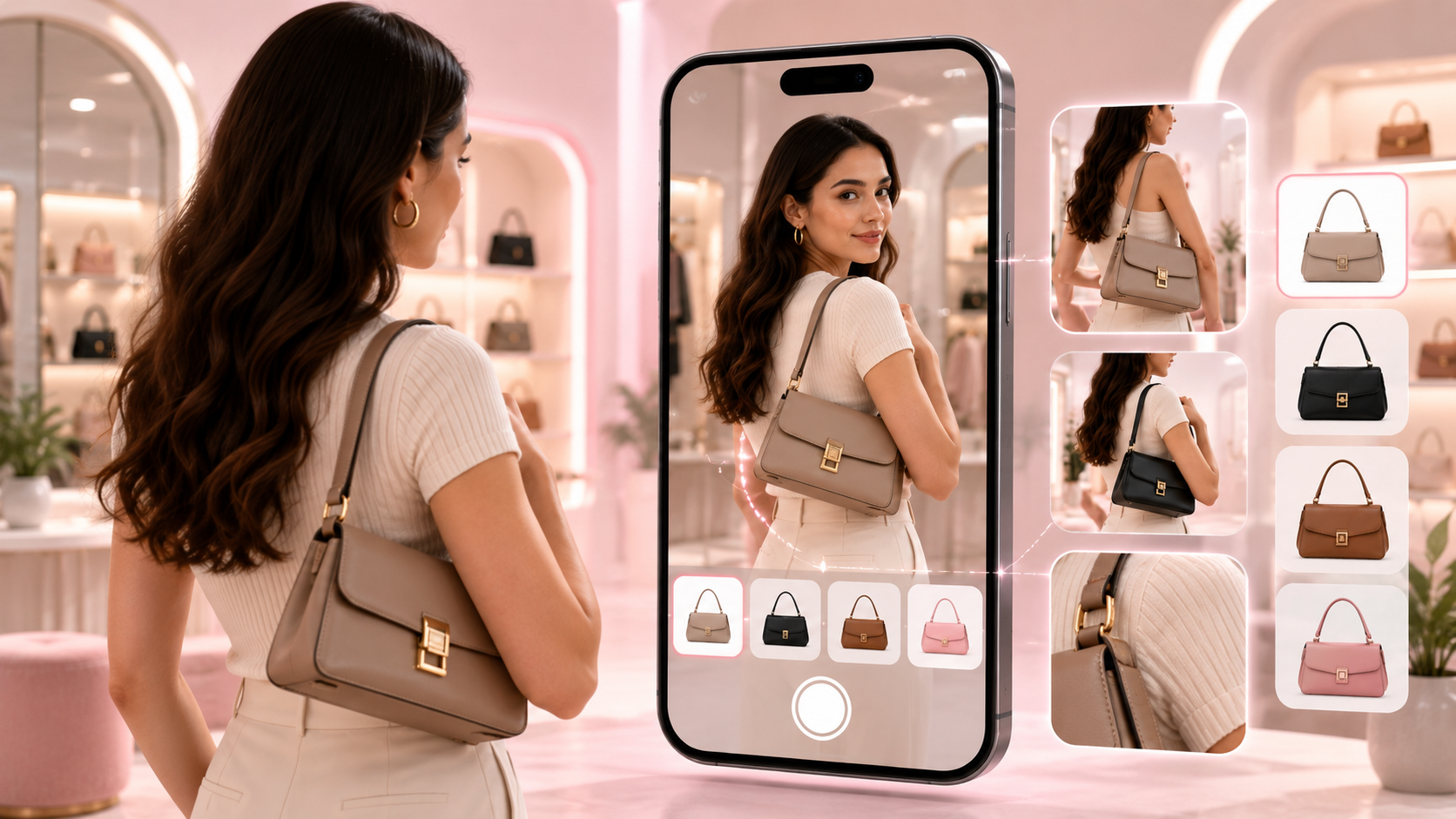
Virtual try-on for handbags lets shoppers see how a bag looks against their body (scale, proportion, strap drop, and color) through a device camera or uploaded image, before placing an order. For accessories brands and e-commerce managers evaluating the technology, the core question is not whether it works: it is which implementation approach fits your catalog, stack, and commercial targets.
Apparel and accessories carry return rates of 25–40% in 2026, with expectation gaps between online product images and real-life appearance as the primary driver. 3D handbag visualization and AR placement close that gap directly at the product page, before the customer decides, not after.
What Is Virtual Try-On for Handbags?
Virtual try-on for handbags is a commerce technology that renders a photorealistic 3D model of a bag in real time, anchored to a shopper's body via camera-based AR or placed against a reference image. Unlike a flat product photo, a 3D model can be rotated, scaled accurately against a human figure, and viewed under different lighting conditions.
This distinction matters for the accessory category specifically. A tote, crossbody, or structured satchel reads very differently at scale on a person's shoulder versus as a flat lay on a studio background. Proportions that read as oversized in a product photo can look balanced on the body, and vice versa. Static imagery cannot resolve that judgment. AR placement can.
From a B2B platform perspective, virtual try-on for bags typically combines three components: a 3D model of the product (converted from physical samples, CAD files, or photography), a real-time rendering engine delivered via SDK or web plugin, and body or surface anchoring that keeps the bag correctly positioned as the camera moves.
How It Works
3D Modeling and Catalog Onboarding
Every handbag virtual try-on workflow begins with the product asset. The brand supplies physical samples, high-resolution photography, or existing CAD/3D files, and the platform converts these into optimized 3D models, typically in glTF/GLB format for web delivery. The model must accurately capture the bag's dimensions, material surface (leather grain, canvas texture, hardware finish), and structural shape at different viewing angles.
Catalog onboarding can be done at individual SKU level or through a bulk upload workflow for larger ranges. Once in the platform's console, models are tagged with metadata (category, dimensions, color variants) and made available to the SDK for rendering.
The quality of the 3D model is the single biggest variable in the experience. A low-polygon or incorrectly dimensioned model will undermine purchase confidence regardless of how the AR layer performs. Evaluating a provider's 3D creation capability is as important as evaluating the try-on SDK itself.
AR Placement and Real-Time Rendering
Once models are in the system, the rendering layer uses the device camera to identify body landmarks, primarily shoulder and torso position, and anchors the bag to the correct position in frame. The bag scales against the person's body in real time, moves as they move, and maintains correct perspective as camera angle changes.
Delivery happens across three main modes: live camera AR (the shopper points their camera at themselves), image-based placement (upload a photo), and model-based try-on (place the bag on a pre-loaded reference figure). Each mode has different technical requirements and suits different catalog types and retail contexts.
The SDK integrates into an existing website or mobile app via plugins or custom code. For brands without a development team, Shopify plugin deployment is the lowest-friction entry point.
Why Handbag Brands Are Adopting This Now
Reducing Return Rates
Accessories and apparel combined represent the highest return rates in e-commerce, running 25–40% for online purchases as of 2026. The dominant return reason across this category is that the product looked different in real life than it did online, a problem that static photography structurally cannot solve.
Virtual try-on attacks this at the source. By giving customers an accurate sense of scale, proportion, and color against their own body before purchase, it removes the most common source of disappointment post-delivery. Brands deploying AR try-on across fashion categories have reported return rate reductions in the 25–40% range, with the impact concentrated on the expectation-gap returns that are hardest to address through copy or photography improvements alone.
For handbag-specific categories, size perception is the dominant driver of returns. A buyer who can confirm that a structured tote sits correctly on their shoulder, or that a mini bag reads as intended against their frame, is a buyer who has already done the fit evaluation that would otherwise happen after delivery.
Increasing Purchase Confidence
The same mechanism that reduces returns also increases conversion. Shoppers who engage with AR product experiences spend more time with products than those who view static images alone. GlamAR's platform data shows that 3D and AR-enabled products drive up to 4x more time-on-product compared with standard product pages, and that average order value doubles when AR is part of the purchase journey.
The confidence effect is particularly pronounced for higher-ticket accessories, where purchase hesitation is higher and the cost of a wrong decision is greater. A £300 structured bag carries more decision weight than a £30 impulse buy, and the ROI on try-on is proportionally larger.
What to Look for When Evaluating a Provider
Brands evaluating handbag virtual try-on platforms should apply these criteria:
3D model quality and creation process
Ask to see example models of structured bags, not just soft accessories like scarves. Structured bags require accurate corner geometry, hardware rendering, and leather-grain surface detail. Ask whether the provider handles model creation from your source materials or whether you are expected to supply ready-made 3D files.
Catalog onboarding scalability
For a brand with more than 50 SKUs, individual model uploads are not viable. Confirm whether bulk onboarding workflows exist and what the per-model creation timeline and cost structure looks like.
Integration method and development requirement
Plugin deployment (Shopify) requires minimal development resource. SDK integration gives more control but requires developer time. Web-based delivery means no app install barrier. Establish what your team can realistically support before selecting a deployment path.
Platform coverage
Confirm the SDK works across Android, iOS, web, and (if you have physical retail) in-store tablet and mirror surfaces. A solution that works well on mobile web but degrades on desktop, or vice versa, creates an inconsistent experience across your customer base.
Data handling and privacy
Camera-based try-on captures image data from your customers. Confirm how that data is processed, where it is stored, whether it is retained, and whether the provider holds relevant certifications (SOC 2, GDPR compliance, ISO). For brands selling into the UK or EU, this is a procurement requirement, not optional.
White-label delivery
Your AR experience should carry your brand, not the platform provider's. Confirm white-label interface options are available and what level of customisation is supported.
Analytics
The platform should provide product-level engagement data: which SKUs are being tried on, average try-on duration, and conversion attribution. Without this, you cannot measure ROI or optimise your catalog for the experience.
Implementation timeline
Understand what "ready to launch" actually means: model creation time, integration testing, QA, and staged rollout. A realistic timeline avoids a situation where a commercial deadline is set before the technical work is complete.
How GlamAR Supports Handbag Virtual Try-On
GlamAR's accessories virtual try-on solution supports 3D handbag visualization alongside a broader accessories category that includes hats, caps, watches, necklaces, earrings, bracelets, and rings. The platform's 3D rendering capability is designed for structured product categories where surface detail and accurate dimensioning are critical to purchase confidence.
Integration follows a three-step workflow. Brands upload SKUs individually or in bulk to the GlamAR console, integrate the SDK into their website or app via plugins or custom integration, and preview the AR experience before going live. The SDK supports Android, iOS, web, in-store tablet, in-store mirror, and Unity AR deployment from the same platform.
Custom features available on request include side-by-side product comparisons (relevant for evaluating two bag options against each other), an accessories virtual store environment, Apple Vision Pro immersive experience, and an accessories 3D configurator for brands that offer customization options.
The platform reports an average 94% increase in conversion and 40% decrease in returns across accessories customers, alongside a 4x increase in time spent with AR-enabled products.
GlamAR holds SOC 2, GDPR, and ISO certifications, relevant for brands requiring data handling verification as part of procurement.
To see the platform's accessories capability in action, visit the GlamAR accessories demo store or speak with the team about running a proof of concept with your own catalog.
Conclusion
Handbag virtual try-on is a measurable commercial tool, not a novelty layer. For accessories brands experiencing high return rates driven by expectation gaps, or conversion pressure from shoppers hesitant about purchasing higher-ticket items online, 3D visualization and AR placement address the problem at its source.
The decision criteria are practical: 3D model quality, catalog onboarding scale, integration method, platform coverage, and data handling. Brands that get these right see the return and conversion benefits. Brands that rush to deployment without resolving model quality or integration fit see marginal results.
Talk to the GlamAR team about running a proof of concept with your own handbag catalog, or explore the accessories demo store to see the AR experience live.
No. GlamAR's SDK delivers the AR experience through the web browser and via your existing mobile app if integrated. There is no separate app download required for your customers. The experience runs directly within your product page environment.
GlamAR handles 3D model creation from your source materials: physical samples, photography, or existing CAD files. You do not need to supply ready-made 3D files. Bulk onboarding workflows are available for larger catalogs. Contact the team for specific format guidance and per-model creation timelines.
Implementation timeline depends on catalog size, integration complexity, and whether you are deploying via plugin (Shopify) or custom SDK integration. Plugin deployment is faster; custom SDK integration requires developer resource. A realistic timeline discussion with the GlamAR team before committing to a launch date is recommended.
GlamAR operates a commercial model based on the scope of integration, catalog volume, and platform coverage required. Pricing for AR try-ons is outlined at glamar.io/pricing/ar-try-on. For handbag or accessories-specific scoping, the best route is a direct conversation with the team.
Camera-based AR try-on processes image data to anchor the product to the user's body in real time. GlamAR holds SOC 2, GDPR, and ISO certifications, which cover data handling, storage, and privacy obligations. For brands selling into the UK, EU, or other regulated markets, the team can provide detailed data processing documentation as part of the procurement process.
Yes. GlamAR's SDK supports in-store tablet and in-store mirror deployment, alongside web, iOS, and Android. For accessories brands with both online and physical retail, this means the same catalog and 3D model set can serve both channels without separate platform arrangements.
Scopri come AR, VR e 3D possono favorire la crescita dei ricavi nel 2026
Pianifica una chiamata con il nostro team

.avif)