


AI Skin Analysis Privacy and Consent: What Brands Need to Know


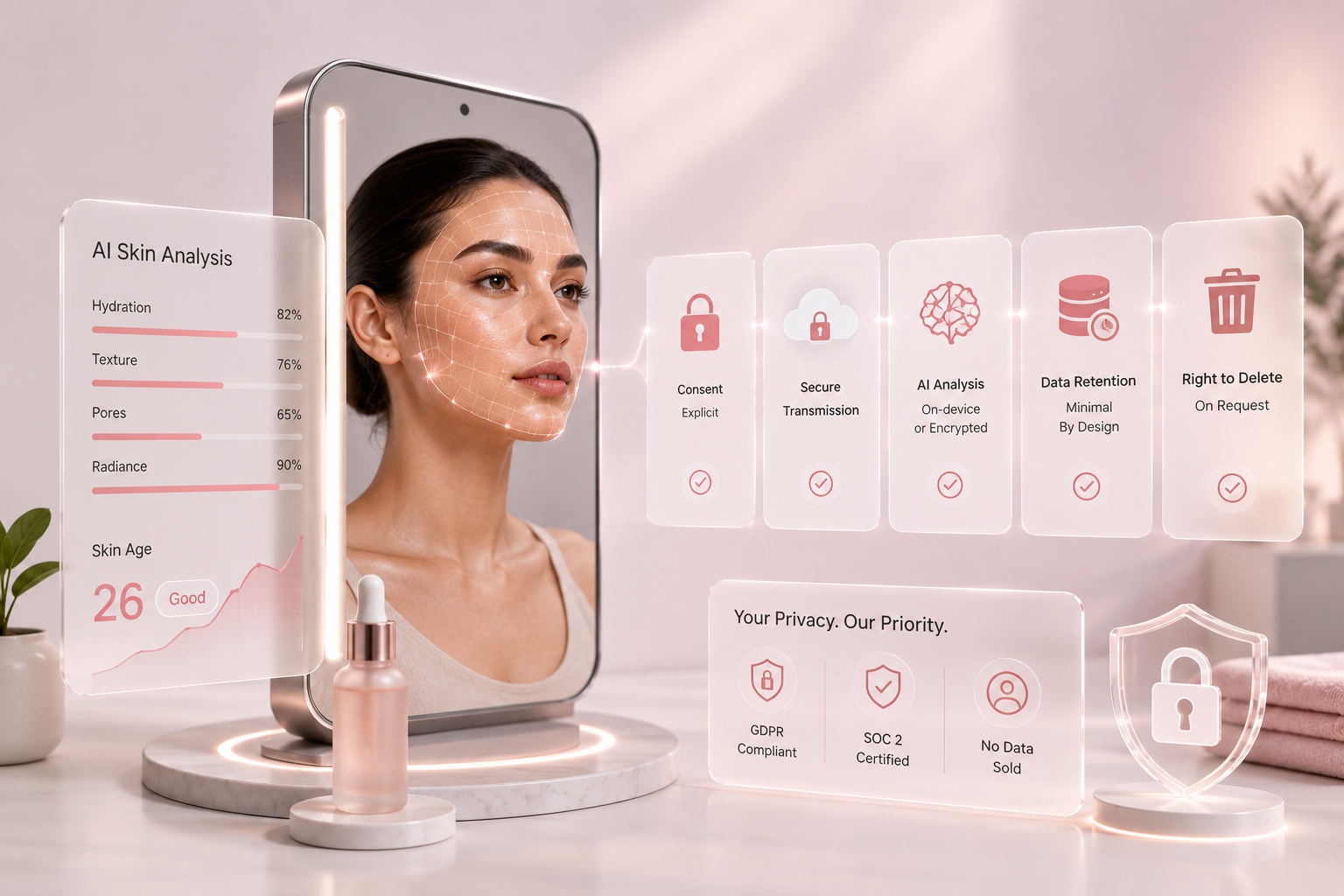
AI skin analysis privacy comes down to four things: what happens to a customer's facial image after it's captured, whether consent was collected properly before that capture, who legally controls the data, and whether a customer can get it deleted on request. Below is how that data flow actually works, what a compliant consent mechanism looks like, and a procurement checklist for any brand evaluating a vendor.
A skin scan is not the same category of data as an email address or a purchase history. It's biometric or biometric-adjacent data, treated as a special or sensitive category under most privacy frameworks, and it carries a different risk profile precisely because a face can't be reset the way a password can. Brands adding AI skin analysis to their ecommerce site or in-store experience are taking on privacy obligations that go beyond a standard data processing agreement, and getting this wrong has produced some of the largest privacy settlements on record, including Meta's 650 million dollar settlement over facial recognition in photo tagging and a 1.4 billion dollar settlement with the Texas Attorney General over similar practices. Beauty and skincare brands aren't the ones being sued in these specific cases, but the underlying legal exposure, collecting facial data without proper consent or retention controls, applies just as directly to a skin analysis feature on a product page.
Why facial scan data gets treated differently
Most customer data a brand collects, email, purchase history, browsing behavior, can be changed or reissued if it's ever compromised. A password can be reset. A credit card can be cancelled and reissued. A face cannot. That permanence is the core reason regulators single out biometric identifiers, including facial geometry derived from a skin scan, for stricter handling than ordinary personal data.
It's worth being precise about a distinction that trips up a lot of teams: a photograph itself is generally not classified as biometric data under most laws. What crosses into biometric territory is the mathematical template or set of measurements a system extracts from that photo, the facial geometry, landmark positions, or skin-region measurements a skin analysis model generates during processing. An AI skin analysis tool, by design, extracts exactly this kind of data in order to detect and score skin concerns, which is precisely why this category sits inside biometric privacy regulation rather than general data protection rules alone.
The data flow: what actually happens to a scan
Understanding privacy risk starts with understanding where a customer's image actually goes, since each stage carries different obligations.
1. Capture. A customer either grants live camera access or uploads a photo. This is the point where consent needs to be collected, before the camera activates or the upload is processed, not buried in a general terms-of-service page the customer may never read.
2. Transmission. The captured image is sent from the customer's device to wherever processing happens. This can occur entirely on-device, never leaving the customer's phone or browser, or it can be transmitted to a server for processing. On-device processing carries meaningfully lower privacy risk, since the raw image never travels across a network or touches third-party infrastructure at all.
3. Processing. The system extracts skin measurements and concern scores from the image, whether that happens on-device or server-side. This is the stage where biometric data, in the legal sense, is actually generated, since the raw photo is converted into a structured set of facial and skin measurements.
4. Storage. The image, the derived biometric data, or both may be retained after the session ends, depending on the vendor's architecture and the brand's own configuration. This is the stage that determines most of a brand's ongoing compliance exposure, since data that isn't retained can't later be breached, misused, or subject to a deletion request that wasn't honored.
5. Deletion or retention expiry. Data should be deleted according to a defined retention policy, either automatically after a set period or on customer request, with that deletion actually executed and verifiable rather than just promised in a privacy policy.
A brand evaluating any AI skin analysis vendor should be able to get a clear answer, in writing, about what happens at each of these five stages, not just a general assurance that "privacy is a priority."
Consent mechanisms: what actually holds up
Consent for biometric data collection has a higher bar than consent for general marketing data, and getting the mechanism wrong is the single most common compliance failure in this category.
1. Specific and separate, not bundled.
Consent for biometric collection needs to be its own distinct action, not folded into a general terms-of-service checkbox a customer clicks without reading. Regulators and courts have repeatedly found bundled consent insufficient, particularly under Illinois's Biometric Information Privacy Act, which has generated the largest volume of biometric privacy litigation in the United States.
2. Informed, not assumed.
A compliant consent flow discloses, before capture, what data is being collected, why, and how long it will be retained. A vague "we use AI to analyze your skin" notice does not meet this bar in most frameworks. The disclosure needs to name the actual category of data (facial image, derived skin measurements) and the actual purpose (generating a skin analysis and product recommendation).
3. Freely given, with a real alternative.
Where practical, a customer should have a path to use the feature, or an equivalent alternative like a quiz-based flow, without being forced into biometric capture as the only option. This matters both for regulatory compliance in jurisdictions that require consent to be freely given, and for accessibility, since not every customer wants to enable a camera.
4. Captured and logged, not just displayed.
The system should record that consent was given, when, and under what version of the disclosure text, since being able to demonstrate consent after the fact is often as important as collecting it correctly in the first place. A consent screen that flashes past without any record of acceptance doesn't hold up under audit or legal challenge.
5. Renewed when purpose changes.
If a brand later wants to use previously collected scan data for a new purpose, training a new model feature, for instance, that's generally a new processing purpose requiring fresh consent, not something covered retroactively by an initial disclosure written for a narrower use.
Image capture and retention: the specifics that matter
What's captured versus what's retained are different questions.
A system might capture a live video frame for real-time processing but retain only the derived scores, discarding the actual image immediately after analysis. This is a materially lower-risk architecture than one that stores the raw photo indefinitely, and it's worth asking any vendor to describe their actual retention behavior at this level of specificity rather than accepting a general statement that data is "handled securely."
Default retention periods should be short and disclosed.
A reasonable default is retaining raw images only as long as needed to complete processing, then discarding them, while derived, non-identifying scores may be retained longer for the customer's own benefit, such as tracking skin improvement over time. Any retention beyond immediate processing needs to be disclosed as part of the consent flow, not decided unilaterally by the vendor after the fact.
Anonymization reduces but doesn't eliminate risk.
Some platforms strip identifying facial features from stored data while preserving the skin-relevant detail needed for analysis and historical comparison. This is a meaningful risk reduction technique, since anonymized data is less likely to be classified as biometric data requiring the strictest handling, but it needs to be implemented correctly, since poorly executed anonymization can sometimes be reversed.
Cross-session tracking requires its own disclosure.
If a brand wants to track a customer's skin progress across multiple visits, which requires retaining some identifying link between scans, that's a distinct data use from a one-time analysis and should be disclosed and consented to separately, ideally tied to an account the customer explicitly opted into rather than an anonymous device fingerprint.
Processor versus controller: who's actually responsible
This distinction determines who bears legal responsibility when something goes wrong, and it's frequently misunderstood by brands licensing a third-party skin analysis tool.
The data controller decides why and how personal data is processed. In most AI skin analysis deployments, the brand itself is the controller, since the brand decides to offer the feature, determines what happens with the results, and owns the customer relationship.
The data processor processes data on the controller's behalf and instructions, without independently deciding how it's used. A skin analysis vendor should generally sit in this role relative to the brand, meaning the vendor processes scans according to the brand's configuration and doesn't repurpose that data for its own separate ends, such as training models for other customers, without explicit agreement.
Get this assignment in writing, not assumed. A vendor's actual contractual role, controller or processor, should be explicit in the data processing agreement, not inferred from marketing language. GlamAR's model, for example, positions the brand as the owner of captured data with the underlying platform acting strictly as processor, meaning data is exportable and deletable on the brand's request and is not used to train models for other customers. Confirm this same structure, in writing, with any vendor before deployment, since a vendor that treats itself as a co-controller or reserves rights to reuse data introduces materially different risk than a pure processor relationship.
Subprocessors need the same scrutiny. If a vendor relies on third-party infrastructure, cloud hosting, or additional AI providers to deliver the service, those subprocessors should be bound by the same data handling terms as the primary vendor, and a brand should know who they are rather than treating the vendor as a black box.
Deletion rights: making them real, not theoretical
Customers should be able to request deletion, and that request should have a defined response time. Most privacy frameworks that treat biometric data as sensitive require honoring deletion requests within a specific timeframe, and a vendor should be able to state that timeframe explicitly rather than leaving it undefined.
Deletion needs to propagate everywhere the data lives. If an image or derived data was replicated across backups, analytics systems, or subprocessor infrastructure, a genuine deletion request needs to reach all of those locations, not just the primary database. Ask a vendor directly how deletion propagates through their systems, since a deletion that only touches the front-end record while backups retain the data indefinitely doesn't meet the standard most regulations expect.
Account-level deletion versus scan-level deletion. A customer may want to delete a single scan while keeping their account, or delete their account entirely along with all associated scan history. A well-built system supports both, and a brand should confirm which options are actually available before assuming full flexibility.
Deletion confirmation should be verifiable. A brand-facing dashboard or API response confirming a deletion was executed, not just a customer-facing message saying a request was received, gives a brand the audit trail it needs if a deletion is ever challenged or reviewed by a regulator.
Security standards worth confirming
Independent certifications carry more weight than self-declared policies. Look for certifications like SOC 2 and ISO 27001, which require independent audit of a vendor's security practices, rather than a general statement of taking security seriously. GDPR compliance documentation should similarly be something a vendor can produce on request, not just a checkbox on a marketing page.
Encryption in transit and at rest. Confirm that image data is encrypted both while being transmitted from the customer's device and while stored on the vendor's infrastructure, since either gap creates a meaningful exposure point.
Access controls internally. Ask who inside the vendor's own organization can access raw customer images or derived biometric data, and under what circumstances. A vendor with broad internal access to sensitive scan data, without logging or role-based restriction, represents a real risk even if external-facing security is strong.
Incident response commitments. Confirm what a vendor's breach notification timeline and process look like, since most regulations impose specific notification deadlines on the controller, meaning your brand, and you need your processor to notify you fast enough to meet those obligations yourself.
Regional compliance checklist
European Union and United Kingdom. Biometric data processed to uniquely identify a person is classified as special category data under GDPR Article 9, with processing prohibited by default unless a specific exception applies, most commonly explicit consent. A Data Protection Impact Assessment is generally required before deploying a biometric processing system, and UK GDPR mirrors this structure closely post-Brexit.
United States, Illinois specifically. Illinois's Biometric Information Privacy Act is the strictest and most litigated biometric law in the country, requiring written informed consent before collection, a written retention and destruction policy, and reasonable security safeguards. It's the only US biometric law with a private right of action, meaning individuals, not just regulators, can sue, with statutory damages per violation. Any brand with customers in Illinois should design to this standard regardless of where the brand itself is based.
United States, Texas and Washington. Both states have dedicated biometric statutes similar in substance to Illinois's law but enforced only by the state attorney general rather than through private lawsuits. Recent enforcement, including a large settlement secured by the Texas Attorney General over facial recognition practices, shows these laws carry real regulatory teeth even without a private right of action.
Other US states. A growing number of states, including Virginia, Colorado, and Connecticut, treat biometric data as sensitive personal information under broader comprehensive privacy laws, generally requiring opt-in consent and granting access and deletion rights. California's CCPA and CPRA similarly classify biometric information as sensitive personal information with its own specific handling requirements. The practical implication for a brand operating nationally is that designing to the strictest applicable standard, effectively Illinois's BIPA, covers most of the requirements elsewhere by default.
Other target markets. For brands operating across the Middle East, Africa, Southeast Asia, and Australia, biometric and facial recognition rules vary significantly by country and are evolving quickly, with some markets adopting GDPR-influenced frameworks and others still developing dedicated biometric provisions. Confirm current requirements for each specific market you operate in rather than assuming a single global consent flow covers every jurisdiction adequately.
Procurement questions for buyers
Before signing with any AI skin analysis vendor, get direct, written answers to these questions.
- Where is the image processed, on-device or on a server, and does the raw image ever leave the customer's device?
- What data is retained after processing completes, and for how long, by default?
- Is the vendor a data processor or a co-controller, and is this explicit in the contract rather than implied?
- Can a customer's data be deleted on request, how long does that take, and does deletion propagate to backups and subprocessors?
- What independent security certifications does the vendor hold, and can they produce audit documentation on request?
- Does the vendor use customer scan data to train models for other customers, and if so, is that disclosed and consented to separately?
- What does the consent flow actually look like at the point of capture, and is it a distinct, informed action rather than bundled into general terms?
- What is the vendor's breach notification timeline, and does it meet the regulatory deadlines your brand is required to follow?
A vendor that answers these questions clearly and specifically, ideally with documentation rather than verbal assurance, is a meaningfully lower-risk choice than one that responds with general reassurance instead of specifics.
Getting started
Privacy and consent shouldn't be an afterthought bolted onto a skin analysis feature after launch. Build the consent flow, retention policy, and deletion mechanism into the initial scope of any integration, and get the processor relationship documented in writing before the first customer scan happens, not after. For a closer look at the underlying technology this privacy framework applies to, see the AI facial skin analysis solution.
The photograph itself is generally not classified as biometric data under most laws. The facial geometry or skin measurements a system extracts from that photo during analysis typically are, which is why the processing step, not just the image capture, is what triggers biometric privacy obligations.
In most frameworks with biometric-specific provisions, yes. Bundling biometric consent into a general terms-of-service acceptance has repeatedly been found insufficient, particularly under laws like Illinois's BIPA, so a distinct, informed consent step at the point of capture is the safer standard to design to.
A common, lower-risk approach is retaining the raw image only as long as needed to complete processing, then discarding it, while derived scores may be retained longer with disclosure and consent, particularly if a customer wants to track skin changes over time.
Typically, the brand, acting as the data controller, bears primary responsibility, while the vendor acts as a processor handling data according to the brand's instructions. This should be explicit in a written data processing agreement rather than assumed.
Yes, and most privacy frameworks that classify biometric data as sensitive require honouring that request within a defined timeframe. Confirm with any vendor how deletion actually propagates across their systems, including backups and any subprocessors.
Illinois's Biometric Information Privacy Act is generally considered the strictest and most litigated biometric law globally, given its private right of action and statutory damages. Designing consent and retention practices to meet BIPA's standard tends to cover most other applicable requirements as a byproduct.
Descubra cómo la realidad aumentada, la realidad virtual y el 3D pueden impulsar el crecimiento de los ingresos en 2026
Programa una llamada con nuestro equipo

.avif)