


Magic Mirror for Retail: How Smart Mirrors Work in Stores


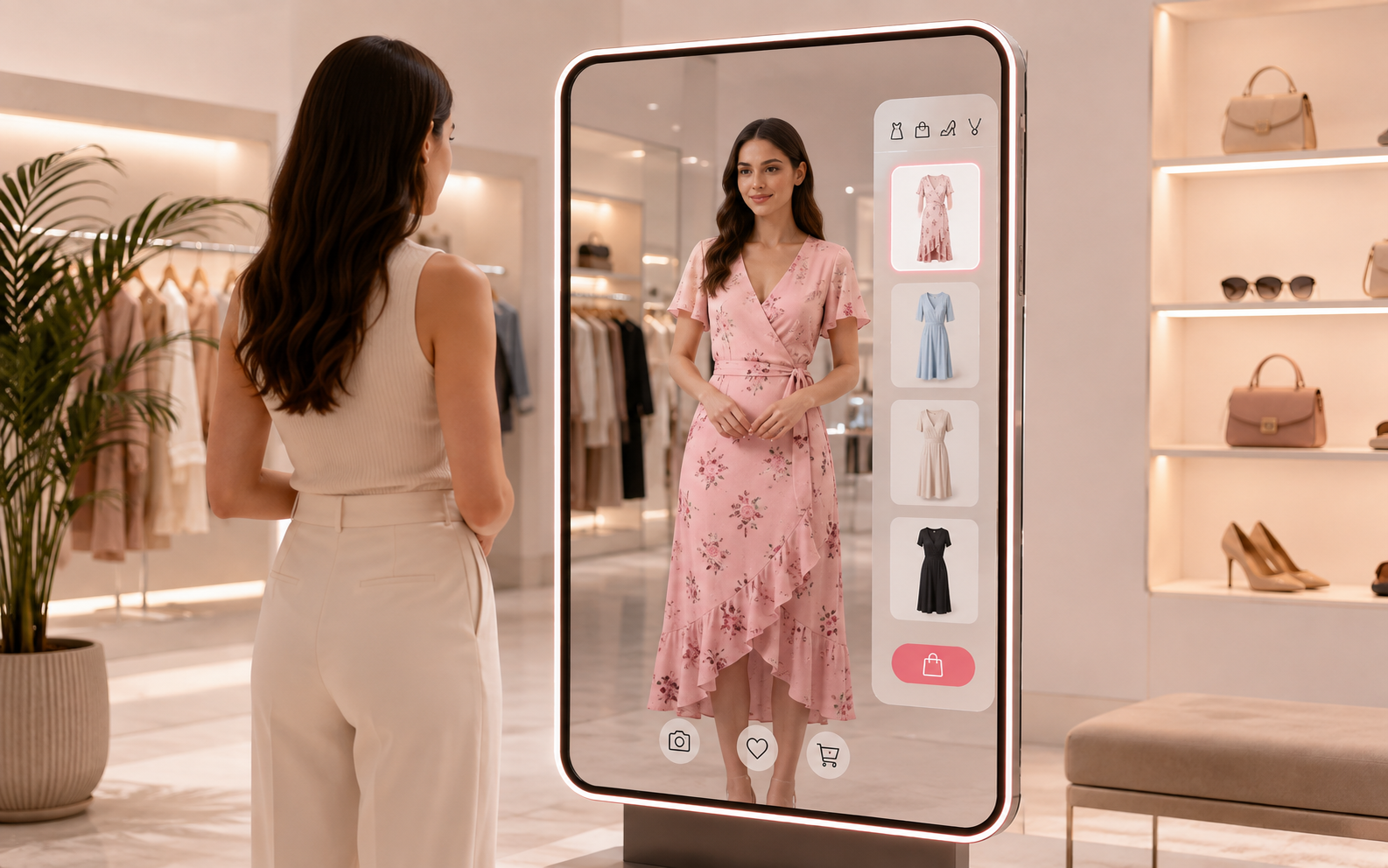
A Magic Mirror for retail is a full-length AI-powered screen on the shop floor that lets shoppers try on products from a store's entire catalogue without physically handling them or entering a fitting room. Shoppers step in front of the mirror, browse the digital catalogue on a touch interface, and see items rendered on their own reflection in real time.
This guide covers how a Magic Mirror actually works under the hood, where it fits in fashion, beauty, jewellery, and eyewear retail, what a brand needs to prepare before deploying one, and what to check before choosing a provider.
What a Magic Mirror Is
A Magic Mirror, also called a smart mirror or AR mirror, is an interactive retail display that combines a large screen, a camera, and virtual try-on software into one in-store fixture. Instead of a static reflective surface, it functions as a digital catalogue browser and a fitting tool at the same time.
The core idea is simple. A physical store can only display a fraction of what a brand actually sells, limited by shelf space, rack capacity, and how much stock a location can hold. A Magic Mirror removes that ceiling. Shoppers standing in front of one screen can browse the full digital catalogue, not just what happens to be on the rack that day, and see how any item looks on them before deciding whether it is worth trying on physically or buying outright.
GlamAR's Magic Mirror is built around this exact model: a single mirror on the shop floor that lets shoppers try on anything in a store's catalogue, build outfits, get size guidance, and order, all from one screen.
How the Hardware and Software Work Together
A Magic Mirror is not just a screen with a camera bolted on. It is a coordinated system where hardware capture, catalogue data, and rendering software all have to work together in real time for the experience to feel instant.
The hardware side. GlamAR's Magic Mirror uses a high-resolution RGB camera for body and face capture, a touch screen interface with an optional companion tablet, and a standard six-foot display (or a custom size depending on the store layout). The footprint is under four square feet, which means it does not require construction or a dedicated room to install.
The software side. The touch interface pulls from the connected product catalogue, which syncs automatically once integrated. When a shopper selects an item, the try-on software renders it on their live reflection, calibrated to the actual product's fabric drape, color, and fit, rather than a generic overlay.
How they connect. The mirror integrates with a store's catalogue, inventory, point-of-sale, and order management systems. It is built natively for Fynd Commerce and connects to other platforms through API connectors, so the mirror is not an isolated kiosk. It reflects live stock and pricing, and an order placed at the mirror can flow into the same fulfillment systems as any other sale.
Put together, the flow looks like this: a camera captures the shopper's proportions, the software matches that data against the selected product's calibrated fit model, and the render appears on-screen within seconds, life-size and positioned against the shopper's actual reflection rather than a static mannequin.
Store Use Cases: Fashion, Beauty, Jewellery, and Eyewear
A Magic Mirror is not a single-category tool. GlamAR's version is built to support fashion and apparel, footwear, eyewear, cosmetics, accessories, jewellery, and other lifestyle categories from the same hardware, with the interface customized to match the retailer's catalogue, brand identity, and in-store journey.
Fashion and apparel. This is the most direct use case: full collection try-on, outfit building across tops, bottoms, shoes, and accessories, and the ability to order an out-of-stock size or color directly from the mirror instead of losing the sale. Bridal and occasion retail is a related use case, letting a shopper see more looks with far less garment handling than trying on physical samples one at a time.
Beauty. In beauty retail, the Magic Mirror pairs with GlamAR's Skin Analysis and virtual makeup try-on, so a shopper can get a skin assessment and try shades on their own face at the same fixture, without a counter consultation or physical testers.
Jewellery and eyewear. Both categories benefit from a live try-on that improves fit confidence before purchase. A shopper can compare frame shapes and colors through eyewear virtual try-on without a staff member handling every pair, or preview how a piece from jewellery virtual try-on actually looks worn, which reduces the guesswork that drives returns in both categories.
Across all of these, the mirror is deployed in flagship stores, department stores, experience centers, shopping malls, pop-up stores, and retail showrooms, wherever a brand wants to extend its catalogue reach beyond what physical shelf space allows.
What Catalogue Inputs You Need to Run a Magic Mirror
The mirror's usefulness depends entirely on what it can pull from a store's digital catalogue, so getting the catalogue in order is the real preparation work before a deployment.
At minimum, this means a synced product catalogue covering the SKUs a brand wants available at the mirror, since the whole point of the experience is showing shoppers more than what is on the rack. GlamAR's integration connects to a retailer's existing catalogue, inventory, POS, and order management systems, and once connected, the catalogue syncs automatically rather than requiring manual re-uploads every time stock changes.
Because the mirror renders garments and products against the shopper's actual proportions, calibrated to real fabric drape, color, and fit, the underlying product data needs to support that level of rendering, not just a product photo and a price. Brands with existing 3D assets or detailed size and fit data will generally have a faster path to a working mirror than brands starting from flat product photography alone.
The practical starting point for most brands is a pilot: sync the catalogue for one category or one store, confirm the render quality and size recommendations look right against real inventory, then expand from there rather than trying to onboard an entire multi-category catalogue on day one.
The Customer Journey Through a Magic Mirror Experience
GlamAR's Magic Mirror is designed to take a shopper from walking up to checking out in roughly 90 seconds, across five steps.
- Capture. The shopper steps up to the mirror, and one photo captures their body and proportions. No app, no account, no login.
- Browse. The full digital catalogue appears on screen, not just what is physically stocked on the shop floor that day.
- Try on. The shopper taps a product, and it renders life-size on their reflection within seconds.
- Style. Shoppers can layer tops, bottoms, shoes, and accessories to build a complete look without changing clothes between each combination.
- Order. The mirror recommends a size, the shopper adds the item to cart, and pays through the kiosk or a QR code, choosing in-store pickup, home delivery, or (where supported) delivery within 30 minutes.
Store associates are not cut out of this journey. They can use the same mirror to recommend products, suggest complementary items once a shopper has built part of a look, and guide a shopper toward a complete outfit, which turns the mirror into an upselling tool rather than a self-service kiosk that replaces staff interaction.
Analytics: What Data a Magic Mirror Captures
A Magic Mirror generates a layer of in-store behavioral data that a traditional fitting room simply cannot produce, because every interaction happens on a connected digital system instead of behind a closed door.
The core metrics a retailer can track through a mirror deployment include how many garments or products get tried on per session (GlamAR's data shows shoppers typically try on 20 to 50-plus items in a single session), how that compares to what a shopper could physically try in a traditional changing room, basket size and conversion from mirror sessions, and how much fitting-room space and garment-handling time the mirror frees up. Retailers running a pilot are specifically encouraged to measure trials, conversion, basket size, staff time saved, and customer response over a defined period before deciding whether to scale.
This data matters beyond justifying the mirror itself. It gives merchandising and buying teams visibility into which styles, colors, and combinations shoppers actually try, not just what they eventually buy, which is a layer of signal a standard POS system does not capture on its own.
Privacy Considerations
Because a Magic Mirror captures a photo of the shopper to render try-on, privacy is a reasonable and common question for any retailer evaluating the technology, and it is worth confirming directly with a provider before deployment.
On GlamAR's Magic Mirror, photos are processed in real time and are not stored. No images are saved to disk or to the cloud, and session data is discarded the moment the shopper walks away from the mirror. There is no persistent facial or body data retained after the session ends.
For retailers operating across multiple regions, this matters for regulatory reasons as much as customer trust. GlamAR's platform is SOC 2, GDPR, and ISO 27001 certified, which covers the broader data handling and security posture around the deployment, not just the individual photo-capture step at the mirror itself.
Implementation: What a Brand Needs to Do to Deploy One
Setting up a Magic Mirror is a lighter lift than most retailers expect, mainly because the hardware footprint and setup process are both deliberately minimal.
Space and power. The mirror requires under four square feet of floor space, standard power, and a network connection. No construction is needed.
Setup time. A GlamAR Magic Mirror can be set up in under two hours once power, network, and floor space are ready, with the catalogue syncing automatically from there.
Systems integration. The mirror needs to connect to the retailer's product catalogue, inventory system, POS, and order management system. This is native for brands already on Fynd Commerce, and available through API connectors for other platforms.
Pilot before scale. The recommended path is to run one mirror in a single flagship store for 30 to 60 days, measuring trials, conversion, basket size, staff time saved, and customer response, then use that real data to decide on a wider rollout rather than committing to multiple locations upfront.
Ongoing cost structure. Pricing is typically a monthly subscription covering hardware, software, catalogue integration, and support, with the exact cost depending on the number of mirrors and the size of the catalogue being connected.
Vendor Evaluation Checklist
Not every AR mirror provider is built the same way, so it is worth checking a short list of specifics before signing with one.
Rendering accuracy. Ask whether garments render against the shopper's actual proportions, calibrated to the real product's fabric, color, and fit, or whether it is a generic overlay that looks convincing in a demo but not on an actual customer.
Catalogue integration depth. Confirm whether the catalogue syncs automatically from your existing systems, or whether it requires manual re-uploads every time inventory changes. Manual sync becomes a real operational burden fast.
Systems compatibility. Check whether the provider connects natively to your commerce platform or requires custom development to link catalogue, inventory, POS, and order management systems together.
Privacy and data handling. Get a direct, specific answer on whether photos or session data are stored anywhere, for how long, and under what compliance certifications. This should not require a follow-up meeting to clarify.
Hardware footprint and setup time. A large footprint or a multi-day installation changes the store-level economics of deploying more than one mirror. Ask for the real floor-space requirement and setup timeline, not just the marketing figure.
Pilot availability. A provider willing to start with a single mirror in one store for a defined trial period, rather than requiring a multi-location commitment upfront, gives you a much lower-risk way to validate the technology against your own catalogue and customers before scaling.
Category coverage. If you sell across multiple categories (fashion plus beauty, or jewellery plus eyewear), confirm the mirror actually supports all of them from one deployment rather than requiring separate hardware per category.
Conclusion
A Magic Mirror works by combining a calibrated camera, a synced product catalogue, and real-time rendering software into a single in-store fixture that gives shoppers access to a store's full catalogue instead of just what fits on the rack. The technical pieces (capture, catalogue sync, rendering, and checkout integration) all have to work together smoothly for the experience to feel instant rather than gimmicky, which is why catalogue readiness and systems integration matter as much as the physical hardware.
For retailers evaluating whether this fits their stores, the lowest-risk path is a pilot: one mirror, one flagship location, a defined measurement window, and a decision based on actual trial and conversion data rather than a demo alone.See how the Magic Mirror fits your products and store layout, or talk to the GlamAR team to plan a pilot.
A kiosk typically shows a catalogue on a screen a shopper interacts with directly. A Magic Mirror is built around the shopper's own reflection, capturing their proportions and rendering products on them in real time, which makes it function as a fitting tool rather than just a browsing screen.
Not necessarily. It reduces dependence on fitting rooms by letting shoppers narrow down choices before physically trying anything on, which frees up fitting-room capacity and staff time rather than eliminating the fitting room altogether.
Yes. GlamAR's Magic Mirror has a footprint under four square feet and does not require construction, which makes it viable in smaller-format stores as well as flagship locations.
Because the mirror connects to inventory and order management systems, a shopper can typically order an out-of-stock size or color directly from the mirror, with fulfillment options like in-store pickup, home shipping, or fast local delivery depending on what the retailer supports.
No. Shoppers walk up, the camera captures a photo for the session, and they start browsing and trying on products immediately. No app or account is required.
Once power, network, and floor space are ready, setup typically takes under two hours, with the product catalogue syncing automatically once the integration is connected.
Descubra cómo la realidad aumentada, la realidad virtual y el 3D pueden impulsar el crecimiento de los ingresos en 2026
Programa una llamada con nuestro equipo

.avif)