


Best 5 providers of AI customized skincare recommendation software for beauty ecommerce


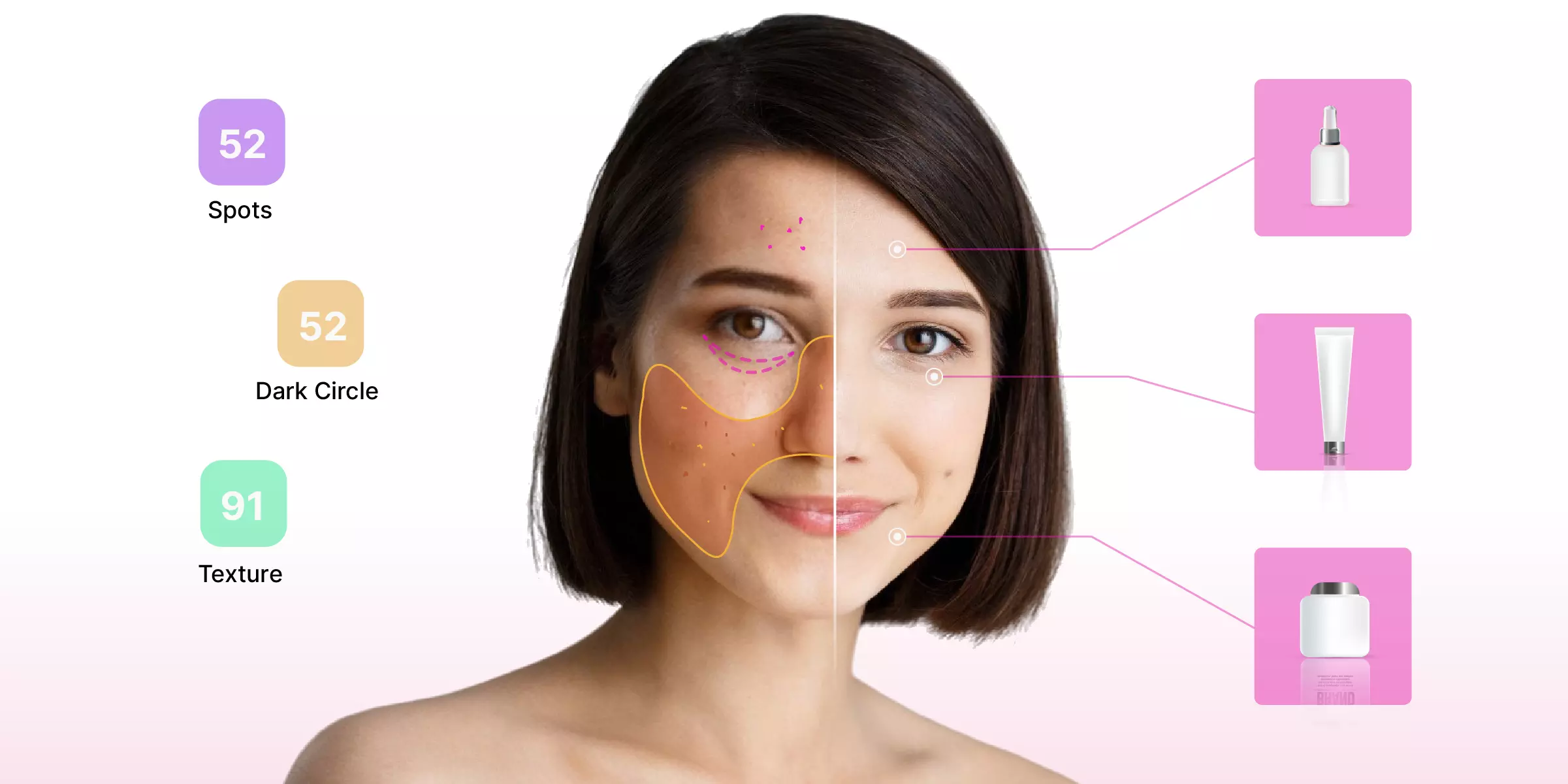
Personalized skincare recommendations are product suggestions generated by matching a shopper's skin data (from a scan, a quiz, or both) against a brand's catalog using a set of rules. Below is how that workflow actually runs end to end, what inputs feed it, and a comparison of 5 providers brands use to build it in 2026.
Skincare is a famously trial-and-error category: shoppers rarely know their own skin well enough to pick the right product on the first try, and brands lose sales, generate returns, and burn support time on that mismatch. This is where beauty tech has stepped in, and AI-customized skincare recommendation software exists specifically to close that gap by giving each shopper a routine built around their actual skin, not a generic bestseller list.
The category has grown accordingly. The global skincare market is projected to grow at roughly 3.53% annually between 2026 and 2030, and personalization has become one of the clearer ways a brand differentiates on an ecommerce product page rather than competing purely on price or ad spend. Today's shoppers expect brands to recognize their unique needs and deliver personalized shopping experiences, and as ecommerce becomes a larger share of the beauty and cosmetics market, customized product recommendations have become one of the clearest ways brands can meet that expectation.
For a brand evaluating this space for the first time, the practical challenge isn't whether to add personalized recommendations. It's understanding which part of the technology stack actually drives the result, since "AI skincare recommendation software" bundles together two genuinely different systems that are worth separating before comparing vendors, especially as more of skincare ecommerce and beauty ecommerce overall shifts toward these AI-driven experiences.
{{component="/internal/widgets"}}
What is an AI customized skincare recommendation software?
%202.gif)
By adopting smart devices, wearables, and AI technology, the beauty industry is shifting its focus from sales to personalized experiences. The technology uses demographic data, environmental factors, and past purchases to provide customized skincare recommendations. For this, the AI-driven system works based on the machine learning models trained on massive datasets. It continuously learns from user interactions.
Thus, it can recognize the patterns that will lead to more accurate and effective recommendations for your customers. As a result, you can help your shoppers reach their skincare goals. AI-powered computer vision tools analyze consumers’ images. Then, it will extract key insights about skin texture, tone, and specific concerns like acne, fine lines, or dryness. Integrating skin analysis into your product databases enables highly personalized product recommendations for your customers.
Skin analysis vs. recommendation engine: two different jobs
The single most common confusion in this space is treating "skin analysis" and "recommendation engine" as the same thing. They're not, and understanding the split matters before evaluating any provider.
Skin analysis is the diagnostic layer. It takes an image, either a live camera capture or an uploaded selfie, and uses computer vision to detect and score skin conditions: acne, wrinkles, pigmentation, redness, hydration, pores, and similar concerns. The output of this layer is a set of scores and, often, an annotated image showing where each concern was detected. GlamAR's own AI skin analysis solution, for example, returns 15 customer-visible scores backed by 150+ biomarkers, generated from a single selfie in about 15 seconds with no app install required.
The recommendation engine is a separate layer that sits downstream of the analysis. It takes those scores as input, applies a brand's own product rules (which ingredients address which concerns, which products are in stock, which routines the brand wants to promote), and outputs specific SKUs. A brand can have excellent skin analysis and a weak recommendation engine (accurate scores, but generic or poorly matched product suggestions), or the reverse. Evaluating a provider means checking both layers separately, not assuming one implies the other.
This distinction also explains why personalized skincare recommendation software varies so much in what it actually delivers. Some providers are strongest on the diagnostic side. Others lean harder into the matching and routine-building layer. The strongest platforms do both well and connect them directly, so a scan result flows straight into a specific, purchasable product, not a generic category page.
There's a practical test for telling the two layers apart when evaluating any provider's demo: ask what happens to the output if you swap in a different brand's catalog behind the same scan. If the recommended products barely change, the platform is likely doing most of its work in the analysis layer and treating recommendations as an afterthought. If the same scan produces meaningfully different, well-matched suggestions against a different catalog, the recommendation engine is doing real, catalog-aware work rather than just attaching generic labels to a scan result.
The recommendation workflow, step by step
A working personalized skincare recommendation system runs through four stages, regardless of which vendor powers it.
1. Capture input. The shopper provides a selfie (live camera or upload), answers a quiz, or both. Some systems also factor in purchase history or environmental data (climate, season) if that data is available to the brand.
2. Run skin analysis. Computer vision models score the image against known skin concerns, returning a set of numeric or graded results: for example, a 0 to 100 score per concern, plus a severity grade and an annotated image showing where each issue was detected.
3. Apply product rules. This is where the brand's own logic comes in. The recommendation engine maps each detected concern to ingredients known to address it, then filters the brand's catalog against those ingredients, current stock, price tier, and any routine structure the brand wants to enforce (for example, always recommend a cleanser, a treatment, and a moisturizer, not three treatments).
4. Deliver and track. The shopper receives a specific set of recommended products, typically organized into an AM/PM routine, with a path to add them to cart. The system logs which products were recommended, which were added to cart, and, if the brand tracks repeat visits, whether the shopper's skin scores improve over time with continued use.
The quality of stage 3 is where most of the real differentiation between providers sits, since stages 1 and 2 have become fairly commoditized across the category.
What inputs actually feed a recommendation
Skin scan data. The core input for most systems: scores per concern (acne, hydration, pigmentation, and so on), a skin type classification, and sometimes an estimated skin age. This is the most objective input, since it comes from image analysis rather than self-report.
Quiz or survey responses. Some shoppers don't want to use their camera, and some concerns, such as sensitivity history, known allergies, product preferences, and budget, aren't visible in a photo at all. A quiz captures this and either substitutes for the scan or supplements it.
Purchase and browsing history. For returning customers, past purchases and browsing behavior can refine recommendations further, for example by avoiding re-suggesting a product a customer already owns, or by weighting toward a price tier they've shown a preference for.
Environmental context. A smaller number of systems factor in the shopper's climate or season, since hydration and sun-protection needs shift with environment in ways a static scan doesn't capture.
How product rules actually work
This is the layer brands have the most control over, and the one worth scrutinizing most closely during evaluation, since it's where a recommendation engine either builds trust or erodes it.
Ingredient-to-concern mapping. The system needs a maintained table connecting detected concerns to the ingredients known to address them: retinoids for fine lines, niacinamide for redness and barrier support, salicylic acid for acne, and so on. This mapping is either built into the provider's platform or configured by the brand's own team, and its quality directly determines whether recommendations feel genuinely useful or just plausible.
Catalog filtering. Once ingredients are matched to concerns, the engine filters against the brand's actual catalog: which products contain the relevant ingredients, which are in stock, and which fit any routine structure the brand wants to enforce.
Business rules layered on top. Brands typically add their own constraints: promote higher-margin products when multiple options address the same concern equally well, exclude products above a certain price point for first-time buyers, or always include a specific hero product in every routine. These rules are what make a recommendation engine feel like it belongs to the brand rather than a generic third-party tool, and they're also the layer most likely to need ongoing maintenance as a catalog changes.
Getting this layer wrong is the most common reason a personalized recommendation feature underperforms even when the underlying skin analysis is accurate. A scan that correctly detects dehydration but then recommends an out-of-stock moisturizer, or suggests three products that don't fit any coherent routine, will erode shopper trust faster than having no personalization feature at all. Brands evaluating a provider should ask specifically how catalog updates propagate into the rule set, whether it's automatic or requires manual remapping, since that maintenance burden compounds as a product line grows.
5 Best AI-customized skincare recommendation software for beauty e-commerce
- GlamAR (Best for suitable skincare product alternatives)
- Perfect Corp (Best for AI skincare recommender)
- Haut.AI (Best for AI-driven skin simulations)
- PulpoAR (Best for customized skincare recommendations)
- Orbo AI (Best for beauty recommendation engine)
Glance at the table of the best AI-customized skincare recommendation software for beauty e-commerce
Best AI customized skincare recommendation software for beauty ecommerce
I performed testing and tried the free trials of each software mentioned in my list. Based on my research and evaluation, these are the best AI customized skincare recommendation software:
1. GlamAR

GlamAR pairs an in-browser skin scan with a recommendation layer that maps detected concerns directly to a brand's own catalog by ingredient, rather than a generic product list. The scan runs from a single selfie with no special device, and product suggestions are built specifically to fill gaps in a brand's own product lines rather than pull from a generic library.
Its conversational layer, SkinGPT, extends this into a chat interface, letting shoppers ask follow-up questions about ingredients or routines and get answers grounded in their actual scan result and the brand's catalog rather than generic advice. The full analysis-to-recommendation flow is built to run through a documented API, so a brand's own catalog can be connected to the recommendation logic rather than relying on a fixed, pre-built product set.
Features:
- Interactive skin analysis: GlamAR’s AI skin analyzer can scan your consumer's face and give accurate skin diagnostics. It delivers detailed skin analysis reports in seconds. Most importantly, this tool needs no special device.
- Accurate product recommendations: GlamAR offers AI-powered skin analysis to provide your customers with customized product suggestions. It will fulfill your shoppers’ unique skin concerns. The facial skin analysis tool analyzes ingredients and maps them to their skin issues.
- In-store integration: You can add GlamAR’s Skin analysis SDK to your e-commerce website and offer in-store experiences. It can detect 15+ skin health and beauty metrics, along with tailored skincare products. In this way, you can facilitate your customers with online as well as in-store personalized shopping.
{{download="/internal/table"}}
2. Perfect Corp
Perfect Corp's skin analysis is dermatologist-verified and uses full-face mapping to cover areas, including the chin and cheeks, that simpler tools sometimes miss. Its Expert Mode API is the more distinctive feature for larger brands: it exposes per-pixel raw analysis data, letting a brand's own team build custom scoring logic aligned to their own clinical testing rather than relying entirely on Perfect Corp's default mapping.
Features:
- Skincare product recommendations: You can easily build a personalized skincare regimen for diverse skin types with this software. You need to add a step-by-step skincare routine recommendation to the virtual skin analysis experience. The good news is that you can do this process in minutes. Plus, you can create autogenerated skin scan reports for your shoppers with no need for coding. They can download it too.
- 180-degree full-face mapping: The skin diagnostic technology analyzes facial images of consumers to offer a detailed skin analysis. It ensures full face coverage, including difficult-to-map areas, such as the chin and cheeks. The skin analysis method can detect different skin concerns: wrinkles, acne, etc. It is able to determine customized skincare products to deal with your customers’ skin issues.
- API for skincare recommendations: The Expert Mode API provides access to per-pixel raw data generated from skincare analysis. It enables brand professionals to create a custom mapping of the score. It aligns with the brand’s own clinical test dataset for the rationale behind personalized product recommendations.
3. Haut.AI
Haut.AI leans into the conversational and simulation side of personalization. Its Skin.Chat feature builds a five-step personalized routine either from an uploaded selfie or from survey answers, which is a useful fallback for shoppers uncomfortable sharing a photo. Its generative skin-simulation tool lets shoppers see a preview of skin changes over time, which is a distinctive feature for brands wanting to sell a longer-term regimen rather than a single product.
Features:
- AI-powered recommendation engine: Haut.AI’s AI engine evaluates your consumers’ faces and identifies 15+ essential skin health and beauty metrics. Based on this skin analysis, it will also suggest the best skincare products to your customers so that they can achieve their perfect skin goals.
- AI skincare advisor: Haut.AI has introduced Skin.Chat to offer a personalized skincare routine in 5 steps. It includes skin analysis along with personalized product recommendations. Consumers need to upload selfies to get a detailed skin report. Instead of uploading images, they can participate in a skincare-related survey to obtain personalized recommendations. Skin.Chat creates routines based on skin condition, preferences, sensitivities, and your brand’s product availability.
- SkinGPT: If you add SkinGPT to your e-commerce platform, your customers will receive Gen AI-powered, realistic skin simulations. It is designed across different skin tones, types, and conditions. Most significantly, your brand can develop, display, and market skincare products with its Generative AI capabilities.
4. PulpoAR
PulpoAR's diagnostic tool is built for accuracy across skin types and ethnicities, and its distinguishing feature is tracking: shoppers can follow how their skin responds to a recommended routine over time, turning the recommendation into an ongoing relationship rather than a one-time suggestion. Its dashboard is built for brands to turn that usage data into marketing and merchandising decisions.
Features:
- Customized recommendations: PulpoAR’s AI Skin Diagnostic tool provides an accurate skin assessment. It is designed for every skin type and ethnicity. It recommends customized skincare products based on your customers' specific skin concerns.
- Face detection: The technology of the skin diagnostic tool can identify the facial features of your customers. Additionally, it helps them identify issues with specific parts of their face.
- Data-driven insights: You can transform data-backed insights into action with PulpoAR’s user-friendly dashboard. It helps your brand in future predictions and marketing activities. Plus, you can customize your dashboard according to the most insightful metrics and monitor it.
5. Orbo AI
Orbo AI's skin analysis is built around a high point count, 209 facial points and 16+ parameters, and its recommendation engine factors in tone and stated preference alongside detected concerns. Its clearest differentiator is deployment flexibility: the same analysis and recommendation logic can run on a website, a mobile app, a digital kiosk, or a smart mirror from a single integration.
Features:
- Easy-to-use solution: The skin analysis technology can decode your customers' facial images to answer all their skin-related queries. You can add this software to your e-commerce and in-store platforms with a single line of code. It allows you to offer your customers unique skin analysis results and product suggestions.
- Recommendation engine: The beauty AI-driven recommendation engine enables you to provide personalized beauty product recommendations. It considers individual preferences, skin tones, and facial features to offer personalized product suggestions.
- Skin segmentation: Orbo AI’s facial feature detection software enables modifications of consumer appearances in AR and face-tracking platforms. It uses advanced convolutional neural networks for skin segmentation technology. Its rendering can adapt effortlessly to varying lighting conditions and skin tones for realistic experiences.

Other platforms you can explore
You have just read my entire list of what I consider to be the best AI customized skincare recommendation software. Apart from these, you can still offer skincare product recommendations with other platforms, such as:
- IQONIC.AI: The AI-powered skin analysis software offers a customizable white-label solution for brands, retailers, and institutions. Dermatologists developed the software. Based on the needs of your customers, it uses proprietary technology to provide customized product recommendations. For this, consumers need to use their smartphone camera to scan their face multiple times to capture different angles. Then, the AI-driven software analyzes their skin to deliver personalized results and personalized recommendations. The good news is that you can integrate this software into online and in-store platforms.
- TINT by Banuba: It offers a skincare AI and try-on platform. For maximum personalization: the TINT platform offers skincare product recommendations via AI. The best part is that it can work on photos, videos, and live streams. Also, it is designed to work on every skin tone, even in dim lighting conditions and low-quality images. With try-on technology, the software can showcase the predicted results right on your customers’ faces.
Brands that are using AI customized skincare recommendation software
Popular beauty and skincare brands are adopting AI-driven, customized skincare recommendation software to enhance user experience and increase sales. Let’s discover how they can use these software solutions:
1. Cetaphil India
The Cetaphil AI Skin analysis Tool assesses your customers’ skin. Based on this, it provides a tailored skincare solution for them through AI skin technology. For a customized skincare routine: consumers need to capture selfies through their mobile phone. ‘MySkin By Cetaphil' will scan their face and analyze their skin.
Finally, your customers will receive a personalized skin analysis report. Plus, they will get skincare routine recommendations, including personalized Cetaphil product suggestions. To access this tool: they can also scan the QR code with their phone.
2. Sephora
Sephora has an AI-powered skin scanning tool. It can detect its customers’ needs for personalized product recommendations. Shoppers need to open the Sephora app and perform the smart skin scan with their selfies. As a result, they will get a personalized skin analysis along with product recommendations.
3. Olay
Olay’s AI skin advisor can provide a personalized skincare routine. For this, consumers need to upload selfies and answer a few questions about their skin concerns and preferences. Then, they will get tailored skincare products to fit their lifestyle.
Most importantly, they are able to see their skin age and personalized product recommendations from Olay. If shoppers know their skin type and issues, they can skip skin analysis and find suitable products for their specific skin concerns with Olay’s product finder.
4. POND’s
It features an AI skin expert that captures your customers’ real-time images for skin analysis. Then, it allows them to choose skincare products to address their skin’s present needs.
Using a smartphone with a good-quality camera and internet speed, consumers can get POND’s personalized skincare product recommendations, based on their skin's overall appearance and personalized analysis.
{{component="/internal/widgets"}}
Measuring whether personalized recommendations are working
A recommendation system that isn't measured is just a feature, not a growth lever. Track these five metrics to know whether it's actually earning its place on the product page:
Scan or quiz completion rate. What share of shoppers who start the analysis actually finish it. A low completion rate usually points to friction in the capture step, such as a confusing camera permission prompt or a quiz that's too long, rather than a problem with the recommendation logic itself.
Recommendation-to-cart rate. What share of shoppers who receive a personalized result add at least one recommended product to cart. This is the most direct signal of whether the product-rules layer is actually matching well, since a low rate here despite a high completion rate usually means the recommendations themselves aren't landing.
Return and repurchase rate on recommended products. Compare return rates on products a shopper bought after a personalized recommendation against products bought without one. A well-tuned system should show measurably lower returns and higher repurchase on the recommended path, since that's the entire premise of the feature.
Skin-score improvement over repeat scans. For brands with returning customers, tracking whether skin scores actually improve after using recommended products over weeks or months is the strongest long-term proof point, both for internal decision-making and as a trust-building result to show the shopper directly.
Recommendation-driven average order value. Compare basket size on orders that included at least one personally recommended product against orders that didn't. Routine-based recommendations, such as a cleanser, treatment, and moisturizer suggested together, tend to lift order value simply by presenting a complete solution instead of a single item, and this is a straightforward way to quantify that effect separately from conversion rate alone.
Getting started
Don't try to build the full pipeline (scan, rules, routine builder, chat) in one release. Start with skin analysis paired against your top three or four best-selling concerns (acne, hydration, and pigmentation cover most catalogs), get the ingredient-to-SKU mapping right for those, and expand the rule set and catalog coverage from there.
Connecting your actual product catalog into the recommendation flow is the step that determines whether shoppers see generic suggestions or ones built around what you actually sell. Talk to the GlamAR team about mapping your catalog into the flow before launch.
Skin analysis is the diagnostic layer that scores an image for concerns like acne or hydration. The recommendation engine is a separate layer that takes those scores and matches them to specific products using ingredient rules and catalog data. A brand needs both working well together, not just one.
Yes. A quiz-based flow covering concerns, sensitivities, and preferences can substitute for or supplement a scan, which matters for shoppers who don't want to use their camera.
Through product rules layered on top of the ingredient-to-concern mapping: filtering by stock, price tier, routine structure, and any promotional priorities the brand sets, so recommendations reflect brand strategy, not just raw matching logic.
The clearest signals are the recommendation-to-cart rate, return and repurchase rates on recommended versus non-recommended products, and, for returning customers, whether skin scores improve on repeat scans after following a recommended routine.
In almost every case, yes. These systems are built to recommend from the specific brand's own product lines or a limited, curated set the platform's operator controls, not to search the broader market.
No. It's a product-matching and diagnostic-preview tool for retail decisions, not a medical device, and it doesn't replace clinical judgment for diagnosing or treating skin conditions.
Discover how AR, VR and 3D can drive revenue growth in 2026
Schedule a call with our team

.avif)