


Ultimate guide on virtual try-on for e-commerce businesses and sellers


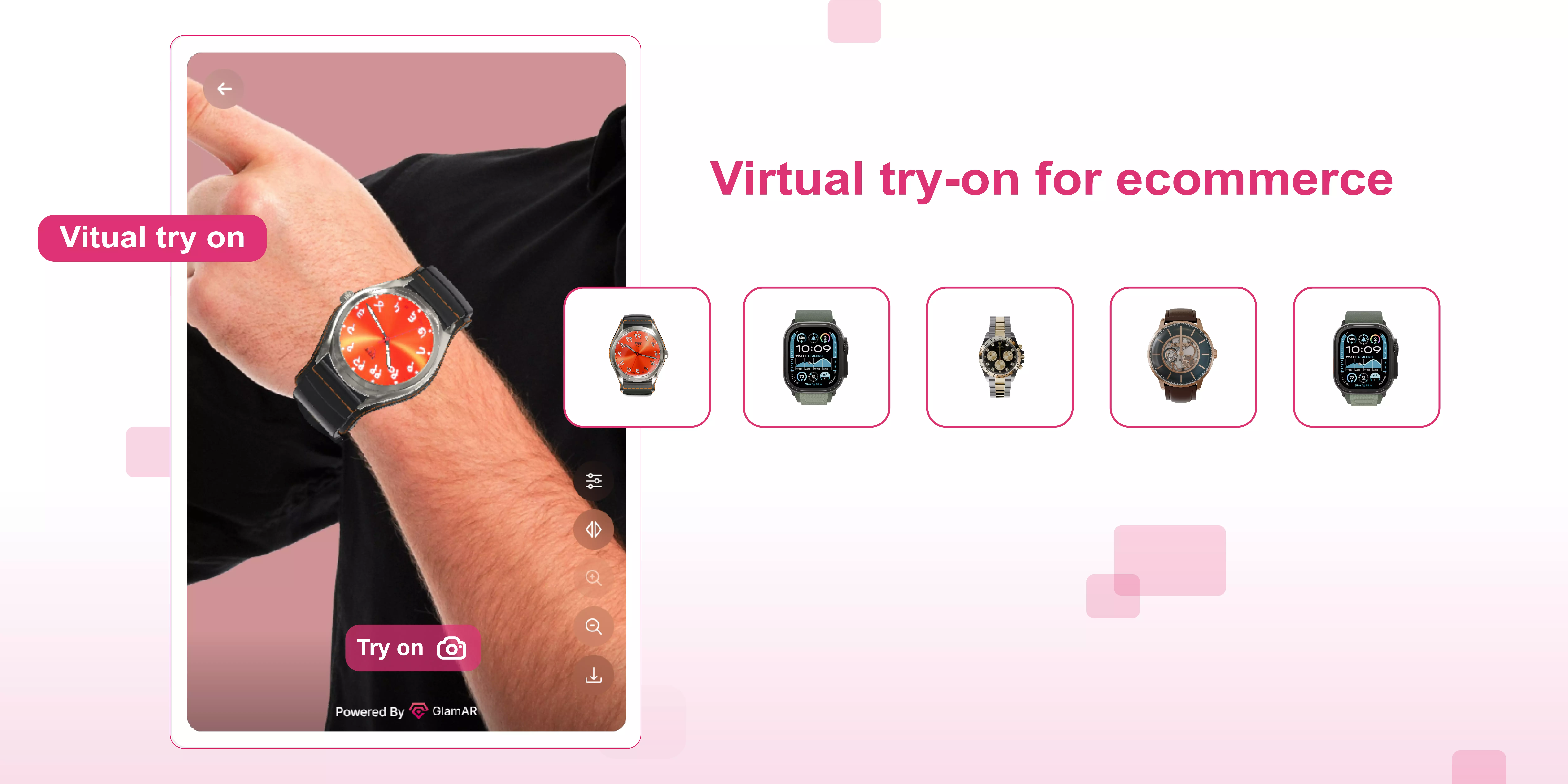
Virtual try-on technology helps the e-commerce industry to provide its customers with an engaging and real-time shopping experience by offering them AR overlays and 3D models of their products during virtual shopping. It can be used for products from different categories, such as clothes, footwear, jewelry, watches, makeup, and nails, which will also help brands and businesses to increase their customer base and user engagement.
With the growing need for virtual try-on technology, the global virtual try-on market is expected to grow from USD 14.2 billion in 2025 to USD 128.1 billion by 2035, which is projected to expand at a CAGR of 24.6% from 2025 to 2035. Apart from that, it also helps businesses to provide their customers with personalized shopping experiences by enabling them to explore and customize products according to their needs and preferences.
Since using a virtual try-on helps businesses a lot, selecting which feature is the best for your business is a cumbersome task, as it requires lots of research and time to understand its features, benefits, and more. In this detailed guide of the virtual try-on, I will provide you with detailed information on the virtual try-on technology, its features, benefits, applications, tips for selection, and integration process. Let’s get started!
What is a virtual try-on?
A virtual try-on is an online tool that helps businesses to increase user engagement and provide their customers with a better experience by enabling them to try products virtually during online shopping. It uses advanced technologies, such as augmented reality, computer vision, and artificial intelligence, which help their customers to try products on their face or body by using AR overlays.
With the help of this online tool, brands can provide their customers with a “try before you buy” feature during online shopping, which they can perform by uploading their image or using the device’s camera, offering them a realistic and lifelike shopping experience. It also helps users to make more informed and confident shopping decisions by simulating real-life fit and style while enabling them to understand how the item will look on their face or body.
Key features of a virtual try-on
- AR overlay: It helps users to understand how the product looks and fits on them by enabling them to try different products on their face or body in the live video or image by superimposing the AR overlay of products, which helps them to visualize products realistically.
- Advanced technologies: It helps users to interact with the product by helping them to check product placement, movement, and color matching in real time by using artificial intelligence and computer vision to analyze and track their facial features, body shape, and skin tone.
- Personalization and customization: It helps businesses to provide their customers with a tailored shopping experience by enabling them to explore and try products in different sizes, colors, and styles, helping them to create complete looks or virtual avatars.
- Multiple category usage: It helps businesses to integrate the virtual try-on feature for multiple category items, such as apparel, footwear, jewelry, makeup, eyewear, watches, and AR visualization for home decor, providing their customers with an interactive shopping journey.
How does a virtual try-on work?
Virtual try-on technology uses multiple advanced technologies, such as augmented reality, artificial intelligence, and computer vision, which help brands to provide their clients with an immersive way to explore products virtually while sitting at home. It also helps their customers to understand how the product looks on their face or body by analyzing their facial and body features to match the item as accurately as possible, according to their choices and preferences.
Typically, it uses pre-prepared product assets (2D images or 3D models) and then overlays/renders them onto the user’s image/video, which will enable end users to get an interactive "try before you buy" experience without physical interaction.
But to understand the working of the virtual try-on technology, it is very important to understand the core technologies and their working pattern behind it. Therefore, in this section, I will help you understand how this virtual try-on works for products from different categories and the technologies behind them.
Key technologies
- Augmented reality: It helps users to explore and try different products virtually on their face or body in a live video or image by superimposing the AR overlays of digital product images or models onto the real-world view with the help of their device's camera.
- Computer vision: It analyzes and detects the facial and body features of users from their live videos and uploaded images, which will help them select the best products according to their facial features while helping them to understand the product placement and appearance on their face or body while sitting at home.
- Artificial intelligence and machine learning: It uses advanced algorithms of AI and ML that will help users match the product to their features, enabling them to understand and create a realistic draping and fit while simulating skin interaction for cosmetics.
- 3D mapping: It provides users with interactive and engaging 3D models of products by using 3D technology that will help them understand the features of the product by enabling users to use a virtual model of themselves to place and fit 3D product models accurately.
Step-by-step working
- User input: The first step of the working of a virtual try-on feature is allowing users to give access to the camera on their device for a live video or upload a photo, enabling them to try and explore products virtually.
- Feature mapping: It helps brands to provide their customers with an interactive shopping journey by scanning and mapping the key points on their face or body, including eyes, nose, shoulders, and waist.
- Real-time visualization: It provides users with an engaging shopping experience and real-time visualization of products by using AR overlays and 3D models, which will enable them to understand the product placement and appearance on their face or body by giving access to their device's camera during try-on.
- Simulation: It uses advanced AI-based algorithms to help users simulate how the product interacts with their features, such as how lipstick sits on lips or how fabric drapes, which will help them select the best product according to their needs and preferences.
- Visualization: It provides users with a real-time and lifelike visualization of the product by enabling them to see how the virtual product looks on themselves, allowing them to rotate, see different colors, and assess fit and style.
{{component="/internal/widgets"}}
Benefits of using a virtual try-on for businesses

Virtual try-on technology helps businesses in multiple ways, such as boosting sales and conversion rates, cutting product returns, enhancing customer satisfaction, reducing operational costs, and offering valuable customer data, which will also help them to get a modern competitive edge and support sustainability goals.
Apart from that, it also helps businesses to establish a stronger bond and relationship with their customers by enabling them to visualize products, such as makeup, eyewear, apparel, and furniture, on themselves or in their space, which will help them to build confidence to buy online.
In this section, I will help you understand the advantages of using a virtual try-on technology for a business model and how it helps them to connect more effectively with their customers and reach a wider audience.
1. Increased sales and conversions
It helps businesses to increase their overall sales and conversions by helping their customers feel more confident during online shopping and enabling them to try and explore products virtually with the help of AR overlays and 3D models.
It also helps their customers to make more confident and satisfied online purchases after enabling them to see how items look on them, which will lead to higher conversion rates and help businesses to increase their sales.
2. Reduced product returns
It helps businesses and sellers to reduce their product return rate by helping their customers to make more confident purchase decisions by reducing their uncertainty and enabling them to purchase the product according to their face and body features.
It also helps the brand to reduce the unnecessary costs of logistics by reducing product returns, which will also help them save on their high costs in logistics and processing.
3. Enhanced customer experience
It helps businesses to enhance their customer experience on the e-commerce website or app by offering them a personalized, convenient, and interactive shopping experience, which can be done by integrating some engaging and interactive features, such as spinning, rotation, and zoom.
It will also help the business to establish stronger relationships with its customers by allowing them to explore and try on products anytime and anywhere, which will foster their trust and loyalty towards the brand.
4. Cost savings
It helps businesses to reduce the overhead cost of trials, samples, and more by integrating the virtual try-on technology on their e-commerce website or app. It also cuts down the overhead cost from physical trials, inventory management, and returns, which will help the business to operate more efficiently while helping the brand to provide its customers with a hygienic product trial experience.
How to choose the best virtual try-on tool for your business?
Using a virtual try-on feature helps businesses to enhance their conversion rate and provide their customers with a better online shopping experience by enabling them to explore and try different products while sitting at home. It also helps businesses to improve experience and boost engagement on their website or application by providing their customers with engaging and exciting features.
Since a virtual try-on feature helps businesses in multiple ways, selecting the best virtual try-on is still a cumbersome task because it consumes lots of time, as it requires lots of research to understand the features and specifications that align with your business goals and needs. Therefore, in this section, I have listed a few tips that you can consider while choosing the best virtual try-on solution for your e-commerce website or app.
1. User experience
To make navigation and the experience easier for users, always select an SDK that provides an excellent and easy-to-use user interface because it will ensure a smooth and natural experience for end users. You can also look for enhanced features, such as improved UI/UX, multi-angle views, and options for both live camera and photo upload modes, which will help you ensure a seamless user experience for your customers.
2. Features
While selecting a virtual try-on for your brand, you can also look for some advanced features, such as precise head mapping, 360-degree rotation, spinning, and zoom, which will help your customers to opt for products that offer them accurate fit adjustments.
You can also pick out some advanced features in an SDK that will enable you to offer AI-driven recommendations, analyze user features (face shape, skin tone, etc.), and suggest the most suitable products, which will help you as a brand to increase conversion rates.
3. Pricing and support
While selecting the virtual try-on, always opt for the one that aligns with your company's budget and growth plans and helps you to provide your customers with engaging and immersive features.
You can also compare the pricing structure, offerings, and features of different AR try-on solution providers to understand which one aligns best with your business plans by evaluating their pricing models, trial options, and technical support.
4. Updates and maintenance
While selecting the virtual try-on, always make sure to opt for the one that offers good services after purchase and implementation, because it will help you to provide your customers with a smooth and seamless experience.
You can also opt for the virtual try-on that provides regular updates and maintenance while helping you to understand that all the features are running smoothly and incorporate new functionalities.

How to integrate the virtual try-on technology into the e-commerce platform?
Using a virtual try-on on your website or app can transform your relationships with your customers because it will help you to increase your engagement rate, reduce your return rate, and enhance your conversion rate while offering them an engaging and immersive shopping experience. Since using a virtual try-on helps businesses to enhance their customer relationships, sales, and conversions, on the other hand, to make sure that your customers get an enhanced experience, it is very important to integrate the SDK properly with your e-commerce platform.
To help you understand how to integrate the virtual try-on into your app or website, I will provide you with a list of various steps that you can consider to understand the perfect implementation of a virtual try-on on your pre-existing e-commerce platform.
1. Select a suitable SDK provider
Always select a virtual try-on SDK that helps you to meet your expectations from your business goals, which also include technical resources and the desired user experience.
While choosing the virtual try-on SDK, always consider some exciting factors, such as the realism and accuracy of AR overlays, device and platform compatibility, integration support and documentation, and pricing and licensing.
2. Integrate the SDK with your e-commerce platform
After selecting the virtual try-on SDK provider, it’s time to integrate the virtual try-on into the e-commerce website or app while aligning it with the brand’s image and identity.
You can also integrate or add the SDK with the e-commerce platform seamlessly by adding the SDK library to your project, configuring permissions, embedding AR components into product pages or a dedicated try-on feature, and connecting the SDK to your product catalog for dynamic updates.
3. Enable 3D model creation
After integrating the SDK on your e-commerce platform, try to develop high-quality 3D models of your products from scratch or convert the pre-existing 2D images of your products to provide your customers with a realistic try-on experience.
To create high-quality 3D models of your products that you can use to display them on the e-commerce website or app, you can use some common methods, such as 3D scanning for precise digital replicas, photogrammetry for creating models from multiple product images, and manual 3D modeling to build digital assets.
4. Test and deploy
After building and integrating the 3D models of your products, it’s time to conduct a thorough test to check the functionality of the virtual try-on on different devices and platforms, which will also help you ensure that all features are working properly.
To gather realistic feedback, you can also conduct user beta testing to refine the user experience and fix bugs available in the SDK before making the final launch. After the completion of the testing, you can position the virtual try-on SDK on your website to provide your users with an advanced online shopping experience.
GlamAR virtual try-on: Why is it perfect for your business?
GlamAR is an AR-based solution provider that helps online sellers and brands provide their customers with an engaging shopping experience and enable them to explore various products by 3D models and AR overlays during online shopping. It offers virtual try-ons for different categories of products, including jewelry, makeup, watches, and eyewear, which will help online brands build stronger customer relationships and boost their confidence.
With the help of the virtual try-on, e-commerce brands and businesses can help their customers explore different types of items, which are available in various styles and fits, through the device's camera. It also allows users to try products using a live camera, select a model, or upload an image, which will provide a 3D visualization to users in a real-time environment.
With the help of the virtual try-on SDK, brands can reduce the product return rate by decreasing the product mismatch uncertainty among customers. It also enables them to perform the easy integration of the software into the pre-existing e-commerce platform to provide a simplified and enhanced interface to their customers.
Therefore, by using the virtual try-on SDK on their website or app, businesses can boost their overall sales, generate higher conversion rates, and enhance user engagement by providing their customers with an engaging shopping journey.
Key features
- Real-time AR simulation: It provides users with the digital images of different products, which will provide them with the ability to explore different items in various styles using the device's camera, providing them with an instant preview of makeup, jewelry, eyewear, and watches.
- Unmatched realism: It provides users with high-resolution visuals and 3D modeling of products that will provide them with a real-time visualization of products by mimicking the in-store shopping experience and offering them the precision of real jewelry.
- Real-time customization: It provides users with the ability to customize products in different sizes, styles, and colors, which will provide them with a personalized shopping experience by offering them a realistic visualization of products according to their needs and preferences.
{{component="/internal/widgets"}}
Applications of virtual try-on in different industries
Virtual try-on is a revolutionary technology that is growing with time and has been helping the e-commerce industry to grow and provide its customers with an engaging and interactive shopping experience. With the help of its advanced features and technologies, it can be used for various industries, such as fashion, beauty, accessories, and home decor, which will help businesses to increase conversion rates and reduce product returns.
In this section, I will help you understand how the virtual try-on technology helps businesses and brands to display products interactively from different categories and sectors while building strong customer relationships.
1. Fashion and apparel
Various fashion and apparel brands can use the virtual try-on technology because it helps businesses to provide their customers with an engaging and immersive shopping experience by enabling them to select the products according to their body shape and size.
It also helps footwear, watches, and jewelry brands to provide their customers with real-time visualization of the products, enabling them to check the fit and style of products and select designs according to their needs and preferences.
2. Beauty and cosmetics
Virtual try-on technology can be used for various beauty and cosmetics brands, which will help them to provide their customers with an immersive shopping journey by enabling them to select products in different shades and textures, according to their requirements.
It can also be used for lipsticks, eyeshadows, foundations, hair colors, nails, and more, which will help brands to bridge the gap between the online and offline shopping experiences.
3. Eyewear
Eyewear brands and businesses can use the virtual try-on technology on their e-commerce website or app, which will help their customers select the frames and styles according to their needs and preferences.
It will also help their customers to AR overlay different frames in various styles, shapes, and sizes by using their device’s camera, which will help the brand to increase its sales and conversions while fostering customer loyalty and trust.
4. Home decor and furniture
Home decor and furniture brands can also use the virtual try-on technology on their e-commerce website or app, which they can use to provide their customers with real-time visualization of furniture items and enable them to check their size and style according to their room.
Apart from that, it also helps designers to accelerate the process of home designing by enabling them to connect with their clients virtually and get feedback on digital prints to save their time and money.
Future outlook of the virtual try-on technology in the e-commerce market
The future of virtual try-on technology has been growing and evolving in the e-commerce industry because it uses advanced algorithms of artificial intelligence and augmented reality technologies, helping businesses to achieve their goals and reach a wider audience. With the help of this technology, businesses can provide their customers with promising, hyper-realistic, and personalized experiences that will help them decrease product returns and boost conversions.
Apart from that, it also helps brands to provide their customers with engaging experiences by using advanced 3D body mapping, real-time clothing physics, seamless omnichannel integration (social, in-store AR mirrors), and AI-powered fit prediction, making online shopping feel like physical retail by enhancing confidence and reducing uncertainty for buyers of apparel, cosmetics, and even furniture. In this section, I will tell you about the future outlook and trends of using virtual try-on technologies and how they will help different industries to grow.
1. Key growth drivers and technologies
- Artificial intelligence and computer vision: It analyzes and detects the facial and body features of users from their live videos or images to help them understand the placement and fit of the product on their face or body while helping them to select the products according to their needs and preferences.
- Augmented reality: It provides users with AR overlays and 3D models of products onto their face or body by superimposing the digital products onto the user's real-world view by using the camera of their computer, tablet, or phone for makeup, eyewear, and furniture.
- 3D scanning and mapping: It helps users to create accurate avatars according to their body measurements and features, which they can use to simulate realistic clothing drape and movement virtually, while offering them a realistic and lifelike shopping experience.
- Real-time rendering: It helps businesses to provide their customers with a realistic shopping experience by offering them real-time rendering of products while providing them with instant visual feedback as users change colors, styles, or move.
2. Market impact and benefits
- Reduced returns: It helps businesses to reduce their product returns by helping their customers make more informed and confident decisions while reducing their uncertainty towards the product color and size mismatch.
- Increased conversions: It helps businesses to increase their sales and conversion rates by helping their customers to make more informed purchases with confidence and leading them to higher sales.
- Enhanced experience: It helps businesses to provide their customers with an interactive, personalized, and immersive shopping experience by providing them with exciting features, such as rotation, spin, and zoom.
- Omnichannel integration: It helps brands to bridge the gap between the online and offline shopping experience by offering them engaging features through social media filters, AR mirrors in stores, and apps.
3. Future advancements and trends
- Hyper-realistic simulation: It helps businesses to provide their customers with hyper-personalized and realistic shopping experiences by enabling them to use advanced simulations from 2D overlays to fully interactive 4D experiences with true clothing physics.
- AI fit prediction: It helps customers to understand the size and fitting of apparel and footwear products with the help of advanced AI-based algorithms, which will help the tool to understand and learn different body types for perfect size recommendations.
- Seamless integration: It helps businesses to perform seamless integration of the tool into the pre-existing and newly acquired e-commerce platforms by using SDKs or APIs, providing their customers with a user-friendly experience.
Conclusion
Using a virtual try-on helps businesses to build stronger customer relationships and bridge the gap between the online and offline shopping journey, while boosting conversion rates, increasing sales, and reducing product returns. In this blog, I have covered a lot about different aspects of a virtual try-on, including its features, benefits, applications, integration process, and future outlook, which will help you understand how using a virtual try-on will help your business grow.
In this detailed guide on virtual try-on for e-commerce platforms, I have also given information about GlamAR’s virtual try-on SDK and its key features that can also be used by brands from different industries to provide their customers with an engaging experience. Therefore, using a virtual try-on will help businesses in multiple ways, from increasing their sales and conversions to fostering customer trust and loyalty; it also enables them to enhance their marketing strategies and reach a wider audience.
No, customers do not need special equipment to use the virtual try-on technology because it can be used by a standard smartphone, tablet, or computer with a front-facing camera and a modern browser, which will help brands to provide their customers with an interactive way to explore and try different products virtually.
Virtual try-on technology can provide customers with approximately accurate results by using artificial intelligence, 3D models, and face or body tracking for realistic previews. It can also lead to minor limitations existing in fabric movement or lighting, which will boost the confidence of users during online shopping and help the brand reduce product returns.
Yes, brands must address some data privacy concerns, which include biometric data collection like facial scans during try-ons, obtaining explicit consent, and informing users. If these concerns are overlooked, then brands can face the lawsuit risks of storing data without permission, so clear privacy policies are essential.
Businesses integrate the virtual try-on feature by using an SDK or API in product pages for camera access and overlays, plus product data syncing. The steps that are included in the integration of the virtual try-on into the e-commerce platform are adding scripts, UI buttons, and testing previews, which can also be tailored for platforms like Shopify.
By using the virtual try-on technology, brands will get multiple benefits, which include data-driven insights on user engagement, try-on sessions, popular products, session times, and conversion impacts like reduced cart abandonment. On the other hand, it also helps businesses to enhance and personalize their strategies for inventory management and marketing campaigns.
The estimated time to build a virtual try-on technology takes from several months to a year, with custom solutions costing hundreds of thousands of USD, depending on complexity and outsourcing. Whereas using the pre-built API or SDK can reduce time and expense significantly for the brand to build the virtual try-on.
Discover how AR, VR and 3D can drive revenue growth in 2026
Schedule a call with our team

.avif)