


Top 10 virtual try-on API providers for beauty and fashion businesses


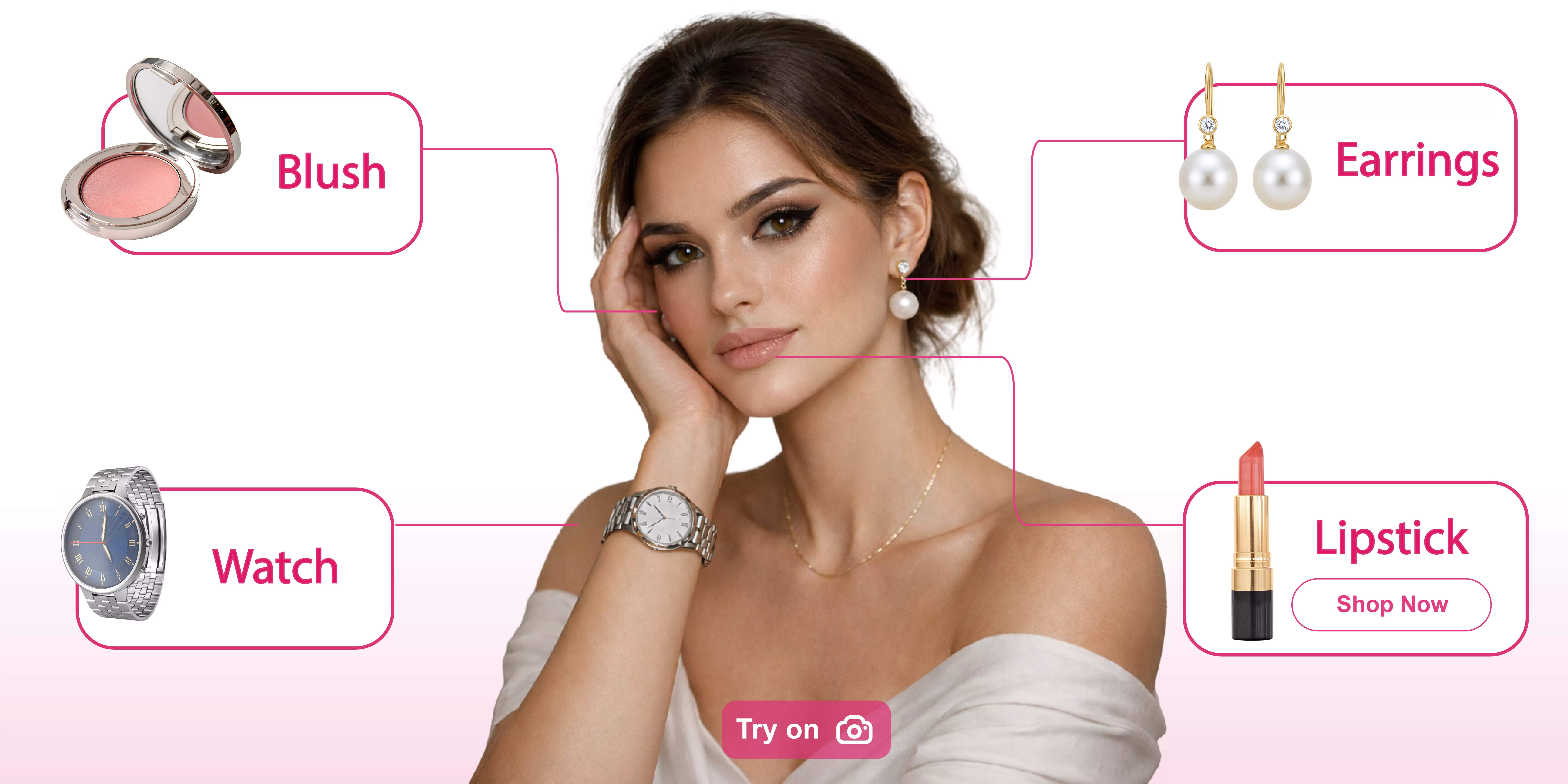
A virtual try-on API is the developer-facing tool that lets a brand build AR try-on directly into its own website or app, rather than relying on a pre-built widget. Below is a comparison of 10 providers beauty and fashion brands use in 2026, what each one is actually built for, and how to shortlist the right one for your catalog and your development team.
Beauty and fashion are the two categories where "what will this actually look like on me" is the single biggest barrier between browsing and buying. A product photo shows a shade or a garment on someone else's face or body, not the shopper's own. That gap is exactly what a virtual try-on API is built to close, using 3D modeling and computer vision to overlay a product onto the shopper's own live camera feed or uploaded photo in real time, creating a more immersive shopping experience.
The market reflects how central this feature has become. Industry estimates put the global virtual try-on platform market on track to grow from USD 5,902.1 million in 2025 to USD 22,101.0 million by 2035, a CAGR of roughly 14.1%, with try-on apps and platforms already driving close to $357.4 billion in global ecommerce revenue. For a category built on appearance and fit, that growth isn't surprising. It tracks directly with how much return volume and cart abandonment in beauty and fashion trace back to shoppers guessing wrong about a shade, a fit, or a style before an API-driven try-on gave them a way to check first.
This is also a category where the "build vs. buy" decision matters more than in most other ecommerce features. A handful of the largest beauty and fashion companies (L'Oréal being the clearest example) have built or acquired their own try-on technology outright, because the volume of shoppers and the strategic value of owning the underlying computer vision made that investment worthwhile. For the overwhelming majority of brands, though, licensing an existing SDK or API is the faster, lower-risk path: the computer vision, rendering, and device compatibility work has already been solved, and the integration effort is limited to connecting that capability to your own catalog and product pages rather than building the underlying technology from scratch.

What is a virtual try-on API?
A virtual try-on API is a developer toolkit - typically delivered as an API endpoint, SDK, or both, that a brand's engineering team integrates directly into its own website, app, or checkout flow, rather than dropping in a fully packaged, pre-styled widget. The distinction between "API" and "off-the-shelf plugin" matters here: an API gives a brand's developers control over exactly where and how the try-on appears, what data it captures, and how it connects to the brand's existing product catalog and checkout, at the cost of needing development resources to wire it up.
Functionally, the API takes a live camera feed or an uploaded photo, uses computer vision to detect the relevant landmarks, a face, a hand, a body outline, and overlays a rendered version of the product in real time, adjusting as the shopper moves. For beauty, that means tracking facial landmarks precisely enough to place a lipstick shade or an eyeshadow color convincingly. For fashion, it means either face/body tracking for accessories and eyewear, or full-body segmentation for apparel try-on.
Core features to expect from a virtual try-on API:
- Real-time product visualization - accurate rendering of shades, textures, and materials so a shopper sees a believable result, not a flat filter.
- AR overlay with low latency - the product needs to track the shopper's movement smoothly enough that it doesn't feel like a lagging sticker on top of the video.
- Face and body mapping - computer vision that locates the correct landmarks precisely enough for the product to sit where it actually would.
- Cross-platform delivery - support for WebAR (browser-based, no install) alongside native iOS and Android SDKs, since brands typically need both.
- Ecommerce integration hooks - the ability to connect try-on data to product catalogs, inventory, and checkout, rather than running as an isolated feature.
- Usage analytics - data on which products get tried on, how long, and whether that correlates with a purchase, so the investment can be measured.
The best providers also offer some combination of image upload and live camera modes, since not every shopper wants to turn on their camera, and some categories, makeup shade matching in particular - work well from a single well-lit selfie.
It's worth being precise about terminology before comparing vendors, since "API" and "SDK" get used loosely across this market. An API typically refers to a set of endpoints a brand's backend calls to process an image or session and return a result, while an SDK is a packaged library that handles more of the camera access, rendering, and UI directly within a mobile app or webpage. Most providers on this list offer both, but the balance differs: developer-centric platforms like DeepAR and Banuba lean heavily on SDK integration for teams building custom interfaces, while platforms like GlamAR offer API access alongside simpler, more turnkey integration paths for teams that don't want to build the try-on interface themselves from scratch.
Glance at the table of the top virtual try-on API providers for fashion and beauty brands
10 best virtual try-on API providers for beauty and fashion
With the growing technologies, brands and businesses are getting confused while selecting the best virtual try-on API for their products because comparing various software and their features is a cumbersome task. While researching for a virtual try-on provider, brands and businesses must select the best one according to their business goals, needs, and requirements.
In this section, I will provide you with a list of the top 10 virtual try-on API providers that will save time for fashion and beauty brands and help them provide their customers with an enhanced and engaging experience.
1. GlamAR
GlamAR provides an AR-based virtual try-on API and SDK for fashion, beauty, accessories, and furniture brands, alongside a broader solutions stack that includes 3D model creation, a product configurator, and 360-degree viewers. That range matters for brands whose catalog spans more than one category, a beauty brand that also sells accessories, for instance, since the same developer integration can extend across product types instead of requiring separate vendors per category.
The API supports three input modes: uploading a photo, using a live camera feed, or selecting a pre-built model, so brands can accommodate shoppers who don't want to enable their camera as well as those who do. Brands using GlamAR's virtual try-on have reported a 94% increase in engagement, a 45% lift in conversion, and a 40% reduction in returns, figures confirmed on the virtual try-on solution page.
Confirmed features:
- Real-time AR try-on that keeps products correctly positioned as a shopper moves, turns, or smiles, whether the category is makeup, eyewear, jewelry, or watches.
- Web-based delivery, so the try-on runs directly in a mobile or desktop browser without requiring an app download.
- High-fidelity 3D rendering, showing texture, shine, and true proportions rather than a flat sticker-style overlay.
- Multi-product try-on, letting a shopper combine items, a lipstick shade alongside a necklace, for example, in a single session.
- An analytics dashboard showing which products get tried on most, how long shoppers engage, and which try-ons convert.
- Shopify, WooCommerce, and Magento compatibility, with code-snippet or custom SDK integration and dedicated developer support during setup that helps make launch a seamless process.
Beyond the catalog range, GlamAR's approach to accuracy is also worth flagging: its precise shade-matching helps users select the right blush color for their skin tone, cutting down on the color and shade mismatch that drives returns, while its cross-device compatibility means the experience holds up consistently across phones, tablets, and desktops.
For a beauty or fashion brand evaluating whether to build against one vendor's API or stitch together several category-specific ones, this single-stack approach is the practical case for GlamAR: one integration, one analytics source, and one vendor relationship covering makeup, eyewear, jewelry, and apparel accessories rather than four separate contracts.
That single-stack advantage compounds over time in ways that are easy to underestimate during initial evaluation. A fashion-and-accessories brand adding jewelry to its catalog, for instance, doesn't need to source, contract, and integrate a second vendor just for that category, the same GlamAR integration extends to cover it. For a growing brand, that reduces both the ongoing engineering maintenance burden of running multiple third-party AR SDKs simultaneously and the analytics fragmentation that comes from having try-on engagement data split across separate vendor dashboards.
{{component="/internal/widgets"}}
2. Zakeke
Zakeke is a cloud-based platform for fashion, jewelry, and sportswear brands, combining a visual product customizer, a 3D asset manager, an AR viewer, virtual try-on, and a 3D product configurator under one roof. Its try-on tool is built around 3D models and 360-degree previews rather than a pure face-tracking AR overlay, which makes it a stronger fit for brands where product customization - colors, textures, personalized text - matters as much as the try-on itself.
Integration covers Shopify, WooCommerce, Magento, and BigCommerce, and the platform includes detailed analytics on engagement and cart abandonment. One distinctive feature is its production-ready file handoff: once a customer confirms a customized order, Zakeke can generate a manufacturing-ready file automatically, which is a meaningful efficiency gain for brands selling made-to-order or personalized products rather than fixed-catalog items.
That production-file capability is worth weighing carefully against pure try-on platforms, because it reflects a genuinely different use case. Zakeke is arguably better understood as a customization-and-configuration platform that happens to include try-on, rather than a try-on platform first.
For a brand that sells largely fixed SKUs without much personalization, that extra configuration layer may be more complexity than needed; for a brand built around personalized or made-to-order products, it can remove a manual step between order confirmation and production that would otherwise require a separate system.
Features
- Seamless integration: It helps businesses to perform seamless integration of the tool into various leading e-commerce platforms, which will also help them sync the VTO technology with various apps to help them streamline the workflow.
- Limitless customization options: It provides users with a personalized shopping experience by enabling them to customize by trying the product in different styles, sizes, and fits, while letting them add their personal touch according to their needs before making any final decision.
- Easy production process: It provides brands with an easy production process by providing them with a production-ready file once the customer confirms the order, which they can use to streamline the production process and reduce error chances, helping them to build customer trust and reduce return rates.
3. Wanna Fashion
Wanna Fashion focuses specifically on footwear and apparel, using AR and 3D models to let shoppers try on and rotate products from multiple angles via a device camera. Its real-time try-on runs on mobile, with a web-upload option for desktop users, and the platform is built as an iOS-first experience, which is worth flagging for brands whose traffic skews toward Android.
Wanna Fashion reports a 9% conversion lift tied to reduced uncertainty around size and color - a more modest figure than some broader platforms, but one that reflects its narrow, apparel-and-footwear-only scope rather than a general-purpose AR toolkit. For a brand selling exclusively shoes or clothing and wanting a specialist rather than a multi-category platform, that narrower focus can be an advantage in depth of feature support for the specific problem of garment and footwear fit.
The iOS-first design decision is worth flagging specifically for any brand doing a serious evaluation, since device split varies significantly by market and demographic. A fashion brand whose customer base skews toward markets or age groups with higher Android penetration should confirm Wanna Fashion's Android experience is at feature parity before committing, rather than assuming iOS-first design translates evenly across platforms.
Features
- 3D viewer: It provides users with a high-quality 3D model of the product that they can rotate to explore it from different angles and perspectives, while bridging the gap between online and offline shopping experiences.
- Increase conversions: It helps the brand to increase conversion rates by 9% because it helps their customers to make more informed and confident purchase decisions by reducing the product uncertainty due to size and color.
- Personalized experience: It also helps users to pair the brand’s outfits with their pre-existing clothes while sitting at home, providing them with a personalized online shopping experience without any geographical limitations.
4. Fashn API
Fashn API is an AI-first virtual try-on provider built specifically for clothing visualization, offering a developer-facing SDK that generates a try-on result from a single product image in around 20 seconds. That speed is the platform's core differentiator - rather than requiring a full 3D asset pipeline, Fashn's AI generates a realistic rendering of the garment on a model or the shopper's own image directly from 2D photography.
This approach lowers the production barrier for fashion brands with large, frequently-changing catalogs, since there's no need to build a 3D model or shoot a dedicated try-on asset for every SKU. The tradeoff is that AI-generated renders can vary in fidelity depending on garment complexity - a plain t-shirt tends to render more convincingly than a heavily textured or patterned piece - which is worth testing against your specific catalog before committing.
This speed-versus-fidelity tradeoff is really the central question for any brand comparing Fashn API against a 3D-model-based platform. A brand launching new styles weekly, where waiting for a full 3D asset pipeline per SKU isn't realistic, benefits enormously from a same-day, single-image try-on generation process. A brand selling a smaller number of higher-value, texture-heavy garments - outerwear, formalwear, structured pieces - may find that the extra fidelity of a properly modeled 3D asset justifies the additional production time and cost.
Features
- Seamless integration: It offers a ready-to-use SDK that helps the brand perform seamless integration of the software into the pre-existing e-commerce platform, enabling them to generate high-quality results with the help of a single image in 20 seconds.
- Identical models: It provides brands with a replica of the original product that will help the user to understand the detailing and texture, enabling them to make confident decisions and reducing the product return rates.
- Natural visualization: It provides users with a natural visualization of the products on the user's body to help them understand the clothing fitting and size, helping them to understand the natural properties of the product.
5. ModiFace
ModiFace is one of the longest-established players in beauty AR, backed by L'Oréal, and focused specifically on makeup, hair color, and skincare try-on. Its core strength is facial analysis precision - capturing fine facial detail, adjusting for different lighting conditions, and rendering product overlays accurately across a wide range of face shapes and skin tones.
Beyond the core try-on, ModiFace offers live scan (matching a look from a reference photo to the brand's own catalog) and color-match tools that help shoppers land on an accurate shade rather than guessing. Cross-device support spans iOS, Android, and web browsers. For a pure-play beauty brand, ModiFace's narrow focus and backing from one of the largest beauty companies in the world is a meaningful signal of long-term investment in the technology, though it doesn't extend into fashion or accessories categories the way a multi-category platform does.
Worth noting for brands evaluating ModiFace specifically: because it's backed by L'Oréal, a competing beauty brand should confirm current licensing terms and any restrictions directly with ModiFace before assuming availability, since ownership by a major industry player can affect access or pricing differently than an independent vendor would.
Features
- Personalized experience: It helps businesses to provide their customers with a personalized shopping experience by helping them select the accurate shade and texture of the makeup product according to their skin conditions and facial features.
- Cross-device compatibility: It provides brands with the ability to integrate the tool with multiple platforms, including iOS, Android, and web browsers, which will enable them to reach a wider audience and make virtual shopping more accessible, irrespective of their geographical location or time zone.
- Realistic application: It helps users to understand the application of makeup products on their face by using the device camera, which will provide them with the application of the product, along with the adaptability to different lighting and skin tones, to help them make more informed decisions.
6. DeepAR
DeepAR provides cross-platform AR SDKs aimed at developers building custom try-on experiences, with strong support for face filters, virtual makeup, and lens-style effects. Its 3D models are uploaded by the brand and rendered with what the platform describes as hyper-realistic fidelity, converting physical products into interactive AR try-on experiences.
The SDK is explicitly developer-centric, DeepAR positions itself as infrastructure a team builds on top of, rather than a plug-and-play widget, with broad compatibility across iOS, Android, HTML5, macOS, and Windows. This makes DeepAR a stronger fit for brands or agencies with in-house development capacity who want granular control over the try-on experience, versus a brand looking for the fastest path to a working feature with minimal engineering involvement.
DeepAR's broad platform compatibility, spanning desktop operating systems alongside mobile, is also worth calling out specifically, several providers on this list focus primarily on mobile and web, while DeepAR explicitly supports macOS and Windows as first-class targets. That matters for brands building AR experiences beyond a typical ecommerce product page, such as desktop-based virtual consultation tools or in-store kiosk software running on standard PC hardware.
Features
- Ultra-realistic visualization: It provides users with a real-time visualization of the products, which will help them explore and try on various products from different angles, enabling them to make more informed and confident decisions.
- Developer-Centric SDK: It provides online brands and sellers with easy-to-use, quick, and powerful SDKs, which will help developers to integrate the tool seamlessly with the pre-existing e-commerce platform while offering their users a similar interface.
- Broad compatibility: It provides brands with cross-device compatibility with multiple devices, including phones, tablets, and desktops, which will enable users to perform multiple device logins into several web browsers, such as iOS, Android, HTML5, macOS, and Windows.
7. MirrAR
MirrAR provides AR-based virtual try-on across jewelry, beauty, watches, and skincare, positioning itself as a retail-and-ecommerce-focused alternative to pure beauty-only or pure fashion-only platforms. It supports both live camera and uploaded-photo try-on, and is built as a web-based solution, no native app requirement, which lowers the friction for shoppers trying it for the first time.
MirrAR reports a 37% reduction in product returns for brands using its AI-powered try-on across jewelry and beauty categories. Its multi-category focus across accessories and beauty makes it a reasonable alternative to consider alongside GlamAR for brands specifically selling jewelry, watches, and beauty products together, though it doesn't extend into apparel the way fashion-focused platforms do.
The web-based, no-app-required design is worth weighing as a genuine advantage rather than just a convenience detail: for jewelry and watch brands in particular, where the purchase consideration cycle is often longer and more research-driven than an impulse beauty purchase, removing any friction, including an app download, between "considering the product" and "trying it on" can meaningfully affect how many shoppers actually use the feature at all.
Features
- AI-powered technology: It uses artificial intelligence technology that provides a realistic visualization of makeup and jewelry products, which will help the brand build user trust by providing them with the facility to find the perfect products according to their needs and requirements.
- Web-based try-on: It is a web browser-based try-on solution that offers an enhanced online shopping experience for users, which will help them to complement their energy and overall appearance by helping them make informed decisions, while reducing the product return rate.
- Mimics in-store experience: It enables brands to provide an engaging and interactive experience to users during makeup and jewelry shopping by bridging the gap between online and offline shopping, offering an interactive and engaging try-on solution.
8. Banuba
Banuba is a widely-used AR SDK covering makeup, face AR, beauty effects, and video-based filters, positioned as a high-accuracy face-tracking platform with broad device compatibility across Android and iOS. Its "look creation" feature lets shoppers apply multiple AR products at once, a full makeup look rather than a single product, which is a useful differentiator for beauty brands selling complete routines rather than single SKUs.
Its 3D face tracking is built to hold accuracy across a range of facial expressions and head positions, which matters for beauty try-on specifically since a shopper checking how a lip color looks when smiling needs the product to track that movement convincingly. Banuba's SDK-first approach means, similar to DeepAR, it's aimed at teams with development resources to integrate and customize the experience rather than brands wanting a pre-built, no-code widget.
Banuba's video-first heritage is also a distinguishing factor worth understanding, the platform grew out of video effects and filter technology before extending into commerce-focused try-on, which shows up in how well it handles try-on within recorded or live video content specifically, not just static camera-feed overlays. For a beauty brand investing heavily in video content or livestream shopping formats, that video-native foundation can be a meaningfully better fit than a platform built primarily around static-image or single-frame try-on.
Features
- Cross-platform compatibility: This feature allows brands to integrate the SDK with various Android and iOS devices and browsers, ensuring a seamless user experience for both online and in-store shopping.
- Look creation: It also helps users apply multiple AR products simultaneously on their faces to create different looks, allowing them to select which products will enable them to achieve various makeup styles.
- 3D face tracking: It provides customers with the advanced face tracking technology that enables them to try various makeup products on their face while offering them different facial expressions and face positions during the try-on.
9. MakeupAR by Perfect Corp
Perfect Corp (the company behind the "MakeupAR" branding referenced across the industry) offers virtual try-on alongside skin analysis and skin-shade-finder tools, aimed at helping shoppers find accurate product matches rather than just previewing a look. Its user controls include zoom, image download, and side-by-side style comparison, giving shoppers an in-store-like ability to evaluate multiple options before deciding.
Its omnichannel integration and cross-platform compatibility make it a common choice for larger beauty brands running try-on across web, app, and in-store kiosk experiences simultaneously. The tradeoff worth noting is that Perfect Corp's positioning and pricing tend to target larger beauty enterprises rather than smaller or mid-size brands, which is a reasonable consideration when comparing total cost against more accessible platforms on this list.
Its skin analysis and shade-finder tools, layered on top of the core try-on, also position Perfect Corp closer to a full beauty-tech platform than a single-feature try-on vendor. For a beauty brand that eventually wants to expand from try-on into broader personalization, skin diagnostics feeding product recommendations, for instance, that adjacent capability may reduce the need to add a second vendor down the line, provided the enterprise-level pricing and onboarding fit the brand's scale.
Features
- Several user controls: It provides customers with engaging and interactive controls, including zoom in and out, multiple style comparison, and an image downloader, helping them to explore different makeup products by uploading their image or selecting any of the models.
- Boost conversion rates: It provides customers with an engaging and interactive way to try multiple products with the help of virtual try-ons, which helps brands to build a stronger relationship with them and boost their conversion rate and overall sales globally.
- Multiple product try-ons: It allows users to explore various makeup products, including eyeliner, blush, and lipstick, along with the comparison of various styles and looks, so that they can select the best products according to their choices, helping them to make more informed decisions.
10. FFFace
FFFace is built around fashion retail specifically, combining AR try-on with Instagram and TikTok filter integration and in-store AR mirror hardware. Its "semi-digital clothing" feature lets brands activate digital elements on physical garments through social filters, which is a distinctive angle aimed at generating shareable, branded content rather than a purely transactional try-on experience.
Its core AR try-on lets shoppers preview clothing and beauty products before purchase, with detailed analytics on engagement. The social-filter and AR-mirror combination makes FFFace a stronger fit for fashion brands prioritizing brand awareness and social reach alongside conversion, compared to platforms built purely around the product page try-on experience.
The in-store AR mirror hardware component is a meaningful differentiator worth calling out, since most providers on this list are purely software, web, or app-based. For a fashion retailer with a physical store footprint looking to bridge in-store and online try-on under one vendor relationship, FFFace's combined offering removes the need to separately source and integrate physical AR mirror hardware alongside a digital try-on API.
Features
- Semi-digital clothing: It allows users to activate various digital elements on physical clothing products with the help of Instagram and TikTok filters by adding AI and AR to motivate users to create tailored branded content.
- AR-based try-on: It provides users with the ability to try on different clothing items virtually before making any purchase decisions, enabling the brand to generate more revenue and providing them with detailed analytics.
- AR mirror: It helps fashion brands and retailers to increase their user engagement by installing AR-based mirrors in their retail stores, which will help them select different products by using augmented reality animation.
Comparison table of virtual try-on providers based on their use cases for fashion and beauty brands
A quick way to narrow this down by business type: fashion and clothing brands are best served by GlamAR, Zakeke, Wanna Fashion, or Fashn API. Beauty and cosmetics brands should look at GlamAR, ModiFace, Perfect Corp, Banuba, or DeepAR. Accessories and jewelry brands fit best with GlamAR or MirrAR. Brands selling across multiple categories - clothing, makeup, eyewear, and jewelry together, are the clearest case for a single multi-category API like GlamAR's, since it avoids running several separate integrations, each with its own analytics, support contract, and maintenance burden.
Benefits of using a virtual try-on for brands and businesses
By using a virtual try-on, businesses will get multiple advantages, such as increased sales, reduced product returns, and increased customer satisfaction by offering them immersive and personalized online shopping experiences. It also helps businesses to build their brand engagement, provides them with valuable data, enhances convenience, and drives sustainability, which they can achieve by reducing shipping and offering them a competitive edge.
There are multiple benefits or advantages that a brand or business can get by integrating or implementing the virtual try-on API on their e-commerce website or app, and studying them will help you to understand how using a VTO will help you to increase your customer base and accelerate your business growth. In this section, I will tell you about the advantages of using a virtual try-on API that fashion and beauty brands experience on their e-commerce platform.
1. Increased sales and conversions
A virtual try-on API reduces the uncertainty that stops a shopper from adding a product to cart, by letting them check color, fit, and style against their own face or body before committing. That reduction in guesswork translates directly into a higher share of browsers becoming buyers.
2. Reduced product return rates
A large share of returns in fashion and beauty trace back to the product not matching what the shopper expected - a shade that read differently in a photo, a fit that looked right on a model but not on their own body. Virtual try-on catches this mismatch before checkout instead of after delivery, which is where the return-rate reductions across the providers above - from GlamAR's 40% to MirrAR's 37% - actually come from.
3. Enhanced customer experience
Because the API runs directly on the brand's own site or app, shoppers can try products anytime, from anywhere, without visiting a physical store - while still getting a close approximation of the in-person experience of testing a lipstick shade or trying on a jacket.
4. Increased engagement and loyalty
Interactive try-on sessions tend to run longer than passive browsing, and the shareable nature of a try-on result, a shopper posting their look to social media, for instance, extends that engagement beyond the site itself. That combination of longer sessions and social sharing compounds into stronger brand recall and repeat visits.
5. Sustainable and cost-effective operations
Replacing physical sampling, sending shade swatches, offering in-store trial units, with a 3D or AR-based virtual equivalent reduces both the cost and the environmental footprint of getting a product in front of a shopper's eyes. Combined with fewer returns, this reduces the shipping and logistics overhead tied to both outbound orders and reverse logistics.
6. A genuine competitive edge
Brands that have integrated try-on well are visibly differentiated from those still relying on static photography, and the data generated by these APIs, which shades, styles, and products get tried on most, feeds directly back into merchandising and marketing decisions that competitors without this data don't have access to.
7. Fewer pre-purchase support questions
A meaningful share of pre-sale customer service messages in beauty and fashion are shoppers asking a question a working try-on would have already answered, "will this shade suit my skin tone," "how will this fit on me." A well-implemented API answers these questions at the moment of browsing, freeing support teams to focus on issues that genuinely require a person.
Brands that are using a virtual try-on API on their e-commerce website or app
Several fashion and beauty brands are using the virtual try-on technology on their e-commerce website or app to provide their customers with engaging and interactive shopping experiences. Businesses can use this technology for multiple products, such as makeup, eyewear, apparel, footwear, and accessories, which will also help their customers to see products on themselves before buying.
With the help of this technology or feature, brands can boost their customer confidence and reduce product returns because it will help users to explore products from different angles and perspectives, which will enable them to make purchase decisions with increased confidence and satisfaction. In this section, I will help you understand how different brands are using the virtual try-on technology on their e-commerce platforms to provide their customers with a realistic and in-store-like shopping experience.
1. L'Oréal Paris
L'Oréal Paris uses virtual try-on across its makeup and hair color lines, letting shoppers test shades and tones against their own face before choosing a product. Given L'Oréal's ownership stake in ModiFace, this is also a useful example of a beauty conglomerate building try-on capability in-house rather than licensing a third-party API, a path only realistic for brands with substantial internal engineering and computer-vision resources.
2. H&M
H&M has used Snapchat-based AR filters to let shoppers preview fashion, footwear, and accessories, leaning on an existing social platform's AR infrastructure rather than building or licensing a dedicated try-on API. This is a notable alternative path worth mentioning: for brands with a strong social media presence, integrating with an existing AR filter platform can be a lower-cost way to test demand for try-on before investing in a dedicated API integration.
3. Warby Parker
Warby Parker's virtual try-on for eyewear is one of the most widely cited examples in the accessories space, letting shoppers see how frames sit on their own face before ordering, a category where fit and proportion genuinely can't be judged from a product photo alone. It's a useful reference point for any eyewear brand evaluating whether to build try-on in-house or license an API, since it demonstrates the category's ceiling for return-rate impact when the try-on experience is done well.
4. Sephora
Sephora's in-app virtual try-on for makeup, built in partnership with beauty AR providers, lets shoppers test lip, eye, and cheek products across shades before purchase, and is frequently cited as one of the more mature deployments of beauty AR at scale. Its scale - spanning a large multi-brand catalog rather than a single house brand, is a useful reference for what a virtual try-on API needs to handle when applied across thousands of SKUs from many different manufacturers rather than one brand's own line.
5. Ray-Ban
Ray-Ban's virtual try-on for sunglasses and prescription eyewear lets shoppers preview frame shape, size, and color against their own face, the same core problem Warby Parker's implementation solves, applied at a larger, more established brand scale. Together, these eyewear examples illustrate why accessories and beauty are consistently the categories where virtual try-on shows the clearest, most immediately measurable return, since fit and appearance are close to the entire purchase decision in both categories.
Future trends and growth of the virtual try-on technology for fashion and beauty brands
Virtual try-on technology is a trend nowadays because it helps businesses to build stronger and more trusted relationships with their customers by enabling them to use advanced technologies, such as artificial intelligence, machine learning, 3D modeling, and more. With the help of these technologies, the e-commerce industry has been experiencing lots of benefits, such as hyper-personalization, higher confidence, lower returns, and increased sales in fashion & beauty, enabling brands to increase their overall revenue and reach a wider audience.
Along with the virtual try-on technology, the e-commerce industry is also getting along with various future trends that focus on deeper social integration, VR experiences, smart mirror tech, and data-driven sustainability, transforming retail by merging online convenience with realistic previews and data-rich insights. In this section, I will help you understand more about these future trends and how they will help brands and businesses to cope with the rapidly growing market and hit a higher number in sales and conversions, which will show a core retail evolution in the entire industry.
1. Market expansion into new categories
Virtual try-on is expanding beyond its beauty-and-fashion origins into furniture, home decor, and other appearance- or fit-driven categories, as the underlying computer vision and 3D rendering technology generalizes to new use cases. Brands adopting the technology early in a category that hasn't yet standardized on try-on tend to see a stronger competitive differentiation effect than those adopting after it's already table stakes.
2. Enhanced realism through better rendering
Advances in 3D modeling and rendering are steadily closing the gap between a virtual try-on and reality, particularly for fine detail like fabric texture, jewelry facets, and skin-tone-accurate makeup rendering. As realism improves, the remaining gap between "trying it virtually" and "seeing it in person" narrows, which is the single biggest factor holding back return-rate reductions from going even higher than current figures.
3. AI-assisted personalization
Beyond just overlaying a product, providers are increasingly using AI to recommend shades, styles, and sizes based on a shopper's detected facial features, skin tone, or body shape, moving from "try this specific product" to "here's what's likely to suit you." This shift from a passive preview tool to an active recommendation engine is where much of the current provider investment is concentrated.
4. Deeper integration with social and video commerce
Virtual try-on is increasingly built into social platforms and live shopping formats directly, rather than living solely on a brand's own product page, letting a shopper try a product while watching a livestream or scrolling a social feed. Brands that build their try-on API integration flexibly enough to plug into these emerging channels, rather than locking it to a single product-page implementation, are better positioned as commerce continues to fragment across more surfaces.
5. Consolidation among providers
As with many fast-growing software categories, the virtual try-on API space is likely to see continued consolidation, with larger platforms acquiring specialist tools to round out category coverage, similar to the pattern already visible in adjacent AR-commerce segments. For a brand selecting a provider today, this makes vendor stability and roadmap direction worth weighing alongside current feature fit, since a narrow specialist tool acquired or discontinued down the line creates a migration cost that a broader, better-capitalized platform is less likely to impose.
How to choose the right virtual try-on API
1. Match the provider to your product categories
A beauty-only platform like ModiFace or Perfect Corp won't extend into apparel try-on, and a fashion-only platform like Wanna Fashion won't handle makeup. If your catalog spans categories, weigh a multi-category platform like GlamAR against running multiple specialist integrations side by side.
2. Weigh API-first platforms against pre-built widgets
Developer-centric SDKs like DeepAR and Banuba offer more control but require real engineering time to integrate and maintain. Platforms offering both API access and simpler embed options, like GlamAR, let a team start faster and add customization later as needs grow.
3. Test rendering quality against your actual products
Rendering fidelity varies meaningfully between AI-generated try-on (like Fashn API's single-image approach) and true 3D-model-based rendering. Test any shortlisted provider against your specific product photography and shade range, not just their demo catalog, since visual quality on your products is what will actually affect conversion.
4. Confirm what analytics you'll actually get
A try-on feature that doesn't tell you which products get tried on, how long, and whether that correlates with a sale leaves you unable to measure ROI. Look for a dashboard, not just a working widget.
5. Check data handling and privacy compliance
Live camera access and uploaded photos are sensitive data. Confirm how each provider processes and stores images, whether biometric data is retained, and whether the platform meets GDPR, CCPA, and any other regulations relevant to your target markets before integrating.
Getting started
Don't try to evaluate all 10 providers against your entire catalog at once, pick the single category where fit or shade uncertainty is costing you the most in returns or abandoned carts, and pilot two or three providers against that category specifically. For a closer look at what a full integration project actually involves, see how to add GlamAR virtual try-on to your ecommerce store.
Conclusion
A virtual try-on can be used for various purposes, and one of its major use cases is for the beauty and fashion industry, because it helps the e-commerce industry to grow and generate higher revenue by enabling its customers to explore and try multiple products while sitting at home. In this blog, I have provided you with a list of the 10 best virtual try-ons that a fashion and beauty brand can consider to provide their customers with an interactive shopping experience.
Among all these virtual try-ons, GlamAR is the only solution provider that offers a dedicated SDK or API for different beauty and fashion products, along with some interactive features, such as cross-device compatibility, seamless integration, 3D asset management, and more. Therefore, using the GlamAR virtual try-on SDK or API will help the e-commerce brand to opt for a single solution for multiple products, which will save their money and help them to make their site quicker by not integrating multiple APIs for different products.
{{component="/internal/widgets"}}
An API is a developer toolkit a brand integrates into its own website or app, giving full control over placement and design. A pre-built app or widget is a faster, more turnkey option but with less flexibility to customize the experience or connect it deeply to your own catalog and checkout systems.
It depends on the provider. SDK-first platforms like DeepAR and Banuba are built for teams with in-house engineering resources, while platforms like GlamAR offer simpler code-snippet or plugin-based integration alongside full API access, so brands without heavy development capacity can still get started.
Yes, but not every provider does. Category-specialist platforms like ModiFace (beauty only) or Wanna Fashion (fashion only) won't extend to the other category. Multi-category platforms like GlamAR are built to cover makeup, eyewear, jewelry, and apparel accessories from a single integration.
Accuracy depends on the provider's facial mapping precision and how well it adjusts for lighting and skin tone variation. Leading beauty-focused platforms like ModiFace and Perfect Corp are built specifically around this problem, but results can still vary with camera quality and lighting conditions on the shopper's end.
Most providers on this list, including GlamAR, MirrAR, and ModiFace, support both modes, since some shoppers prefer not to enable their camera. It's worth confirming this explicitly with any provider you're evaluating, since a handful of platforms are camera-only.
Pricing varies widely by provider, catalog size, and traffic volume, and most companies, including GlamAR, price based on a brand's specific use case rather than publishing a flat rate. Request a quote against your actual product count and expected traffic rather than comparing published starting prices, which often don't reflect real-world costs.
Discover how AR, VR and 3D can drive revenue growth in 2026
Schedule a call with our team

.avif)