


10 Best Skin Analysis API Providers for E-commerce Brands in 2026


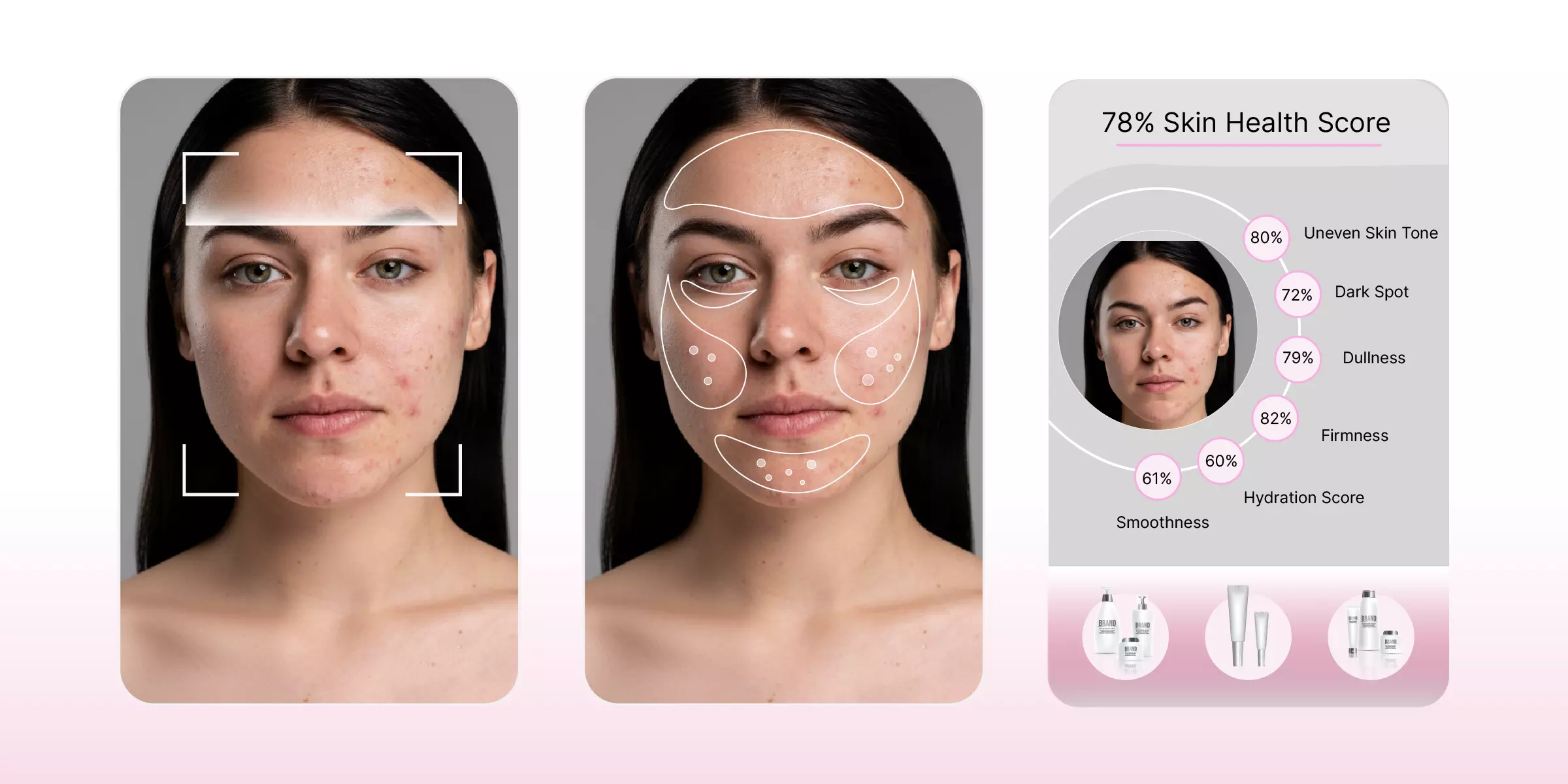
A skin analysis API is a developer-ready service that lets a brand's app or website scan a customer's face, detect skin concerns like acne, wrinkles, and pigmentation, and return a structured report a brand can use to recommend products - without building the underlying computer vision model in-house. GlamAR, Perfect Corp, AILab Tools, ModiFace, Zyla Labs, OrboAI, Skinive, Revieve, Haut, and Iqonic are the ten providers worth evaluating in 2026.
Building this technology from scratch takes a dermatology-grade training dataset, a computer vision team, and months of validation - out of reach for most e-commerce brands. An API removes that barrier: a few lines of integration code, and a brand's product pages gain a feature that used to require an in-house AI lab. This guide covers what the technology actually does, how the ten leading providers compare, where the category is heading, and how to pick the right one for your catalog.
{{component="/internal/widgets"}}
What is a skin analysis API?
%202.gif)
A skin analysis API is the backend service behind any skin-scanning feature a beauty or skincare brand offers online. Instead of a person taking their photo to a dermatologist, they take a selfie on a phone or laptop camera, the image is sent to the API, and within seconds a structured report comes back describing what the AI detected - acne, pores, wrinkles, pigmentation, redness, hydration levels, and more, depending on the provider.
The "API" part matters because it's what makes the feature buildable by a normal e-commerce team rather than a research lab. A brand doesn't need to train a computer vision model, source a dermatology-grade image dataset, or hire a machine learning team. They call an endpoint, or embed a prebuilt SDK, and the diagnostic layer is handled entirely by the provider.
These tools have multiple applications beyond retail - skincare platforms, beauty apps, dermatology-adjacent tools, and even cosmetic research all use variations of the same underlying technology, tuned for their specific use case. For an e-commerce brand specifically, the API's job is narrower and more commercial: turn a scan into a personalized, purchasable recommendation, not just a diagnostic readout.
Why Beauty and Skincare Brands Need a Skin Analysis API
Skincare is a category where the right product depends entirely on information a static product listing can't capture - a customer's actual skin condition. Without that information, shoppers are left guessing between dozens of near-identical serums and moisturizers, and brands lose the chance to recommend the product that's actually right for them.
A skin analysis API closes that gap directly on the product page or in-app. The customer takes a selfie or live scan, the API detects specific skin concerns, and the brand's own recommendation logic maps those concerns to specific SKUs. The result is a shopping experience closer to a consultation than a catalog browse.
This is showing up in market growth: the global AI skin analysis market is valued at roughly $2.13 billion in 2026 and is projected to reach $6.30 billion by 2033, growing at a CAGR of around 16.8%, according to 2026 industry research - driven largely by beauty and skincare brands adding diagnostic tools to their online storefronts. That growth isn't hypothetical: major beauty brands, including Cetaphil, Neutrogena, and L'Oréal, already run their own AI-powered skin analysis experiences built on this category of technology (more on those brand deployments further down), which is a signal of how mainstream the feature has become rather than a niche add-on.
Building this in-house is a heavier lift than most brands expect. A credible skin analysis model needs a large, dermatologist-graded, demographically diverse training dataset - often millions of images - plus a computer vision team to build, validate, and continuously retrain the model. Very few e-commerce brands have the resourcing to do that internally, which is exactly the gap a skin analysis API is built to fill: the diagnostic layer, pre-built and continuously improved by the provider, that a brand plugs into its own storefront.
What to Look for in a Skin Analysis API
Not every skin analysis API is built for the same use case, and the differences matter more than they first appear.
Detection depth and accuracy. How many skin concerns does it detect, and what's the model trained and validated against? A provider that benchmarks its results against dermatologist grading is a stronger signal than one that only reports an internal accuracy number.
Data privacy and compliance. Facial images are sensitive biometric data. Look for clear answers on who owns the captured data, whether it's used to train other customers' models, and what compliance certifications (SOC 2, GDPR, HIPAA where relevant) the provider holds.
Integration effort. Some providers offer a single-line embed and prebuilt UI; others hand over a raw API that needs a development team to wire up. Match this to your own technical resources.
Platform coverage. Whether the API needs to run on a Shopify store, a native mobile app, or an in-store kiosk changes which providers are realistic options.
Product recommendation logic. Detecting a skin concern is only half the job - the API should be able to map results to a brand's own product catalog, not just hand back a generic report.
Ongoing model quality. Ask how often the underlying model is retrained and on what data. A model trained once and never updated tends to drift in accuracy as cameras, lighting conditions, and skin-tone representation in real-world usage diverge from its original training set.
Latency and drop-off risk. A scan that takes 30 seconds to a minute to return results will lose a meaningful share of customers before they ever see a recommendation. Ask for real, on-device timing figures rather than lab-condition benchmarks, since network conditions and phone hardware both affect real-world speed.
Support during onboarding, not just at sales. Skin analysis integrations touch sensitive data, brand-specific product catalogs, and multiple platforms at once, so the quality of a provider's implementation support matters as much as the technology itself. Ask what onboarding actually looks like - self-serve documentation only, or dedicated technical support through go-live.
Best skin analysis API at a glance
10 Best skin analysis API providers
Using a skin analysis API helps brands reduce development costs and time while providing an interactive and intuitive user interface. However, with multiple skin analysis providers in the market offering different features and services, choosing the right one can be challenging.
Selecting the best provider requires extensive research, as you need to evaluate their features, pricing, and system requirements. To save you the effort, I’ve curated a list of the top 10 skin analysis API providers, along with their key features, to help you find the one that best fits your needs and requirements.
1. GlamAR

GlamAR's AI Facial Skin Analysis is built as a full diagnostic platform rather than a single detection endpoint. From one selfie, it returns 15 customer-visible skin scores - covering acne, wrinkles, pores, pigmentation, redness, hydration, and eye conditions - backed by 150+ skin biomarkers and a 94-model machine learning ensemble, in-browser, in around 15 seconds with no app install required.
Every metric returns a 0–100 score, a dermatologist-aligned severity grade (Good / Average / Needs Attention), and an annotated image highlighting exactly where each concern was detected. The models are trained on more than 5 million dermatologist-graded images across six global regions and are fairness-audited across Fitzpatrick skin types, then benchmarked against board-certified dermatologists using inter-rater agreement scoring.
Features:
- Capture quality gating: before analysis runs, GlamAR checks pose alignment and lighting, giving the customer corrective guidance ("move toward the window") instead of returning an unreliable read
- SkinGPT integration: a conversational layer that references the customer's last scan, answers follow-up questions, and builds a personalized AM/PM skincare routine
- Ingredient-to-SKU mapping: analysis results map directly to the brand's own product catalog, not a generic report
- Data ownership: the brand owns the captured data contractually; GlamAR acts as processor, not controller, and no image is used to train models for other customers
- Broad integration options: native SDKs for Android, iOS, React Native, and Flutter, plus plug-and-play connectors for Shopify, Magento, Wix, WooCommerce, and a custom REST API for anything else
- Enterprise certification: SOC 2, GDPR, and ISO 27001 certified
For brands weighing build-versus-buy, the practical case for GlamAR comes down to time and validation cost: reaching a 5-million-image, dermatologist-graded training set and a 94-model ensemble in-house would take most beauty brands years and a dedicated ML team, not a sprint.
Best for: Beauty and skincare brands that want a dermatologist-grade skin analysis API with a prebuilt recommendation and routine-building layer, not just a raw detection endpoint.
{{download="/internal/table"}}
2. Perfect Corp
Perfect Corp is an established AI beauty tech provider offering skin analyzers, virtual try-on, and shade finders alongside its skin diagnostics. Its skin analysis tool uses 180-degree face mapping to scan for acne, pores, spots, and eye bags, then delivers personalized product recommendations based on the results.
The provider reports its tool helps brands increase conversion and sales by around 30%, with a dermatologist-verified 95% test-retest reliability rate. It supports omnichannel integration across web browsers, mobile devices, and iOS, and includes an AI skin simulation feature that generates before-and-after visualizations across up to seven skin issues, letting customers see a projected treatment outcome rather than just a current-state score.
Perfect Corp's broader business - spanning skin analysis, virtual try-on for makeup and hair, and shade-matching - means brands adopting its skin API often end up standardizing on the same vendor for adjacent AR features, which simplifies vendor management but can mean less flexibility to mix and match best-of-breed tools per category.
Best for: Enterprise beauty brands wanting a well-established provider with strong omnichannel reach and simulation features for treatment tracking.
3. AILab Tools
AILab Tools serves beauty and clothing brands with a developer-friendly API stack, backed by a large existing base of over 50,000 developers and 100,000+ registered users. Its Skin Analysis Pro API detects more than 24 skin conditions, including eczema, acne, and urticaria, and performs facial landmark detection across up to 201 key points for precise mapping of facial contours, lips, eyes, and nose.
The API translates results into quantifiable data rather than just a qualitative report, which is useful for brands wanting to track skin metrics numerically over time or feed the output into their own analytics stack. Beyond skin, the same face analyzer layer can detect facial position and attributes - skin age, gender, expression - with quality scores and occlusion detection, which is a useful sanity check for filtering out unusable scans before they reach a recommendation engine.
Best for: Developer teams that want a lightweight, well-documented API without a heavy managed-service layer around it.
4. ModiFace
ModiFace pairs skin analysis with its more established AR virtual try-on technology, making it a fit for brands that want both in one integration. Its skin analysis tool detects more than 20 skin concerns, including fine lines, pores, acne, and deep wrinkles, and was validated on a dataset of more than 10,000 skin analysis images under dermatologist and skin-expert supervision.
The API is built with flexible customization options, letting brands tailor the diagnostic experience to their own catalog and brand identity across web, iOS, and Android, and its results feed directly into search-filter logic — so a detected concern can automatically narrow a product catalog to relevant items rather than just displaying a report the shopper has to act on manually.
Best for: Beauty brands that already use or plan to use AR try-on and want skin analysis from the same vendor relationship.
5. Zyla Labs
Zyla Labs operates as an API marketplace rather than a single-purpose skin analysis provider, giving brands access to a skin analysis tool alongside other AI utilities like hair-switch and hand-recognition APIs from a single account. Its skin analysis API detects wrinkles, pores, blackheads, dark circles, and eye bags, and supports tracking a customer's skin history over time.
Because it's marketplace-based, pricing and access tend to be more flexible and self-serve than a full enterprise sales process - useful for smaller brands or developers who want to test the technology before committing to a longer vendor relationship. The tradeoff is less dedicated onboarding support compared to a managed provider.
Best for: Brands or developers who want skin analysis alongside other AI capabilities without managing multiple vendor relationships.
6. OrboAI
OrboAI focuses on precise, dermatology-adjacent measurement - its skin analyzer is trained on more than 700,000 images and can make measurements across 209 unique facial points and more than 16 skin parameters, detecting six different skin types and ethnicities. The API is designed for fast integration, with a single line of code to get a basic implementation running, and it's built to deliver a consistent experience across web browsers, apps, and in-store devices like smart mirrors.
OrboAI's positioning leans toward brands that want granular measurement data they can act on directly - rather than just a pass/fail severity read - which suits teams building their own scoring or loyalty logic on top of the raw output.
Best for: Brands wanting granular, measurement-heavy skin data and a fast, low-effort integration path.
7. Skinive
Skinive is positioned closer to medical-grade skin diagnostics than a typical retail beauty tool. It's CE-marked medical software capable of analyzing more than 50 skin issues, including moles, rashes, and acne, and is used by both individual consumers and clinical practitioners, with 24/7 availability and no geographical restriction on use.
The API supports multilingual output and detailed disease descriptions, including predisposing factors and symptoms, and can be integrated with around 100 lines of code. It also runs an image quality check before analysis, rejecting low-quality captures rather than returning an unreliable result from a poor photo — a safeguard particularly important given its clinical positioning.
Best for: Brands or platforms operating in or adjacent to dermatology and medspa contexts, where medical-grade certification matters.
8. Revieve
Revieve focuses on the consultation experience as much as the raw detection - its API can assess more than 200 skin health metrics, covering hydration, pigmentation, and sensitivity, with the flexibility for brands to define their own custom metrics tailored to their specific product line. A distinctive feature is real-time feedback during the selfie capture itself, guiding customers on lighting, positioning, and image quality before the scan completes, which reduces the number of failed or low-confidence scans reaching the results stage.
Revieve is built mobile-first, and its broader product suite extends into haircare consultations and foundation matching, which makes it a reasonable fit for brands running a multi-category personal care catalog rather than skincare alone.
Best for: Brands that want a highly customizable metrics set and a mobile-first, consultation-style user experience.
9. Haut
Haut's skin analysis API is trained on more than 3 million data points and reports 98% accuracy on its validation set. It analyzes more than 15 skin health and beauty metrics and is built for minimal-code integration, making it accessible to brands without a large engineering team.
The provider reports that brands using its API have seen measurable increases in both add-to-cart rate and overall customer conversion, driven by more relevant product recommendations following the scan. Haut positions itself specifically for e-commerce and consumer wellness use cases rather than clinical ones, which shows in how directly its output is designed to funnel into a purchase decision rather than a diagnostic report.
Best for: Smaller or mid-sized beauty brands wanting an easy, low-code integration with a strong reported accuracy benchmark.
10. Iqonic
Iqonic extends beyond facial skin analysis alone, offering a B2B API that also covers hair and lip condition and type. It's built for brands that want to combine skin diagnostics with broader personal care recommendations from a single provider, including early detection flags and continuous treatment-progress tracking based on repeated scans over time.
Because Iqonic requires users to upload high-resolution images rather than relying solely on a live camera capture, it can support a more detailed initial scan, at the cost of a slightly higher-friction capture step compared to providers built around instant live scanning.
Best for: Personal care or multi-category beauty brands wanting skin, hair, and lip analysis bundled into one API relationship.

Applications of a Skin Analysis API Beyond Retail
The most common use case for this technology is beauty and retail, but the same underlying diagnostic capability shows up in several adjacent industries, each adapting it slightly differently.
In this section, I will tell you about different applications of a skin analysis tool in different industries that will help brands and practitioners to improve their customer relationships and offer them better services.
1. Beauty and retail
This is where a skin analysis API delivers its most direct commercial value. Brands use it to offer customers personalized product recommendations and real-time visualization on the product page, generating data-driven insight into what concerns their customer base actually has - information that's otherwise invisible in a typical e-commerce funnel. Beyond the recommendation itself, the interactive nature of a scan tends to extend session time and deepen engagement compared to a static product listing, and it gives shoppers a more informed basis for a purchase decision, which supports both conversion and lower return rates.
2. Dermatology and medspas
Dermatology practices and medical spas use skin analysis technology to support in-clinic consultations - checking a patient's skin for concerns like acne, inflammation, wrinkles, and pigmentation as a structured starting point for a professional assessment, not a replacement for one. Practitioners can track a patient's history and treatment progress over multiple visits, using repeated scans to evaluate whether a treatment plan is actually working rather than relying on subjective before/after comparison alone.
3. Cosmetic research and development
Cosmetic formulators and researchers use skin analysis tools during product development and clinical trials to assess how a moisturizer or active ingredient performs — measuring factors like moisture levels and transepidermal water loss (TEWL) to gather objective data that can support marketing claims or guide reformulation. This lets a brand test multiple formulations against consistent, quantified skin metrics rather than relying purely on subjective panelist feedback.
4. Occupational and workplace skin health
A less obvious but growing use case is occupational skin health monitoring - identifying skin hazards that may affect workers in specific environments, particularly where repeated exposure to chemicals, sun, or friction is a known risk. This is a smaller market than retail or dermatology today, but it illustrates how portable the same underlying computer vision technology is once it's been productized into an API.
Brands that are using a skin analysis tool
Several major beauty and skincare brands have already built consumer-facing skin analysis tools on this category of technology, which is useful context for any brand evaluating whether to add the feature - this isn't an early, unproven category.
These brands allow users to upload a selfie or use the live camera of their device to upload the image of their face to conduct the skin analysis and get the analysis report. In this section, I will tell you about some of the leading beauty and skincare brands that help their customers understand more about their skin health and enable them to select the best products accordingly.
1. Cetaphil
Cetaphil's MySkin by Cetaphil tool is built specifically around sensitive skin, letting customers scan a QR code to access an AI-powered assessment covering metrics like hydration level, acne, and skin sensitivity. Cetaphil has positioned the tool as a complement to its existing sensitive-skincare product line, explicitly framing it as part of the brand's broader commitment to personalized, inclusive skincare recommendations rather than a standalone gimmick.
2. L'Oréal Paris
L'Oréal runs its own AI-powered skin diagnostic tools across several of its brands, comparing a customer's selfie against a large set of clinically evaluated reference images to assess concerns like wrinkles, radiance, firmness, and pore quality. Results feed directly into personalized product recommendations from L'Oréal's own portfolio, following the same broad pattern as Neutrogena and Cetaphil: scan, detect, recommend, track over time.
3. Neutrogena
Neutrogena's Skin360 tool, refreshed with AI capabilities from parent company Kenvue, uses a smartphone camera to analyze skin through a 180-degree selfie. It measures more than 2,000 facial attributes across roughly 100,000 skin pixels and returns a Skin360 score across six skin attributes, alongside an AI skin coach (branded NAIA) that offers personalized advice.
The model has been informed by scans of more than 10,000 different faces spanning a range of ages and ethnicities, and Neutrogena positions the tool explicitly around ongoing tracking - helping customers reassess their routine as their skin changes with season, lifestyle, or hormonal shifts, rather than a single one-off scan.
4. Minimalist
Minimalist is a skin and body care brand that provides its users with high-quality skincare products, built with appropriate formulations. It helps its customers to select the best products by providing them with detailed information on their skin conditions and concerns, enabling them to perform the skin analysis test. Users can perform the skin analysis test by uploading a selfie using the mobile’s camera and get a detailed report identifying their affected areas.
With the help of this skin analysis test, its customers can analyze different skin concerns, such as pigmentation, uniformness, dark circles, and redness, providing them with 95% accurate test results. Along with the skin analysis report, it also provides users with personalized product recommendations that are suggested by using artificial intelligence technology to help you treat your skin concerns with appropriate products.
5. Clinique
Clinique is a leading skincare brand that provides its customers with high-quality skincare and makeup products according to their needs and concerns. It helps its customers build a personalized skincare routine by enabling them to perform a skin analysis test and providing them with a detailed skin analysis report. To perform this skin analysis test, users have to take a selfie using their mobile device and upload it to the mobile app to scan it in seconds for skin issues.
After the skin analysis is complete, the app will generate a skin analysis report that will help customers understand the affected areas, and it will also provide them with personalized product recommendations depending on their skin concerns. It provides users with a detailed skin analysis based on the dermatological research of more than 55 years and trained on more than 3 million face scans.
6. Estée Lauder
Estée Lauder is among the other major beauty conglomerates running AI-powered skin analysis services similar in structure to Neutrogena's Skin360 — analyzing a customer photo and recommending a skincare routine built from the company's own product lines. The presence of comparable tools across nearly every major beauty conglomerate is itself a signal: when direct competitors independently converge on the same feature, it's a strong indicator the underlying technology has moved from experimental to expected.
7. Olay
Olay's Skin Advisor tool has been one of the longer-running examples of AI-driven skin analysis in mainstream retail, using a photo-based assessment to estimate a user's skin age relative to their actual age and recommend products targeted at the gap between the two. It's a useful example of how a relatively simple, singular metric - skin age - can be an effective, easy-to-understand hook for driving product discovery, compared to a denser multi-metric report.
{{component="/internal/widgets"}}
Benefits of using a skin analysis API for brands
Building a skin analyzer from scratch is a resource-heavy project - it demands specialized talent, a large validated dataset, and months of development before a brand ever sees a return. A skin analysis API removes nearly all of that upfront cost and time, letting a brand integrate the feature with a fraction of the effort. Beyond the build-versus-buy calculation, adopting an API tends to deliver a consistent set of commercial benefits.
1. Personalized recommendations and accuracy
An API lets a brand move from generic product listings to a tailored recommendation built around each customer's actual detected skin concerns. Because the underlying AI model has typically been trained and validated on a large, diverse image set, the resulting recommendations tend to be more consistent and more defensible than a quiz-based or self-reported skin type selector, which depends entirely on how accurately a customer can self-assess.
2. Increased engagement and conversion rates
An interactive scan and report naturally extends the time a shopper spends on a product page or in an app, compared to a static listing. That extra engagement isn't just a vanity metric - a shopper who has just seen a detailed, personalized report of their own skin concerns is working from a much stronger basis for a purchase decision than one comparing anonymous product photos, which is reflected in the conversion lifts several providers in this list report.
3. Reduced returns and dissatisfaction
Skincare purchases made on a guess - the wrong product for the wrong skin type or concern - are a common source of dissatisfaction and returns. By narrowing the recommendation to what the scan actually detected, a skin analysis API reduces the uncertainty that drives a customer to buy the wrong product in the first place, which shows up downstream as fewer returns and higher repeat-purchase rates.
4. Data-driven product development
Beyond the individual customer interaction, aggregated (and properly anonymized) skin analysis data gives a brand visibility into what skin concerns are most common across its actual customer base - information that's otherwise invisible in a typical e-commerce funnel. Brands can use these patterns to inform which products to prioritize in development, where to focus marketing messaging, and which underserved skin concerns represent a product gap worth filling.
Future Trends of AI in Skin Analysis
The underlying technology is still moving quickly, and several trends are shaping where skin analysis APIs are headed over the next few years.
1. Hyper-personalization and custom formulation
The next step beyond product recommendation is custom formulation - using detailed skin profile data, and in some cases genetic or environmental data, to recommend or even generate a fully individualized product rather than pointing a customer to the closest existing SKU. Some providers are already moving in this direction, pairing skin mapping with AR overlays that let a customer visualize a recommended treatment plan before committing to it. For a beauty brand, this shifts the API's job from "find the closest match in our catalog" to "define what the ideal product would look like" - a meaningfully bigger step that pushes further into product development territory, not just merchandising.
2. Better diagnostics and long-term monitoring
Earlier detection of skin issues, paired with ongoing monitoring rather than a single scan, is becoming a bigger part of how these tools are positioned - both in retail and in clinical settings. Integration with CRM systems lets brands or practitioners track a customer's or patient's history over time, and some providers are exploring integration with wearable and smart-device data to support more continuous, real-time monitoring rather than a point-in-time snapshot.
3. Data integration and a more holistic view of skin health
Rather than relying on a single facial image, the category is trending toward combining multiple data sources - imaging, self-reported lifestyle factors, and in more advanced cases genomic data - to build a more complete picture of a person's skin health. This holistic approach supports more precise personalization, but it also raises the data-governance stakes considerably, since it means handling more sensitive data types than a single photo.
4. Market growth alongside tighter ethical standards
As adoption grows, so does scrutiny of how these tools are built and deployed. Brands and providers are under increasing pressure to demonstrate diversity and inclusion in their training data, establish clear data governance frameworks to protect user privacy, and run regular bias audits across skin tones and demographics. Expect compliance and fairness credentials - not just detection accuracy - to become a bigger differentiator between providers over the next few years, particularly as more markets introduce specific regulation around biometric and health-adjacent data.
How to Choose the Right Skin Analysis API
1. Start with your integration resources. A brand with a small team benefits from a provider offering prebuilt SDKs and e-commerce connectors (Shopify, Magento, WooCommerce). A brand with in-house engineers has more freedom to work with a raw, developer-focused API.
2. Weigh detection depth against your use case. A retail brand recommending skincare products doesn't need the same clinical depth as a dermatology platform — but more detection categories generally mean more precise product matching.
3. Check the data governance terms before signing anything. Facial scan data is sensitive. Confirm in writing who owns the data, whether it trains other customers' models, and what happens to it if the contract ends.
4. Ask how results map to your actual product catalog. A skin score is only useful commercially if it connects to a specific recommended SKU — test this mapping with your own product list before committing.
5. Request a live trial, not just a demo video. Accuracy and speed both vary meaningfully with real lighting conditions and real device cameras — test on the devices your actual customers use.
5. Confirm the retraining cadence. A provider that can tell you exactly how often its model is retrained, and on what data, is generally further along in operational maturity than one that treats the model as a one-time build.
Conclusion
Using a skin analysis tool helps a brand to foster customer loyalty and trust by offering them the best-suited alternatives, depending on their skin issues and concerns. With the help of skin analysis devices, users can get educated about their skin type, tone, condition, and concerns, which will help them understand the affected areas and provide them with personalized product recommendations.
Therefore, to provide users with an easy-to-use tool, it is advisable to integrate the skin analysis feature into the e-commerce website using an SDK or API. In this blog, I have given you the information on the 10 best skin analysis API providers that skincare and beauty brands can consider to understand their features and offerings. Brands can utilize this listing to opt for the best skin analysis API provider that will help them to provide their customers with the best experience and increase their engagement on the website or app.
Most APIs return a structured report per scan — typically a score or severity grade for each detected skin concern, plus supporting data like an annotated image or facial landmark coordinates. GlamAR's API additionally returns a confidence interval, model version, and timestamp for each metric, useful for brands building their own analytics on top of the results.
No. These APIs are built to guide product recommendations and personalize the shopping experience, not to diagnose medical conditions. Even medical-grade tools like Skinive are positioned as a supplement to, not a replacement for, professional dermatology care.
Pricing varies widely by provider and usage volume, from marketplace pay-per-call models to enterprise SDK licensing. Most providers, including GlamAR, require a conversation to scope pricing against expected scan volume and integration depth.
With the help of skin analysis tools, users can detect multiple parameters such as moisture, texture, spots, wrinkles, pores, elasticity, and pigmentation, enabling them to estimate skin age or sun damage risk, offering robust skin profiling.
Yes, with providers that offer a web SDK. GlamAR's skin analysis runs directly in a browser with no app install required, in addition to native SDKs for brands that do have a dedicated app.
Accuracy varies by provider and depends heavily on how diverse the training data is. GlamAR's models are fairness-audited across Fitzpatrick skin types I through VI using a training set spanning six global regions, specifically to avoid the accuracy gaps that under-diverse training data can cause.
Discover how AR, VR and 3D can drive revenue growth in 2026
Schedule a call with our team

.avif)