


Why every jewelry brand needs virtual try-on in 2026 (Important benefits)


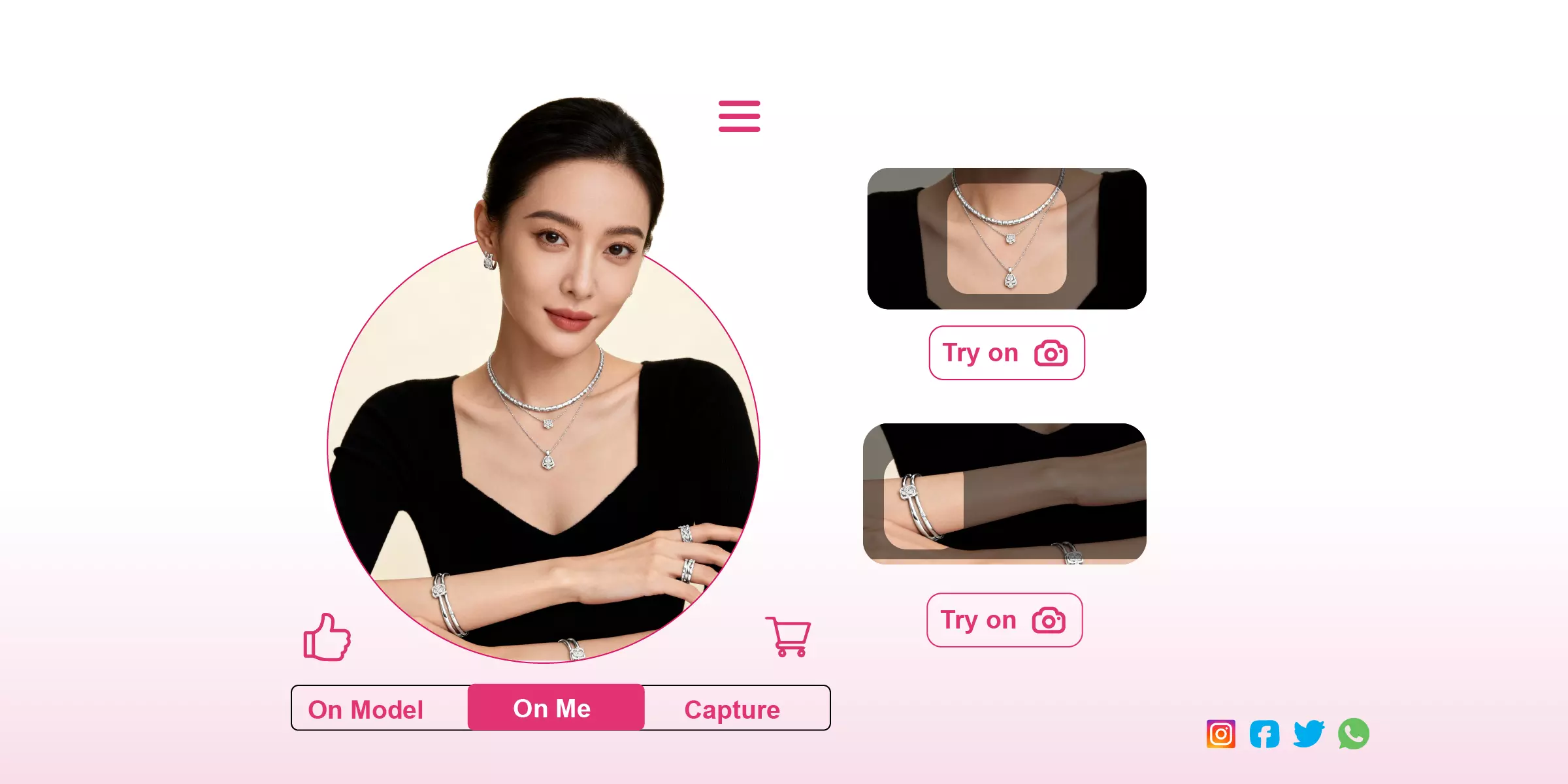
Today’s jewelry market is on the verge of major change. Consumers are now expecting in-store shopping experiences without leaving their homes. Virtual jewelry try-on technology can meet their demands and ensure buying convenience. It has transformed the way your customers can engage with and purchase jewelry items.
Imagine a busy customer purchasing a wedding ring late at night. He is worried about how the ring will look from different angles, how it sits on his finger, and if the stone is “too big” or “too small.” That anxiety makes shoppers hesitant to make purchases, compare prices, or abandon the cart. Many of them return expensive pieces later.
Virtual jewelry try-on can replace guesswork with a realistic preview. Your customers can see the ring on their hands, earrings in their ears, or a necklace on their necklines. It can reduce the consideration period and increase purchasing confidence. If you want to turn your picky shoppers into eager buyers, you should invest in AR solutions.
In 2026, there are approximately 1.07 billion mobile AR users. It is projected to rise to 1.19 billion by 2028. Considering this trend, jewelry brands may need virtual try-on solutions in 2026 to stay competitive in the market. I am going to walk you through the benefits of jewelry try-ons for your brand.

What is a virtual jewelry try-on solution?
Virtual jewelry try-on is a set of AR experiences. It overlays digital jewelry models onto a live camera view or an image of your customer. It uses the power of computer vision, 3D modeling, and real-time rendering to allow your customers to try on jewelry items digitally. Thus, they can gain a realistic visualization of how the products would look on their faces, bodies, or hands.
As a result, consumers can buy the jewelry pieces with less reluctance, and they are less likely to return the products. They just need to upload their images, select their desired item, and then experiment with different styles. Some virtual try-on platforms can generate public or private shareable try-on links that they can send for a personalized shopping experience.
Why every jewelry brand needs virtual try-on in 2026

Virtual try-on is a tool that can merge an in-store purchasing experience with digital shopping. Integrating the technology, you can transform the shopping experiences of your customers and enhance conversions. In this way, it can increase your sales and grow your business. Let’s explore the advantages of virtual jewelry try-ons:
1. Enhancing purchase confidence
AR try-ons allow your customers to see how your jewelry products look on them. They can experience realistic visual sizing and get face-shape-based recommendations during the try-on session. It can help them purchase those products with confidence. Also, they are less likely to return.
2. Personalized product suggestions
Virtual jewelry try-ons can facilitate a personalized approach. They will get unique jewelry recommendations based on their needs and preferences. Thus, they can choose their favorite jewelry items after trying them on, with no guesswork. It can help you build strong customer relationships and long-term loyalty.
3. Minimizing return rates
In traditional online shopping, consumers won’t touch, feel, or try on jewelry pieces before making a purchase. If you keep your product offerings conventional, it may result in increased return rates. Customers may often face complications due to return processes. So, introducing virtual jewelry try-ons can help you avoid these situations. It can lead to enhanced conversions.
4. Improving conversion rates
Jewelry try-ons allow your customers to try on products in real time. It will help them accurately gauge the size, length, and proportion of jewelry pieces on themselves and make an informed purchasing decision. In this manner, you can convert more website visitors into paying customers. It has the potential to increase long-term loyalty.
5. Increasing customer engagement
You can provide your customers with realistic virtual jewelry try-ons. It is a transformative tool to enhance customer engagement and satisfaction. Virtual try-on solutions can offer your customers 3D views, mix-and-match options, social sharing features, and unique recommendations to engage consumers for a long time on your website.
Thus, you can encourage visitors to spend more time on your website, which you can measure through data analytics tools. Therefore, virtual try-on tools can turn a passive browsing experience into an interactive adventure.
6. Unique brand experience
You can offer estimated sizing recommendations, using some advanced VTO systems. Also, it can reduce customer service inquiries about product appearance. It helps minimize the need for physical sample displays. Thus, you can get indirect support for more efficient inventory usage.
Therefore, integrating VTO solutions can help you provide unique, interactive shopping experiences. Also, it may offer advanced customization options for consumers. Thus, jewelry brand owners can outperform competitors with operational efficiency.
7. Cost saving
As jewelry try-ons can increase purchasing confidence and reduce return rates, they can help you decrease your business expenditure. Plus, you may reduce the need for large physical displays or samples.
Thus, you can lessen associated costs with the help of virtual try-on tools. It may result in minimal waste. On top of this, AR shopping can decrease the costs of logistics, labor, and restocking that you need to bear in traditional product offerings.
8. Convenient & hygienic shopping
Virtual jewelry try-ons can help you offer an interactive and remote shopping experience for your customers. In the present day, some shoppers are willing to purchase high-priced items, like jewelry, online to maintain safety and hygiene. Integrating AR try-on solutions into your e-commerce platform, you can meet your customers’ evolving demands and allow them to try on jewelry remotely.
Best jewelry try-on SDKs
I have been playing around with virtual jewelry try-on tools for a while now. With lots of research and testing, here are the top 5 jewelry try-on platforms that can change the way consumers shop.
1. GlamAR
Jewelry retailers and brand owners can transform the shopping experience with jewelry try-ons. GlamAR provides virtual try-on solutions for major jewelry types: earrings, rings, necklaces, bracelets, and maang tikkas. I explored GlamAR's virtual jewelry try-on and experienced the real-time effects of jewelry on my live video or image.
On this platform, I found adjustment tools for placing the earring at the right piercing position or the necklace along the neckline. Also, I discovered two options available on the jewelry try-on: scale and position (right & left). Through them, I can adjust the selected jewelry piece to help maintain accurate alignment.
GlamAR has the zooming feature. So, your customers can zoom in and out to view the result. In some cases, they can use the comparison tool to compare different jewelry looks. With the download option, they can save their try-on experiences for future purchases. Plus, they can share it with their friends and family to get their feedback.
Features:
- Compatible solution: GlamAR is designed for WebAR (browser), mobile, desktop, and cross-device use. So, you can find it easy to add to your brand’s existing platform. It allows your customers to try on jewelry in real time. In this manner, they can instantly see how each jewelry piece looks on them before making a final purchase.
- Face tracking: GlamAR does provide real-time jewelry AR try-on with tracking and placement on ears, fingers, neck, etc. Thus, jewelry stays aligned with consumers’ movement.
- Interactive jewelry shopping: GlamAR’s jewelry try-on tools can help you improve purchase confidence and reduce uncertainty in shopping. As a result, shoppers are less likely to return, improving conversions.
{{component="/internal/widgets"}}
2. Banuba
‘TINT’ is a virtual try-on platform introduced by Banuba. It has virtual jewelry try-on software that you can integrate into your e-commerce platform. In this way, you can give your customers an interactive online shopping experience with anatomically accurate jewelry placement, realistic gravity, and lighting adaptation.
By embedding the 3D virtual try-on SDK of Banuba, you can display precise virtual representations of earrings, piercings, ear cuffs, etc. Now, your shoppers can experiment with earrings, necklaces, chokers, pendants, engagement rings, and more. Thus, they will achieve a try-before-you-buy experience.
Banuba offers some free digitization options depending on the plan. You can get free AR models. Only frontal photos of jewelry products should have a minimum resolution of 1024x1024. As a result, you can showcase high-resolution and hyper-realistic product models on your online platform.
Features:
- Easy integration: Banuba offers an easy-to-use virtual try-on plugin for jewelry brand owners. You are able to integrate the jewelry try-ons through SDKs and available marketplace plugins, depending on the platform. Then, you need to upload your SKUs and select AR attributes like color, texture, & shape for each item.
- Cross-platform support: Banuba SDK is designed for Web, iOS, Android, Mac, and Unity. Consumers should use minimum OS versions, such as iOS 10/Android 6, and a 1280x720 camera.
- Accurate tracking: Banuba has face tracking algorithms. It can detect a face and its features: mouth, eyes, nose, hair, neck, etc. Then, the AR technology allows real-time virtual try-on of jewelry and other items. It transfers natural colors, texture, and lighting and creates real-world object physics to create a realistic look and fit of AR jewelry. On the other hand, its real-time 3D hand tracking can ensure accurate placement of AR rings, bracelets, etc. Now, consumers can move to see the products from different angles.
3. Perfect Corp
Perfect Corp allows you to use 3D models and AR VTO technology across web and mobile platforms. It uses proprietary VTO-compatible 3D model formats. Its VTO engine can generate AR try-on experiences for jewelry brand consumers. Your customers can enable the camera on their mobile phones or desktops to try on jewelry items, such as rings, necklaces, earrings, and bracelets.
On this platform, I tested and tried different jewelry designs with realistic lighting, reflections, and a dynamic motion simulation. I explored the AR jewelry try-ons through live camera mode and found my perfect style. Some of its jewelry try-on implementations allow mixing and matching multiple pieces of jewelry and accessories.
Perfect Corp’s ecosystem supports omnichannel integration. So, your customers can try on all types of jewelry items directly on your website or e-commerce platform. You can introduce jewelry try-ons in stores with smart beauty mirrors. It allows shoppers to virtually try on 3D jewelry pieces within your brick-and-mortar store.
Features:
- Customizable integrations: Jewelry brand owners can easily implement virtual try-on experiences for lines of 3D objects on Perfect Corp.’s VTO platform with high-performance data retrieval and rendering. It allows you to customize attributes, such as 3D mesh files, textures, materials, and images. Thus, you can generate high-performing jewelry try-on experiences with low technical requirements.
- User-friendly solution: On this platform, you can use 2D images to provide high-quality virtual try-on experiences with less effort. It can help you save time and expenses. On the other hand, you can create 3D models to display intricate product details and offer your customers highly realistic VTO experiences. Therefore, any jewelry brand, regardless of its size, can opt for this platform.
- PBR technology: Perfect Corp uses Physically Based Rendering (PBR). Integrating its jewelry try-ons allows your customers to experience ambient lighting simulations, realistic material reflections, advanced light scattering, and detailed surface textures.
4. MirrAR
Do you want to enhance your conversion and reduce return rates? Opt for MirrAR’s augmented reality jewelry software. Your customers can try on a wide range of highly realistic jewelry designs without stepping outside. They can explore MirrAR's earring, necklace, ring, and bracelet try-on solutions.
To my surprise, the AR software can generate high-resolution textures and material reflections while consumers are trying on your jewelry products. It can help them get a realistic visualization from any device or browser they are using. Thus, you can make the virtual try-on jewelry software accessible to all.
Using a webcam, I can use its virtual try-on tool and see a virtual representation of how your jewelry pieces will look on me in real life. For this, I won’t need to install your company’s app (and all the annoying push notifications). On top of this, I can try on jewelry directly on your website or e-commerce platform.
Features:
- Compatible interface: The AR jewelry software of MirrAR is compatible with desktops, tablets, and mobile devices on major browsers. Your customers can try on highly realistic jewelry designs, no matter what device or browser they are using.
- Realistic experience: It detects key facial landmarks and relevant body regions to accurately position jewelry. It supports motion simulation and occlusion handling to make sure your 3D jewelry designs look and move naturally on your branded app.
- In-store smart mirror: Introducing the in-store smart mirror, you can showcase the jewelry pieces that will suit your customers. It can capture live video to detect facial landmarks for an accurate virtual tryout of 3D jewelry in real time.
5. Kivisense
Kivisense provides an AI-powered AR try-on engine that supports omnichannel retail experiences. It enables your customers to get a personalized jewelry try-on experience using their phone or webcam. Based on their unique preferences, they can buy their desired products with confidence.
With a simple tap, consumers can explore a range of earrings, pendants, bracelets, and rings with different styles and colors. Also, they can capture their best try-on experiences and share them on social media. The best part is that they can see an instant and actual positioning of jewelry with its AI-driven AR solutions, even as they move and adjust camera angles.
Kivisense’s jewelry try-on software is compatible with modern camera-enabled devices, including desktops, smartphones, and tablets. Integrating its virtual jewelry try-on tools allows you to make your brand’s digital presence strong. It may help you enhance your competitiveness and customer engagement.
Features:
- Advanced 3D rendering: Kivisense has a realistic 3D rendering. It can help you showcase jewelry items, simulating real-world lighting, material reflections, and intricate details of every gem. With its physics engine, the AR jewelry try-on adapts in real time to the wearer’s every move and delivers a realistic try-on experience.
- Accurate tracking: It offers smooth and stable virtual try-on with its responsive motion tracking capability. So, your customers can engage in interactive shopping. Thus, you can set a standard in virtual jewelry shopping with real-time face and hand tracking.
- AR try-on mirror: AR virtual try-on mirrors can detect facial or hand landmarks. It can help place jewelry in an accurate manner. AR mirrors allow you to display different jewelry designs without stuffing your product inventory. As a result, you can reduce customer disappointment due to your limited in-store stock.
Popular brands that are using jewelry try-on solutions
Many jewelry brands are adopting virtual try-on tools to transform their customers’ shopping experiences. Here, I am going to discuss some renowned jewelry brands and how they use virtual jewelry try-ons to grow their businesses:
1. Tanishq
As the first jewelry brand in India, Tanishq brought its first AR experience for customers. It launched an augmented reality/hybrid reality (a combination of physical space and augmented reality) campaign at Delhi and Bengaluru airports in 2019 to engage and interact with a large audience. Tanishq allows online customers to virtually try on jewelry.
It has partnered with MirrAR to enable jewelry try-ons. I explored the website of Tanishq and clicked the ‘Try it on’ button. On this platform, I used a model to see a realistic representation of virtual earrings. Consumers can use the ‘live’ option to see how the jewelry looks on them in real time. They can save their ‘try-on’ experience or directly add the product to the cart from the try-on window.
Sharing her thoughts on the launch of the AR experience, Deepika Tewari, Associate Vice President, Marketing, Jewellery Division at Titan Company Limited, said, “Tanishq has always aimed at providing the best for our customers, and this fascinating initiative is one such approach in achieving the objective. Consumers have the option of browsing through multiple jewelry pieces virtually with just one click. The real-time customer experience will definitely strengthen the retail connection between the brand and our esteemed consumers—a transformative step in how India will shop and purchase jewelry in the near future.”
2. Reliance Jewels
Reliance Jewels provides its online consumers with an easy-to-use virtual jewelry try-on, powered by Plushvie. I experimented with different pieces of jewelry, from necklaces to earrings, on its website.
It gave me a real-time visualization of the jewelry items. I can zoom in to see the result. Also, I compared my looks wearing my favorite jewelry. So, consumers can try on this brand’s jewelry pieces before making a purchase.
3. Tiffany & Co
Tiffany & Co. has introduced 3D display and AR try-on features on WeChat MP and JD PDP pages. It aims to enhance conversions through the use of 3D display and AR try-on technologies. It has high-precision 3D rendering techniques to encourage customers to explore the exquisite details of stunning diamond rings.
Most importantly, consumers can see highly realistic representations of diamonds and gold on this platform. Thus, AR static and dynamic try-on experiences help them visualize the real-life effects of wearing Tiffany’s jewelry products.
4. Kalyan Jewellers
Candere is an online jewelry platform owned by Kalyan Jewellers. It offers virtual try-on features for jewelry. So, customers can get a virtual trial of jewelry. They can explore various suites of collections and find the right one for them with its ‘TRY ON’ features. It can give them a scope to try before buying with its AR solutions. Apart from this, they can save and share their virtual jewelry try-on experiences.
5. Cartier
Cartier has integrated AR try-on tech. It delivers virtual try-on solutions for bracelets, rings, earrings, necklaces, wedding bands, etc. Customers can choose different designs and variations while trying them on.
They can try on different designs and view how each piece looks in real time. Now, Snapchat users can explore Cartier’s Trinity Collection as Cartier and Snapchat collaborate with each other to implement personalized AR try-on experiences.
How to choose the best virtual try-on SDK for your jewelry brand?
Choosing the right virtual try-on SDK comes down to your business type, workflow, and budget. Most AR try-on software can serve businesses in any industry. But some can be specially designed for jewelry businesses. So, select an SDK that can fit your brand's size and operations for budget purposes, too.
The list I mentioned here contains a collection of excellent virtual jewelry try-on tools tested by me. If there is a particular feature you need, check them out and choose the best for your jewelry brand.
When picking a virtual jewelry try-on platform for your brand, you should consider some factors. They include realism & rendering quality, jewelry-type support (rings, earrings, necklaces, etc.), accuracy of face/hand tracking, ease of integration (SDK, plugins, APIs), multiplatform support (web, iOS, and Android), cost and licensing, backend tools/analytics, 3D model support & digitization, customization options, and customer support.
I kept GlamAR in the first position on my list. It can provide your customers with customizable jewelry try-on solutions with its easy-to-integrate SDK and cross-platform support. Apart from it, you can explore other platforms or go for their demos for your jewelry brand.
Conclusion
As a high-priced item, some of your shoppers would think twice before purchasing your jewelry online. For them, seeing is believing. Therefore, the appropriate way to seal the deal is to allow them to try on your jewelry from anywhere they want. Thus, the digital innovations, like virtual try-ons, continue to reshape your customers’ decision processes and shopping patterns.
If you don’t want to stay on the sidelines and don’t have to just survive, integrate jewelry try-on technology into your e-commerce platform. For this, choose a platform, like GlamAR, that can match your business goals. It’s time to explore its demos. Also, you can contact their sales team to discuss your needs.
{{component="/internal/widgets"}}
Virtual jewelry try-on uses AR and AI. It can help your customers see how jewelry will look on them before they buy it. Their phone or laptop camera captures their faces, hands, or neck. Then, the technology places a 3D digital version of the jewelry, like earrings, necklaces, or rings, right on their live images. It can track their movements. When they move their heads or hands, the jewelry will follow them. Also, the technology can understand the shape of their faces and hands and add the right lighting and shadows. It will make the jewelry look realistic while trying it on. Thus, they can check the style, size, and fit in real time, just like trying it on in a store, but from the comfort of their homes.
It helps online businesses and gives your customers a confident shopping experience. When consumers can see how a product looks on them before buying, they are more likely to make a purchase. It may result in higher sales and improved conversions. Also, it can reduce returns because your customers can choose the right product the first time. Thus, virtual jewelry try-ons can make shopping easy and satisfying for customers. So, you can find it profitable for your jewelry business.
Implementing virtual try-on for a jewelry brand comes with many challenges. Creating detailed 3D models of jewelry is difficult because pieces are small and shiny. Also, making the lighting, reflections, and sparkle look real needs advanced technology. The system can track hands, fingers, ears, and necks accurately, based on the platform. So, the jewelry fits perfectly on screen. It can work smoothly on different phones and browsers without slowing down the website. Poor lighting or camera quality can affect results, and strong privacy measures are needed when using the camera. Developing and updating virtual jewelry try-ons can be costly and time-consuming for brands.
Jewelry brands can implement virtual try-ons with the help of AR and AI technology. First, they need to create clear 3D product models of each jewelry piece. Most importantly, the models can show the exact shape, size, and shine. Then, the brand can connect the models to the VTO software. The virtual jewelry try-on software uses the phone or laptop camera to detect the face, hands, or neck of a consumer. It places the jewelry in the right spot on the screen. The jewelry moves when the person moves. Developers can add this feature to their website or app. The brand tests everything to make sure it works smoothly. You can add new jewelry designs to update the system.
Yes, virtual jewelry try-ons can help brands reach more people. The tools can remove distance limits. So, anyone can try jewelry from anywhere. Your customers can feel confident, as they can see how items look on them. It can reduce returns and build trust. The experience is fun and interactive to keep consumers engaged. Also, it can attract shoppers who prefer quick and convenient online shopping. People who cannot visit the store can explore the online collection in real time. It helps brands connect with their customers across countries and time zones. As a result, the customer base grows much bigger than what a local store can reach.
The virtual jewelry try-ons can help customers feel confident when buying expensive items. They can see the fit, size, and style in real time. It can reduce confusion and hesitation. Shoppers know what the jewelry will look like on them. This, in turn, results in more purchases and fewer returns. Also, it can give an in-store-like experience while shopping online. The virtual try-on can show clear and personalized visuals that online images cannot offer. Thus, your customers feel secure when making big online purchases, such as engagement rings.
Discover how AR, VR and 3D can drive revenue growth in 2026
Schedule a call with our team

.avif)