


Augmented reality in the jewelry business (5 brands)


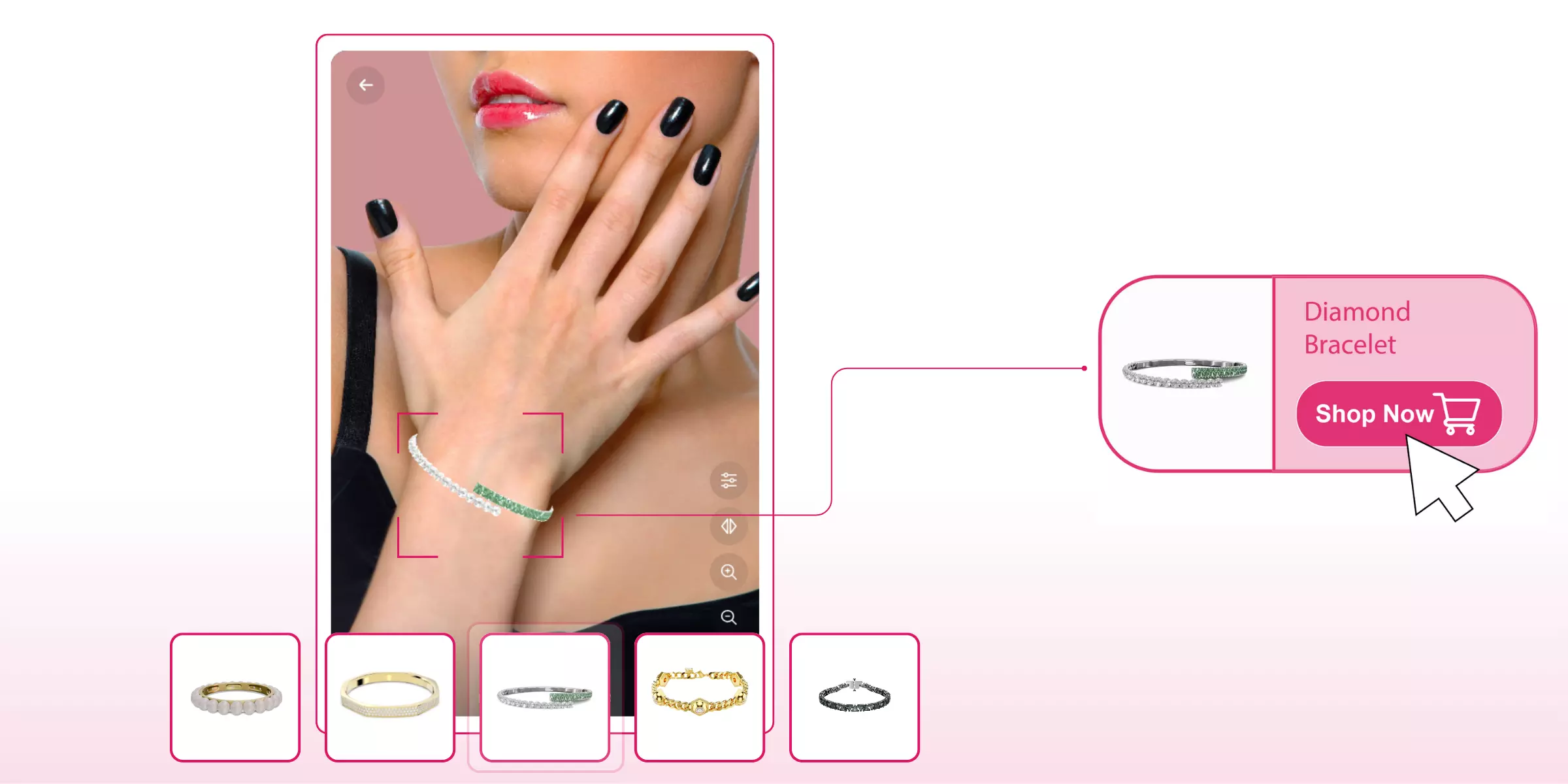
Jewelry is more than just an accessory. It creates an emotional attachment with consumers. As a jewelry brand owner, you can connect your customers with your AR jewelry items. It can fill the gap between online and offline stores. So, you can narrate a visual and interactive story to customers about jewelry pieces through AR.
For years, customers have been going to brick-and-mortar stores and trying on jewelry before making a final purchase. But online jewelry stores have brought the AR try-on tools to make their customers feel the ‘try-before-you-buy’ experience. Therefore, augmented reality is increasingly seen as a practical commerce tool rather than just a tech gimmick. It can positively influence buying decisions and improve conversion rates.
According to a CRN report in 2020, 48% of consumers say they remember brands that engage them with immersive technologies. As AR jewelry platforms mature, more brands are investing in them. It allows shoppers to try on jewelry pieces in real time and, on some platforms, customize them before buying.
In this article, I am going to explore the jewelry brands that are using augmented reality and future-proofing their business:
{{component="/internal/widgets"}}
What is AR in jewelry?
AR in the jewelry business has been transforming the shopping experiences of consumers with virtual try-on technology. It allows them to experiment with rings, earrings, necklaces, bracelets, etc., in real time through smartphones, WebAR links, and in-store AR mirrors. It works with highly realistic 3D models and advanced face and hand tracking to generate lifelike results.
If your customers want to see the ring using a 3D model overlaid in augmented reality, they can activate the AR view to see the ring in both augmented reality and 3D. AI and machine learning analyze camera input to detect the user’s hand, face, or body landmarks and position the jewelry accurately. Then, it overlays a 3D model of the chosen jewelry onto a real-time camera feed of their hand or body.
Depending on the platform, users can adjust orientation or view angles, while AI tracking automatically maintains accurate placement. If the person moves, the jewelry item moves, too, as if in the same space. Also, your customers can view jewelry from multiple angles and, on supported platforms, customize designs without visiting a physical store.
Glance at the table of the best jewelry brands that are using AR
Popular jewelry brands that are using AR
In the present era, some renowned jewelry brands are embracing AR to provide their customers with realistic try-on experiences. Here, you can have a look at them:
1. H. Samuel

H. Samuel offers 2D virtual try-on experiences for selected jewelry items, particularly rings, directly on its website. So, customers can access the try-on either via QR codes or directly through mobile browsers.
They need to hit the ‘Try On Me’ button, and the camera view will appear before them. It will help them visualize how the jewelry may look on them before purchasing. Based on personal testing, the experience felt smooth and engaging.
2. De Beers
De Beers’ Forevermark brand has experimented with digital and AR-based jewelry visualization experiences. Forevermark has launched digital fitting and visualization experiences for select collections. On this platform, they can explore rings, earrings, and pendants from the Forevermark Millemoi collection in an interactive 3D viewing environment.
Customers can use their computers to view rings, earrings, and pendants from the new Forevermark Millemoi collection that sparkle in the light. It helps users understand how the jewelry appears from different angles.
3. Berganza
Berganza offers a photo-based virtual ring try-on feature on its website. E-commerce consumers can try on Berganza’s extensive ring collections before buying by clicking the CTA button “View on hand.”
Then, they can upload a photo of their hand or use their mobile camera. They can select different ring sizes and viewing angles. Berganza also offers virtual consultations for more detailed product viewing. Shoppers need to book an appointment for a virtual viewing.
4. Tiffany & Co.
Tiffany & Co. has introduced 3D display and AR try-on features on WeChat MP and JD PDP pages. It aims to enhance consumers’ virtual shopping experience. Both Cartier and Tiffany have launched separate AR campaigns as part of luxury digital innovation. Now, Snap AR has partnered with several luxury brands, including Tiffany and Cartier, for select AR experiences.
5. Pandora
Partnering with Tangiblee, Pandora offers their customers virtual try-on features, powered by Tangiblee. It is expanding the AR try-on solutions across a large portion of its product catalog. They can hit the ‘TRY IT ON’ button on supported products while browsing with their mobile devices. Then, they will be able to visualize how jewelry appears on hands, fingers, ears, or necklines using digital previews.
Also, shoppers can explore ring stacking with Pandora’s virtual try-on solutions or stacking multiple rings on a model's hand. They can compare the jewelry items side by side to select the right one for themselves. I found this feature pretty useful for consumers.

Why are jewelry brands using AR?
Staying connected with consumers may seem challenging. But integrating AR solutions can help address this pain point for jewelry brand owners. Virtual try-ons allow your customers to experience luxurious or expensive jewelry pieces in real time, which can help them make more confident purchase decisions. So, you can provide improved shopping experiences with augmented reality.
AR try-on can provide benefits to consumers that extend beyond just product visualizations. It enables them to see jewelry items on their body parts with reasonable visual accuracy from the comfort of their homes. Some implementations offer customizable features and comparison capabilities to find the right product to reduce guesswork when selecting the right product. Thus, you can reduce abandoned cart rates and returns.
If you want to create a successful virtual shopping space with the "try before you buy" feature, AR solutions can help reshape the traditional jewelry shopping experience. It will bring interactive and fascinating experiences for new-gen buyers. With AR virtual try-on, customers can engage with your jewelry brand and its products in a convenient way.
It can result in enhanced customer engagement and higher sales. Apart from this, you can get access to various data insights by embedding AR with your website or app. Then, they can use it to track their product performance and do a detailed customer analysis. It may help you boost your customer service and elevate your business strategies. So, forward-thinking jewelry brands are using and implementing AR technology.
Glance at the table of the best AR jewelry platforms
Best AR jewelry platforms
After evaluating multiple AR jewelry platforms, I considered 10 AR jewelry platforms. Based on hands-on evaluation and feature comparison, here are five notable AR jewelry platforms:
1. GlamAR
If you want to bridge the gap of online jewelry shopping, integrate GlamAR’s jewelry try-on to enhance online jewelry shopping experiences. They can see how different jewelry items look on them in real time. It offers accuracy when it comes to the fit of virtual earrings, placement of necklaces along the neckline, alignment of maang tikkas, wrapping of bracelets around consumers’ hands, and realistic rendering of rings on fingers.
I can use live video, upload my images, or choose models irrespective of gender, race, age, and ethnicity to create more personalized try-on experiences. The platform provides scale and position controls that allow users to adjust jewelry placement during the try-on. Thus, you can use it, which can help improve customer purchase confidence.
GlamAR’s engine handles surface detection, light simulation, and AR anchoring for fine details. Embedding jewelry try-on experiences through iFrame or API can enable you to obtain live analytics on usage, engagement, and interaction metrics, with optional conversion tracking. You can upload 3D models, product images, and metadata into the GlamAR console to optimize assets for web and mobile AR performance.
{{component="/internal/widgets"}}
2. Perfect Corp
Perfect Corp offers proprietary AR and 3D asset workflows that support virtual try-on across modern web browsers and mobile devices. The platform enables brands to display 3D jewelry models such as bracelets, earrings, rings, and necklaces. Then, you can enable virtual try-ons for consumers. Its Physically Based Rendering (PBR) supports realistic lighting, material reflections, and detailed surface textures. It can create visually realistic representations of jewelry items in live camera views.
Perfect Corp supports AR try-ons for rings, bracelets, earrings, and necklaces for brands of various sizes. Also, you can help reduce uncertainty around how an engagement ring may fit. The online ring sizer tool can provide a more accurate ring size estimation during online shopping.
Depending on implementation, consumers can mix and match multiple jewelry items during try-on. Some implementations allow experimenting with rings on different fingers within the same interface. Consumers can experience the virtual try-on experiences through the cameras on their mobile devices or desktops in real time. Apart from this, you can offer in-store jewelry try-on experiences by integrating smart mirrors that support AR try-on experiences in-store.
3. MirrAR
MirrAR allows shoppers to try on realistic digital jewelry designs using AR software. It works across desktops, tablets, and mobile devices. Using this AR software, you can display high-resolution textures and material reflections of your jewelry items during the virtual try-on session. It supports occlusion and realistic positioning, depending on the device and tracking conditions. It detects facial, hand, or body landmarks to position jewelry accurately.
As a result, your customers can experience visually accurate placement of virtual jewelry. For this, they typically won’t need to install a dedicated app. Using a webcam, they can experience the virtual representations of your jewelry pieces directly from your website or e-commerce platform.
Plus, they can try on necklaces, rings, earrings, and bracelets through MirrAR’s AR jewelry solution. It allows them to use custom effects or filters to capture “Instagrammable” images or videos of themselves wearing the virtual jewelry and share them with their followers. You can introduce in-store smart beauty mirrors to estimate facial landmarks and position jewelry in a precise manner.
4. Banuba
Banuba offers virtual try-on solutions through its TINT AR platform, which supports select jewelry experiences. It uses advanced face-tracking software. It can provide your customers with an interactive online experience with accurate jewelry placement, lighting effects, and responsive motion behavior, depending on the device and setup. The software supports several jewelry types, particularly earrings, ear cuffs, necklaces, and chokers.
Integrating this AR jewelry software, you can create and showcase high-resolution and visually realistic product models. It preserves natural colors, textures, and lighting effects to enhance visual realism. The good news is that shoppers can experiment with AR jewelry in web browsers. Depending on the platform, you can quickly and easily integrate it through SDKs and available marketplace plugins.
As a jewelry brand owner, you can access a completely customizable UI and some high-quality base AR models for free, based on your selected plan. Apart from this, you can offer multilingual interfaces for global users. Now, consumers can get a virtual jewelry try-on experience at any time from anywhere.
5. Kivisense
Do you want to enhance your customers' experience when shopping for jewelry online? Integrate Kivisense’s AI-powered AR try-on engine. It allows your customers to experiment with various jewelry items such as earrings, pendants, rings, and bracelets, depending on the configuration. They can try on the jewelry items using 3D AR visuals through mobile cameras or webcams.
Consumers can capture their virtual jewelry try-on experiences and instantly share the photos or videos on their social media handles. It can help strengthen digital presence and improve engagement. Kivisense offers an advanced 3D rendering engine to create a realistic experience. It can simulate realistic lighting, material reflections, and fine design details.
Apart from this, your AR jewelry try-on adapts in real time to user movements using motion and landmark tracking. With the help of advanced facial features and wrist tracking, the combination of AR and AI technologies enables shoppers to see responsive and visually accurate jewelry placement. They can move and adjust camera angles at the time of jewelry try-ons. Therefore, you can give them an interactive jewelry shopping convenience in real time.
How to choose the best platform for AR jewelry
The AR jewelry try-on feature is a powerful tool. But every platform is not always the right fit for all brands. The good news is that there is no shortage of jewelry try-on platforms, each with its own strengths.
If you are seeking a platform that checks all the boxes—realism & rendering quality, jewelry type support (rings, earrings, necklaces, etc.), accuracy of face/hand tracking, ease of integration (SDK, plugins, APIs), multiplatform support (web, iOS, and Android), cost and licensing, backend tools/analytics, 3D model support & digitization, customization options, and customer support—GlamAR stands out as a strong option across many of these criteria.
It offers customization, multiplatform compatibility, and scalability suitable for growing brands. You can go for its demo and test it yourself. Like GlamAR, you can explore demos or trial options offered by other platforms on the list.
Conclusion
Consumers’ demands are changing with time. So, your jewelry brand should adapt to it. You can do it by adopting digital innovations, like AR technology. So, jewelry brands are investing in it to remain competitive in an increasingly digital retail landscape. Integrating AR software can help communicate your brand story through interactive and immersive experiences.
AR brings interaction and real-time experiences to your customers’ shopping journeys. It allows them to try on different jewelry pieces without a physical touch, which can help shoppers feel more confident in their purchase decisions. Therefore, augmented reality offers an experience that closely resembles in-store shopping convenience. If you want to keep pace with digital-first consumer expectations, choose an AR jewelry platform and add it to your platform.
AR helps online jewelry shoppers. It allows them to virtually try on jewelry pieces using their simulated realistic lighting, material reflections, and fine design details.phone camera. So, they can see how the jewelry looks on their skin in terms of size, fit, and style. With this realistic preview, you can build confidence in buying decisions and reduce returns by making online shopping feel more like an in-store experience. Also, AR enables personalization, design customization, interactive viewing, and easy sharing with others. Thus, it can make the process engaging, transparent, and convenient. Customers find it just like visiting a virtual jewelry showroom from home.
In most cases, shoppers don’t need to download a separate app to try on jewelry with AR. Now, many brands use WebAR, which works directly in a mobile or desktop browser. Customers only need to click a button and grant the camera access. Then, they can see the jewelry on themselves in an instant. Though some brands still offer AR inside their apps, the growing trend is browser-based AR because it’s easier and faster to use. With tools like face tracking and realistic 3D models, WebAR provides a smooth, app-free try-on experience with minimal effort.
Yes, modern AR jewelry try-ons can be very accurate. They use AI, face or hand tracking, and detailed 3D models to place jewelry in real time on consumers. Thus, they provide visually accurate placement and proportional sizing rather than exact physical measurements. Also, they can understand how the metal or stones appear against their skin. The appearance makes it easier to feel confident about buying online and helps reduce returns. For the best results, proper lighting and using trusted platforms make a big difference.
AR can give a good visual idea of diamond clarity and gemstone sparkle. But it is not perfect. AR uses high-quality 3D models, lighting effects, and reflections to show how a stone catches light and shines. But very fine details, such as tiny inclusions or exact clarity grades, are difficult to display in an accurate manner through your customer's phone's camera. AR works best as a preview tool to understand beauty and brilliance. At the same time, official grading reports and close-up images are still important for confirming diamond quality.
Yes, AR works very well for engagement and wedding rings. Online jewelry stores widely use it. It lets customers virtually try on rings using their phone or camera. So, they can see how different rings look on their hands without a physical store visit. Thus, you can create a realistic and interactive shopping experience for consumers with AR. Shoppers find it easy and comfortable to choose the right ring from home.
The future of AR in jewelry focuses on creating an interactive, personalized, and convenient shopping experience. It will go beyond basic try-ons to include AI-based recommendations, virtual showrooms, and social shopping features. As it allows your customers to see jewelry on themselves in real time, it will increase confidence, enhance engagement, and reduce returns. Therefore, AR can make luxury jewelry easy to explore and buy online.
Discover how AR, VR and 3D can drive revenue growth in 2026
Schedule a call with our team

.avif)