


12 Virtual try-ons examples in 2026


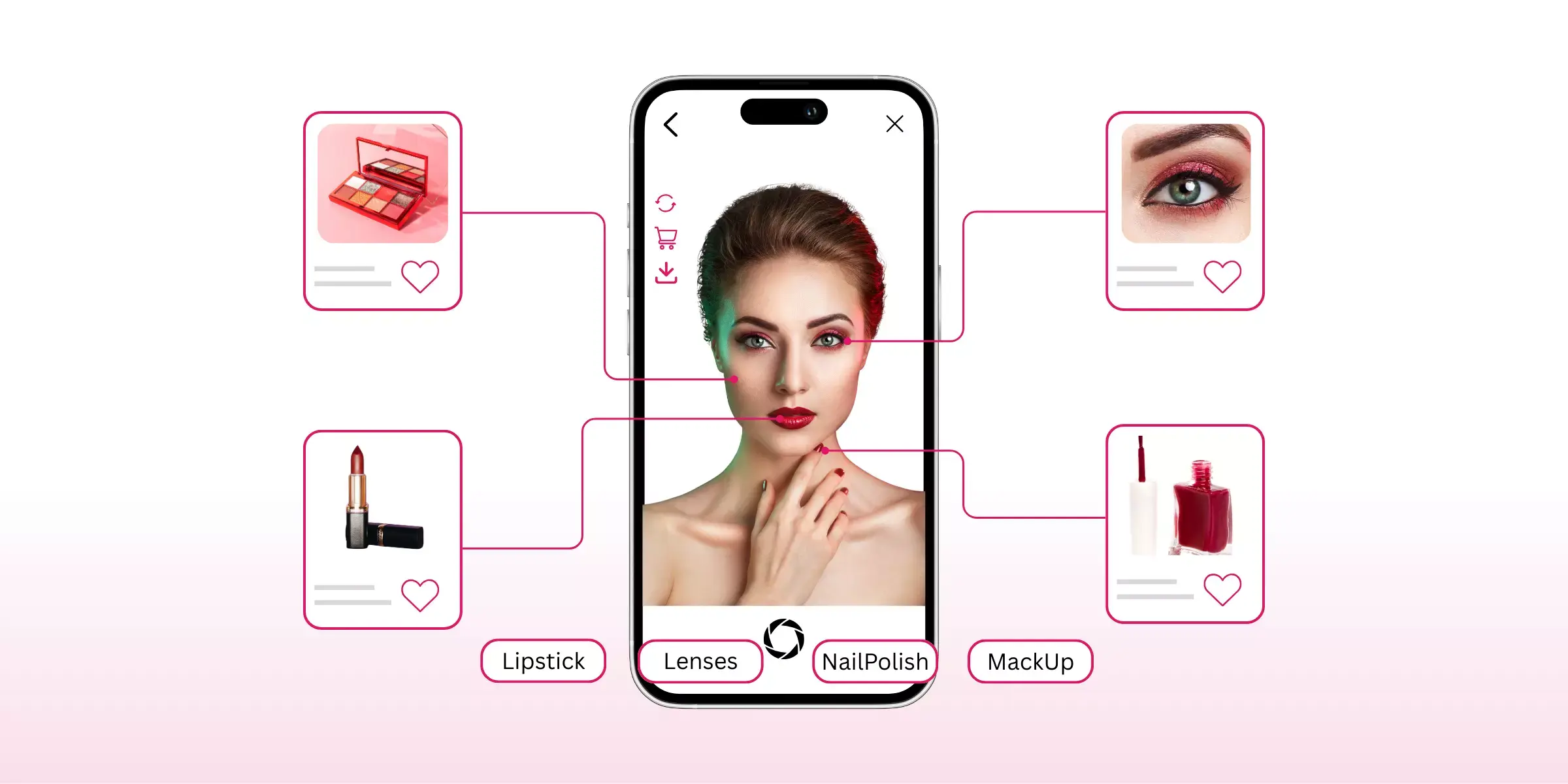
E-commerce has revolutionized the way consumers find and buy their items, yet it has brought one basic problem: consumers usually have to make a purchase decision without completely knowing what a product will look like, fit, or work in the real world. Displayed images and videos are useful, but they do not convey such important visual information as size, shade precision, proportion, and coordination with the body or surroundings of the customer.
Such a visualization lapse often leads to indecision, cart abandonment, and expensive product returns. The virtual try-on technology has come as a strong solution to this issue. Virtual try-on closes the divide between online shopping and offline shopping by enabling the shopper to see the product on themselves or in their real-world environment with the help of augmented reality.
Your customers are able to view the effect of a lipstick shade on their skin tone, glasses on their faces, or the effect of a piece of furniture within their living room before they make a purchase. With the ever-changing consumer expectations, the brands are increasingly adopting immersive shopping technologies that ensure confidence and less friction in the shopping process. The virtual try-on is no longer a feature that is deemed experimental; it is becoming a tactical element of the modern e-commerce infrastructure.
And as a result, the virtual try-on segment is growing at a very fast rate according to industry estimates, with the worldwide market size set to increase by about USD 5.9 billion in 2025 and even more than USD 22 billion in 2035, which translates to a compound annual growth rate of above 14%. This is made possible by the rise in mobile adoption, enhanced AR abilities, and the desire of consumers to see products realistically.
Hence, businesses in beauty and fashion, eyewear, and home décor are using virtual try-on to enhance their engagements, raise conversions, and reduce unnecessary returns. This article examines the usefulness of the virtual try-on technology, the available virtual try-on SDKs, and how brands are using the virtual try-on solution to scale up in their business in the real world.

What is a virtual try-on solution?
Virtual try-on is an augmented reality technology that enables buyers to see products on themselves or their surroundings virtually with the help of a smartphone camera, a web camera, or uploaded photographs. It is an amalgamation of augmented reality, computer vision, artificial intelligence, and 2D/3D rendering to superimpose a digital representation of a product on real-world images.
This technology functions by identifying important marks like facial features, body shapes, hands, feet, or surfaces of rooms. After it has been identified, the product overlay anchored by the virtual try-on system responds naturally to movement. For instance, eyewear virtual try-on is a technology reality that can help to track the head and ensure the product stays fixed to the face of your customer as expected. It can also be used to ensure that a furniture piece is always in proportion on the floor, even when the camera is being moved.
The virtual try-on has become very popular in various sectors, including beauty, fashion, eyewear, jewelry, footwear, and home decor. It enables your customers to compare options, test colors or styles, and check fit and compatibility before making a purchase. Virtual try-on can improve the quality of decisions and increase the enjoyment of the shopping experience.
12 Virtual try-on examples
In this section, we will take a look at the brands that are using the virtual try-on solution to provide and enhance a better customer experience.
1. Sephora (Virtual makeup try-on cosmetics)

Sephora has a virtual artist tool, which is powered by augmented reality and artificial intelligence technologies. The virtual artist tool allows Sephora to display thousands of makeup shades, including lipstick, eyeshadow, etc., to be virtually tried or tested via its app or website.
It has features such as the AR overlay, AI personalization, product try-on, and comparison feature. These enable the shopper to assess the true appearance of the product in real time and have a sense of confidence in the product before making a purchase.
2. Warby Parker (AR eyewear try-on)
The Warby Parker app embraced the virtual try-on solution that runs on AR and facial mapping to virtually enable users to try on any available pair of eyeglasses. With the help of the phone camera, your users can test various frames on their face to evaluate their fit, size, and style with the purpose of making an informed purchase decision.
3. Zalando (Shoes and clothes visualization)
Zalando builds its online fitting room with virtual try-on technology to enable users to virtually try on outfits of their choice before making a purchase. It has experimented with digital fitting rooms and avatar-based visualization.
This will allow customers to view the clothing fitting and hanging on their unique body shape, which removes size uncertainty and returns. In addition, the tool enables users to see the heatmap of tightness and looseness of the cloth on the 3D avatar after the virtual try-on experience.
4. Prada (AR luxurious fashion previews)
On its site, Prada uses AR and computer vision, which allows their customers to virtually put on and test various available sunglasses and accessories before making a purchase. The products are properly placed on the facial features of your user, providing an immersive preview that aids in increasing confidence before making a luxury purchase.
Users can activate the virtual try-on experience on Prada’s website or app and use their camera to overlay the 3D model of the product onto their image and view it from all angles.
5. COSMO (Beauty product experimentation)
The Cosmo Group has an app named Neonail, which allows users to virtually apply more than 2,500 nail polish colors with the help of AR and machine learning, and recreate a natural manicure experience in the online space for users. This increases the level of engagement for users since it allows them to experiment with the available nail colors and styles before they purchase.
6. L’Oréal Modiface (AR try-on for beauty products)
Modiface’s l’Oréal provides a virtual try-on of its beauty products, such as lipstick, eyeshadow, and foundation, for its customers. It also overlays these beauty products realistically placed on the faces of the users, which could be matched in terms of the user’s facial tone and preferences. Basically, L’Oréal integrates the Modiface virtual try-on technology to enable its customers to try on different looks to suit or match their real-time needs.
7. IKEA (AR placement of furniture in actual rooms)
IKEA Place enables clients to overlay virtual 3D models of furniture in their real locations using their smartphone camera in a true-to-life way. This AR application shows your customers the fitting of sofas, tables, and other decorations in their homes to enhance confidence in purchasing.
All the furniture items are available in 3D visualization, which will enable users to get a factual sense of the right scale and size of the products before making a purchase. And after the virtual try-on experience, the user can proceed to purchase through IKEA’s digital channel after the AR experience.
8. Garnier (Hair and skincare visualization)
The virtual try-on tools offered by Garnier allow customers to see various shades of hair color on themselves using the camera on their phones. This AR experience will assist your customers in visualizing and exploring what hair colors will suit their real-time look.
This experience will help to eliminate confusion in the choice of hair products. The tool can work directly on the user’s browser without the need to download the app. To get started, customers need to upload a photo or use a live camera feed to experiment with the different hair colors available.
9. Gucci (Luxury accessories trial on)
Gucci embraces the AR virtual try-on to enable users to try on sneakers and beauty products virtually. On its website platform, users can view how each Gucci product, such as shoes and makeup, will look on them in real time, combining the branding of luxury and the tech-immersive experience.
Moreover, Gucci has integrated the virtual try-on in its app to enable users to view and explore the features of its products more interactively. This helps to build customer satisfaction and enables them to understand the brand’s offering without the need to visit their physical store.
10. Louis Vuitton (VTO for eyewear & accessories)
Louis Vuitton embraced the virtual try-on technology to help customers effectively explore their eyewear and accessories products. This will enable them to examine how these products will suit their needs or preferences in real time. It was later recorded that Louis Vuitton extended the integration of the VTO technology to its makeup line, which makes it easy for customers to have an immersive and realistic shopping experience.
11. Nike (Fit for sizing and shoe visualization)
Nike Fit is an AR-powered tool launched by Nike that integrates AI and AR to scan the feet of users and suggest the right shoe size. It assists customers in identifying the most suitable Nike footwear after measuring and examining the shape of the feet, enhancing confidence in the shoe fit, and decreasing shoe reimbursements. Nike's new app is made available for both in-store and online audiences.
12. Zara (Virtual fitting room experience)
Zara launched a virtual fitting room that could be used to demonstrate how clothes could fit a user without having physical contact through the help of digital models. It also has AR displays and smart mirrors for high-tech stores, which enable an in-store customer to see how a selected cloth will appear on them in real-time through 3D models.
This experience is to augment online shopping by removing uncertainty with regard to fit and making the entire digital wardrobe experience better for their customers.
Best virtual try-on SDKs for businesses
It is not really a question of picking the most popular name when it comes to choosing a virtual try-on SDK, but rather about choosing the engine that fits what you sell, how you sell it, and where your customers experience you (web, mobile, in-store). Five SDK choices currently available or emerging for businesses are discussed below, and a practical discussion of each choice based on its best activity and timing is presented.
1. GlamAR
GlamAR identifies as a commerce-oriented AR platform for businesses where AR try-ons can support or expand into categories such as beauty, eyewear, jewelry, accessories, fashion, and home with complementary features, including a 3D product viewer. More importantly, GlamAR's virtual try-on uses AR and AI technologies to enable businesses to give an immersive and realistic virtual try-on experience to their customers.
Why it’s strong:
- Multi-product category coverage: In case your catalog spans more than one category (such as beauty + accessories or eyewear + jewelry), a multi-category SDK can help decrease vendor fragmentation and make rollout simpler. GlamAR aims to support the general category and associated immersive business modules.
- Integration for better shopping experiences: The SDK is presented as being designed for integration into shopping workflows, implying that it is intended to be incorporated into shopping experiences, and rather than being limited to short-term marketing activations.
- More inclusive experience stack: Brands interested in try-on + visualization of products + analysis process can leverage GlamAR's virtual try-on. This is because it is a platform that combines these features for better visualization of products.
Best for:
The GlamAR's virtual try-on is particularly suitable for retailers exploring AR try-on across multiple categories. Brands interested in AR try-on and additional features (3D viewer, artificial intelligence personalized recommendations, and analysis) without requiring a separate consumer app.
{{component="/internal/widgets"}}
2. ModiFace
ModiFace can be considered one of the most popular beauty-tech companies that focus on AR makeup and hair color applications, among other beauty-related solutions. The descriptions of its own products point to a virtual try-on of lip, eye, cheek, face, and brow products, and hair shade try-on, and specify that it is available both on the web and in the app, and in-store.
Why it’s strong:
- Extensive beauty expertise: Beauty try-on is not merely about putting on the color. It deals with realism, realistic drawing, tone adjustment, combination, and steadiness in motion. ModiFace is clearly constructed with beauty use cases (makeup + hair), which, in practice, can translate into a greater depth of the domain.
- Omnichannel feature: The positioning of Web, App, Store, and more is the one that helps those businesses that prefer to have the same experiences at e-commerce and retail touchpoints.
- Hair shade rendering: Hair try-on requires realistic shade sims and tracking. ModiFace explicitly mentions tracking + shade realism in its product documentation and demos. The modiFace hair try-on tool uses AI-based hair segmentation, head pose estimation, and facial landmark tracking to get the head shape for precise product placement.
Best for:
- The tool is suitable for beauty companies targeting hair color and color cosmetics.
- Businesses seeking brand-equivalent experiences in online and offline implementations can also leverage this tool.
3. Banuba AI
Banuba provides AR try-on SDKs for various types of e-commerce: makeup, skincare, glasses/sunglasses, hair color, jewelry, rings, nail polish, and others. It is positioned as a tool for improving conversion and potentially reducing returns.
Why it’s strong
- Wide AR capability base: Banuba emphasizes the fundamental AR building blocks such as face tracking and hand tracking, which are essential to stable try-on experiences (e.g., rings/bracelets).
- Spread of e-commerce category: The Banuba virtual try-on tool has a provision for a wide variety of product categories, which is helpful in case a brand is expanding to the product line or has diverse campaigns.
- Commercial outcomes messaging: Although all vendors sell ROI, Banuba directly links VTO to such outcomes as increased add-to-cart and reduced returns, which is handy when developing a business case internally (unless you still need to verify with pilots).
Best for:
- Brands that desire AI/AR try-on in a variety of categories, particularly brands that require high tracking primitives (face/hands).
- Those teams that desire a provider who has a distinct e-commerce packaging and clear e-commerce positioning and integration messaging.
4. Haut.AI
The most notable product Haut.AI has developed is AI skin analysis, i.e., the ability to identify skin issues using images and make personalized suggestions, but also markets SkinGPT, i.e., AI-based skincare visualization and simulation (e.g., simulated, non-clinical projections).
SkinGPT is one of the early platforms focused specifically on skincare outcome visualization to serve the B2b markets. This will help your audience to virtually experience the effect of a particular skincare product before they buy it in real time.
Why it’s strong
- Skin intelligence layer: In the case of skincare and dermocosmetic companies, the conversion driver is not just how it looks now, but also what it helps with. Skin mapping can be used to drive personalization, learning, and product matching.
- Skincare visualization: SkinGPT is framed around the visualization of skincare benefits and results, which can be used to supplement try-on to overcome skepticism and enhance product knowledge.
- Strategic differentiation: Brands can be differentiated through the delivery of a guided shopping experience (analyze → recommend → visualize) as opposed to a simple try-on widget.
Best for
- Personalization based on analysis and not mere shade try-on. The skincare brand that desires such.
- Firms create routines, packages, or some form of consultation experience online.
5. Orbo
Orbo positions itself as beauty-tech that improves the customer experience, such as in-store experiences, smart mirror-style contact, and brand-oriented personalization. Its positioning is customer engagement through AI and retail enablement.
Why it’s strong
- Retail + salon orientation: Most brands are forgetting that try-on does not need to exist on e-commerce PDPs. Virtual try-on in-store is capable of saving time during consultations, enhancing the amount of experimentation, and boosting upsell. The Orbo messaging is well aligned with the physical shopping experiences.
- Phygital experience focus: In case you are using kiosks, smart mirrors, or assisted selling in a physical setting, with a phygital DNA, it can more naturally be deployed compared to a web-first SDK.
Best for
- Firms that have salon business relationships with partners or a good in-store retail presence.
- It consists of teams developing phygital customer journeys (online discovery - in-store conversion).
Key features of a suitable virtual try-on (how to select the right virtual try-on solution)
Selecting the appropriate virtual try-on solution is essential in terms of providing the shopper with a highly immersive and smooth shopping experience that will translate into conversion. Not every virtual try-on tool is made equal: the most successful ones should be accurate, realistic, user-friendly, easy to integrate, scale, and keep the data safe to achieve the business objectives and the objectives of customers.
1. Accuracy, realism & tracking
An appropriate virtual try-on should provide the correct fit between the product and the characteristics or setting of your user. It implies accuracy of body, facial, or scene tracking and natural appearance of items such that the digital overlay is not artificial. Minimize visual distortion and build confidence in product appearance. The high-fidelity visuals, appropriate body mapping, and responsive AR behavior reduce visual distortion.
2. Compatibility & integration
An excellent virtual try-on solution must be compatible with your existing e-commerce systems, mobile applications, or content management systems. Find native or custom integrations with platforms such as Shopify or WooCommerce, and your own stacks, and make sure that the experience works on devices (mobile, desktop, tablet). Flexibility in the integration makes the feature feel like it is a part of the shopping process, rather than an add-on.
3. Smooth user experience (UX)
Ease of use is crucial. The virtual try-on should be able to ideally be activated within one or two interactions. The user-friendly nature of interfaces, the speed at which they load, and the responsiveness of interfaces retain the shopper and do not turn them away, increasing the chances of conversion.
4. Individualized & variant management
The solution must allow switching of variants, allowing your users to test on different colors, sizes, and styles representations where applicable. The elements of personalization, such as suggested shades depending on the user's characteristics or preferences, also enhance the experience and stimulate exploration.
5. Data privacy & scalability
Because virtual try-on tends to imply cameras or picture submissions, a robust data privacy policy (i.e., encryption and adherence to GDPR/CCPA) is needed to gain customer confidence and avoid legal liability. Besides, the platform must be able to scale with product catalogs and not cause performance degradation.
Benefits of using a virtual try-on as a business (and for customers)
The virtual try-on technology presents strong benefits to both the e-commerce brands and the consumer, as well as the ability to bridge the gap between the online shopping experience and the experience with the product in real life.
This immersive technology allows shoppers to visualize products on themselves or within their real-world environment before purchase, which is as close as currently possible to an in-store visual experience, and removes a significant amount of uncertainty.
1. Improved customer trust
Virtual try-on allows customers the possibility to view products in real-time, such as makeup, eyewear, or furniture. This reduces hesitation and improves decision -making since the customers can view the appearance of products and the ways they fit on themselves or in their environment before adding them to the cart.
Your customers will be more confident in their purchases through the visual information, and the level of conversion rates often improves. This also comes as a convenience whereby customers can do their shopping at any time and place without necessarily having to visit a brick-and-mortar store.
2. Sale growth
As soon as customers feel sure about their purchase decisions based on a realistic preview, the chances of them going ahead to make a purchase are much more probable. Many brands report that adopting virtual try-on has significant gains in the conversion metrics, and in select case studies and categories, the sales have increased by double-digit percentages when compared to old image browsing.
3. Fewer product returns and cost savings
Online retailers face tremendous returns that are influenced by the desire of their customers to get products that are not as big, colored, or fashionable as they expected. Virtual try-on is an important contributor to lowering this risk since it ensures that the correct visualization of products is made before checkout. Some studies and pilots indicate meaningful reductions in return rates, particularly in high-visual categories.
4. Better Interaction and brand image
The interactive try-on tools are engaging in nature. Shoppers used to spend a longer time on the product pages because they are trying to adopt various variants, colors, or styles. The higher engagement increases opportunities for cross-selling and upselling. Also, brands that embrace the use of the newest digital experiences are usually viewed as more progressive and customer-focused, which increases brand loyalty.
5. Enhanced data analytics and individualization
Virtual try-on systems can produce valuable customer behavior insights - including the most tried-on variants or styles, product frequency compared, and the suggestions that result in conversions. These insights enable businesses to adjust product assortments, make marketing decisions, and optimize future product launches.
6. Competitive advantage and sustainability
Virtual try-on can contribute to sustainability efforts and reduce expenses by minimizing unnecessary returns and the need to use physical samples. If these brands implement the technology effectively, they can adopt a competitive advantage in an already saturated digital market, attracting those shoppers who desire experiential and interactive experiences.
Conclusion
Virtual try-on technology is changing the way online shoppers engage with products. Virtual try-on can help reduce the number of expensive returns because it allows customers to have realistic previews, reduces uncertainty, and makes the shopping process more interesting.
With the increased availability of AR technology and its consequent accuracy, virtual try-on is shifting to a strategic requirement for many appearance-driven e-commerce brands as opposed to an optional feature. Companies embracing a superior virtual mode of trying on will be in a better position to stay relevant to the emerging standards of consumers and compete well in a world that is turning out to be more engaging and immersive.
{{component="/internal/widgets"}}
It is an AR technology experience that can enable customers to preview products on themselves (face/body) or in their space (room) using a camera or uploaded photos. It overlays digital products like makeup shades or eyewear frames so customers can evaluate appearance, fit, and style before buying.
It is used in e-commerce, especially for appearance-driven categories, because it can improve product understanding and purchase confidence. Retail-focused AR try-ons are specifically associated with higher customer satisfaction and more informed purchasing decisions.
Most providers offer integration via SDKs, APIs, plugins, and embedded widgets. Usually, the businesses make the try-on available on product pages or landing pages, attach it to the product catalog (variants such as shades/sizes), and handle camera permissions and device compatibility as part of implementation.
GlamAR can be suitable if your business needs an AR SDK designed for real-time try-ons and commerce engagement. It positions its AR SDK as a way to let customers try products before purchasing and describes benefits like increased engagement and fewer returns. The best fit still depends on your category, platforms, and realism requirements.
Yes. Virtual try-on will reduce returns since customers will be able to make better decisions before placing an order. According to public statements and case studies, AR/virtual try-ons can decrease the rates of returns because of better decision-making, and Zakeke also reports lower rates of returns because of better visualization of the product.
Virtual try-on can help businesses achieve higher engagement, improved conversion, and potentially fewer returns. It also helps to improve customer experience, increase conversion rates, and decrease returns. It can also focus more on helping to reduce the return rates and increase satisfaction due to realistic visualization.
Discover how AR, VR and 3D can drive revenue growth in 2026
Schedule a call with our team

.avif)