


Virtual try-on solutions for enhancing jewelry shopping experiences


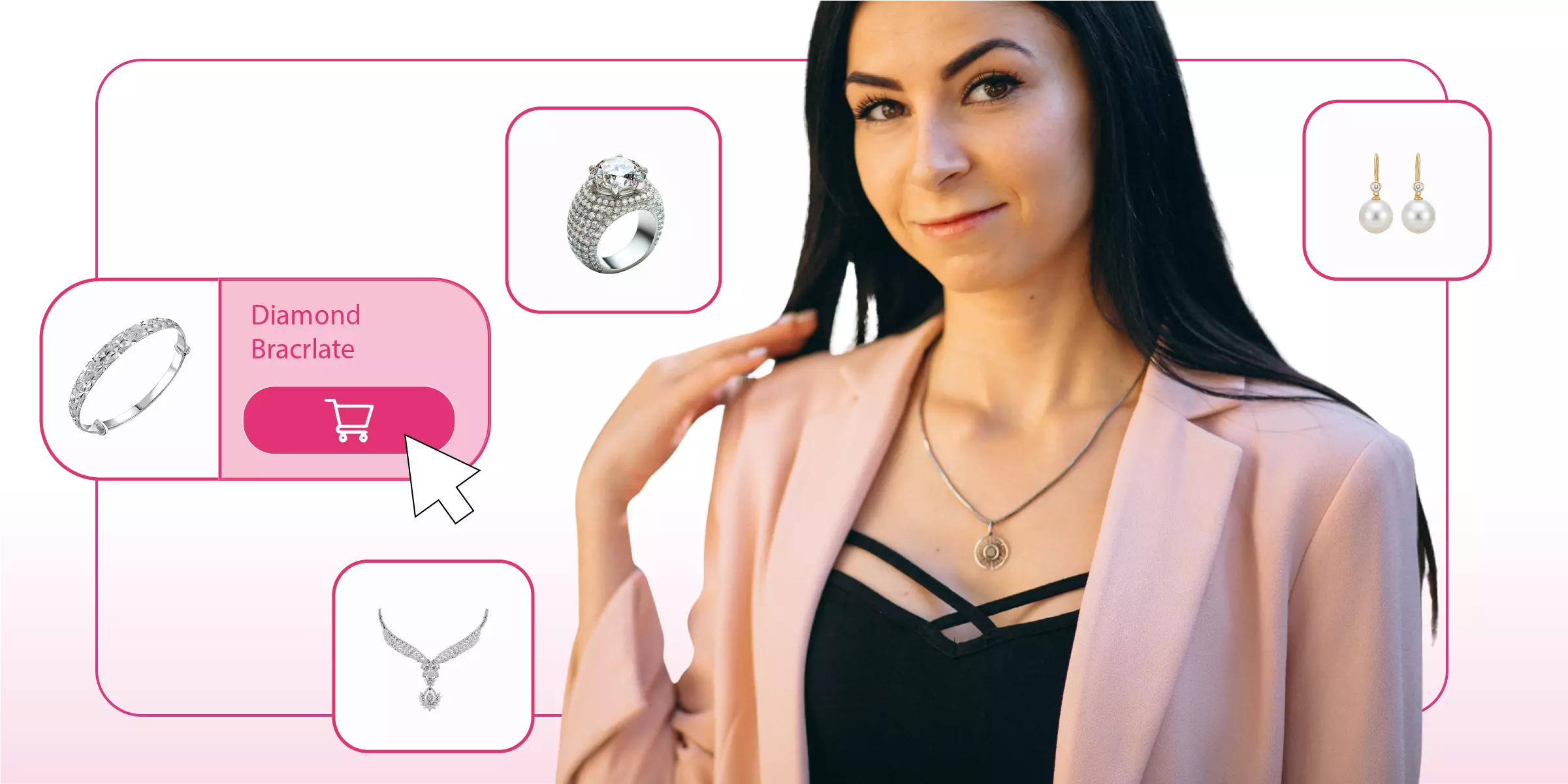
Many consumers increasingly look beyond local stores, seeking a wider variety of designs and global styles. Nowadays, they often want to buy the unique ones that resonate with their personality and preferences. So, the present jewelry market is undergoing a big change. Emerging virtual try-on technology can meet the demands of your customers.
According to 2026 jewelry industry statistics: Global and US trends, the global jewelry market is growing at a CAGR of 5.2% from 2020 to 2026. As a jewelry retailer, you can use jewelry try-ons to keep up with the fast-paced market. It will help shoppers experiment with an ornate gold necklace or a dazzling diamond ring without stepping out of the comfort of their home.
Therefore, virtual jewelry try-on is not just a trend; it can be a game-changer for brand owners that can transform how your customers discover, experience, and buy jewelry. It allows them to try on jewelry in multiple positions, such as the neck, face, ear, finger, and wrist. Thus, you can greatly reduce the need for physical testing in online and in-store sales.
In this blog, I am going to show why and how virtual try-on is transforming the jewelry shopping experience. Let’s get started:
{{component="/internal/widgets"}}
What is virtual try-on for jewelry shopping?
Virtual try-on for jewelry overlays digital jewelry onto your customer's image or live video feed. It allows them to see how it looks on them in real-time without physical contact. Consumers can try on rings, earrings, and necklaces via their smartphones or desktops. AR jewelry try-on combines computer vision, AI, and real-time 3D rendering. It can help you create an easy and interactive virtual try-on experience for consumers.
Thus, jewelry try-ons can help overcome a major barrier to online jewelry sales and improve your customer experience. The technology maps jewelry onto consumers in real-time with an accurate face or body tracking solution. As a result, shoppers can experience high-quality VTO solutions that simulate natural finger, face, and neck movements.
How is virtual try-on transforming the jewelry shopping experience?
Virtual jewelry try-ons use augmented reality technology to allow your customers to see how the pieces look on them in real-time. The realistic preview of virtual try-on can significantly reduce purchasing uncertainty. As the buying confidence of your customers increases, it may result in higher conversions and lower return rates. You can recommend jewelry based on your customers’ preferences using some of the virtual try-on platforms.
Real-time face and hand tracking technology can detect facial features and hand movements in your customers. Thus, it can ensure accurate jewelry placement. Also, consumers can see detailed 3D representations of the jewelry. So, they can help them make more confident purchase decisions. Social sharing features would be a plus for them, and you could promote your brand on social media platforms.
Apart from this, they can compare different jewelry items at the same time within the virtual window. During the try-on experience, some virtual try-on platforms enable users to swipe the colors and designs of those jewelry pieces. Most importantly, you can modify your product offerings and marketing strategies with this technology and fulfill your customers’ changing expectations.
Benefits of virtual try-on in jewelry shopping

Integrating virtual try-on solutions is increasingly significant for jewelry retailers. It offers realistic and engaging product displays for its shoppers. So, they can see what the jewelry pieces will look like on them before checkout. Thus, it can impact the jewelry shopping experiences of your customers. Here, I am discussing how virtual jewelry try-ons facilitate you and your customers:
1. Encouraging confident purchase
Your customers can visualize how your jewelry products, such as necklaces, earrings, etc., look on them before making a purchase. They can experience accurate sizing and face-shape-based jewelry through virtual try-ons. As a result, they can buy those products with confidence and have less tendency to return.
2. Personalized recommendations
You can provide customized jewelry recommendations based on consumers’ needs and preferences through virtual try-on technology. Thus, you can create a close connection with your customers. It may result in consumer loyalty.
3. Increasing conversions
Jewelry try-ons allow your customers to experience products beforehand and make an informed purchasing decision. It can minimize a buyer's hesitation with actual and real-time visualizations of jewelry items. It can help you convert your website visitors into loyal clients.
4. Boosting customer engagement
You can provide shoppers with realistic virtual try-ons of your jewelry products. It is a captivating experience. It can help enhance customer engagement and satisfaction. Some features, like 360-degree views, mix-and-match options, social sharing features, and unique recommendations, are examples of how visitors spend more time on your jewelry websites. In this way, you can transform a passive browsing experience into an interactive adventure.
5. Unique brand experience
Virtual try-on solutions automate sizing recommendations. Apart from this, it can reduce customer service inquiries about product appearance. So, it would be an innovative method to streamline your inventory management through digital showcasing. You can deliver unique, interactive shopping experiences and advanced personalization options for your customers. Thus, as a jewelry retailer, you can stand out from competitors with operational efficiency.

Challenges of implementing virtual try-on in jewelry shopping
While implementing virtual try-ons in your jewelry business, you may face some hurdles. Let me walk you through the challenges of using jewelry try-ons:
1. Technical issues
You need to create high-quality 3D models. It will help you in the accurate representation of your jewelry pieces. Also, regular software updates and maintenance are necessary for incorporating virtual try-ons into your jewelry platforms. Slow internet and limited access can prevent some of your consumers from using your virtual jewelry try-on platforms. Plus, you may face cross-platform compatibility issues. So, you should choose the platform that can support many devices and browsers.
2. Financial barriers
Building AR infrastructure requires initial costs and staff training for effective usage. Also, you will need ongoing technical support for this. For medium- and small-sized businesses, it may be difficult, depending on the provider and required features.
3. Security concerns
Jewelry try-on platforms collect and use consumer data. To protect your customers’ privacy, you should follow data security laws and regulations. It will help you build customer trust and keep their data safe.
Best SDK providers of jewelry try-ons
I've been playing around with virtual jewelry try-on tools for a while now. Also, I have continued to update this list with lots of research and testing from me. With that, here are 5 platforms that can facilitate your customers and jewelry business:
1. GlamAR
If you are running a jewelry business, you can amplify your product range and meet the demands of diversified customers with the help of GlamAR’s jewelry try-ons. GlamAR supports major jewelry types (earrings, rings, necklaces, and bracelets). Some versions also support maang tikkas. When I have been exploring it, I have discovered its real-time effects on the live image of the consumer.
I tried its virtual jewelry try-on option and found that there are adjustment tools for placing the earring at the right piercing position or the necklace along the neckline. There are two options available on the jewelry try-on: scale and position (right & left) to adjust the selected jewelry piece, maintaining the perfect alignment.
GlamAR includes features like zooming, sharing, and in some cases, comparison tools. Your customers can zoom in and out to view the result. Plus, they can use the comparison tool to check how they look after wearing different jewelry. With the download option, they can save the image for future purchases. Also, they can share it with their friends and family to get their feedback.
Features:
- Compatible solution: GlamAR works on websites, Android phones, and iPhones, making it easy to add to your existing platform. It lets customers try on jewelry in real time so they can instantly see how each piece looks on them before making a purchase.
- Face tracking: The virtual jewelry try-on uses face tracking technology. It can follow the facial movements and expressions of your customers while they are trying on jewelry.
- Interactive jewelry shopping: You can help improve purchase confidence, potentially reducing returns and improving conversions, with the help of GlamAR’s jewelry try-on tools.
{{component="/internal/widgets"}}
2. Banuba
Banuba is a face software company that has also launched a virtual try-on platform: ‘TINT.’ It can help improve customer engagement and potentially boost sales. It offers your customers an interactive online shopping experience with accurate placement, adaptive lighting, and realistic movement simulation. I explored its virtual jewelry try-on solutions and listed my findings here.
I tested its virtual try-on for jewelry. It provides a precise representation of virtual earrings, ear cuffs, piercings, necklaces, chokers, pendants, and engagement rings. Its advanced face-tracking software helps place the jewelry items accurately with a realistic motion simulation. Banuba does offer hand tracking, but accuracy varies depending on device, lighting, and model complexity. As a result, consumers can move to see the products from different angles.
You can access self-service product digitization with the Admin Panel to update your products without delays. According to your selected plan for the TINT virtual tryout platform, you will get the number of items available for free digitization. Remember! Frontal photos of jewelry products need a resolution of at least 1024x1024. The good news is that Banuba provides free access to some base AR models; custom models may require separate digitization.
Features:
- Easy integration: Banuba provides an easy-to-integrate virtual try-on plugin. It has a quick, no-code setup through CMS marketplaces. Then, you need to upload your SKUs and select AR attributes like color, texture, & shape for each item.
- Customizable UI: You can get a completely customizable UI. It will match your brand identity. Plus, its multiplatform compatibility facilitates your consumers. Thus, your customers will obtain a unique shopping experience for different product categories, such as jewelry.
- Global user interface: Banuba supports multilingual interfaces for global users. It is available 24/7 for global consumers. You can access its ultra-realistic and high-resolution product models for free. It can give consumers a straightforward try-on solution.
3. Perfect Corp
Perfect Corp provides virtual try-on experiences. You can combine the VTO format and 3D model creators across web browsers and mobile devices. With the .vto file, you can convert their 3D models into AR try-on experiences through its VTO engine. It offers high-performing AR with a simplified setup process for the jewelry industry.
Consumers can experience AI-driven virtual earring, bracelet, and ring try-ons with three options available on this platform: Live Try-On, Choose a Mode, and Use Photo. I tested diverse jewelry designs with lifelike lighting, reflections, and a dynamic motion simulation. While exploring online jewelry try-ons, I got the chance to mix and match a variety of ear accessories in real time.
Your customers can virtually try on every earring, ear piercing, bracelet, and ring straight from your website or e-commerce platform. As a jewelry brand, you can integrate an in-store smart beauty mirror for the shoppers. So, they can try on ultra-realistic 3D jewelry before making a purchase. Thus, you can enhance their jewelry shopping experiences.
Features:
- Cross-platform support: You can integrate virtual jewelry try-on solutions into major web and mobile browsers. So, your customers can experience them through iOS, Android devices, macOS, and Windows.
- Dynamic try-ons: From a 2D image, you can create an ultra-realistic and dynamic virtual try-on without any expensive 3D modelling.
- Physically based rendering: It provides accuracy in jewelry placement with PBR technology. Thus, you can offer realistic looks for various jewelry items in your customers’ live images. It can ensure ambient lighting simulations, realistic material reflections, advanced light scattering, and detailed surface textures.
4. MirrAR
MirrAR offers AR jewelry software. It enhances both online and in-store jewelry shopping experiences. Your customers can try on an extensive range of jewelry designs directly on your website or e-commerce platform. They can experience realistic product visualization.
I was surprised to see the real-time jewelry models from different angles while exploring their virtual jewelry try-on platform. Also, I had fun creating images and videos of myself wearing virtual earrings, necklaces, rings, and bracelets with my smartphone camera. Also, I shared them on my Instagram feed.
You can connect with global shoppers with MirrAR’s multi-platform web AR solutions. With no installation of your company’s app, consumers can access its virtual try-on tools to experiment with how the jewelry pieces would look on them in real time.
Features:
- Compatible interface: You can easily blend MirrAR’s user-friendly interface with desktops, tablets, and mobiles, irrespective of the type of device or browser your customers use. Your customers can try on hyper-realistic jewelry designs without going to retail stores with its virtual try-on solutions.
- Accurate outcome: MirrAR has AR-powered jewelry software. It can detect the anatomical features of the particular body part. Thus, it can generate accurate jewelry placement with a realistic result. It supports motion simulation and occlusion handling for natural-looking jewelry movement. In this way, it can make sure your 3D jewelry designs look and move naturally on your branded app.
- In-store smart mirror: Introducing the in-store smart beauty mirror, you can showcase the jewelry pieces that will suit your customers. It can capture live video to detect facial landmarks for accurate virtual try-on of 3D jewelry in real time.
5. Kivisense
Kivisense has an AI-powered AR try-on engine. Kivisense’s AR engine supports omnichannel retail experiences. They can get a personalized jewelry try-on experience using their phone or webcam. Based on their unique preferences, they can make a confident purchasing decision.
With a simple tap, I explored a range of earrings, pendants, bracelets, and rings with various styles and colors. Then, I captured my best try-on experience and shared it on social media. The best part is that your customers can get an instant and actual positioning of jewelry with its AI-driven AR solutions, even if they move and adjust camera angles.
Your consumers can try it on most camera-enabled devices, including desktops, mobiles, tablets, etc. Integrating its AR try-on tools, you can raise your brand’s digital existence. In this way, you can strengthen your competitiveness and improve customer engagement.
Features:
- Realistic 3D rendering: It provides advanced 3D rendering for jewelry and other categories. It can generate a true-to-life experience, replicating real-world lighting, material reflections, and intricate details of every gem.
- Accurate AR Tracking: Kivisense features instant motion response, an extremely accurate AR tracking solution. It enables consumers to engage in interactive shopping. Therefore, it can set a standard in virtual jewelry shopping with real-time face and hand tracking.
- AR mirror: You can elevate your in-store presence with AR virtual try-on mirrors. The magic mirror can detect facial or hand landmarks to place jewelry accurately. Plus, it allows you to display a diverse range of jewelry designs without stuffing your inventory. It may result in no customer disappointment over product shortages.
Popular brands that are transforming the jewelry shopping experience with the virtual try-on
Still today, many consumers prefer to visit stores to purchase jewelry. So, jewelry brand owners are keen to invest in virtual try-on tools to transform shopping experiences. Here, I am presenting some renowned jewelry brands, offering virtual jewelry try-on experiences:
1. Tanishq
Tanishq adopted AR solutions (hybrid reality campaigns) at Delhi and Bengaluru airports in 2019 to engage and interact with a large audience. Tanishq allows its online customers to try on its bridal Polki collection: the latest one. Vossale’s 3D virtual try-on tool aims to ensure the perfect fit of Tanishq’s jewelry.
From necklaces to earrings, Tanishq has chosen the web-based AR solutions to provide its consumers with an enhanced user experience. They can use models or their live videos to try on different jewelry items in real time. Also, they can capture and save their try-on experience.
Tanishq uses AR try-on at airport kiosks.
A prospective customer tries on Tanishq Jewellery at Bridal Asia 2018
2. Reliance Jewels
Reliance Jewels offers its online consumers an easy-to-navigate virtual jewelry try-on, powered by Plushvie. They aim to build trust with potential shoppers with their ‘Try Now’ option.
It provides them with additional insight about what they will buy and whether it will suit them well in real time. I used my face to try on the virtual earrings instead of selecting a model and achieved a satisfactory result.
3. Tiffany & Co
Tiffany & Co. has integrated 3D display and AR try-on features on WeChat MP and JD PDP pages. It aims to impress their online consumers to add jewelry items to their carts and improve conversions through the use of 3D display and AR try-on technologies. Using high-precision 3D rendering techniques, they invite customers to explore the exquisite details of stunning diamond rings.
It can perfectly replicate the brilliance of diamonds and the luster of gold. Most importantly, AR static and dynamic try-on experiences guide consumers to visualize the real-life effects of wearing Tiffany’s jewelry products.
4. Kalyan Jewellers
Kalyan Jewellers has launched ‘Candere.’ It is a virtual try-on platform. It allows customers to get a virtual trial of jewelry. Online buyers can explore its various suites of collections and choose the best one for them with its ‘TRY ON’ features. Thus, they will get a scope to try before buying with its AR solutions. They can save and share their virtual jewelry try-on experiences.
5. Cartier
Cartier offers virtual try-on solutions for bracelets, rings, earrings, necklaces, wedding bands, etc. Customers can choose the design, material, and size of their jewelry while trying it on.
They can compare different pieces of jewelry to select the right one for themselves with the help of AR technology. Snapchat users can now explore Cartier’s Trinity Collection as Cartier and Snapchat collaborate with each other to incorporate personalized AR try-on experiences.
How to choose the best virtual try-on platform for jewelry shopping?
It seems like every time I turn around, there are a dozen more virtual jewelry try-on tools clamoring for attention. To be fully transparent, I haven't gotten around to testing every single tool on the market, mostly because it would be easier for you to decide which platform would be the best for your jewelry business. But I'm doing my best to create an ever-growing list.
The list you're about to see contains tools I have tested myself or researched deeply. If there's a particular one you like, check it out in detail. While all these platforms are updating themselves every day, they're far from perfect. You should be sure to always check their try-on functionality with your human brain. So, please keep all hands and legs inside the vehicle. Now, it's time to explore.
You need to consider some factors, like realism & rendering quality, jewelry type support (rings, earrings, necklaces, etc.), accuracy of face/hand tracking, ease of integration (SDK, plugins, APIs), multiplatform support (web, iOS, Android), cost and licensing, backend tools/analytics, 3D model support & digitization, customization options, and customer support, while choosing a virtual jewelry try-on platform for your brand.
GlamAR can provide your customers with customizable jewelry try-on solutions with its easy-to-integrate SDK and cross-platform support. Apart from it, you can try other platforms or go for their demos to transform your jewelry shopping experiences.
Conclusion
During the present era of the jewelry industry, you need to keep up with new trends to satisfy your customers. Virtual try-on technology can help you succeed in the online marketplace. It is really thrilling to see how jewelry retailers are using AR try-on platforms to transform the shopping experiences of consumers.
Thus, jewelry brand owners want to bridge the gap between the convenience of online shopping and the hands-on experience of traditional jewelry buying. Adopting virtual try-on platforms can help turn online interest into actual purchases by increasing customer trust and confidence. If a platform matches your business needs, you can explore its demos or speak with its support teams to evaluate the best fit.
{{component="/internal/widgets"}}
Virtual try-on for jewelry lets your customers see how earrings, rings, bracelets, or necklaces would look on them without actually wearing them. It uses their phones or webcams along with AR and AI. It detects facial and hand landmarks to understand shape and position. Then, it will place the jewelry on their live images in real time. Also, it can follow their natural motions to create a realistic look. They can turn their heads, move their hands, or change angles, and the jewelry will adjust in an automatic manner. It can help them make confident buying decisions before purchasing anything.
Consumers don’t always need a special app to use a virtual jewelry try-on. Many brands use WebAR. It allows shoppers to try on earrings, rings, and other jewelry directly from their website. They just need to open the site on their phones, turn on the camera, and the jewelry appears on their live image. It works instantly in the browser without any downloads. But some companies also offer their own mobile apps or partner with standalone apps to give consumers extra features or a smooth experience. So, depending on the brand, your customers can try on jewelry either through a website or an app.
Jewelry virtual try-on technology uses AR. It can make online shopping much easier and more trustworthy for customers. Instead of guessing how a ring, necklace, or pair of earrings will look, shoppers can see it on themselves instantly through their phone or laptop. This interactive experience can help people feel more confident about their choices because they can view the jewelry from different angles in real time. As a result, customers make better decisions, are more likely to buy, and are less likely to return items. Overall, it turns online shopping into a fun, engaging, and reliable experience.
Most types of jewelry can be tried on virtually with good accuracy. This includes rings on any finger, all kinds of earrings, necklaces of different styles, bracelets, and bangles. Even unique pieces like nose pins or Maang Tikkas can be previewed, helping shoppers see how everything looks in real time.
Virtual try-ons can help jewelry retailers increase online sales. It can give your customers a clear and realistic way to see how items will look on them. When shoppers can try on rings, earrings, necklaces, or bracelets, they feel more confident. It also helps reduce return rates. Virtual try-ons make jewelry shopping fun and interactive. They improve customer engagement by giving a personalized experience. Buyers can explore styles easily. They can compare different looks. They can make better decisions. Virtual try-ons increase customer satisfaction and build trust. They can also help brands earn loyal customers and increase sales.
Implementing jewelry try-on features in your app uses AR technology. AR places realistic 3D jewelry models over the consumer’s live camera view. It can make the jewelry models look realistic. For this, you will need high-quality 3D models of your jewelry and a simple interface. Your app can track the consumer’s face, hands, or wrist in an accurate manner. So, the jewelry appears in the right place and moves naturally with them. Your customers can try on rings, earrings, necklaces, etc., in a fun, real-time way, with good tracking and clear visuals.
Discover how AR, VR and 3D can drive revenue growth in 2026
Schedule a call with our team

.avif)