


AI in personalized beauty recommendations: learn how to implement it


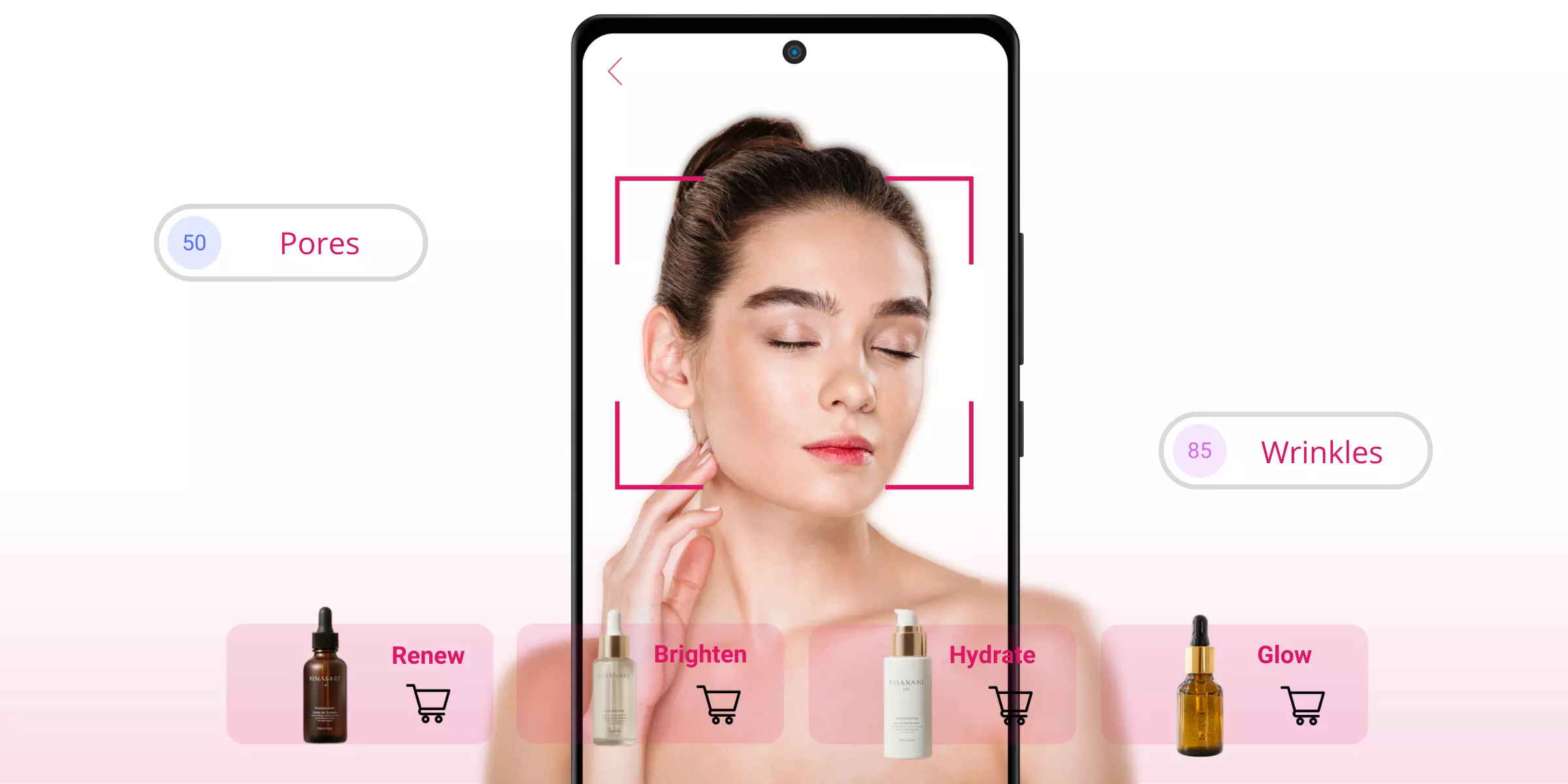
Today’s shoppers expect beauty brands to recognize their unique requirements and recommend personalized products. As a result, many e-commerce platforms are adopting solutions to help online customers access more customized products. In this area, AI-powered product recommendation systems can perform particularly well. It can transform how brands understand and interact with their customers.
Now, AI is not just the future or a trend in beauty retail. It can analyze customer data (with user consent) to generate personalized product recommendations. Brands may consider adopting AI to stay competitive and meet evolving customer expectations with the fast-paced technological advancements.
What about a consumer who is purchasing a beauty product for someone and is not sure if it would suit or fit them well? You can help your customer with AI-driven personalized beauty recommendations and make the job easy with accuracy. Thus, you can build customer loyalty and increase sales with fewer returns.
In this era, the $450 billion global beauty market has a seemingly insatiable appetite for newness. Developers or brand owners can use AI to personalize beauty recommendations and contribute to this ever-growing beauty industry. Here, I am going to reveal the role of AI and how you can implement it in offering unique shopping journeys for your customers:
{{component="/internal/widgets"}}
What are AI-driven personalized beauty recommendations?
Salesforce research consistently shows that over 90% of customers are more likely to make repeat purchases after a positive service experience. You may consider introducing AI-driven personalized beauty recommendations into your brand’s platforms. It uses demographic data, environmental factors, and past purchases to offer customized product suggestions. The technology can identify patterns that help improve the accuracy and relevance of recommendations.
With user consent, AI-powered computer vision tools can analyze customer-uploaded images. Then, it can estimate visible skin attributes, such as their skin textures, tones, and specific concerns: acne, fine lines, dryness, etc. By embedding AI-powered personalized recommendations with your product databases, you can provide your customers with convenience and efficiency. Most importantly, you can help them embrace their unique beauty.
Features of AI-powered recommendation engines:
- Machine learning and AI models analyze vast amounts of historical and real-time customer data. The data may include an analysis of available customer attributes. Thus, the technologies can continuously learn and adapt to observed customer preferences and behaviors over time. It will help you make personalized, relevant, and interactive beauty recommendations.
- With computer vision and skin analysis technologies, AI can analyze facial images of your customers. Then, it will estimate visible skin concerns, such as wrinkles, acne, pigmentation, and texture irregularities.
- Integrating platforms like GlamAR can provide data-driven, contextually relevant product recommendations aligned with dermatological best practices.
- AI learns from consumer interactions and adapts to customer preferences, environmental factors, and evolving skincare needs. Thus, it offers product suggestions that customers love. It can give accurate results over time. Also, it can operate without previous customer data, with collaborative filtering techniques.
- AI uses information about the consumer's location, the weather in their area, the time of year, and their lifestyle to change its recommendations. If a consumer lives in a dry climate, the AI system will recommend hydrating products for their environment.
How to use AI for personalized beauty recommendations
%202.gif)
AI is reshaping how beauty brands understand and interact with their customers. You can use AI-powered personalized recommendations that are helping elevate customer experience standards.
1. AI-driven recommendation engine: It analyzes a combination of browsing behavior, purchase history, location, beauty preferences, and environmental factors. It can deliver more personalized product suggestions.
2. AI chatbot: You can add this conversational AI assistant to your digital platforms. It will act as a 24/7 virtual beauty assistant. The AI chatbots use natural language processing (NLP) to understand and respond to consumers’ queries like “What is a suitable lipstick for fair skin with cool undertones?” Then, it will give personalized suggestions based on trends and available user data.
3. AR virtual try-ons: They allow your customers to experience how beauty products look on their faces through their devices' cameras. It will help them visualize products and experiment with personalized makeup looks. They can get a realistic virtual experience with AI-powered facial tracking, lighting adaptation, and color rendering capabilities. Thus, you can enhance buyers' confidence in online beauty product shopping.
4. Skincare AI: AI-powered skin analysis can analyze images to estimate visible skin types, tones, and appearance-related concerns, such as acne-prone areas, pigmentation, or dark circles. Based on their skin analysis report, they will receive personalized skincare recommendations. Some AI skin analysis tools can offer product recommendations and general skincare routines, excluding medical or health advice, to improve their skin. The best part is consumers can track changes over time using visual progress tracking or predictive simulations.
5. AI face shape detector: You can use this AI tool as an alternative or complement to traditional quizzes. It can help your customers find products according to their face shape and unique facial features. Analyzing their facial features and structures, AI will estimate face shape categories. In this way, you can refine your product selection. As a result, your customers will get personalized beauty recommendations.
6. AI facial analysis: Now, you can offer your customers personalized beauty products based on self-declared preferences and appearance-related insights. You need to use AI face analysis tools, paired with virtual try-ons, for this.
7. AI-powered emotion analysis: You can use AI-powered emotion analysis technology and add it to your makeup applications. It will give you valuable insights about your customers’ sentiments and address concerns in real time. It can experiment with sentiment analysis based on user interactions and feedback. Thus, it can infer engagement trends and potential sentiment patterns. You can use these insights for future product development. Therefore, it would be helpful to deliver a personalized shopping experience.
5 Best providers for AI-driven personalized beauty recommendations
For this blog, I reviewed multiple platforms and explored the capabilities of leading contenders. Here is one of my top picks for AI-driven platforms for personalized beauty recommendations:
1. GlamAR

If you want to recommend beauty products to your customers, GlamAR’s makeup virtual try-on and AI skin analysis can assist you. The makeup try-on can support experimentation and enable AI-assisted product recommendations within the same platform.
You can integrate GlamAR’s AI skin analyzer tool into your brand’s platform to analyze visible skin characteristics or concerns. It can help you provide personalized skincare product suggestions for consumers. It can map skincare ingredients to specific skin concerns or goals. Apart from this, your customers can view estimated skin progress or visual simulations over time.
It would be a strong option for brands looking to promote products through an integrated skin analysis experience. Based on my hands-on exploration of GlamAR’s virtual try-on and skin analysis tools, I received AI-driven personalized beauty product recommendations. You can embed these tools with your online and in-store platforms to connect shoppers in an interactive way.
{{shopifyskin="/internal/table"}}
2. Perfect Corp
Perfect Corp has introduced many AI tools for personalized beauty recommendations. They are including AI skin analysis, face analysis, Fitzpatrick skin type estimation, and skin shade matching tools. You can integrate its AI tools into your websites, apps, and other e-commerce platforms for beauty recommendations.
The Expert Mode API for skincare recommendation rationale allows brands to configure scoring logic or weighting for skincare recommendations. It provides detailed skin analysis outputs and attribute maps for deeper insight. It can be aligned with brand-specific testing data or internal evaluation frameworks. Its AI-driven skincare recommender scans and analyzes product data, such as names, descriptions, images, and categories.
Perfect Corp uses AI and face AR to scan and analyze 70+ facial structure points. Thus, it can deliver personalized recommendations for makeup, hairstyles, etc., based on your customers’ facial features, skin tone, and face ratio assessment. With the help of the AI skin shade finder tool, you can provide your customers with accurate foundation shade recommendations. It can detect their skin tones, and they can try on the foundation shade matcher.
3. Haut.ai
Are you scrolling through a lot of platforms to enable personalized beauty recommendations? Are you still unable to find a platform that meets your brand's personalization needs? Haut. AI offers AI skin analysis and Gen AI SaaS solutions. It is designed to support personalized digital experiences and faster product innovation.
Haut.AI's Skin Analysis SaaS is an AI-powered platform developed using scientific research and data-driven models. It allows beauty brands to provide personalized product recommendations and interactive skin assessments to their customers. Most importantly, it aims to deliver consistent skin analysis performance across diverse skin tones and types. On the plus side, it helps you to create customized and brand-specific tools with minimal or no coding, depending on customization needs.
Brands of different sizes can access customizable and relatively easy-to-integrate tools. Its AI-powered recommendation engine can identify 15+ essential skin health and beauty metrics. Thus, your customers will get the best skincare products to reach their perfect skin goals. Haut.AI has introduced Skin.Chat, an AI skincare advisor. It will help you offer a skin analysis engine along with personalized product recommendations.
4. Orbo AI
Finding the right products online seems difficult. Orbo AI aims to simplify online product discovery. It features virtual makeup, a foundation shade finder, and smart skin analysis tools. The beauty AI recommendation engine can factor in available customer preferences, skin tone estimates, and facial features. It can help you offer personalized beauty product suggestions.
It is important to note that you can incorporate the tools with your smart mirror, digital kiosk, website, tablet, and mobile application. For this, you only need a single line of code. Orbo AI's skin analysis tool can analyze customer facial images. Then, it will respond to common skincare-related queries within its supported scope. Finally, your customers will receive personalized skin analysis insights and product recommendations.
Developers and brand owners would find this platform useful to connect consumers with customized beauty products. Thus, they can enhance the shopping experience using AI-driven personalization. The AI tools can estimate a person’s skin tone and suggest relevant, personalized beauty products.
5. PulpoAR
PulpoAR offers AI-powered skin analysis tools for personalized beauty experiences. The AI skin analysis tool can assess visible skin characteristics across a range of skin types and surface-level concerns. It can detect facial features and identify visible skin concerns in specific facial regions. It will help recommend skincare products aligned with identified skin concerns. Also, it allows customers to track visual changes over time based on consistent product use.
Apart from this, PulpoAR offers SkinGPT, an AI-powered skincare assistant. It can work as a 24/7 personal beauty expert for your customers. The best part is using this platform, they can access personalized makeup and skincare suggestions across devices. Most importantly, SkinGPT is an AI-powered chatbot. It can help you build customized beauty routines and deliver personalized product suggestions.

Popular brands that are using AI-powered personalized beauty recommendations
Nowadays, popular beauty and skincare brands have been adopting AI-powered, personalized beauty recommendation SDKs. It can help them achieve their product recommendation goals, which may help improve engagement and conversion rates. Let me walk you through some of the brands:
1. Cetaphil India
It is a widely trusted skincare brand known for sensitive-skin formulations. It offers an AI-powered skin analysis tool to evaluate visible skin characteristics. Then, it will deliver personalized skincare recommendations. Shoppers need to use their selfies to access this tool.
With AI skin technology, 'MySkin By Cetaphil' will scan their face and analyze their skin. As a result, consumers will receive their personalized skin analysis report along with skincare routine recommendations. On the other hand, consumers can scan a QR code to access the personalized skin analysis and product recommendations.
2. Olay
Olay launched its AI Skin Advisor around 2016. It provides its customers with a personalized skincare routine. To obtain their skincare solutions, they need to upload selfies, and the AI performs a visual skin analysis based on uploaded selfies. Then, they have to respond to a few questions about their skin issues and preferences.
Finally, they will get tailored skincare product recommendations based on their inputs. Most significantly, they can see an estimated skin age or skin age comparison. If shoppers know their skin types and concerns, they can skip skin analysis. So, they can find customized products for their skin concerns using Olay’s product finder.
Dr. Frauke Neuser, Principal Scientist for Olay, has stated in interviews that “Olay’s research shows that browsing the shelf is the #1 purchase influencer for women, yet one-third of women do not find what they are looking for.”
3. Sephora
Sephora has partnered with Modiface and introduced an AI-powered smart skin scan tool. It can infer customer needs for personalized product recommendations. Consumers need to open the Sephora app and perform the smart skin scan with their selfies. First, they will receive near-real-time skin analysis results. Then, they will get four-step recommended skincare routines customized for their results.
“We have been working with Sephora and other beauty brands for almost a decade now,” according to interviews cited by Retail Dive.“The problem of product discovery has been a substantial problem, which can be addressed partially with augmented reality-based try-on.
“However, using AI to actually match shades and recommend products before trying is a key step. We have been working on this for almost 5 years now, but we felt that the technology was finally accurate enough for large-scale deployment,” according to Retail Dive’s reports.
4. POND’S
POND’S offers an AI-powered skincare analysis tool. It offers personalized skincare insights to support better skin care decisions. Consumers can find it on POND’s website. It analyzes visible skin characteristics from images. POND’S SKIN INSTITUTE AI Skin Expert analyzes their skin based on their images.
It captures real-time images for skin analysis. Then, it suggests skincare products aligned with identified concerns. Using a smartphone with a good-quality camera and internet speed, shoppers can get POND’s personalized skincare product recommendations, according to their skin's personalized analysis.
How to choose the best platform for AI-driven personalized beauty recommendations
Most platforms on this list offer demos, trials, or pilot programs, depending on the engagement model. So, I would suggest testing shortlisted platforms through demos or trial periods to evaluate fit with your brand’s needs. If you are hesitant about where to start, these tools can help you quickly experiment with personalization use cases.
When it comes to an all-in-one platform, GlamAR positions itself as an all-in-one platform covering multiple personalization use cases. It offers AI-assisted, personalized product recommendations based on facial features and visible skin concerns. The AI technology can help customers find their customized products with ease, building your brand’s loyalty.
One of the most effective ways to evaluate platforms is by testing their demos alongside technical and business considerations. Also, you may gain insights from user interactions (where consent and compliance allow), which can inform optimization and strategy decisions.
Conclusion
Therefore, using AI in personalized recommendations has been changing the business operations of beauty retailers and brand owners. AI now supports beauty advice, product development, and elements of the supply chain. From beauty product recommendations to virtual try-ons, AI is delivering a level of personalization that was once impossible at scale.
But you should be aware of some ethical considerations, such as data privacy, diversity in training data, and transparency about AI use in personalized recommendations, while implementing AI in your beauty business. Finally, choosing a reliable platform for AI-powered beauty recommendations can help create relevant and engaging shopping experiences that support stronger customer relationships over time.
{{component="/internal/widgets"}}
AI analyzes customer-uploaded images and user-provided data (with consent) to estimate visible skin and hair characteristics. Based on this, it recommends skincare, makeup, and hair products, often through chatbots or AR-powered virtual try-ons. Some tools also offer progress tracking or predictive visualizations. This helps move beyond generic advice and deliver more data-driven, personalized product recommendations for concerns such as acne-prone skin, wrinkles, or foundation shade matching.
Yes, AI can recommend products for all skin types. But it does not suggest the same products to everyone. It analyzes a consumer’s skin concerns, lifestyle, and environment to create personalized routines and recommend the right ingredients. Thus, you can make the product recommendations more accurate and helpful.
AI-driven beauty recommendations can be helpful for sensitive skin when used carefully. These tools can support product discovery by highlighting ingredients and routines that may suit individual preferences, but they cannot replace dermatologists. Consumers should still perform patch tests and seek professional advice for persistent or severe skin concerns.
AI beauty recommendations can be reasonably effective for common appearance-related concerns such as hydration, texture, or shade matching. However, accuracy varies by platform, training data, and implementation. These tools do not fully understand medical skin conditions and cannot replace dermatologists. Bias in training data, oversimplification, or commercial influences may also affect results.
Consumers can share information directly or through their online behavior while providing accurate data for recommendations. Also, they may answer questions or upload details themselves. At the same time, AI systems can learn from their shopping and browsing behaviors or from their in-store activities. Thus, consumers can help create personalized beauty recommendations with accurate data.
Some AI-powered beauty recommendation systems can consider ingredient preferences and sustainability factors when recommending products. This depends on how brands configure their platforms and tag product data. As consumer demand for clean, ethical, and eco-friendly products grows, more brands are incorporating these preferences into AI-driven personalization.
Discover how AR, VR and 3D can drive revenue growth in 2026
Schedule a call with our team

.avif)