


Increase Shopify product page engagement using 3D viewer and AR try-on


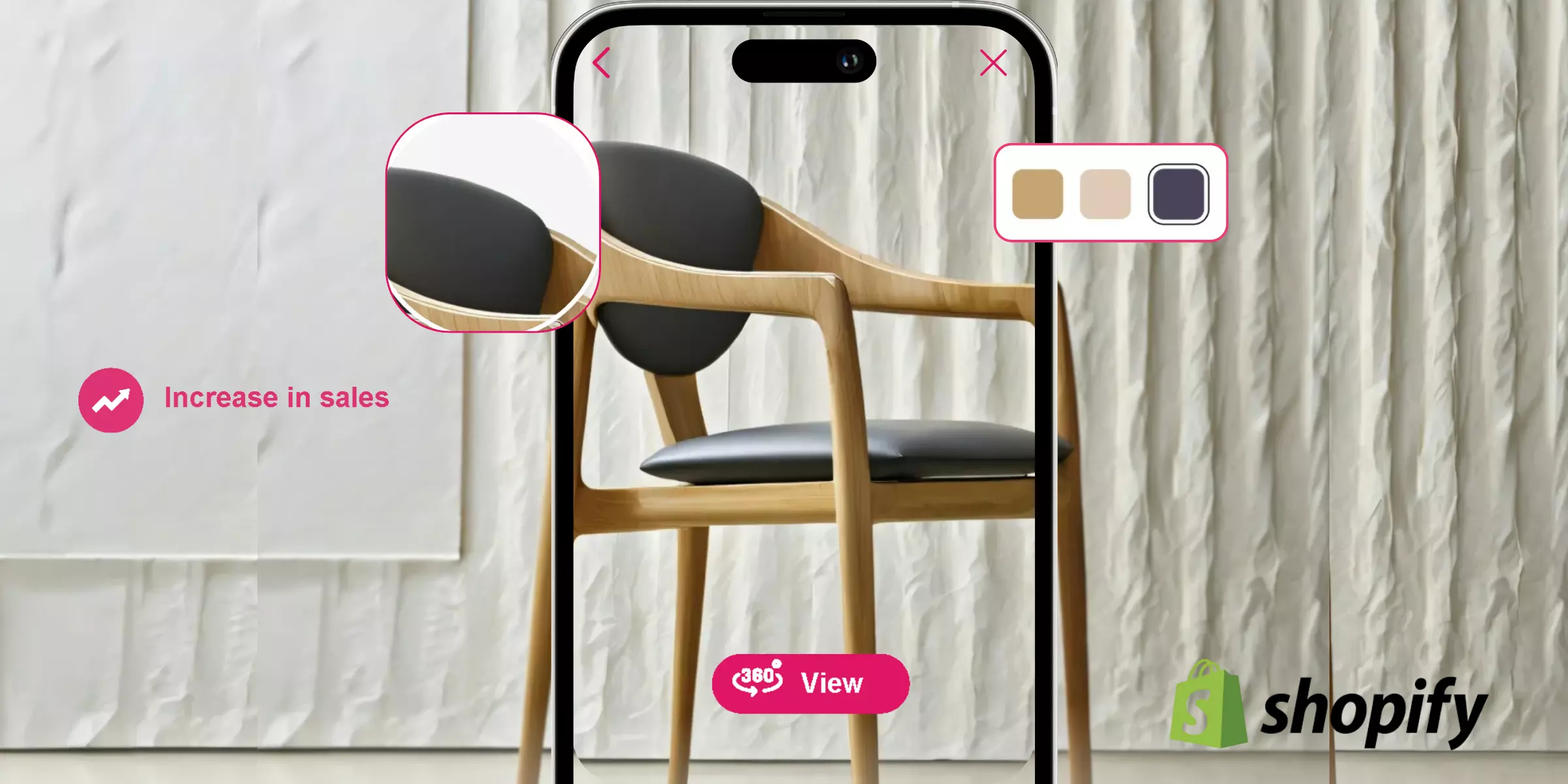
Since the COVID-19 pandemic, the adoption of e-commerce has significantly increased as customers opt to shop online instead of walking into a physical store to buy anything. Due to the increasing demand and necessity of online shopping, the e-commerce industry encountered various challenges, such as adapting to rapid technological changes, delivering seamless cross-device experiences, managing data privacy, and personalizing the customer journey, which caused issues in improving their engagement on the product page.
To overcome these challenges, the e-commerce industry has started using the virtual try-on and 3D viewer on its website and app, which helped the global market, which is expected to reach USD 128.1 billion by 2035, up from USD 14.2 billion in 2025 at a CAGR of 24.6%. With the help of virtual try-ons and 3D viewers, online brands can improve their product page engagement by enabling their customers to try and explore different products virtually using AR overlays, 3D models, and 360-degree viewers.
But have you ever wondered how a virtual try-on and 3D viewer help businesses to improve their engagement rate on their product page? In this blog, I will provide you with detailed information on how a brand can increase engagement rate on the product page with the help of the AR try-on and 3D viewer. Let’s get started!
{{component="/internal/widgets"}}
Challenges that Shopify-based brands face in increasing their product page engagement

Several Shopify-based e-commerce brands face difficulty in increasing user engagement on the product page due to several reasons, including high mobile shopping friction, slow load speeds, and poor-quality visual content, which can negatively impact consumer confidence and satisfaction with their products and services.
There are some key challenges that online brands and businesses encounter, which include high cart abandonment, unclear product descriptions, a lack of social proof/trust signals, and ineffective targeting, which often results in low conversion rates despite high traffic. In this section, I will let you know about various challenges that Shopify-based e-commerce brands face while increasing user engagement on the product page.
1. Mobile optimization failures
One of the major factors to increase product page engagement is providing users with an engaging and seamless experience across various platforms, including web browsers and mobile devices.
Since most of the customers browse on their mobile devices, including applications or web browsers, brands must optimize their product page for various mobile screen sizes to provide their customers with engaging and immersive shopping experiences.
2. Slow load speeds
Another reason why e-commerce brands encounter challenges in increasing their product page engagement is slow loading speed, which can be improved by removing excessive and unoptimized apps and large, uncompressed images.
Slow loading speeds can reduce the product page engagement due to the slow speed of the website or app, which can frustrate visitors during browsing and exploring products, leading to a reduction as they abandon the product page from the website or app.
3. Lack of trust signals and social proofs
Missing customer reviews and testimonials is another reason behind lower engagement on the product page because businesses fail to build customer loyalty and trust towards the brand and its products.
It can be improved by clearly displaying return policies, adding case studies, and getting customer reviews, which will help businesses to provide their customers with a satisfying experience, along with higher confidence and trust in the product or service.
4. Poor visuals and descriptions
Another reason for the lower engagement rate on the product page is due to poor visuals and missing descriptions, which can discourage customers from proceeding with the purchase of products because they don’t get enough information about the product.
Apart from this, using static 2D images with low quality can also lead to a decline in sales and engagement rate on the product page because users fail to understand the details of the products during virtual shopping.
Different strategies that online sellers can use to increase their product page engagement
Online businesses and brands can use various strategies, such as leveraging interactive content, enhancing visuals, and implementing user-generated content, which can help build customer trust and loyalty towards their products and services while increasing their product page engagement.
Apart from that, they can also opt for some effective strategies, including offering personalized recommendations, utilizing live chat, and optimizing for mobile to create a seamless experience, which can also contribute to building stronger and more trusted customer relationships. In this section, I will provide you with detailed information on different strategies that brands or businesses can use to improve their user engagement rate on the product page of their website or app.
1. Interactive content and visuals
To provide users with an engaging and interactive shopping experience, businesses can use high-quality content and visuals on their website or app, along with 3D models, 360-degree viewers, and AR overlays, which will help their customers to explore and try various products virtually.
Apart from that, using 3D models alongside high-quality 2D images with detailed descriptions will also help online sellers and businesses to build customer trust and loyalty towards their brand while offering them a satisfying shopping experience.
2. User-generated content
Another effective strategy that e-commerce brands and businesses can opt for is using user-generated content, in which they can publish customer reviews, case studies, and testimonials on their website or app to provide their customers with an authentic experience.
It can also provide valuable insights that will help brands improve their products according to their customers' experience, while encouraging them to stay more engaged with the product by using photo reviews to build customer trust and loyalty.
3. Personalization and recommendations
Another effective strategy for brands to opt for to increase their product page engagement is offering customers a personalized experience with AI-powered recommendations, which can help the brand increase its average order value by helping users select the best-suited products according to their preferences.
Apart from that, brands can provide their customers with information on “frequently bought products” or personalized recommendations, which will also help them to increase their chances of further interaction.
4. Live chat and support
Brands can also install live chat and support services on their product page, which will help their customers to ask their questions or queries to the AI-powered chatbot while enabling them to select the products according to their needs and preferences.
Apart from that, it will also help online brands and sellers to increase user engagement on the product page by keeping their customers engaged for a longer time on the website or app while they are asking their questions to the chatbot to implement co-browsing technology to guide customers in real-time, reducing, for instance, cart abandonment.

What are 3D viewers and AR try-ons, along with their key features?
The 3D viewer and AR try-on are two different technologies; however, using them collectively will help e-commerce businesses to provide their customers with an engaging and immersive shopping experience. But before implementing these two tools on the website or app, it is important to understand what these two different tools are and their key features, because it will help you to understand which one will help you to provide your customers with better experiences.
In this section, I will provide you with detailed information on how these tools will help you to provide your customers with better services while enabling them to explore and try different products interactively on the website or app.
AR try-on
An AR try-on is an online tool that helps users explore and try different products virtually by uploading their image or using a live video with the help of advanced technologies, such as augmented reality, artificial intelligence, and computer vision. It enables users to visualize products, such as clothing, footwear, accessories, makeup, and jewelry, which will help them make more informed and confident decisions during online shopping.
With the help of this online tool, brands can provide their customers with an interactive and engaging shopping experience that will also help them increase their engagement, which may lead to higher sales and conversion rates. Apart from that, it also helps businesses to build stronger relationships with their customers by increasing their satisfaction during online shopping and fostering their trust by offering them a real-time and in-person-like shopping experience.
Features
- Motion tracking: It allows devices to understand and track the position and orientation of users, which will enable them to track their movements and enable virtual objects to stay fixed in the physical world as the user moves, providing them with an engaging shopping journey.
- Environmental and depth understanding: It detects surfaces or planes, including floors, tables, and walls, which will allow developers to place virtual objects on the surface or plane. Apart from that, it also measures the distance to create realistic interactions like object occlusion, where a virtual object can appear behind a real-world object.
- Light estimation: It provides users with a realistic shopping experience by analyzing the real-world lighting along with its intensity and color to render virtual objects with matching shadows and highlights, providing them with a lifelike visualization of products.
- Face tracking: It provides users with an interactive experience by tracking their facial features and movements, which will help them ensure the accurate placement of products on their face and enable them to explore products from multiple angles.
3D viewer
The 3D viewer is an interactive tool used in e-commerce to allow customers to view and rotate products in three dimensions on a website. It helps brands to enhance the online shopping experience for users by helping them preview items from different angles and perspectives.
It provides the advantage of zooming, panning, and rotating the product image or video, which will enable them to explore products from different angles and perspectives while offering an engaging experience. It helps businesses to enhance their conversion rate and user engagement by helping them reduce product uncertainty and make satisfactory decisions.
Features
- Interactive 360-degree rotation: It can help businesses to build trust among their customers by enabling them to explore products from different angles and perspectives by using interactive features, such as rotation, spin, and zoom. It also provides users with a comprehensive understanding of the product, which will help the brand increase its user engagement rate and conversion rate on the website or app.
- Zoom and detail inspection: It helps users to understand the detailing of products by enabling them to zoom in and out on the product during virtual shopping to explore their features, textures, and details. It allows customers to reduce the uncertainty of style and size mismatch, which helps the brand to opt for a sustainable option by reducing the return rates.
- Seamless integration: It allows the brand to perform easy integration of the software with the popular e-commerce platforms. It provides a smooth user experience for both customers and businesses, which will also enhance total user session time, leading to enhanced user engagement.
- Mobile and cross-device compatibility: To increase the audience reach and connectivity, it provides cross-device compatibility for mobile phones, tablets, and desktops, which allows users to be consistent and have an engaging user experience during online shopping.
Comparison table of AR try-on and 3D viewer
Introducing GlamAR’s AR try-on and 3D viewer SDK for online brands and businesses
GlamAR is a leading AR- and AI-based solution provider that helps e-commerce brands and businesses to provide their customers with engaging shopping experiences by using AR overlays, 3D models, and 360-degree viewers. It offers solutions for various industries, such as jewelry, eyewear, furniture, and skincare, which will help businesses to enhance user experience and engagement on the e-commerce website and app.
Since GlamAR offers multiple solutions for various industries and for different purposes, in this section, I will provide you with detailed information about two of its solutions, including virtual try-on and 3D viewer, which brands can use to improve their online sales, conversions, and engagement rate.
Virtual try-on
Virtual try-on is an AR-based online tool that helps online businesses to provide their customers with try-before-you-buy experiences by superimposing AR overlays onto their face or body with the help of face mapping and augmented reality technologies. It helps several brands dealing in various categories, including makeup, jewelry, watches, hair, nails, and eyewear, which can provide their customers with an engaging and immersive shopping experience.
With the help of augmented reality and face mapping technology, the tool helps businesses to provide their customers with a realistic experience by enabling them to try different products on their face and body while detecting their facial and body movements to help them understand the product placement. Apart from that, using the virtual try-on will help the brand to improve its engagement rate on the website or app by up to 94%, as it keeps users engaged on the e-commerce store for a longer period of time and turns passive browsers into active shoppers.
Features
- Real-time 3D rendering: It helps users to explore products from different angles and perspectives by offering them a realistic rendering of products, which will help them to see how the product will look in real-time lighting and real-world environments, providing them with a realistic product visualization during online shopping.
- Cross-device compatibility: It provides brands with the ability to integrate the virtual try-on with the e-commerce platform for various devices and platforms, including AR/VR devices, mobile devices, web browsers, desktops, and in-store screens, which will help businesses reach a wider audience on both online and offline platforms.
- Seamless integration: It provides businesses with a seamless integration process via API, SDK, or a Shopify-based application, which will allow them to easily integrate the virtual try-on with the e-commerce platform with zero to minimal coding knowledge, while offering them detailed documentation and technical team support.
- Customizable 3D asset: It helps brands to interactively display their products on the e-commerce store with the help of 3D assets, which they can customize according to their image and identity by changing their color, pattern, and finish to provide their customers with a similar shopping experience throughout the store.
- Easy catalog onboarding: It provides businesses with easy catalog onboarding so that they can sync their products' information and list with the tool, which will help their customers to discover, explore, and try new products effortlessly while enabling them to understand the details of products more proficiently.
3D viewer
A 3D viewer or a 360-degree viewer is another SDK of GlamAR, which helps online brands to provide their customers with the ability to explore products using a 3D model or 360-degree viewer, enabling them to explore product details from different angles and perspectives. It offers various engaging features, such as rotate, spin, and zoom, which will help users to have a closer look at every detail of products effortlessly during virtual shopping while increasing their session time on the website or app.
Apart from that, it also provides users with various customization options so that they can tailor products according to their preferences by changing their color, texture, size, and design, providing them with a wide range of products along with high-quality visuals. It also helps brands to elevate the user shopping experience by enabling them to integrate the 3D viewer with AR try-on so that they can provide their customers with the ability to visualize products in real time.
Features
- 360-degree spin: It provides users with a 360-degree view of products, including various features, such as rotate, spin, and zoom, which will help them understand product detailing using a 3D model before making any purchase decisions.
- Photorealistic render: It helps brands to create thumbnails and marketing visuals using WebGL technology, which they can use to display their products in their e-commerce store with high-quality visuals while using real-time photo renders for a lifelike product visualization.
- Customization option: It helps businesses to provide their customers with personalized shopping experiences by enabling them to customize the color, design, specification, and pattern of products according to their needs and preferences with the help of a wide range of configurators.
- Augmented reality integration: It helps brands to provide their customers with an engaging and immersive shopping experience by enabling them to integrate the 3D viewer with AR try-on, which will help users try and explore various products using 3D models and AR overlays.
- Multiple industry solutions: It provides brands with multiple category solutions by enabling them to use the 3D viewer for various products, including jewelry, eyewear, nails, hair, and furniture, which will provide their customers with an engaging shopping experience.
{{component="/internal/widgets"}}
Benefits of using GlamAR’s SDK for a Shopify-based online brand
GlamAR is an AR-based SDK provider that provides AR try-ons and 3D viewers to help online sellers and businesses provide their customers with engaging product visualization and enhance user interaction, which will help them to improve their engagement rate, conversions, and sales for different categories, including beauty, footwear, jewelry, and watches.
It can help businesses in various ways, such as enhanced personalization, seamless integration, cross-platform compatibility, and more, which will enable them to provide their customers with an engaging and immersive shopping experience. In this section, I will provide you with detailed information on the benefits that online brands and businesses will get by using the GlamAR SDK AR try-on and 3D viewers while building stronger and more trusted customer relationships.
1. Enhanced personalized experience
It helps businesses to provide their customers with a personalized and real-time online shopping experience by allowing them to customize products according to their needs and preferences. It also enables them to explore new products and try them before buying by using AR overlays and 3D models, which will also help the brand to bridge the gap between online and offline shopping experiences.
2. Increased conversion rates
It also helps online brands or businesses in increasing their overall sales and conversion rates, along with product page engagement rate, by providing their customers with unmatched realism and accuracy. Apart from that, it also allows customers to explore new products and helps them make more informed purchasing decisions by enabling them to use AR try-on and 3D viewer technology while exploring products before buying.
3. Reduced product returns
With the help of this online tool and advanced technology, customers can try and explore products online before making any purchasing decisions, which will help them make more informed buying decisions and reduce uncertainty due to color mismatch. Therefore, it will also help the brand to reduce the product return rate and enable it to increase customer satisfaction and trust in the business while increasing their session time on the product page.
4. Seamless integration
It provides businesses with the ability to perform seamless integration of the virtual try-on into the e-commerce platform by using an SDK or API, which will reduce the need for an experienced developer during the integration process. It also provides businesses with detailed documentation of the try-on SDK, which they can use to understand the integration process and fix bugs in a timely manner using the tutorials or seeking assistance from experts.
Applications of AR try-on and 3D viewer for different categories
AR try-ons and 3D viewers can be used for various purposes by various online brands and businesses, as they are powered by various technologies, such as computer vision, augmented reality, and 3D rendering, which will provide their customers with an engaging and interactive shopping experience. When it comes to understanding the different applications for several products, some of their use cases are product visualization, personalized recommendations, realistic experience, enhanced engagement, and detailed marketing insights.
Apart from that, it can also help businesses to significantly improve conversions, sales, and engagement rate by providing their customers with a lifelike experience to explore and try on different products while sitting at home with the help of AR overlays and 3D models. In this section, I will provide you with detailed information on the different applications or use cases of the AR try-on and 3D viewer for various brands and businesses.
1. Realistic product visualization
- Interactive try-on feature: With the help of the virtual try-on and 3D viewer, businesses can allow their customers to try on and explore different products virtually by using AR overlays and 3D models on supported AR-enabled devices. It will also help them to make more informed and confident purchase decisions by offering them real-time visualization of products on their live video or the images uploaded by them in real-world environments.
- Compare options: It helps users to compare different products side-by-side, which will help them to understand which product will suit them according to their needs and reduce their uncertainty about the product mismatch. It also provides users with a slider option that will help them to understand the before-and-after comparison of the product application, which will help them to select the most suitable products while helping the brand boost user engagement on the product page.
2. Personalized recommendations
- AI-powered product suggestions: It helps users select the appropriate products that align with their choices and preferences, as it uses advanced AI algorithms to analyze and detect their facial features or body type. Apart from that, it also provides users with personalized product recommendations that depend on multiple factors, such as previous purchase history, facial features, and body type, which will also help them select the products with more confidence.
- Custom looks: It helps users select custom items by suggesting products to them according to their facial features and body type, enabling them to select the most suitable products that complement their unique features. It will also help the brand to improve its product page engagement because it can help them to make more confident virtual shopping decisions while increasing the product page engagement.
3. Enhanced shopping experience
- Increased confidence: It helps users to make more confident purchase decisions by helping them to select the products according to their needs and preferences, which will enhance their shopping experience by offering them AI-based product recommendations. It will also reduce the uncertainty among customers about online purchases, which will also help them make more informed decisions with higher satisfaction while keeping them engaged on the product page for a longer period of time.
- Decreased returns: It can help businesses to reduce their product return rate while improving the online sales, as it helps their customers to choose the accurate products as per their needs. Apart from that, it also helps businesses to bridge the gap between in-store and online shopping experiences by enabling them to integrate the virtual try-on and 3D viewer feature into apps, websites, and even smart mirrors in physical stores.
4. Marketing and data-driven insights
- Hyper-personalized ad: It helps businesses to improve their marketing strategies by enabling them to create targeted marketing campaigns based on user preferences and virtual try-on history. Apart from that, businesses can also use this tool to send personalized messages and emails to their customers based on the data provided by the virtual try-on, which will help them retain their customers and foster their trust in the brand.
- Social sharing: It allows users to perform social sharing of the looks that they create while using virtual try-on, which will help the brand reach a wider audience via their social media platforms. It will also help them to drive more sales and organic marketing traffic by building their trust in the brand with the help of their social sharing feature, which will help them to reach a wider audience globally and help them to explore new products while sitting at home.
Case studies of brands that are using AR try-on and 3D viewer on their e-commerce website or apps
GlamAR is an SDK provider that helps brands from different industries to provide their customers with engaging and interactive shopping experiences, which will help them explore and try on products interactively. With the help of its AR try-on and 3D viewer, it allows users to explore products using engaging features, such as rotation, zoom, and spin, which will enable them to explore products from different angles and perspectives.
In this section, I will provide you with some use cases of the AR try-on and 3D viewer and how it can help several online brands and businesses to improve their engagement rate on the product page.
1. Low-Cost Glasses
Low Cost Glasses is an eyewear brand that uses AR try-on and 3D viewer technology to provide its customers with a realistic shopping experience by enabling them to virtually try different eyewear products while sitting at home.
It provides its customers with multiple features, such as virtual try-ons, 3D model creators, and 360-degree viewers, which will offer them some engaging features, such as spin, zoom, and rotate, to help them explore products from different angles and perspectives. It also helps them reduce the product return rate by helping their customers make more informed and confident purchases during online shopping.
2. White Cut Diamonds
White Cut Diamonds is an online jewelry brand that uses the virtual jewelry try-on along with a 3D product viewer from GlamAR on its website and app, which helps it provide its customers with an engaging and interactive shopping journey. It provides its customers with exciting features, such as virtual try-ons, 360-degree viewers, and 3D model creators, which will help them to try and explore different products interactively from different angles and perspectives.
With the help of this online tool, the brand bridges the gap between the online and offline shopping journey by replacing static 2D images with interactive 3D models to help their customers make more informed purchasing decisions.
Conclusion
Using the combination of both AR try-on and 3D viewer will help online brands and businesses to provide their customers with the advanced technology of AR overlays and 3D models, which will help them to try and explore various products while offering them a realistic shopping experience. Apart from that, it also helps businesses to increase their product page engagement on their website or app by keeping their customers engaged for a longer period of time by offering them engaging features, such as AR overlays, 3D models, rotation, zoom, and spin.
With the help of the GlamAR SDK, brands and businesses can provide their customers with multiple engaging features, including AR overlays, face mapping, 3D models, and 360-degree viewers, which will help them to try and explore different items in real-world environments from different angles and perspectives. Therefore, using the AR try-on and 3D viewer will help brands from different industries to increase their product page engagement while helping them to display their products using 3D models instead of 3D images with AR try-on technology.
The 3D viewer provides customers with a 3D model of the product, which they can use to explore the details of products from different angles and perspectives by enabling them to rotate, zoom, and spin in a digital space. On the other hand, the virtual try-on allows customers to try products virtually by using AR overlays of their product onto their face or body using AR and AI. Therefore, a 3D viewer helps users to focus on product visualization, whereas the virtual try-on provides them with a personalized, real-time try-before-you-buy experience.
A 3D viewer uses interactive 3D models to help customers rotate and zoom the product directly on the e-commerce website or app, which will help them to explore products from various angles and perspectives while offering them a 360-degree preview. On the other hand, the virtual try-on uses a combination of augmented reality and artificial intelligence technologies to detect facial features or body positioning through a camera to digitally place the product in real time while adjusting the product for movement, scale, and orientation.
In most cases, customers do not need to download an app to use the AR try-on and 3D viewer because modern AR try-on and 3D viewer tools work on web-based technologies, enabling them to directly work on mobile or desktop browsers. It will also help the brand to provide its customers with better experiences by reducing friction, improving accessibility, and allowing them to engage with interactive product experiences instantly without additional installations.
With the help of AR try-ons and 3D viewers, businesses can provide their customers with an engaging and interactive shopping experience by enabling them to explore and try various products using 3D models and AR overlays, respectively. These two tools also help online businesses to enhance customer confidence by giving them a realistic understanding of how products look and feel on their face or body. It also allows them to examine details, assess proportions, and visualize the fit of products before making any purchase decisions, which reduces uncertainty, speeds decision-making, increases satisfaction, and minimizes the likelihood of returns.
Reputable virtual try-on solutions prioritize privacy, as they help businesses to protect customer data by enabling them to process their images in real time without permanently storing personal data. Most of the platforms use secure, encrypted systems and comply with data protection regulations like GDPR, which will help them to inform their customers about camera usage and ask for their explicit consent before activating the feature.
Virtual try-on technology provides customers with a close visual approximation of size and fit by using facial mapping, body tracking, and scaling algorithms, which do not guarantee highly realistic accuracy, because there are various reasons, such as lighting, posture, or device differences, due to which results may not be perfectly exact. However, using advanced AI-based algorithms will help the brand to significantly improve accuracy, which will also improve customer confidence while making purchase decisions during online shopping.
Discover how AR, VR and 3D can drive revenue growth in 2026
Schedule a call with our team

.avif)