


AR try-on jewelry brands


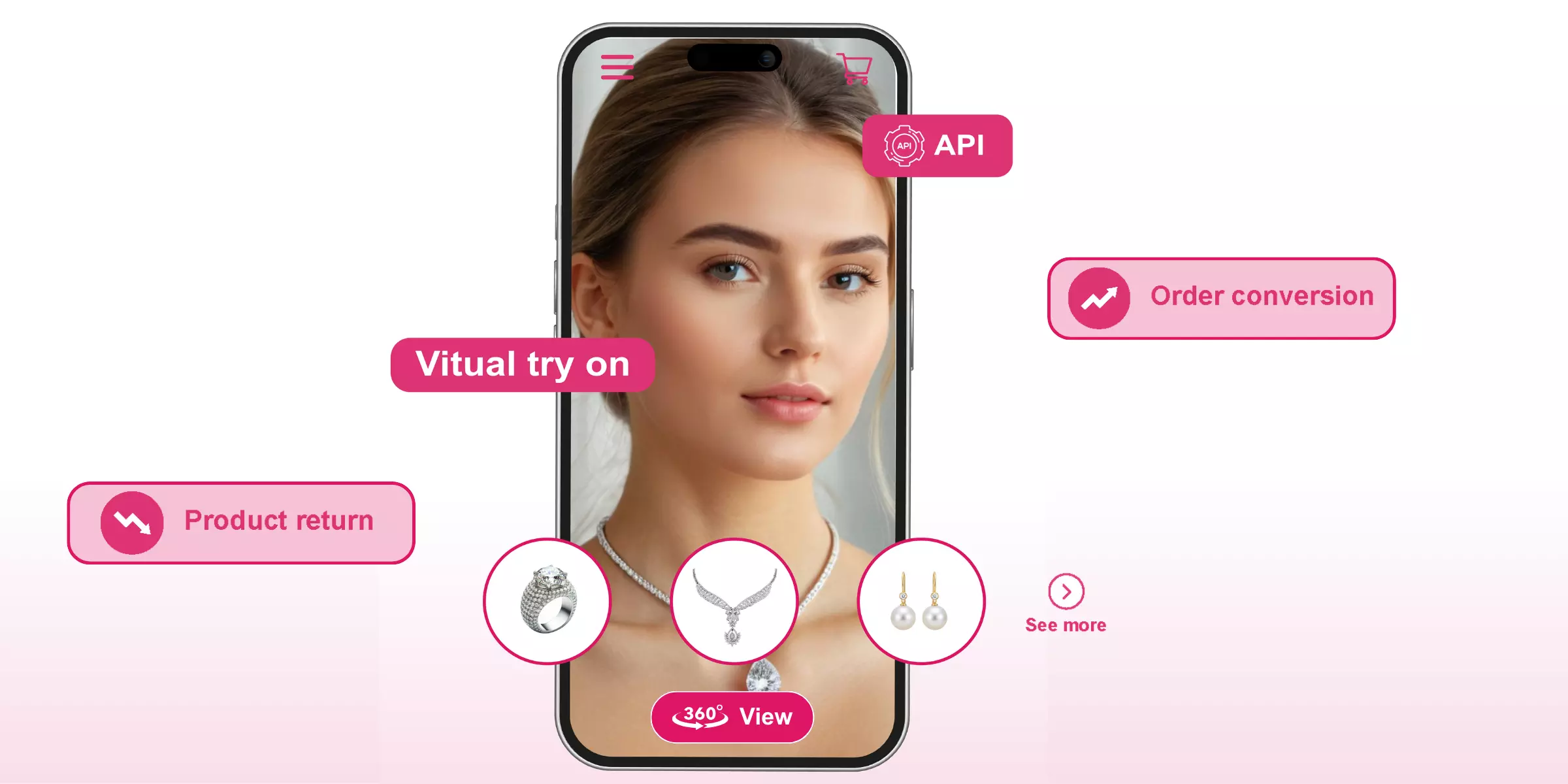
The AR virtual try-on technology is serving as a solution to some pain points of certain sectors in the business world. Before its emergence, the lack of personalization and the inability to virtually try on for possible fitting or sizing before making a purchase have been major concerns in modern online e-commerce. However, since its inception, AR try-on adoption has grown significantly among major retailers because of its ability to empower their shoppers to preview and interact with supported products with AR models on a personalized level.
Many leading jewelry retailers now tend to integrate the AR virtual try-on right on their product page as a means of helping customers to virtually try on any jewelry product right from the comfort of their home without the need to visit the physical store. And this has proven to yield tangible results, as Shopify pointed out that there has been a 40% reduction in the return rate of products like rings and watches. The AR is now serving as a better marketing strategy and a productive means of displaying jewelry to online buyers in real-time.
Even more than this, augmented reality technology is also playing a significant role in helping to add a touch of flexibility to modern stores, as it can be integrated into smart mirrors or kiosks, allowing shoppers to virtually try on jewelry of their choice without the help of a salesperson or physically handle it in real time. The rapid adoption is also seen in its market growth because, according to the future marketing insights, the global AR market size was valued at $18.4 billion in 2020 and is likely to reach $95.4 billion in 2026. This growth reflects increasing investment across industries, including retail and they are embracing it to create a difference in the competitive market.
Let's take a deeper look at brands that GlamAR's AR try-on has improved their engagement or conversion and how your brand can leverage it to make more sales.

What does AR try-on jewelry mean?
Augmented reality try-on is an advanced technology that uses your buyer's smartphone camera or webcam to enable them to virtually put on selected jewelry in real time. It uses 3D models (or digital overlays) combined with face or hand tracking technology to position the jewelry realistically on the user in real-time via the lens of the buyer's camera or webcam.
This allows shoppers to visualize how the jewelry may look and its approximate size and placement in a situation where a physical try-on is not possible, or the shopper does not wish to visit the jewelry store in person.
Integrating this tool as a jewelry retailer helps to enhance customers’ engagement, rather than just displaying some static photos of your products on your product pages.
How does AR try-on jewelry work?
Most AR try-on tools combine computer vision, face or hand tracking, and 3D rendering technology to overlay digital jewelry onto a live camera view. All these enable the possibility of making your buyer virtually place jewelry on their neck and see how the jewelry may look and how it sits visually in real time.
This experience can take place on a smartphone, desktop, tablet, or in-store AR mirror. Basically, the tool overlays the 3D model of the selected jewelry on the user's body through an uploaded image or a live video feed from any suitable smart device’s camera. It also allows users to view the jewelry from multiple angles as they move naturally in front of the camera.
Key features of the AR try-on technology

The AR try-on has some core features that your shopper will experience.
1. Virtual overlay of products
This implies that your shoppers will have the opportunity to virtually place the jewelry on their body to check its size and compatibility with their skin tone in real time. AR try-on helps create clarity through product visualization, allowing shoppers to see how the product looks before they commit to making a payment or worry about its appearance.
2. Works with 3D rendering
The tool can help to overlay your jewelry product in an optimized 3D model rendering containing detailed visual elements, which enables the shoppers to have a better understanding of your product offering in real-time.
3D models can be created from product images or CAD files using specialized modeling tools, and the try-on technology will help you virtually place the model on users in real life for proper assessment. The importance of a high-quality 3D model is to help to enhance realism and visual accuracy.
3. Cross-platform compatibility
Many modern AR tools are compatible with iOS, Android, and supported web browsers, depending on device capabilities. It can also work with compatible smart devices and modern browsers. Such versatility gives a wide reach opportunity to your customers, regardless of the platform used to access the tool.
4. Precise body tracking
The tool has a tracking sensor to map out the necessary parts of the user's body so as to properly overlay the jewelry in real time. It allows objects like the necklace, earrings, rings, and bracelets to be placed and appear at the right part of the user's body, even as the user moves.
5. 360-degree previews
With this feature, shoppers can preview your 3D product from multiple angles as they move naturally in real time. In some cases, separate 3D viewers allow manual rotation for additional inspection. The product tends to move as the user moves. This technique helps to create an engaging interaction with the product.
Challenges faced by most jewelry brands before the arrival of AR try-on
Let's talk about the common challenges faced by many online jewelry brands before adopting integrative visualization tools like AR try-on.
- Lack of trust in modern online stores: Some customers remain hesitant to purchase high-value jewelry online due to certain reasons. It is believed that visiting a physical store or a nearby brand outlet where they can physically handle and closely examine the quality and design of the jewelry might save them from unnecessary regrets. Also, the concerns about product-image mismatch have made many lose trust in purchasing from online stores. Even high competition can make it more challenging for brands to stand out and convert visitors into buyers.
- High rate of product return: Simd jewelry retailers report returns due to sizing or expectations mismatches. This issue is common with online jewelry stores, in which customers complain about the selected ring or bracelet not fitting well on their fingers or wrist in real time. As a result of this, the rate of product return becomes a serious concern to the jewelry retailers, especially to those who operate online modern stores.
- Customer experience: Some customers seek more personalized and interactive shopping experiences, whether on the online or in-store platform. It was stated that many always find it so hard to get a unique or customized design, a piece suitable for their personal needs in real time. Also, static images may not always fully convey fine details, scale, or texture.
- Inaccuracy and inconsistency with product presentation: Some online jewelry customers tend to complain about the inaccuracy of the product image and the actual product in real life. Some product images seem to convey details that the actual product does not entail, which presents the brand as inconsistent with the information provided to its customers. Imagine a product image of a bracelet containing designs like gems and hues, with a touch of metal tone, but the actual product (purchased by the customer) does not have all these details. This will make the customer distrust and lower the sense of loyalty to the brand in question.
Benefits of integrating the AR try-on into your jewelry store
Below are the advantages of integrating an AR try-on tool into your business for improving customers’ shopping experience.
1. Realistic product preview
The tool uses detailed 3D models to present products more realistically. This enables the user to understand and to better visualize key visual details of the product. Not only this, but customers can view the jewelry from multiple angles as they move in front of the camera.
2. Enhance customers’ confidence
If your buyer can easily interact and preview the product in real time, this can increase purchase confidence. Also, the AR try-on can help engage your customers by allowing them to virtually try supported products via the camera on their smart device. This experience will help increase customers' confidence in purchasing the product without much hesitation.
3. Reduce product returns
AR try-on can help to reduce the likelihood of returns due to visual mismatch. When the expected goods or products successfully match the selected one in real time, there is no need to return the product. AR seeks to enable this capability by helping customers better understand what they are about to purchase through the placement of the product into their real-time environment for closer observation.
4. Boost product sales
AR try-on may help improve engagement and potentially increase conversions. The AR try-on tool comes with the ability to virtually overlay the selected product in real-time via their smart devices. This experience can influence the user to make an informed purchase decision.
5. Realistic try-on experience
AR try-on tools make it possible for your customers to visually examine how the product may look in their real-time location or on their body. Without leaving their comfort zone, your audience can access the jewelry right from your product page to visualize approximate size, shape, and possible compatibility options (whether it will suit their skin tone, neckline, or face in real time).
Case study of jewelry brands that use GlamAR’s AR try-on
Here is the case study of the “White-cut diamond” brand that has used GlamAR’s AR try-on for advancing its brand and making more sales.
What do they do?
White cut diamond is a jewelry retailer based in India. They specialize in designing and producing handcrafted and exquisite jewelry for their audience. They function as a walk-in store, openly and readily showcasing their products on various counters for potential buyers.
Problem identify
It's surprising that a successful brand with a renowned store would identify its customers' minor pain points in real time. This shows how intentional they are about their customers. Let's dig deeper into these observed pain points.
- Space constraints: The idea of having their products well displayed behind a glass counter, showcasing a few designs, might seem to be enough. However, the question of what if the customer does not find their preferred design piece of jewelry among the available ones remains unanswered. Why? Creating another sort of space to occupy samples of different designs, including size, metal, and stone combinations, might seem like another great investment for the company. So what will they do?
- Product uncertainty: Even if an order is being made to create the imagined design of the customer in real time. Is it certain that this new design ordered by the customer will suit their needs? Will it suit their face in real time? Will it suit their neckline or skin tone? Evidently, their customers remain uncertain about the outcome of their new order in real time.
- Inability to decide on time: Due to the uncertainty of whether the new design (which contains an imagined combination of different variations like gems, stones, colors, sizes, etc.) might suit the customer in real-time, this might cause the customers to take a longer time to process their thoughts and make a firm decision on time.
{{component="/internal/widgets"}}
Solution GlamAR's AR try-on bought
On the quest for changes, GlamAR suggests some suitable solutions. And here are the solutions we prescribe and provide for them.
- 3D product display: This tool allows products with 3D models to be presented in a more realistic and interactive format. It enables buyers to preview and view detailed visual elements from multiple angles before selecting it.
- Virtual try-on experience: This solution helps to reduce visual uncertainty and imagination. Here, customers will be able to virtually try supported jewelry designs to see how the jewelry may look and fit visually before purchasing. It also answers the uncertainty of whether the selected combinations of variations will suit their needs.
- Large digital catalog: Instead of investing in building another physical space for accommodating different designs, we help to create a virtual catalog that contains designs that are not physically stored. This format enables shoppers to explore a wider range of designs digitally.
Outcome
And of course, the brand recorded some significant results after implementing these solutions. Let's talk about it.
- Stand out as an innovative and modern jewelry store amidst the traditional market.
- Promote a sense of confidence among customers in selecting a particular piece of jewelry.
- Create a better and more engaged shopping experience for customers.
How to integrate GlamAR’s AR try-on technology into your jewelry business
Integration typically involves creating compatible 3D models (or digital assets) for selected products and embedding any of our custom integration options (plugin or SDK, etc.) directly into your website. Below are the simple steps to follow:
Step 1: Visit our website page and find the pricing option located either at the footer or the three-dash symbol at the top of the website.
Step 2: Select the AR try-ons pricing plan option, and either go through the compare plans or get a suitable quotation for your budget.
Step 3: After all these, we will provide you with a suitable custom integration option, either a simple plugin or SDK that can be directly embedded into your website seamlessly. But know that integration complexity may vary depending on your platform and customization needs and in case you don't have 3D model assets for your products, we offer 3D model creation for a wide range of jewelry categories, which can be plugged into your AR try-on when they are ready.
Step 4: It is advisable to test the tool across some platforms and then make the necessary performance changes before making it go live. Afterward, activate it on your platform.
Conclusion
The AR try-on is an advanced technology usable for product visualization, engagement and digital merchandising of suitable products that many jewelry brands may benefit from leveraging to stand out in the competitive markets. Embracing GlamAR's try-on comes with salient advantages for scaling up your business. Depending on the integration method, minimal technical expertise may be required before you can integrate GlamAR's try-on.
Right from the concept of the integration process, GlamAR can deliver a ready-to-deploy solution across web, mobile, and supported in-store environments suitable for your business needs. Whether you are a retailer or trying to set up your luxury store, you can integrate the tool for omnichannel operations across your business platforms in real time.
If you are ever looking for a means of improving your selling strategies through improved customer engagement, 3D product visualization, 360-degree previews, and a virtual try-on experience for supported products within your catalog, then you can trust GlamAR’s AR try-on solution to serve as a strong option for your jewelry brand seeking enhanced digital engagement.
AR try-on technology is a digitalized tool that enables users to virtually try on your products in real-time via the camera of their smart devices. This tool makes it possible for online and sometimes on-site consumers to visualize approximate size, placement, shape, and color before making a purchase commitment. It typically combines computer vision, 3D modeling, and real-time tracking technologies to help shoppers try on a particular product in real time.
Assuming a customer walks into your store or checks your website to get a product, along the process, they realize that they can personalize and virtually put the product on their body via their smart devices to check for compatibility in real-time. This experience may improve engagement and potentially increase conversion rates. And in the long run, it may encourage positive word-of-mouth experiences.
The AR try-on can enable you to showcase or display your products to your customers in a more realistic way. It tends to overlay your products on their body in real-time through camera-based face or hand tracking technology that maps out the suitable area where the product is meant to be placed on the body. This creates an engaging and personalized experience for your customers in real time.
GlamAR's AR try-on can work on supported iOS and Android devices, compatible web browsers, and certain in-store AR systems. It works with smartphones like iOS and Android. Also, it can be accessible via web-based AR, mobile apps, smart mirrors, and other in-store experiences. In essence, the tool is available for an omnichannel experience.
Yes. GlamAR's AR try-on can be embedded into both new and existing e-commerce platforms. It can be integrated into most popular existing e-commerce platforms, such as Shopify, depending on the integration method. They can be embedded easily through custom integration options like a plugin or SDK directly into your platform or website, depending on your technical setup. The tool is designed to be compatible with smart devices that have the capacity for technical elements like face tracking and 3D rendering.
GlamAR's AR try-on jewelry can be an effective tool that enables your customers to try on your jewelry on their bodies via their smart devices. And after this experience has occurred, customers can better visualize how the product will truly look on them in real-time. So when they finally purchase and get the product, they might be unsurprised by what they are getting in reality. This is because they have examined the product beforehand through the AR try-on experience.
Discover how AR, VR and 3D can drive revenue growth in 2026
Schedule a call with our team

.avif)