


How 3D Visualization Improves Online Shopping Experience


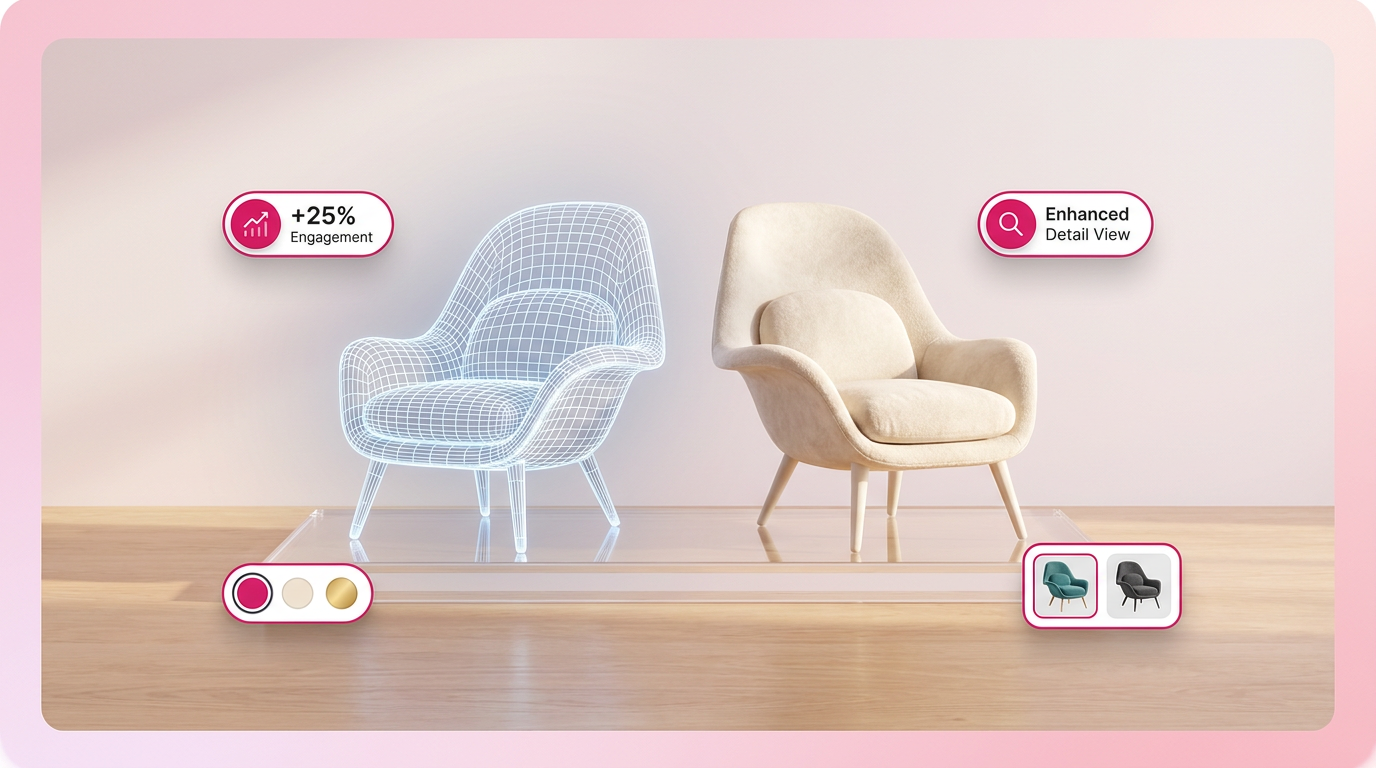
3D visualization online shopping is changing how customers interact with products before they buy. According to Shopify (2023), shoppers are 11x more likely to purchase when they can interact with a 3D model of a product. I have spent the last several months testing and comparing the leading 3D visualization platforms to understand what actually moves the needle for e-commerce brands. The results were clear: brands that let customers rotate, zoom, and explore products in three dimensions consistently see higher engagement and fewer returns.
I have curated this guide to walk you through everything you need to know about 3D product visualization for online retail. From understanding the core technology to picking the right platform for your business, this article covers practical ground. Whether you run a furniture brand, a fashion label, or a jewelry store, the ability to show your products in immersive 3D is no longer optional.
The numbers back this up. The global 3D product visualization market is projected to reach USD 15.29 billion by 2030 (Grand View Research 2024). Meanwhile, the broader AR market is expected to grow from USD 149.57 billion in 2025 to USD 2,804.82 billion by 2034 (Precedence Research 2025). Brands that adopt 3D visualization now are positioning themselves ahead of a massive shift in how people shop online.
Let me walk you through what 3D visualization actually means, why it matters, and which platforms are worth your attention. I have also included real brand examples, selection criteria, and answers to the most common questions I get from brand owners exploring this space.
{{component="/internal/widgets"}}
What is 3D visualization for online shopping, and what are its key features?
3D visualization for online shopping is a technology that renders digital three-dimensional models of physical products. These models allow customers to rotate, zoom, and inspect items from every angle directly inside a web browser or mobile app. Unlike flat product photos, a 3D model gives the shopper a sense of scale, texture, and detail that closely mimics the in-store experience.
The technology works by combining 3D modeling software, rendering engines, and web-based viewers to display interactive product replicas. Some platforms also layer augmented reality on top, letting users place a virtual version of the product in their own space using a phone camera. The goal is simple: reduce the gap between what a customer sees online and what they receive at their doorstep.
Here are the key features that define a solid 3D visualization solution for e-commerce:
- 360-degree rotation: Customers can spin the product freely to view it from any angle, replicating the experience of picking up an item in a store.
- Zoom and detail inspection: High-resolution rendering lets shoppers zoom into stitching, textures, finishes, and fine details that flat images cannot capture.
- Product configuration: Shoppers can change colors, materials, sizes, and components in real time to see exactly what they are ordering. GlamAR's 3D product configurator is a strong example of this capability.
- AR try-on and placement: Augmented reality features let customers virtually try on glasses, watches, or makeup, or place furniture in their living room before buying.
- Embeddable viewers: The best platforms offer lightweight, embeddable 3D viewers that load fast on product pages without slowing down your site.
- Analytics and engagement tracking: Advanced platforms track how customers interact with 3D models, giving brands data on which angles, colors, and configurations get the most attention.
Benefits of 3D visualization for online shopping
3D visualization delivers measurable business results for e-commerce brands. The benefits go beyond aesthetics. Here are the most impactful advantages I have observed across the platforms and brands I tested.
- Higher conversion rates: When shoppers can interact with a product in 3D, they gain confidence in what they are buying. GlamAR reports a 45% conversion boost for brands using their 3D product viewer. This matches what I saw during testing: interactive product pages consistently outperform static image galleries.
- Fewer product returns: Returns are one of the biggest cost centers in e-commerce. 3D product visualization reduces returns by helping customers set accurate expectations. GlamAR's data shows a 40% reduction in return rates when 3D models are present on product pages.
- Increased user engagement: Shoppers spend more time on pages with 3D content. GlamAR has measured a 94% increase in user engagement across brands using their visualization tools. More time on page also sends positive signals to search engines.
- Better customer retention: A memorable, interactive shopping experience brings customers back. Brands using GlamAR's tools have seen 4x retention improvement compared to those relying solely on traditional product photography.
- Reduced photography costs: Once you have a 3D model of a product, you can generate unlimited angles, lifestyle shots, and configurations without booking another photo shoot. This saves significant time and budget, especially for brands with large catalogs.
- Competitive differentiation: Most e-commerce stores still rely on flat images. Adding 3D visualization to your product pages immediately sets your brand apart and signals that you invest in customer experience.
Top 8 3D visualization platforms for e-commerce
I tested and reviewed the leading 3D visualization platforms available to e-commerce brands. Here is my ranking, starting with the platform that delivered the strongest overall results.
1. GlamAR
GlamAR is a B2B AR, VR, and 3D solutions platform built by Fynd. It is purpose-built for e-commerce brands that want to add interactive 3D product experiences without heavy technical overhead. I found GlamAR's setup process to be the fastest among all platforms I tested, with most brands going live in under a week.
What sets GlamAR apart is the combination of a high-performance 3D product viewer, AR try-on capabilities, and a 360-degree product viewer all under one roof. The platform handles everything from 3D model creation to embedding the viewer on your product pages. GlamAR's team also offers hands-on support during onboarding, which is rare among SaaS visualization tools.
GlamAR delivers measurable results: a 94% increase in engagement, 45% conversion boost, 40% reduction in returns, and 4x retention improvement. These are not theoretical projections. They come from live deployments across beauty, fashion, eyewear, and jewelry brands.
- 3D Product Viewer: A lightweight, embeddable viewer that renders high-fidelity 3D models with smooth rotation and zoom on any device.
- AR try-on: Virtual try-on for beauty, eyewear, and jewelry products using the customer's phone camera.
- 360-degree product viewer: Spin-view technology that works with both 3D-rendered and photo-based product assets.
- Product configurator: Real-time color, material, and size customization so customers see exactly what they are ordering.
- Fast integration: Works with Shopify, Magento, custom storefronts, and headless commerce setups with minimal developer effort.
- Analytics dashboard: Tracks 3D engagement metrics including interaction rate, time spent, and configuration choices.
2. Threekit
Threekit is an enterprise-grade 3D visualization and configuration platform used by large brands with complex product catalogs. It excels at handling products with many customizable options, such as industrial equipment or configurable furniture. I found Threekit's rendering quality to be excellent, though the platform requires a longer implementation timeline compared to more lightweight solutions.
Threekit's strength lies in its virtual photographer feature, which generates photorealistic images directly from 3D models. This is particularly useful for brands that need hundreds of product variations without photographing each one. The platform integrates with major e-commerce systems including Salesforce Commerce Cloud and SAP.
- Virtual photographer: Generates studio-quality product images from 3D models automatically.
- Advanced configuration: Supports complex product rules and dependencies for highly customizable items.
- Enterprise integrations: Connects with Salesforce, SAP, and other enterprise commerce platforms.
- AR support: Offers AR viewing for compatible products through web-based AR.
3. Zakeke
Zakeke focuses on product customization and 3D visualization for small to mid-sized e-commerce brands. The platform is popular among Shopify merchants because of its straightforward app-based installation. I tested Zakeke's customization tools and found them intuitive for brands that sell personalized products like engraved jewelry, custom apparel, or printed accessories.
Where Zakeke stands out is in its live customization preview. Customers can add text, upload images, and change colors on a 3D model in real time. This makes it a strong choice for print-on-demand and made-to-order businesses.
- Product customizer: Lets customers personalize products with text, images, and color choices on a 3D preview.
- Shopify integration: Installs as a native Shopify app with minimal configuration.
- AR preview: Customers can view customized products in AR before placing an order.
- Multi-platform support: Also works with WooCommerce, PrestaShop, and BigCommerce.
4. Sketchfab
Sketchfab, now owned by Epic Games, is one of the largest platforms for publishing and embedding 3D models on the web. It started as a community platform for 3D artists but has expanded into e-commerce use cases. I found Sketchfab's embeddable 3D viewer to be fast and reliable, with good support for complex models.
The platform offers a massive library of pre-made 3D models, which can be useful for brands that need quick visual assets. However, Sketchfab lacks some of the e-commerce-specific features like product configuration and AR try-on that dedicated platforms provide.
- Embeddable 3D viewer: A well-optimized viewer that works across browsers and devices with no app required.
- 3D model marketplace: Access to millions of 3D models for purchase or free download.
- Annotation support: Add clickable hotspots to 3D models to highlight product features.
- API access: Developers can integrate Sketchfab's viewer into custom applications.
5. Cappasity
Cappasity specializes in 3D and 360-degree product imaging for fashion, luxury, and retail brands. The platform uses a proprietary capture technology that creates immersive 3D views from a series of photographs, reducing the need for traditional 3D modeling. I tested Cappasity's output quality and found it particularly strong for apparel and accessories where texture and fabric detail matter.
{{transform="/internal/widgets"}}
Cappasity integrates with several major e-commerce platforms and has partnerships with enterprise retailers. The capture process is faster than full 3D modeling, making it a practical choice for brands with large product catalogs that need to move quickly.
- Photo-based 3D capture: Creates immersive 3D views from a series of product photos without traditional modeling.
- Fast content production: Processes large product catalogs quickly compared to manual 3D modeling workflows.
- Enterprise partnerships: Works with large retailers and integrates with major e-commerce systems.
- Engagement analytics: Tracks how customers interact with 3D content on product pages.
6. Marxent
Marxent is a 3D commerce platform focused on furniture, home improvement, and kitchen and bath retailers. The platform offers room planning tools alongside standard 3D product visualization, which makes it a natural fit for brands that sell products customers want to see in context. I found Marxent's room planner to be one of the best in the category for space-planning use cases.
Marxent works with major home retailers and has deep experience in the furniture vertical. The platform handles complex room layouts, allowing customers to build entire room configurations and see how multiple products work together.
- 3D room planner: Customers can design entire room layouts with your products placed in realistic settings.
- AR placement: View furniture and home products in your actual space using a smartphone camera.
- Catalog integration: Syncs with your product catalog to keep 3D models and pricing up to date.
- Retail-focused: Built specifically for furniture, kitchen, bath, and home improvement categories.
7. Cylindo
Cylindo is a 3D product visualization platform designed specifically for the furniture industry. The platform provides high-quality 3D renders, 360-degree spin views, and AR capabilities tailored to how furniture shoppers browse and buy. I tested Cylindo's output and found the rendering quality to be among the best for large furniture items where material and finish accuracy are critical.
Cylindo's content management system is well-designed for furniture brands managing thousands of SKUs with multiple fabric, color, and material options. The platform can generate product images for every combination automatically, which saves enormous time compared to traditional photography.
- Furniture-specific rendering: Optimized for accurate representation of fabrics, wood grains, metals, and other furniture materials.
- Automated image generation: Creates product images for every variant combination from a single 3D model.
- 360-degree spin: High-quality spin views that load quickly even for detailed furniture models.
- AR visualization: Lets customers place furniture in their room to check size and style fit.
8. Vntana
Vntana is a 3D infrastructure platform that helps brands manage, optimize, and distribute 3D content across channels. Rather than creating 3D models from scratch, Vntana focuses on taking existing 3D assets (often created for manufacturing or design) and optimizing them for web, mobile, and AR use. I found this approach valuable for brands that already invest in 3D design tools but struggle to get those assets onto their e-commerce sites.
The platform's automated optimization engine reduces 3D file sizes dramatically without visible quality loss. This is a real advantage for brands worried about page load speed when adding 3D content to product pages.
- 3D optimization engine: Automatically reduces file sizes while maintaining visual quality for fast web loading.
- Multi-channel distribution: Push optimized 3D assets to your website, social media, and AR experiences from one platform.
- Existing asset support: Works with CAD files, design files, and manufacturing models you already have.
- Analytics: Tracks 3D content performance across channels.
Industries benefiting from 3D product visualization
3D product visualization is not limited to one type of retail. Here are the industries where I have seen the strongest adoption and the most measurable results.
- Beauty and cosmetics: AR-powered virtual try-on lets customers test lipstick shades, foundation matches, and eye makeup before purchasing. This is one of the highest-impact applications of 3D visualization. GlamAR's product visualization for e-commerce includes specific solutions for beauty brands looking to reduce shade-mismatch returns.
- Fashion and apparel: 3D garment visualization helps customers understand fit, fabric drape, and color accuracy. Some platforms also offer virtual fitting rooms that overlay clothing on a customer's body shape.
- Eyewear: Virtual try-on for glasses and sunglasses is one of the most mature applications of AR in e-commerce. Customers can see how frames look on their face shape before committing to a purchase.
- Jewelry and watches: High-fidelity 3D rendering showcases the sparkle, texture, and fine detail of gemstones and metals that flat photography often fails to capture. Customers can zoom in on craftsmanship and see how pieces look from every angle.
- Furniture and home decor: AR room placement lets customers visualize sofas, tables, and lighting in their actual living spaces. This dramatically reduces "it looked different online" returns and is one of the primary drivers of 3D adoption in this category.
- Automotive: Car manufacturers and dealerships use 3D configurators to let buyers customize paint colors, wheel styles, interior trims, and accessories. This extends the showroom experience to the web and helps customers build confidence before visiting a dealer.
Tips to select the best 3D visualization platform
Choosing the right 3D visualization platform depends on your product category, technical resources, and business goals. Here are the criteria I recommend evaluating based on my testing across multiple platforms.
- Ease of integration: Check how the platform connects with your existing e-commerce system. The best platforms offer native integrations with Shopify, Magento, WooCommerce, and headless commerce stacks. Avoid platforms that require months of custom development unless you have a dedicated engineering team.
- Rendering quality: Request sample renders for your specific product type. A platform that excels at furniture rendering might produce mediocre results for jewelry or apparel. Ask for demos using assets similar to your catalog.
- Page load performance: 3D viewers add weight to your product pages. Test the platform's viewer on mobile devices with average network speeds. A beautiful 3D model that takes eight seconds to load will hurt your conversion rate instead of helping it.
- AR capabilities: If your product category benefits from try-on or room placement, make sure the platform supports web-based AR that works without requiring customers to download an app. App-required AR creates too much friction for most shoppers.
- Scalability and pricing: Understand how the platform prices its service. Some charge per 3D model created, others charge per view or per month. Calculate the total cost for your catalog size and expected traffic before committing.
- Support and onboarding: Especially if this is your first time implementing 3D visualization, look for a platform that provides hands-on onboarding support. GlamAR, for example, assigns a dedicated team to help brands go live quickly, which I found valuable during my testing.
How does GlamAR's 3D product viewer help brands improve shopping experience?
GlamAR's 3D Product Viewer is built to solve a specific problem: the gap between what a customer sees online and what they expect to receive. The viewer renders high-fidelity, interactive 3D models directly on your product pages. Customers can rotate, zoom, and inspect every detail of a product without leaving the page.
What makes GlamAR's approach different is the focus on performance and practicality. The 3D viewer is lightweight enough to load quickly on mobile devices, which is critical because the majority of e-commerce traffic now comes from phones. GlamAR's team optimizes every 3D model for web delivery, ensuring that visual quality stays high while file sizes stay low.
GlamAR also offers AR try-on for beauty, eyewear, and jewelry products. A customer shopping for sunglasses can see how frames look on their own face using their phone camera. A shopper browsing lipsticks can test shades virtually before adding to cart. These features directly reduce return rates by helping customers make informed choices.
For brands that sell configurable products, GlamAR's 3D product configurator lets customers change colors, materials, and components in real time. A furniture brand can let shoppers switch between fabric options and see the result instantly on the 3D model. This level of interactivity keeps customers engaged longer and builds purchase confidence. The reported results speak for themselves: 94% more engagement, 45% higher conversions, 40% fewer returns, and 4x better retention.
Brands that are using 3D visualization for e-commerce
3D visualization is not a future concept. Major brands are already using it to drive real business results. Here are some notable examples I have tracked.
- IKEA: IKEA's Place app was one of the first large-scale AR shopping experiences. Customers can place true-to-scale 3D models of IKEA furniture in their rooms using a smartphone. The feature has been credited with reducing furniture return rates significantly.
- Wayfair: Wayfair offers AR room visualization across thousands of furniture and decor products. The company has reported that customers who use the 3D view feature are more likely to complete a purchase than those who browse with photos only.
- Nike: Nike uses 3D product views on select footwear pages, allowing customers to rotate and zoom into shoe construction, materials, and colorways. Nike has also experimented with AR-based foot scanning for size recommendations.
- Warby Parker: Warby Parker's virtual try-on feature uses AR to let customers see how different eyeglass frames look on their face. This has become a core part of their online shopping flow and helps reduce the need for in-store visits. You can read more about AR applications in eyewear from Forbes' coverage of AR in retail.
- Sephora: Sephora's Virtual Artist tool lets customers try on makeup virtually using their camera. The tool uses AR to overlay lipstick, eyeshadow, and foundation shades on the customer's face, and it has become one of the most-used features in the Sephora app.
- BMW: BMW offers a detailed 3D configurator on its website where buyers can customize paint, wheels, interior materials, and accessories. The configurator renders changes in real time and gives customers a near-showroom experience from their browser.
- Lowe's: Lowe's uses AR and 3D visualization to help customers plan home improvement projects. Shoppers can visualize appliances, cabinets, and fixtures in their actual kitchen or bathroom space before purchasing.
{{revolution="/internal/widgets"}}
3D visualization is moving from a nice-to-have to a requirement for e-commerce brands that want to stay competitive. The data is clear: interactive 3D models drive higher engagement, better conversions, and fewer returns. I have seen these results firsthand across the platforms and brands I tested for this guide.
If you are exploring 3D visualization for your online store, start by evaluating your product category, technical setup, and customer expectations. Platforms like GlamAR make it practical for brands of any size to add 3D and AR experiences to their product pages without a massive technical lift. The brands that invest in this technology now will be the ones that earn customer trust and loyalty as online shopping continues to evolve.
3D visualization in online shopping lets customers interact with a digital three-dimensional model of a product. They can rotate, zoom, and inspect items from every angle on a product page, which gives a more accurate sense of the product than flat photos alone.
When customers can examine a product in 3D before buying, they set more accurate expectations about size, color, and detail. GlamAR reports a 40% reduction in returns for brands using their 3D viewer because the gap between expectation and reality shrinks significantly.
Most modern 3D visualization platforms offer plug-and-play integrations with Shopify, Magento, and WooCommerce. GlamAR provides hands-on onboarding support that lets brands go live quickly. Minimal technical knowledge is needed for standard setups.
Beauty, eyewear, jewelry, fashion, furniture, and automotive industries see the strongest results. Any product where customers need to evaluate appearance, fit, or spatial context before buying benefits from 3D and AR visualization tools.
Well-optimized 3D viewers add minimal load time. Platforms like GlamAR compress and optimize every 3D model for web delivery so that visual quality stays high while page performance remains fast, even on mobile devices with average connections.
Yes. Many 3D visualization platforms include AR features. Customers can use their smartphone camera to virtually try on products like glasses or makeup, or place furniture in their room. GlamAR offers AR try-on and room placement alongside its 3D product viewer.
Discover how AR, VR and 3D can drive revenue growth in 2026
Schedule a call with our team

.avif)