


Top Virtual Try-On Platforms for Southeast Asian Retailers in 2026


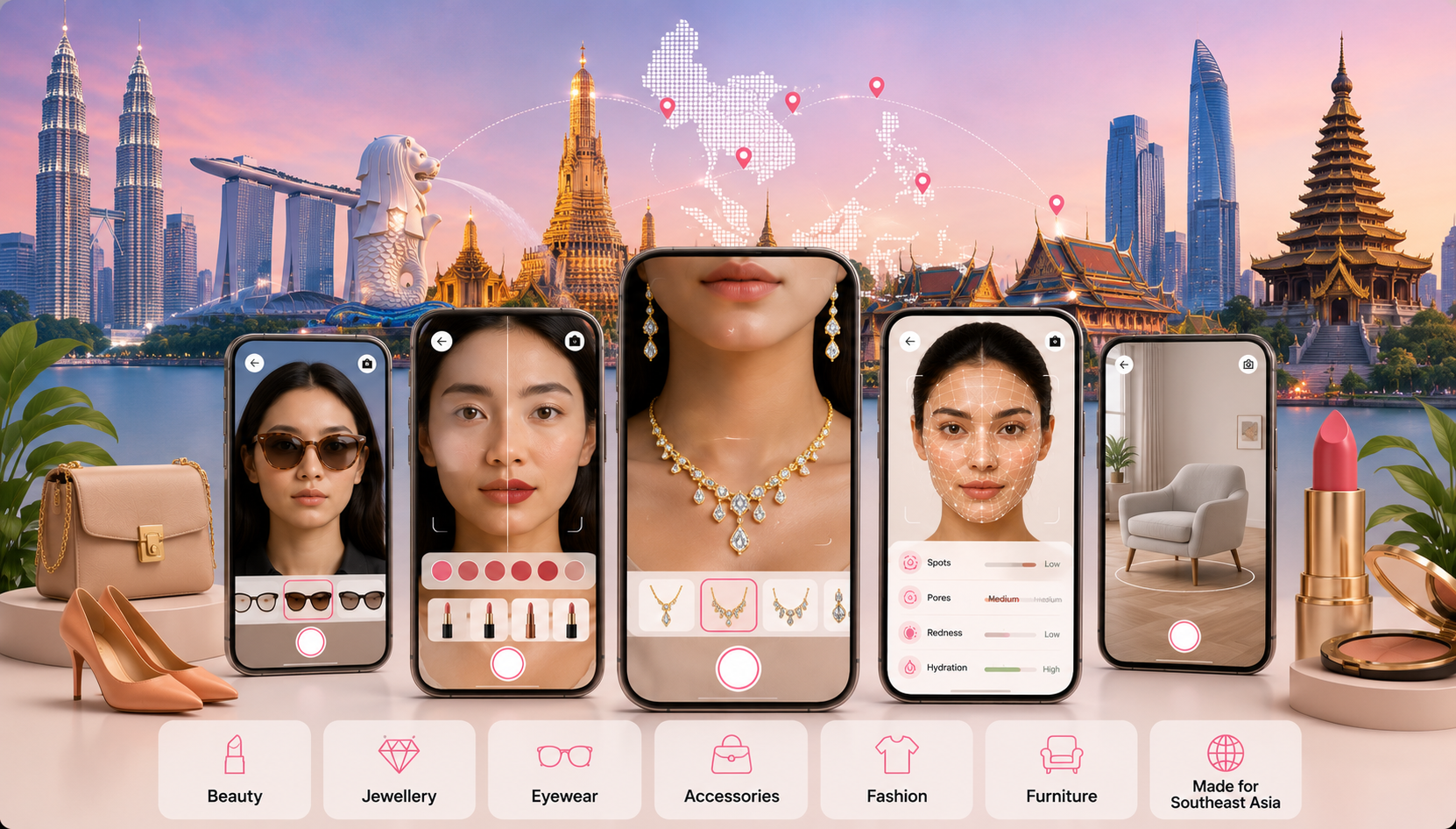
Southeast Asia's e-commerce market hit USD 234 billion in gross merchandise value in 2026 - growing 18% year over year, with a 402-million-strong digital consumer base and over 90% of users shopping on smartphones. It is the fastest-growing major e-commerce region in the world. And it is rapidly becoming one of the most important markets for virtual try-on technology.
This guide covers the top virtual try-on platforms available to Southeast Asian retailers in 2026, the categories where try-on has the highest commercial impact, what leading brands in the region are already doing, and what to consider when choosing a platform for a market this diverse.
Why Virtual Try-On Matters Specifically in Southeast Asia
Three structural facts about the SEA e-commerce market make virtual try-on more commercially important here than in almost any other region.
- The market is almost entirely mobile. Over 90% of internet users in Southeast Asia access the web through smartphones - surpassing North American averages. Shopee, TikTok Shop, and Lazada together account for over 80% of regional e-commerce GMV, and all three are mobile-first platforms. Virtual try-on delivered through a mobile browser - no app download required - is immediately accessible to the overwhelming majority of online shoppers in the region.
- The dominant categories are exactly where try-on has the most impact. Fashion, footwear, and accessories dominate Southeast Asia's e-commerce market with a 26% market share. Beauty and personal care is the fastest-growing cross-border category, advancing at a 10.72% CAGR. These are the same categories where virtual try-on drives the highest conversion uplifts and the sharpest return rate reductions - customers buying clothing, makeup, jewellery, and accessories online without any way to try them on first make more mistakes and return more frequently.
- The consumer base is young, mobile-native, and socially driven TikTok Shop's GMV in Malaysia surged 150% in the first half of 2025 alone, making it the second-largest e-commerce platform in Southeast Asia. Beauty and personal care is TikTok Shop's largest category by GMV across the region. This is a consumer base that makes purchase decisions influenced by short video, live commerce, and creator-driven product demonstrations - interactive, visual experiences that virtual try-on extends naturally. Brands that integrate AR try-on into live-selling formats have a direct conversion advantage in this environment.
Brands deploying AR try-on in Southeast Asia report conversion rate uplifts of up to 30% higher than traditional e-commerce channels for Gen Z consumers - a significant commercial advantage in a market where Gen Z is the primary purchasing demographic.
Top Virtual Try-On Platforms for Southeast Asian Retailers
Quick Comparison
1. GlamAR
GlamAR is a full-platform AR and 3D commerce solution covering the widest range of product categories relevant to Southeast Asian retailers - makeup, skincare (including AI skin analysis and SkinGPT), jewellery, accessories, eyewear, watches, furniture, home decor, and clothing. For Southeast Asian brands operating across multiple product categories, this breadth means a single integration covers the entire try-on requirement rather than separate tools for each category.
GlamAR's web-based AR requires no app download - customers use virtual try-on directly in their mobile browser. Given that over 90% of Southeast Asian consumers shop on mobile, and that requiring an app download significantly reduces adoption in markets where device storage is a consideration, this is a specific technical advantage in the region.
For beauty brands, GlamAR's AI Skin Analysis is trained on a geographically diverse dataset that explicitly includes Southeast Asian skin tones - relevant in a region where skin tone diversity is significant and tools calibrated primarily on Western datasets produce less accurate results. GlamAR's AI Skin Analysis for skin tone detects across six categories: fair, light, medium, olive, tan, and deep, covering the full spectrum of skin tones present across the SEA region.
GlamAR also supports multilingual deployment. For retailers serving Indonesia (Bahasa Indonesia), Thailand (Thai), Vietnam (Vietnamese), Malaysia (Bahasa Malaysia), and the Philippines (Filipino/English), localisation of the try-on interface and AI chatbot (SkinGPT) can be configured per market.
Best for: Multi-category Southeast Asian retailers; beauty and skincare brands targeting diverse SEA skin tones; brands that need a single platform across beauty, jewellery, accessories, and furniture.
Standout features:
- Web-based AR across beauty, jewellery, eyewear, accessories, watches, furniture, and clothing
- AI Skin Analysis trained on diverse SEA skin tones
- SkinGPT AI skincare chatbot with multilingual support
- 3D product configurator and 360° viewer
- Shopify app for fast integration on Shopify-based stores
- 3D model creation service - no existing 3D assets required
2. Perfect Corp
Perfect Corp is one of the most widely deployed beauty AR platforms globally, with strong presence across Southeast Asia. Their YouCam suite powers virtual try-on for over 500 beauty brands - lipstick, foundation, eyeshadow, skincare simulation - and is used on platforms including Lazada, where it powered the region's first AI and AR-powered virtual try-on rollout in 2022. Perfect Corp's AI shade finder and skin tone matching are well-calibrated for Asian skin tones specifically.
Best for: Beauty and cosmetics brands operating at scale across SEA with existing presence on Lazada or major beauty retail platforms.
Standout features:
- Extensive beauty category coverage (700+ SKUs virtually try-able simultaneously)
- Skin tone matching and shade finder
- Integration with major SEA platforms
- AI skin analysis with Fitzpatrick type detection
3. Snap AR (Snapchat Lens Studio)
Snap AR is less of a standalone try-on solution and more of a social commerce tool - but for brands targeting Gen Z across Southeast Asia, it is a channel worth understanding. TikTok Shop's dominance in the region is driven by the same discovery-to-purchase dynamic that Snapchat Lenses enable: a consumer tries on a product virtually while engaging with content and converts immediately from the same surface.Gucci deployed Snap AR try-on for shoes across the UAE and KSA, but the same format is actively used across Southeast Asian fashion and beauty markets. Snap reports that its AR Lenses generate two times the visual attention compared to non-AR equivalents. For brands running paid social in SEA, Snap AR is a creative format - not a standalone e-commerce try-on solution, but a powerful top-of-funnel conversion tool.
Best for: Fashion and beauty brands running paid social and influencer campaigns in SEA targeting Gen Z audiences.
Standout features:
- Social-first AR delivered within Snapchat content
- High-engagement format (significantly higher visual attention than standard ads)
- Custom Lens creation for brand-specific campaigns
- Available across all SEA markets
4. Google Virtual Try-On
In June 2026, Google rolled out its AI-powered virtual try-on feature across Indonesia, Malaysia, the Philippines, Singapore, South Korea, Thailand, and Vietnam - covering every major Southeast Asian e-commerce market. The feature enables shoppers to upload a full-length photo and see how clothing and footwear from Google Shopping results would look on their own body, directly within Google Search.
This is significant for Southeast Asian retailers for one specific reason: it is embedded in search. Shoppers who are already in the consideration stage - actively searching for a product - can immediately try it on without leaving the search interface. The purchase funnel compresses from discovery through try-on to checkout in a single session.
For brands that invest in Google Shopping campaigns, having products eligible for Google's virtual try-on feature is a direct conversion advantage over competitors whose products show only flat photography.
Best for: Fashion and apparel brands running Google Shopping campaigns in SEA looking to increase search-stage conversion.
Standout features:
- Try-on embedded directly in Google Search results - no separate app or platform
- Available in Indonesia, Malaysia, Philippines, Singapore, Thailand, and Vietnam
- Works on full-length uploaded photos
- Fashion and footwear categories currently covered
5. Banuba TINT
Banuba's TINT platform is a beauty AR and skincare try-on solution specifically noted for its performance in varied lighting conditions - a technically relevant differentiator in Southeast Asia, where consumers use try-on in diverse real-world environments with inconsistent lighting. TINT works across photos, live video, and live streams, and is designed to deliver consistent results on all skin tones even in dim lighting. It is available on smartphones, tablets, desktops, and smart mirrors.
Best for: Beauty and skincare brands that need reliable try-on performance across varied consumer environments and diverse skin tones.
Standout features:
- Works in dim lighting and on low-quality images
- Supports all skin tones with consistent accuracy
- Compatible across photos, video, and live streams
- In-store smart mirror integration available
6. Zakeke
Zakeke is a lightweight, fast-to-deploy option for small to mid-size Southeast Asian retailers that need to get AR try-on running quickly without a long implementation project. It integrates with Shopify, WooCommerce, and other platforms with minimal developer involvement. For beauty, accessories, and home decor brands in SEA that want to start with AR without an enterprise-level commitment, Zakeke is a practical entry point.
Best for: SMBs and growing Southeast Asian retailers that need fast deployment and a lower upfront investment.
Standout features:
- Fast integration with Shopify and WooCommerce
- AR try-on and 3D viewer
- Product customization options
- Lightweight mobile performance
The SEA Platforms Driving AR Try-On Adoption
Understanding which e-commerce and social platforms are integrating virtual try-on in Southeast Asia is important for retailers deciding where to prioritise their own implementation.
Shopee - the region's largest platform
Shopee holds approximately 52% of total regional e-commerce GMV and is the leading platform in all SEA markets except Indonesia. Shopee's built-in AR beauty features - available to brand partners on Shopee Mall - let beauty brands offer virtual lip, eye, and foundation try-on directly within product listings. For beauty brands with Shopee Mall presence, activating this feature is the fastest path to AR try-on reaching the largest possible SEA audience.
TikTok Shop - the fastest-growing channel
TikTok Shop has grown from 5% market share in Indonesia in 2023 to approximately 22% by 2025 - the fastest platform growth in SEA e-commerce history. Beauty and personal care is its largest category by GMV. In 2026, TikTok Shop is rolling out AR try-on across SEA markets, allowing consumers to try on lipstick shades, clothing, and preview furniture in real time during live commerce sessions. For beauty brands, the integration of virtual try-on into live-selling creates a direct conversion mechanism: a consumer watching a live beauty demonstration can try the featured product on their own face without leaving the stream.
Lazada - the platform that deployed first
Lazada was the first major SEA platform to deploy AI and AR-powered virtual try-on at scale, rolling it out in partnership with Perfect Corp in March 2022 - enabling beauty shoppers across Indonesia, Malaysia, Philippines, Singapore, Thailand, and Vietnam to sample products via photos or live video before purchasing. As of 2026, Lazada has repositioned toward premium sellers and high-quality assortment, making brand-quality AR experiences a relevant differentiator on the platform.
Country-Specific Considerations for SEA Virtual Try-On
Southeast Asia is not one market. What works in Singapore does not automatically translate to Indonesia, and language, mobile infrastructure, and consumer behaviour differ meaningfully across the six core markets.
Indonesia - the largest market (28% of SEA GMV)
Indonesia is the largest SEA e-commerce market, contributing 28% of regional GMV, with Jakarta and Java accounting for 65% of e-commerce activity. Fashion, electronics, and beauty make up 58% of all online purchases. Cash-on-delivery still accounts for 31% of transactions among first-time buyers - which means purchase confidence is especially important. Virtual try-on for fashion and beauty directly addresses the uncertainty that drives cash-on-delivery preference among hesitant first-time buyers.
Language: Bahasa Indonesia. Ensure any try-on interface or chatbot is available in Bahasa Indonesia for mainstream adoption beyond urban centres.
Vietnam - the fastest-growing SEA market
Vietnam posts the highest growth rate among SEA markets. Shopee and TikTok Shop account for 97% of online platform GMV, with live commerce driving a significant portion of beauty and fashion purchases. The try-on format that fits Vietnam most naturally is live-stream integrated AR - products that can be tried on by the creator during a live session and by viewers simultaneously.
Language: Vietnamese. Manual keyword tweaking beyond automatic translation is required for any localized content.
Thailand and Malaysia - highest growth rates in 2025
Thailand (+21.7%) and Malaysia (+19.5%) showed the highest year-over-year growth rates in 2025. Malaysia is notable for its diverse consumer demographic - Malay, Chinese, and Indian-heritage consumers with distinct beauty and skincare preferences. Skin tone accuracy in AI skin analysis is particularly relevant in Malaysia given this demographic diversity. TikTok Shop's GMV in Malaysia surged 150% in the first half of 2025 alone.
Singapore - the most technically sophisticated market
Singapore has the highest average order value and the most internationally experienced online shopper base in SEA. 55% of online purchases in Singapore are cross-border transactions. Brands deploying try-on in Singapore can expect a higher technical bar from consumers - the experience needs to be smooth, fast, and photorealistic, not just functional.
Philippines - fastest-growing cross-border market
The Philippines grew 68% in e-commerce during the pandemic acceleration period and continues to grow rapidly. English is the primary e-commerce language. Mobile commerce is dominant. The market is particularly receptive to beauty and personal care - a strong fit for makeup and skincare virtual try-on.
What Categories Drive the Most ROI From Virtual Try-On in SEA
Given the region's e-commerce category mix, four categories offer the highest immediate ROI from virtual try-on deployment:
Beauty and makeup - The dominant driver. SEA's beauty e-commerce is mobile-first, Gen Z-driven, and strongly influenced by live commerce and social content. Makeup virtual try-on integrates directly into the content and live-selling formats that already drive beauty purchases in the region.
Jewellery and accessories - High value, high consideration. Gold jewellery is culturally significant across Indonesia, Malaysia, Thailand, and Vietnam. Customers spending meaningfully on jewellery online need confidence that a ring, necklace, or bracelet looks right on their own body - not on a model.
Fashion and apparel - The largest e-commerce category by market share (26%). Returns driven by fit uncertainty are a structural problem for all fashion e-commerce brands in SEA. Virtual try-on for clothing reduces this directly.
Skincare and AI skin analysis - SEA's beauty consumers are sophisticated skincare buyers. AI skin analysis that can accurately assess diverse SEA skin tones and recommend products from a brand's own catalogue is a direct conversion and loyalty tool for skincare brands.
Conclusion
Southeast Asia is one of the most commercially compelling regions for virtual try-on in 2026 - a mobile-first, young, fashion and beauty-focused market where the platforms driving growth (Shopee, TikTok Shop, Lazada) are actively deploying AR try-on and where consumer willingness to engage with interactive shopping experiences is among the highest in the world.
For retailers choosing a platform, the decision comes down to category coverage, skin tone accuracy for the SEA consumer demographic, mobile performance without requiring an app download, and multilingual support across the six core SEA markets.
GlamAR's combination of beauty, jewellery, accessories, and furniture try-on in a single web-based platform - with AI skin analysis trained on diverse SEA skin tones, SkinGPT in multiple languages, and 3D model creation for brands without existing assets - makes it the strongest full-platform option for multi-category SEA retailers. For beauty-specialist brands at scale, Perfect Corp is the established choice. For social commerce-first strategies, Snap AR and TikTok Shop's native AR are the key formats to understand.
To explore how GlamAR's virtual try-on can be deployed for your Southeast Asian customer base, visit the beauty, jewellery, or accessories demo stores, or contact the GlamAR team to discuss multilingual and region-specific deployment.
Related reading:
- AR Try-On for Middle East E-commerce: What Retailers Are Doing Differently in 2026
- How AI Skin Analysis Handles Different Skin Tones - A Technical Look
- SkinGPT for Beauty Brands: What It Is, How It Works, and Why It Converts
- 9 Best Virtual Jewelry Try-On SDKs for E-commerce Brands
- Best AR Try-On Solutions for Furniture Brands in 2026
Ready to deploy virtual try-on for your Southeast Asian customers? Talk to the GlamAR team.
The main virtual try-on platforms available for Southeast Asian retailers include GlamAR (beauty, jewellery, accessories, furniture, and clothing across all SEA markets), Perfect Corp (beauty at scale, widely deployed on Lazada), Google Virtual Try-On (fashion and apparel within Google Search in Indonesia, Malaysia, Philippines, Singapore, Thailand, and Vietnam), Snap AR (social commerce and Gen Z campaigns), Banuba TINT (beauty with strong low-light performance), and Zakeke (lightweight, fast deployment for SMBs).
Southeast Asia's e-commerce market is over 90% mobile, dominated by fashion and beauty categories, and driven by a young, socially-native consumer base that expects interactive digital experiences. These are precisely the conditions where virtual try-on delivers the highest conversion impact. Brands deploying AR try-on in SEA report conversion rate uplifts of up to 30% compared to standard product listings.
Yes. Shopee has built-in AR beauty try-on for brand partners on Shopee Mall. TikTok Shop is rolling out AR try-on across SEA in 2026, including lipstick, clothing, and furniture previews during live commerce sessions. Lazada deployed AI and AR-powered beauty try-on in partnership with Perfect Corp in 2022, covering all six major SEA markets. Standalone AR try-on solutions like GlamAR can also be deployed on brand-owned websites and Shopify stores serving SEA customers.
Yes, significantly. Southeast Asia has one of the most diverse ranges of skin tones of any region - from fair skin tones in parts of Southeast Asia to medium, olive, tan, and deep tones across Indonesia, Philippines, Malaysia, Vietnam, and Thailand. AI skin analysis and makeup try-on tools calibrated primarily on lighter skin tones will produce less accurate results for a significant portion of SEA consumers. GlamAR's AI Skin Analysis is trained on a geographically diverse dataset covering many skin tones and ethnicities.
The six core SEA markets have distinct primary languages: Bahasa Indonesia (Indonesia), Thai (Thailand), Vietnamese (Vietnam), Bahasa Malaysia (Malaysia), Filipino and English (Philippines), and English (Singapore). For mainstream adoption across each market, the try-on interface, AI chatbot, and any in-experience content should be localised per market - not just translated, but with manually optimised keywords and phrasing for each language.
Pricing varies significantly by platform, product category, number of SKUs, and integration complexity. Entry-level solutions like Zakeke are accessible for growing SMBs. Enterprise platforms like GlamAR and Perfect Corp are structured around catalogue size and usage volume. The cost should be evaluated against the return rate reduction and conversion uplift data - in most deployments, the commercial impact exceeds the platform cost within the first few months of launch. Contact GlamAR for pricing specific to your catalogue and markets.
Discover how AR, VR and 3D can drive revenue growth in 2026
Schedule a call with our team

.avif)